The Delhi High Court heard a plea challenging the alleged use of excessive force by Delhi Police during the recent student protest over examination paper leaks. Appearing for the petitioners, Senior Advocate Hariharan N submitted that "brutalities to the largest measure possible" had been inflicted on peaceful protesters. He took the Court through the sequence of events, detailing the alleged instances of police excesses, and placed video recordings on record in support of the allegations.
#DelhiHighCourt #StudentProtest #NEET #DelhiPolice #PoliceBrutality #Constitution #FundamentalRights #PaperLeak #JantarMantar
Note: The content of this video is for informational and educational purpose only and not for any commercial purpose.
क्या गारंटी कि ये RAF वाले हैं
Half पैंट और काली टोपी वाले भी तो हो सकते हैं?
अगर इन लोगों ने हुड़दंग कर तो इल्ज़ाम उनपर डाल दोगे।
पहले इनसे निपट लो भाइयों जाल में मत फंस जाना।
इसकी मुस्कान बता रही है कि पुलिस तो नहीं है।
The core tenets of the Modi government are Asatya and Hinsa.
The removal of Sonam Wangchuk ji from Jantar Mantar while he was on a non-violent hunger strike is wrong.
Paper leaks, the rising cost of education, and student suicides are critical issues for India’s future.
No amount of force can deter India’s students, and those of us who love and believe in them, from raising these issues.
#ChhatronKiGoonj
मोदीलीला के नित नए आयाम!
ऑस्ट्रेलिया में रॉकस्टार की तरह स्वागत कराने के लिए मोदी ने अलग-अलग शहरों से NRI मंगाए थे वो भी चार्टर्ड फ्लाइट्स में भर कर...
ये बात एक ऑस्ट्रेलियाई पत्रकार बता रहा है!
लेकिन इसमें पैसा बरबाद किसका- हमारा या उनका?
Apart from Rape Threats, There are several videos of Hindutva Influencers abusing and threatening Sitting Judge Tabasum Khan because she convicted 14 Cow Vigilants to life imprisonment for 2022 Murder.
Apart from Rape Threats, There are several videos of Hindutva Influencers abusing and threatening Sitting Judge Tabasum Khan.
Below videos by - @Anurag_Dwary
#BREAKING Sr Adv Kishore Datta mentioning a matter on parading of accused by police.
Datta: When an accused surrenders before the police, is arrested and is produced before the magistrate, he is in the custody of the law. In custody of the judiciary, can this be done?
#CalcuttaHighCourt
"All citizens are being made slaves of Indian Government. They cannot stage protests, they cannot agitate-What is all this? Now so many papers have been leaked. If people protest, you will slap cases... What is this? It is the right of the citizens to protest.
The petitioner has just raised slogans like 'BJP Government Murdabad', 'Amit Shah Murdabad'... Why citizens can't raise such slogans? Why externment orders for such slogans?" - Bombay High Court Judge Justice Madhav Jamdar asks.
Yes, 43°C in India feels different to 43°C in Europe. Allow me to explain.
1. Europe is much more north on the planet, compared to the tropical location of India. For example, Paris is even north of Toronto in Canada. In India, the sun hits from the top. In Europe, it hits at an angle, and significantly longer summer days can yield strong solar loads through the course of a day. So the sun feels different.
2. India’s air pollution (suspended particulate matter) dulls the sun a bit. The sun feels sharper in Europe due to the clear skies, while pollution in India scatters and dissipates heat differently.
3. The recent heat waves in Europe have been accompanied with very low or zero winds. The leaves on trees don’t have a hint of movement. So it feels suffocating in a different way. In India, the warm winds and humidity might have different effects.
4. Europe has historically been cooler, so its buildings have been designed to remain warm in winters, while Indian buildings are designed to remain cool in summers. For example, stone or tiled floors in India dissipate heat quickly in summers, but also mean that you can’t walk bare feet in winters. Meanwhile European households might have wooden floors that don’t feel cool in the summers. Some European cities also have black roofs as a norm, which trap heat.
5. Much of Europe has had very limited number of warm days through history, so air conditioning is not a norm. Why would households invest in ACs when it crosses 25°C (minimum) for less than 7 days a year? New York has 4-5x more frequent warm days than Paris, for example. But that’s now changing. As it gets warmer, the case for ACs is obvious.
6. Much of Europe values aesthetics and public spaces a lot. So buildings associations oppose ugly heat-blowing external AC units facing the streets. This is why European cities are the most beautiful and walkable on the planet. Would you sit down to have wine and pasta on a street side cafe if an ugly AC unit was blowing hot air onto you? But of course, it’s too hot during heat waves now, so buildings associations will be forced to relent and change their rules. (You can also find some examples of some activists or institutions opposing ACs for climate change reasons, but I think that has a much smaller impact on decisions than actual building rules).
But the ultimate reality is this: as heat waves get hotter and longer, ACs will become the norm in Europe as well. Most offices and shopping centres are already air conditioned. Households are increasingly purchasing them too.
And the other reality is that Indians suffer a lot from heat waves too, even at 43°C. We just don’t report human interest stories the same way. Many don’t have ACs, live under tin roofs, and are hit by a constant stream of hot AC exhaust air from neighbours. We all need to prepare better for our respective heat waves.
Even USA couldn’t defend killing of 3 Indian nationals like Bagree did for USA.
For him it was a collateral damage & they themselves were responsible for it!!
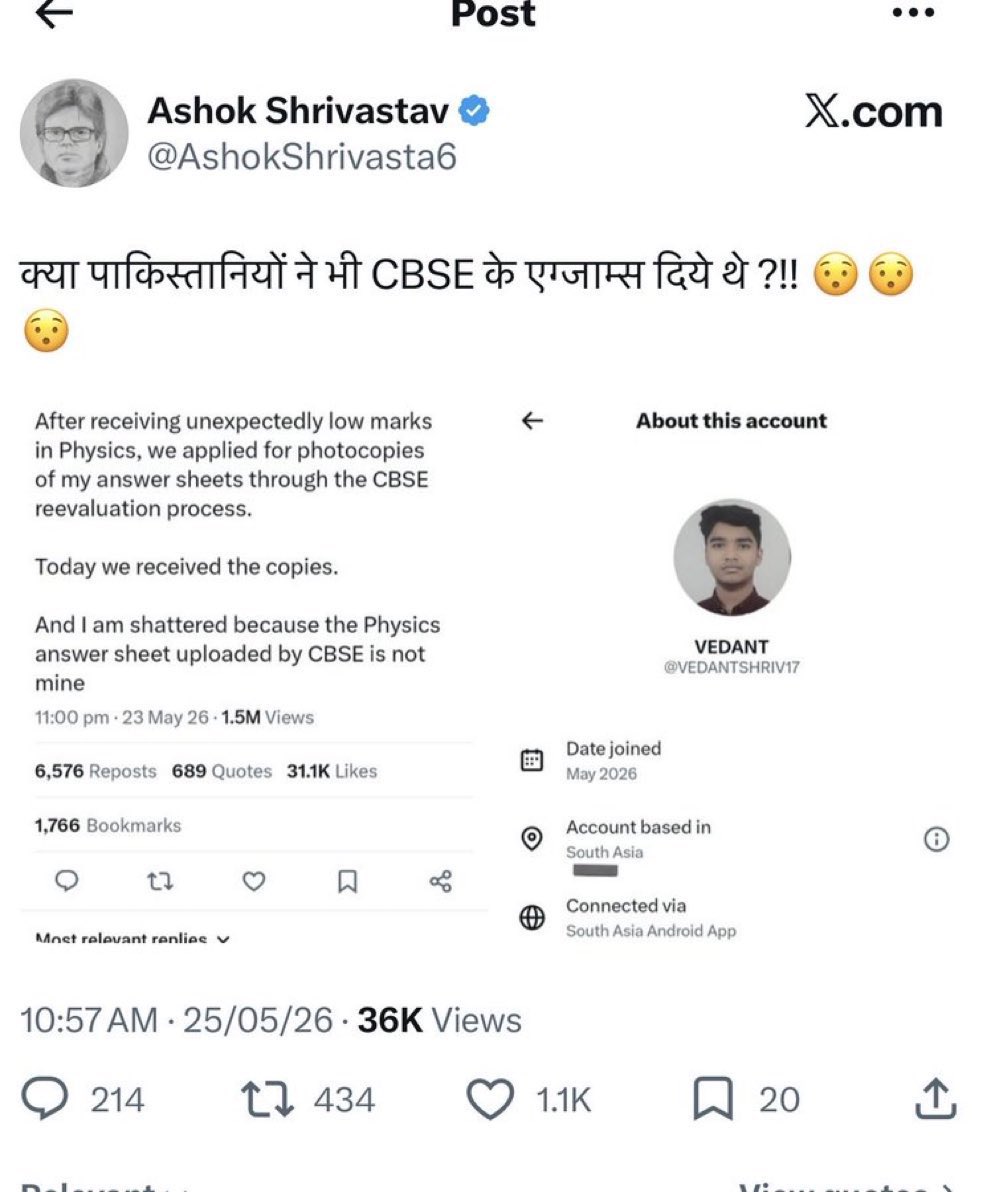
This is BJP IT Cell. These are the real anti-nationals. Only BJP & Modi’s image matters to them.
Those who called our kids Pakistanis need to be named and shamed.
This is the list of those anti-nationals.
Please keep adding names.
1- Ashok Srivastava
His name was Pradyumn Thakur.
He was 7 years old. Class 2 at Ryan International School in Gurugram, Haryana.
His father dropped him at the school gate at 7:55 am on September 8, 2017. At 8:08 am, he was found outside a washroom with his throat slit. He was rushed to hospital and declared dead on arrival.
The school did not call the police. His parents did.
Haryana Police arrived three and a half hours later.
They noticed blood stains on bus conductor Ashok Kumar. The same clothes he wore while carrying a bleeding 7 year old child to a car.
On September 10, the Police Commissioner held a press conference. He declared Ashok Kumar was the killer. He said Ashok had tried to sexually assault Pradyumn and murdered him.
The Chief Minister of Haryana congratulated the police for solving the case.
The Bar Association of Gurugram passed a resolution refusing to let any lawyer defend Ashok Kumar. The Supreme Court later disciplined them for this.
Pradyumn’s mother said from day one she believed Ashok was being framed.
CBI took over the case.
They found no forensic evidence against Ashok Kumar. No evidence of sexual assault. The gardener who was first at the scene said he saw no blood on Ashok before Ashok helped carry the child. The claimed semen sample did not exist. [Source: CBI chargesheet 2018]
In November 2017, CBI arrested the real accused. A 16 year old student at the same school. CBI said he confessed to killing Pradyumn to get his exams cancelled.
He chose his victim randomly.
Ashok Kumar was acquitted of all charges on February 28, 2018. [Source: Child Special Court Gurugram judgment February 28, 2018]
In January 2021, CBI charged four Gurugram Police officers with framing Ashok Kumar. Falsifying documents. Torture. Criminal conspiracy. [Source: CBI chargesheet January 2021]
Those four officers have not been convicted.
The Police Commissioner who declared Ashok guilty on television faced no consequences. The Chief Minister who congratulated police faced no consequences.
Pradyumn’s family is still waiting for justice for their son.
Follow for stories India deserves to remember.
#ImportantNews: The controversy over the alleged Delhi liquor-scam case before Justice Swarana Kanta Sharma is no longer confined to courtroom conduct alone. Now more troubling questions of proximity, patronage, conflict-of-interest, and the appearance of bias have come to light.
Several of the 23 dischargees in the case had formally sought Justice Sharma’s recusal from hearing the CBI’s challenge to their discharge. Even then, the judge has so far resisted calls to step aside, even as former Delhi Chief Minister Arvind Kejriwal himself appears in person to argue the recusal application. Arguments are now scheduled for Monday, 13 April 2026.
In my last Case In Point column for @frontline_india, I had already revealed, through an analysis of all the 165 criminal revision petitions of the same category as Kejriwal’s case, that Justice Sharma clearly departed from her usual pattern of handling such matters and had taken an unusually strange interest in this case. That, along with many other details that if read in singularity can be met with a shrug, but when read together, reveals a troubling pattern and credible fears of apprehension of bias in the liquor case. These by itself had raised serious questions. You may read my piece here: https://t.co/GtqFKFhRYY
What has surfaced now makes those questions HARDER to dismiss.
Justice Sharma’s son and daughter—Ishaan Sharma and Shambhavi Sharma—have both been empanelled by the Union government before the Delhi High Court and the Supreme Court.
According to the empanelment details, both siblings were appointed on the very same days: 11 September 2025 for the Delhi High Court panels and 21 November 2025 for the Supreme Court panels.
1. Ishaan Sharma holds panels before both courts, including the highest Group A panel before the Supreme Court and Senior Panel Counsel status before the Delhi High Court.
2. Shambhavi Sharma, with mere four years of enrolment as advocate, too holds panels before both courts: Group C before the Supreme Court and Government Pleader before the Delhi High Court.
3. Ishaan Sharma also held a panel in the Delhi Development Authority (DDA), under the Union Housing Ministry, till at least 2024 (Check: https://t.co/4DsDonRCyE).
4. He also held a panel in the Delhi State Legal Services Authority since 2021 until at least the end of 2024 (Check: https://t.co/KnfZFVJhCs).
Panel counselship is among the most coveted forms of government legal patronage in the system. Ask any advocate and they will tell you how through these positions, the government allocates litigation, visibility, professional standing, and income. But the more important and troubling part is that they are positions held at the pleasure of the very government whose top law officers are now appearing before Justice Sharma in one of the most politically explosive cases in the country. And that is where the conflict sharpens.
Of course, one need not prove an explicit bargain but justice must also be SEEN to be done, especially when it is a case of public interest. The test for seeking recusal of a judge is whether there exists a reasonable apprehension of bias and whether public confidence in the fairness of the process has been impaired. Like I had explained in my column, Indian law on recusal has long recognised that what matters is not just actual bias, but whether a litigant could REASONABLY FEEL that justice may NOT appear to be done. Here, several of the 23 dischargees feel justice may not be done impartially.
And now this issue of one advocate, who happens to be the son of a judge, accumulating large number of panels within a relatively short post-enrolment period as an advocate. Ask any lawyer and they will tell you how many more accomplished, brilliant persons, with many more years as an advocate have failed to secure a panel through the formal process. The concerns are many.
In this case, the question is whether a judge can continue to hear a politically sensitive challenge brought by the CBI, while her kin hold multiple Union government panels and receive work from the same legal establishment whose top officers allocate cases to them and are now appearing before her?
Note this: as per one RTI reply I received, Ishaan Sharma was allocated 2,487 cases in 2023, 1,784 cases in 2024, and 1,633 cases in 2025. In both 2024 and 2025, he was allocated more case files than even Zoheb Hossain, the top, most publicly visible Enforcement Directorate lawyer—by 91 in 2024 and by 582 in 2025. This of course suggests the sustained and substantial allocation of state work before the son. The allocation is done by the topmost in the legal system.
Also, this is not the first time that such questions of potential conflict of interest have arisen. In September 2024, I had highlighted the case of Padmesh Mishra, whose appointments across multiple union government and Rajasthan government positions drew scrutiny after his father, Justice Prashant Kumar Mishra, was elevated to the Supreme Court. Check: https://t.co/TVr35PmPx3
The unease then was the same as it is now: when the children of sitting judges begin to accumulate government panels and positions in unusual concentration, something a regular lawyer, perhaps much more brilliant and of more history of practice, can only dream of, particularly after or around the parent’s rise within the judiciary, the issue is of institutional credibility.
And no one really needs to state that that credibility is already under strain. Recently, Justice Manmohan of the Supreme Court himself publicly flagged corruption in the appointment of panel counsels by the Union government, questioning whether such appointments are really being made on merit at all. In a system where even a sitting Supreme Court judge is warning that panel-counsel appointments may be infected by extraneous considerations, the appearance of conflict in the present case becomes still harder to shrug away. Check: https://t.co/RGSSDK7ekf
Seen in that light, the present controversy is again not whether Justice Sharma is actually biased. It is about whether the institution can credibly insist that there is nothing to see here. The CBI has just filed an affidavit supporting Justice Sharma. A judge who I have documented, as per her own orders, to show unusual interest in a politically sensitive matter now finds herself in a position where her own kind hold/held as many as SIX government panels between them, while their bosses continue to appear before her. Even if one were to assume the absence of any actual impropriety, does this arrangement augur well for the appearance of judicial independence, especially in this case? The question is whether this not enough evidence of apprehension of bias that should suffice for a recusal.
That is the question the High Court ought to have confronted with seriousness. Instead, by resisting recusal in these circumstances, the judge is unfortunately deepening this very suspicion that it should have avoided at all costs, or at least for the sake of institution.






![san_x_m's tweet photo. His name was Pradyumn Thakur.
He was 7 years old. Class 2 at Ryan International School in Gurugram, Haryana.
His father dropped him at the school gate at 7:55 am on September 8, 2017. At 8:08 am, he was found outside a washroom with his throat slit. He was rushed to hospital and declared dead on arrival.
The school did not call the police. His parents did.
Haryana Police arrived three and a half hours later.
They noticed blood stains on bus conductor Ashok Kumar. The same clothes he wore while carrying a bleeding 7 year old child to a car.
On September 10, the Police Commissioner held a press conference. He declared Ashok Kumar was the killer. He said Ashok had tried to sexually assault Pradyumn and murdered him.
The Chief Minister of Haryana congratulated the police for solving the case.
The Bar Association of Gurugram passed a resolution refusing to let any lawyer defend Ashok Kumar. The Supreme Court later disciplined them for this.
Pradyumn’s mother said from day one she believed Ashok was being framed.
CBI took over the case.
They found no forensic evidence against Ashok Kumar. No evidence of sexual assault. The gardener who was first at the scene said he saw no blood on Ashok before Ashok helped carry the child. The claimed semen sample did not exist. [Source: CBI chargesheet 2018]
In November 2017, CBI arrested the real accused. A 16 year old student at the same school. CBI said he confessed to killing Pradyumn to get his exams cancelled.
He chose his victim randomly.
Ashok Kumar was acquitted of all charges on February 28, 2018. [Source: Child Special Court Gurugram judgment February 28, 2018]
In January 2021, CBI charged four Gurugram Police officers with framing Ashok Kumar. Falsifying documents. Torture. Criminal conspiracy. [Source: CBI chargesheet January 2021]
Those four officers have not been convicted.
The Police Commissioner who declared Ashok guilty on television faced no consequences. The Chief Minister who congratulated police faced no consequences.
Pradyumn’s family is still waiting for justice for their son.
Follow for stories India deserves to remember.](https://pbs.twimg.com/media/HHd7y7uaoAEf5Zr.jpg)


