Having had a run of very good results for the last year and a half, Mexico arrived in Brussels for a pre World Cup 1990 friendly. On June 2 Stade du Heysel was about to stage Belgium’s penultimate test prior to the global event.
🆕 The 1️⃣9️⃣9️⃣0️⃣ World Cup
Italia ’90 wasn’t just a World Cup… it changed football.
😢 Gazza’s tears
🇦🇷 Maradona’s last dance
🎯 Schillaci’s rise
🏆 West Germany triumph
A turning point in football history.
🎧 Listen to podcast here 👇
https://t.co/GpXFGl04lF
@JohnBoyHastings@FootballCliches Denmark could even well have made an impression at Italia '90 had they qualified rather than Romania. They were awesome a year prior to the tournament, but that 3-1 loss in the final qualifier in Bucharest obviously sent the Romanians to the World Cup.
@MwInAndorra@FootballCliches France at Italia '90 would've been another interesting story. 89/90 they were among the top teams on the continent, with a strong finish in the qualification, and with some impressive winter friendlies, most notably a 2-1 home win against the world champions in spe.
@FootballCliches East Germany at Mexico '86. They rounded the qualification off with four straight wins, and among those was a stunning 2-0 home win against reigning European champions France. They did so with a team full of promise: Thom, Kirsten and Stübner early 20s.
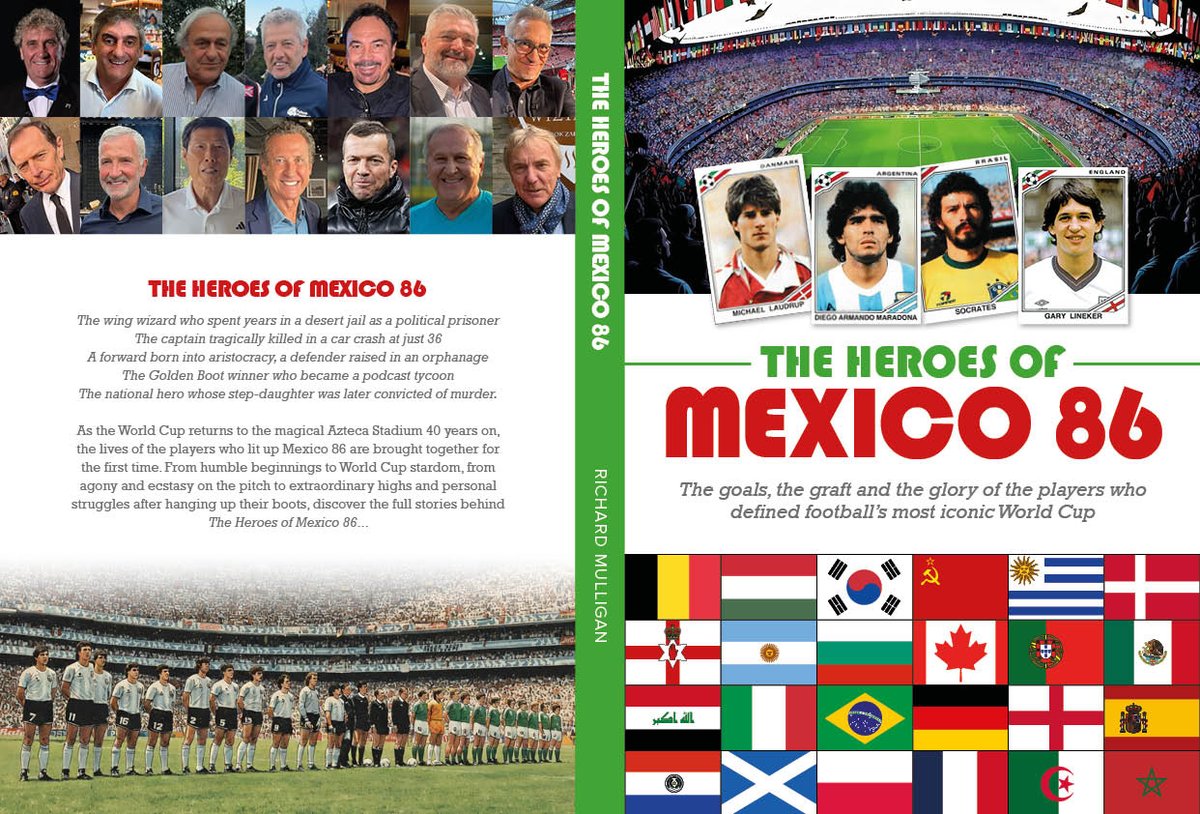
OUT SOON!!! "The Heroes of Mexico 86" will be available for pre-order in early April. Here's an excerpt from the introduction:
"...While Diego Maradona was already a multimillionaire by the start of the Mexico World Cup, life looked very different for many others selected for the Mundial. Behind the Iron Curtain, players were largely prevented from moving abroad to earn their fortunes and could even be ordered to change clubs at the whim of the regime. Canada’s players faced uncertainty following the collapse of the North American Soccer League in 1984. Some prepared for the World Cup by playing indoor soccer in the US, while others had no club at all and trained full-time with the national team.
Then there was George Pakos, an amateur who worked in British Columbia as a water-meter technician. Pakos was already in his 30s when Canada qualified for the World Cup. In the decisive matches against Honduras he scored twice to secure qualification. When the tournament ended he returned home and resumed his day job within the week – a stark contrast to those players enjoying celebrity lifestyles in Europe’s major leagues.
Beyond football and fortune, Iraq’s players represented a nation locked in the long-running Iran–Iraq War that claimed the lives of more than 100,000 of their compatriots. Due to the hostilities, they were unable to stage matches at home, so the national side played their home World Cup qualifiers abroad even as fighting continued. For squad member Basil Gorgis, the terror of the time was not simply an abstract risk – his sister was executed by Saddam Hussein’s brutal regime in the early 1980s.
Players reached Mexico via very different paths. Hungary’s Márton Esterházy descended from one of the country’s most distinguished aristocratic families, while his grandfather had served as Prime Minister during the First World War. Denmark’s Michael Laudrup and Portugal’s António Morato, meanwhile, followed in the footsteps of fathers who had also played international football.
Spain’s Julio Alberto came from entirely different circumstances. As a child he had been abandoned by his parents and raised in social care before building a career that eventually took him to Barcelona and the Spanish national team. After his playing career ended, his troubles led to drug abuse, homelessness and numerous attempts to take his own life. Happily, he was able to turn his life around and now counsels youngsters about the dangers of addiction.
Poland’s Waldemar Matysik overcame serious mental health struggles to appear in Mexico after suffering a breakdown following his heroics at a young age during España 82. He later enjoyed a successful club career in France and Germany. Similarly, Soviet midfielder Fedor Cherenkov – one of the most gifted players of his generation (who featured in the sticker album but was controversially omitted from the USSR squad) – battled severe mental health problems for much of his life. Mexican goalkeeper Pablo Larios became a tragic figure – his life mired by loss, his face left disfigured by the effects of a serious cocaine habit before his premature death at 58..."
OUT IN APRIL! "The Heroes of Mexico 86", featuring full profiles of every player at football's most iconic World Cup.
Here's an old friend revealing the cover!