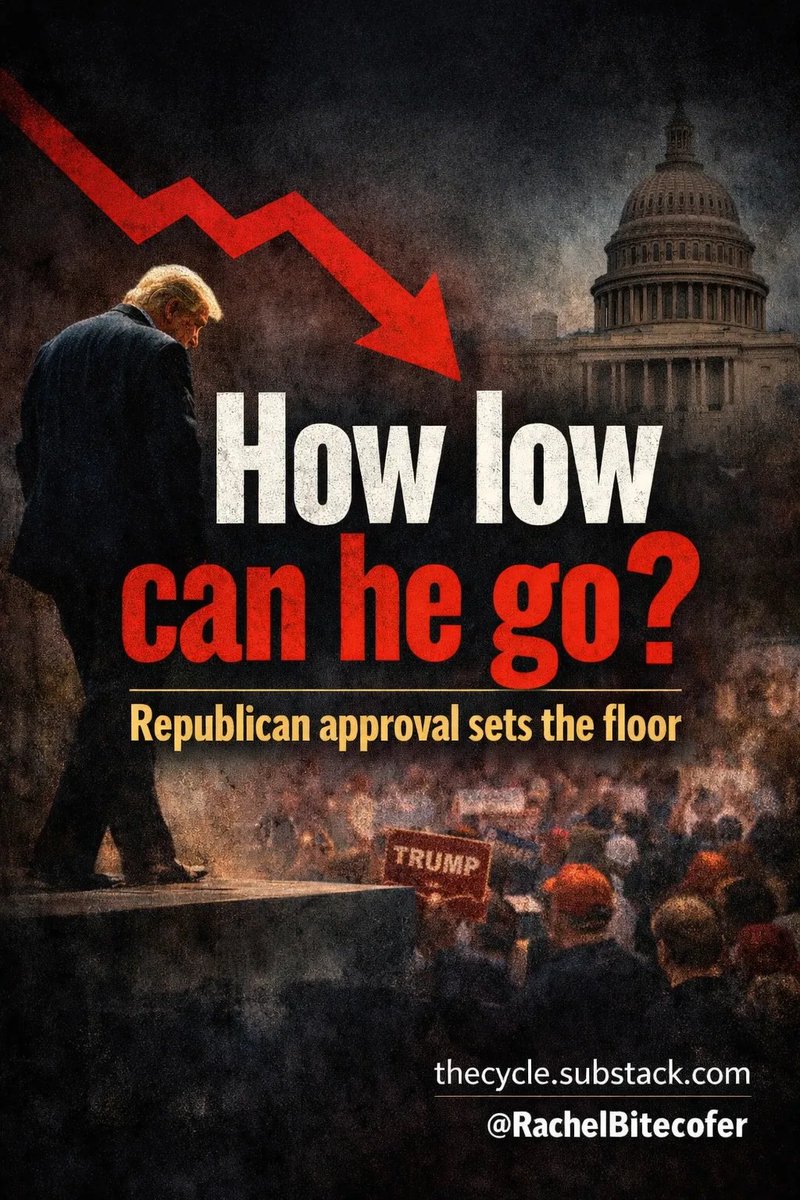
🧵How Low Can He Go?
Republican Approval Sets Trump's Floor
There’s a mistake people keep making when they look at Trump’s approval numbers. They keep treating national approval like it’s the whole story. It isn’t. It never has been. It can go no lower until, and unless, his approval among Republicans declines.
Trump can be hated by a majority of America and still be just as dangerous. He can sit at 35 percent nationally and continue to do enormous damage forever. The number that matters—the only number that actually restrains him—is Republican approval.
That’s the floor. And the whole system is balanced on it.
Right now, Republican approval of Trump is still absurdly high—hovering around the high 80s, flirting with 90 percent. That’s down from the mid-90s where it sat for long stretches of his political life, and yes, it has been decaying slowly since January. Slowly at first, then with a bit more momentum. But let’s be clear about what that still means: the Republican Party remains overwhelmingly loyal to a man who attempted a coup, stole classified documents, openly promises retribution, and has no unleashed lawless armed goons on its own citizenry.
People keep waiting for the moment when “Republicans finally break.” But history tells us that moment is rare—and when it happens, it happens only under very specific conditions.
Republicans have broken with a president before. They did it with George W. Bush. After the financial crisis, Bush’s approval among Republicans collapsed into the 60s and 50s. Party elites abandoned him. He became toxic. That happened at the very beginning of the modern polarized era—before identity fusion hardened, before right-wing media became a sealed epistemic loop, before grievance replaced ideology entirely.
We are now at the opposite end of that story.
Today’s Republican Party is not just polarized; it’s fused. Identity, grievance, and power are bound together. That means the breaking point is higher. Much higher.
In this environment, Republican approval doesn’t need to fall into the 30s to matter. It probably never will, even when he starts shooting people on 5th avenue. What matters is whether it can fall into the 60s again, like it did for W., because that’s the zone where political incentives of Republican members of the House and senate start to change.
This is where David Mayhew’s thesis still rules everything. Politicians are single-minded seekers of reelection. Always have been. Always will be. And here’s the part that a lot of very engaged, very online analysts miss: the reason some Democrats sound fearless and strident is not because they are morally superior—it’s because they are electorally safe.
Members in deep-blue seats don’t face general election risk. They face primary risk. Base positions, defiance, and purity are rewarded. But members in swing districts face an entirely different math. They need voters who are not ideologically aligned. They need people who are uneasy, conflicted, persuadable—or at least movable.
That’s why people get furious at swing-district Democrats for votes they don’t like. They read it as betrayal. It isn’t. It’s rational behavior in a system where majorities matter more than unicorn-fart wish lists. You want Democrats to be rational in swing seats if you ever want Democrats in power at all.
The same logic applies—much more starkly—on the Republican side.
As long as Trump sits at 85–90 percent approval among Republicans, GOP officials have no reason to resist him. None. The primary threat outweighs everything else. But if that number slips toward the low 60s, suddenly the general election re-enters the picture. Silence replaces defense. Hedging replaces loyalty. Not courage—never courage—but self-preservation.
That’s the theory. Now let’s talk about why Trump is suddenly in trouble.
Part of the erosion we’re seeing is coming from Epstein. And let’s stop pretending we don’t know why Trump is blocking the release of the Epstein files. The media keeps asking “who is he protecting?” like it’s a mystery. He’s protecting himself. First and foremost. The sheer number of times Trump appears in those files makes that obvious. He’s also protecting donors, allies, cabinet-adjacent figures—yes. But this is self-interest, plain and simple.
Still, Epstein alone doesn’t explain what’s happening. Immigration does.
What we just watched in Minnesota mattered—not because Americans suddenly oppose border enforcement, but because they recoil from lawlessness. The average voter does not know what an administrative warrant is. They don’t understand the Fourth Amendment implications. They don’t know how often ICE is breaking into homes without judicial warrants.
And yet, even with partial information, they’re saying: this feels wrong.
Trump’s so-called “de-escalation” is a mirage. No one was fired. No one was held accountable. Agents were shuffled, not restrained. Tom Homan was elevated and rebranded as normalcy—despite the fact that Trump previously shut down an investigation into Homan allegedly taking a cash bribe from undercover FBI agents. On its own, that would have ended a presidency in any other era.
There is no real pullback. The violence continues. The stories accumulate. Another catastrophe is inevitable. This is not speculation—it’s math. A lawless political police force operating with impunity will eventually produce another horror.
And here’s the bind Trump can’t escape: he can’t stop.
If he actually reined in ICE, the fascist base would revolt. Roughly 30 million voters—fully committed to Great Replacement ideology—believe he’s already capitulating. They don’t want fewer deportations. They want everyone out. Including naturalized citizens. Including children born here. For them, what happened in Minnesota wasn’t restraint—it was betrayal.
So Trump is bleeding support from two directions at once.
On one side, right-leaning independents—closet partisans who rarely vote Democratic—are recoiling from police-state aesthetics and visible brutality. On the other side, the fascist base is furious that he hasn’t gone far enough.
That is a historically unstable position.
Which brings us back to the question this piece can’t escape: How low can he go?
I don’t know if Republican approval can fall into the 60s in the polarized era which really only got going after 2010. History gives us reasons to doubt it. January 6 showed us something terrifying—that a party can erase its own memory, rewrite reality, and sanctify violence retroactively. If they could do that once, they might be able to do it again.
But I do know this: for the country to survive what’s happening, Republican approval has to break. There is no other internal brake left. Courts are slow. Institutions are compromised. Elections are months away.
Waiting for Republicans to save democracy is not a plan. But it may be the only lever left.
That’s the floor. And we’re all standing on it.
PLZ RT this post!
The Cycle- On Substack is a reader-supported publication. To receive new posts and support my work, consider becoming a free or paid subscriber. https://t.co/DS3RqiJHZQ
If you live in these states, your ACA premiums are about to jump:
SD - Up 235%
LA - Up 150%
WV - Up 387%
WY - Up 382%
TN - Up 320%
MS - Up 314%
AK - Up 346%
Republicans are fighting to make sure this happens to their own constituents.
So the FBI under Donald Trump, which was led by the guy Donald Trump appointed, is responsible for the attack on the US Capitol which Donald Trump incited his supporters to do?
Are MAGAs really this fucking stupid?
Around 30 items have been flagged for potential removal at Harpers Ferry National Historical Park following Trump Administration's orders, spurring one Harpers Ferry councilman to speak out https://t.co/GrCdWJ5tx3
BREAKING: MSNBC just released a montage of Republicans who trashed Trump’s “one big beautiful bill” before caving and voting for it. Their hypocrisy is shameful. Retweet so every American sees this.
BREAKING: Donald Trump just deleted this post because he doesn’t want you to see that he has completely capitulated to Vladimir Putin. Make sure everyone sees this.