I think this is an important point that many new traders need to understand.....We sometimes easily say :
''You need 10-15 good/outlier trades to have a great year''
.....But how hard is it to actually capture them?
Below are some of my realizations over the past 5 years and what I truly mean when I say :
''You must surround yourself with assets where asymmetry or outlier potential can emerge more easily and naturally.''
For years into trading I had the following mindset: ''Filter your universe of stocks with some simple rules that and then focus on the stocks that look strong and the BEST setups.''
That worked nicely and still works nicely in certain windows per year where opportunities are all over the place and everything you touch turns into gold.
But these are small windows within each year.
So what do you do the rest of the months when only selective assets work and most of the universe isn't moving? Are you still executing on great setups? Because this leads to extreme frequency of trades and possible deterioration of your capital.
The other issue I had with that mindset was that without knowing anything about companies ( since I was looking only at price as a guiding factor) , I lacked that conviction element to hit the button big when it was needed. So naturally I was missing out on some moves just because I had nothing else to back up my conviction other than price. Trust issues.
Another problem I also figured out as I studied more was that amazing opportunities didn't emerge always from perfect ''setups''. They just went straight up from setups I would classify as 3*/5 or 2.5*/5......So I thought:
''is focusing on the best setups limiting my opportunity potential? Maybe...''
The other issue I also had was that out of 5K stocks available there are at least ~300 of them that look quite good based on prior price action moves, at any given point in time, and on certain occasions provide ''nice setups''....
So what, am I going to trade all of them when they show some linearity and a 5* setup?
<<We are always limited by time, by how many assets we can hold in our portfolio, and by our frequency.>>
You have to remember that even if you track 800 different stocks over the span of a year as a result of your selection filters , where the list sits around 300-400 at any given snapshot of time......due to frequency and portfolio allocation constraints you can't execute trades in all of them.
So what happens in reality is the following:
If you execute let's say 60 trades per month (your average frequency) and you track a list of 300 stocks, you can essentially attempt on 20% of that universe in any given month.....Essentially you are covering the potential of 20% of that territory..... And how many stocks out of that 20% territory captured by your execution attempts actually have the chance to be outliers?
If you're executing only on great setups within that list of 300 tickers, then it's kind of random whether an outlier will emerge in that 20% coverage you have.
A lot of people might say ''man.... I had $SNDK, $AXTI, $LWLG, $MU etc. on my universe list , why didn't I trade them?''
For many people the reality is that the universe was too big relative to their frequency to potentially trade them, because other opportunities emerged first and didn't materialize.
<<Your frequency relative to the universe you're tracking needs to have a strong overlap.>>
But here is where overfitting starts to spiral....
Because you can attempt to shrink down your universe (e.x from 400 to 50) by butchering your outlier potential, or you can shrink it WHILE carrying the essence of that outlier chance with you.....This is the whole game essentially.... I'll explain:
What butchering your outlier potential means:
For example, some people in their attempts to shrink down the universe put filters to only trade or surface stocks with let's say amazing fundamentals....That's not wrong, because ''usually'' for long term moves great fundamentals need to emerge....BUT IS it universal on all great moves???? The markets show that huge opportunities emerge even without any fundamentals (e.g. $OKLO, $LWLG, $AXTI recently etc.)
So if you put ''great fundamentals'' as a filter to go from 400 stocks down to 50, then you might be shrinking down the outlier potential as well.....
The filters used by traders are many, and each filter you add if you haven't deeply explored it's ripple effects has the potential to heavily exclude phenomena that the market has proven to reward......which essentially means...shrinking your outlier potential in the process. A hole in the water....
There's a reason only a few great traders exist and a lot of average ones.....Because the great traders , through studying, through experience, through observation of past historical opportunities are able shrink down their universe to align it with their frequency, WHILE simultaneously carrying over a large portion of the outlier potential the original ~400 stock list had.
And that's the HARD part. Because you TRULY succeed when you go from 400 stocks down to e.x 50 without losing many of the potential outliers in the process.
Think about it this way.... if 20 tickers out of those initial 400 were going to make a massive move, that's only 5% of the whole initial universe. Now if you shrink down to 50 and still have 10 of those sitting in your new list, your outlier chance just jumped to 20%. That's the whole game right there.......
......That's how you truly increase your outlier chance and position yourself in places where ASYMMETRY can emerge more easily.
And this is where I've focused my work in recent years. We know that great moves can happen because of themes alone, stories, catalysts, great fundamentals, or combinations of all of them. How can you mix all of those elegantly in order to shrink the universe without overfitting, while still carrying a higher outlier potential?
And this is where the phrase I use becomes evident: ''phenomena > setups.'' If, based on historical observations, you create good combinations of behavioral, fundamental, and technical factors, each with their respective weight, the bigger the chance you carry larger chunks of that outlier potential during the universe shrinking process....The more you carry the better your year will be.
<<You can never predict what's going to happen in the markets....only place yourself in places where great opportunities emerge more easily or randomly.>>
A lot of food for thought, but it's a good exercise for many to understand why trading is EASY and yet so damn HARD at the same time.....
There comes that time again when there are more great opportunities than you can buy , even on margin and the feed shifts from excitement, to Oscar style self award ceremonies…..Hmm👀
Am I the only one who honestly doesn’t care if we’re in an AI bubble or at the start of an epic run?
No matter what it is, it doesn’t change the required usual actions: follow price, keep risk management and portfolio dynamics in check, and keep routines sharp.
Even if things go the opposite way, the 20MA will get you out in time. Every big correction starts as a small one.
Overhyping or demoralizing ourselves and others based on macro views never ends well . Staying focused , versatile and not anchored is an edge.
Genuinely curious: anyone whose work involves thematic or sub‑industry insights, especially if you sit inside a firm (e.g, bank, fund, family office, allocator, or research team etc), what are the biggest bottlenecks in your workflow that still make your life harder than it should be?
And what would real fixes look like to you, ones you 'd actually trust to act on? I would appreciate your input
I want to give a quick update to all of you that follow me:
For the past 8 months, I ve doubled and tripled down on AI to make my research way more efficient, to connect the dots better,naturally increase the chances of consistently hitting the best performing stocks, and add 2nd and 3rd order thinking that manually takes time and a lot of brain power.
At the same time, fusing all my experiences, my way of seeing the market, and historical observations of the past.
A ton of bottlenecks, a crazy amount of learnings... building things from the ground up, because that’s what it takes to make the use of AI truly impactful.
A lot of thinking, building models, and of course, many smart people working overtime alongside me to build the best Momentum Intelligence available...
I’m confident to say, as we are finally reaching the latest version, that what we’ve built is now more intelligent than what I could have ever achieved researching things manually... and most of you know, I’m not the kind of ���hype” guy.
It’s not the research itself or the info you collect, it’s how you mix these things and connect the dots where beautiful things emerge, along with fixing blind spots and weak points of all these capabilities that AI offers....and of course, working with genius minds.
The derivative of all this work are 2 projects.
First of all, we’ve built probably the most robust Thematic Intelligence out there. Themes are probably the biggest bottleneck in today’s market... so to build an amazing Momentum system, we had to solve an industry problem.
The level of accuracy, depth, and evolution is exceptional. It even surprises us every day with info or connections we weren’t aware of and that can’t be easily found on a manual level. This is intended for “institutional” level clients.
Secondly, the Momentum Intelligence (which will use a lite version of the Thematic Intelligence as well, tuned to fit that purpose).
The higher scope:
Research time: fully minimized
1st, 2nd, 3rd order thinking between things: done
Every day, to know, based on all dimensions of technical, behavioral, and fundamental forces, what the best assets are... with information to consume if you want to dive deeper and more features.
Of course, we had to build an extreme amount of proprietary models to make all these dots connect efficiently.
My level of clarity is supercharged, and we’re seeing it working live for some time now as we upgrade versions.
It’s not a prediction tool ...it’s a tool to align you and put you in places where outliers naturally emerge way easier , provide clarity and save time.
I’ve never been more excited in my trading career.
It’s a dream coming true since I started trading.
The next few months are intended for testing more and fine tuning, and then I plan to make this available.
I want to apologize for not posting frequently, but Great Work demands some esotericism. Hopefully it won;t be long since I start to be really active again here. Stay tuned!
P.S. I’m happy to share with you that I also got engaged very recently!
https://t.co/fOE5wRT8FJ
I gave a mini masterclass on the Parabolic Shorts setup in an episode that just dropped on @chartfanatics & @Wordsofrizdom .
If you wanna have an A-Z way of how to trade things like $SMCI, $MSTR, $SLV, etc, I recommend watching the full episode, it's full of nuggets
This strategy is a setup that I've used since my early trading days, and it's great both for quick injections of capital into the equity as well as, even more importantly timing your partials if you're already on the long side!
Hope you enjoy!
$NBIS recent news and action look great and there is a chance of bringing some fresh air to the AI Data Center themes overall like HPC/GPU , Colocation , Power etc.
I had higher hopes since October for names like $IREN, $HUT, $WULF $CIFR etc.
I still think that Bitcoin needs to perform a nice bounce and hold a magnitude move for these names to have a chance of acting well.
Even if they are trying to transition away , they still carry that ''tag'' and narratively are being dragged down as well.
I am not focusing so much on them until I notice a shift . We'll see
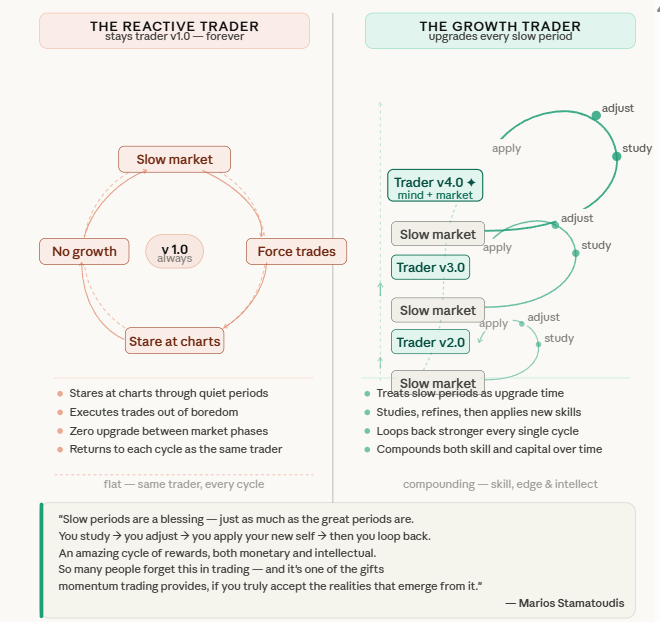
Remember that in slow periods the smartest action is not to stare at charts all day and execute boredom trades.
It's to upgrade ourselves.
Study → Adjust → Apply your new self → Loop back stronger.
The market always returns. The question is, have we updated who we are to make the most out of it?
I used to think slow periods were the enemy. As the years go by I think more and more that they are a gift and a necessity!
Is it just me, or is Twitter/X filled with posts like: “(Company Y) one shotted this”?
For the past 7 months I’ve been immersed in AI ,having a team that works almost full time, sometimes overtime, using the latest developments the moment they emerge… and I haven’t one shotted a single thing.
AI is a human pleaser. Many don’t realize the true magnitude of what this means. It can make things convincing and beautiful even if they are empty inside, not scalable, and faulty.
7+ months, almost working full time on this project , building workflows, building intelligence, creating new models, recognizing and filling industry gaps that have been wide open. Going into rabbit holes that no one I know has ever gone this deep into around trading , physics and mechanisms of the markets… and I haven’t even bothered with the UI still…
There are so many learning curves, best practices, protocols, and discoveries that only happen when you truly mess with AI for a long time, with extreme trial and error.
Of course all that when you want to use AI it for complex purposes like the market ,the most complex game in the world. I am not talking about a quick tool to make an approach easier.
The “one-shotted approach” that all these companies are pushing is incredibly distracting. The ripple effects of this will become evident soon, both in life and in the markets.
Despite the market being a bit of a mess, I have to say that certain things continue working well.
The Optical & Networking theme holds up, $AXTI being a good position of mine, re tried $CIEN. $LITE and $AAOI need more time probably. Also bought $LWLG, we'll see if it holds up.
$FSLY was one of the best catalyst gaps recently, I've held that since day one of the gap. The overall theme of "Edge Computing" is amplified and emerging (for now) I also bought $OSS in the same theme, which is amplified by other themes like "Defense Electronics and Mission Systems." $AKAM is another name I'm monitoring.
Re-tried $MU (Memory & Storage theme) today $STX, $SNDK , $WDC acting good as well .
Overall, this has been a trend for a while. Certain pockets show strength, transitions happen quickly but not of ''extreme'' magnitude generally. Theme monitoring is more mandatory than ever...
https://t.co/VGjAn42XFm
This year marks my 10th year in the markets.
One thing I know for certain is:
The most dangerous moment in a trader’s career isn’t the first or second d blow-up, a big drawdown, or a major streak of losses.
It’s the moment you start deeply believing YOU ARE the problem…
If you have some time this weekend, check out this talk with Riz.
I’ll be going through the YouTube comments and would love to hear your main takeaways
Riz and I had a great discussion about the markets, building a strong foundation, the struggles along the way, and what the future of trading might look like. Hope you enjoy it!
From my side:
It all comes down to research and the underlying connections between things. A cross judgment of behavioral, technical, and fundamental dynamics with their respective weights among assets.
This narrows down the observable universe for me. The more the "filters" of those dynamics align with what has historically occurred in the best performing moves, the better the potential chance of a powerful move occurring.
...I never know which stock is going to make a dramatic move. All I do is position myself in places where asymmetry can emerge.
More on natural randomness, less on personal ego.
Without being an expert on these matters:
We all know the stock market is heavily relying on the AI boom. A big part of that trade assumes that funding is secure, commitments are locked in, and the buildout is relatively frictionless....Part of that trade also relies on Gulf countries.
Saudi Arabia, UAE, Qatar etc, they sell oil, collect dollars, recycle it back into US assets. Over the last few years, a lot of that has been poured directly into the AI race.
The obvious risk in a Middle East escalation is, of course, oil. Oil up → inflation pressure. AI infrastructure is energy intensive, so some friction gets added for sure.
But is it all about oil?
Iran isn’t just hitting military bases. AWS has suffered outages after nearby drone strikes and objects hitting a data center. Saudi’s refinery was hit by drones, drones have also targeted Qatar’s LNG facilities. The Strait of Hormuz is at risk of effective closure...
More critical civilian infrastructure targets next?
What happens if the Gulf countries enter a survival mode? I’m not talking about stopping investments overnight.
A slowdown? A delayed commitment? A paused partnership?
The market runs on the story that AI is frictionless. The Gulf doesn’t need to pull out to change the story...just hesitate a bit and add friction.
Again, no expert on these issues. Just thinking out loud.
For the past few months I’ve spent long nights thinking about the future of Trading and what AI breakthroughs really mean for it.
Not from a tool perspective. Structurally.
Here is my take :
I believe 2026 and beyond will be the golden age of Momentum Trading, given that no major macro event dilutes things.
AI is starting to map behavioral dynamics that were previously unquantifiable. A small clue of that shift is how often you hear the word “themes” now compared to a few years ago , or the increasing effort by platforms to map them out.
That’s not random imo. Capital is organizing itself differently.
The principles that make stocks go up will never change. Supply and demand. Human behavior under uncertainty....What changes is the expression.
What we consider a clean setup will evolve. The details will evolve. Timing windows will compress. Rotations will tighten and happen faster, often at the sub-industry and sub-theme level before most participants even recognize it.
I envision a near-term future where markets become progressively more efficient...not in a way that kills opportunity, but in a way that concentrates it.
Momentum moves will be rapid and explosive. Fades quicker. The velocity of rotation higher. And because of that compression, the footprints in price action will actually become clearer....We’re already seeing it in real time.
I’ve never seen clustering of themes the way I see it now versus 5+ years ago. I’ve never seen rotations happen this fast at a sub-theme level. I’ve never seen structural footprints in price action this clear....That’s compression.
For the past months we’ve been working on problems most of the industry doesn’t even realize they have yet ...all centered on principles that always worked and will continue to work, adapted to a different speed of market structure and the potential velocity shift ahead.
Exciting times ahead for those paying attention!
We’re entering an era where creating your own tool will feel as natural as launching your first social media profile.
In the early 2000s, if you had a blog, you were early.
By the early 2010s, if you built a social media presence, you were relevant.
By the late 2010s, if you built a community, you were strategic.
From 2026 onward, building AI tools and apps will be the thing
Soon, everyone will make something. Everyone will be a Founder.
But here’s the catch:
When execution becomes cheap, cognition becomes priceless.
The first wave will be noise, AI slop.
Endless dashboards.
Polished interfaces.
Convincing visualizations.
The cost of looking intelligent is approaching zero.
Which means appearances will stop meaning anything at all.
In the new building era, judgment will be rare.
Because making something that looks smart is easy.
But building something that thinks smart, that encodes real decision logic, is not.
The real challenge is not building dashboards.
It is engineering the bridge from
Data → Understanding → Incentives → Action → Feedback → Improvement.
That bridge demands extremely deep domain intuition, behavioral insight, incentive design, and second order thinking.
Most tools will stop at insight.
Very few will reach impact.
And here is the uncomfortable truth:
When everyone can build, the depth of your thinking is fully exposed.
AI does not replace cognition.
It magnifies it.
If your thinking is average, you will scale mediocrity faster.
If your thinking is clear, you will scale leverage.
So yes, everyone will be a founder.
But the real divide will not be builders versus non-builders.
It will be
People who use AI to decorate ideas
vs
People who use AI to operationalize intelligence.
The next years will not reward the most polished apps.
It will reward the clearest, most innovative minds
Night out last week with friends, some of them tech enthusiasts as well.
When I mentioned OpenClaw, n8n, or the AI models I use, I mostly got blank stares.
It reminded me of one quiet advantage of being a trader: what feels like 'everyday vocabulary' to us is, for most people, still the future...
If I were new to trading, I would have thrown in the towel with this price action. As I've said since October, the biggest damage happens when indexes kind of trend but deterioration, fast rotation, and small pockets of opportunity exist. Things are easy in clear downtrends or momentum uptrends.
These are the periods when you truly internalize that defense is the priority in trading and find ways to reinforce it.
Offense should always be justified by great defense, no matter the regime. Trading, sports, war....it all works the same.
Don't be demoralized if you've made many mistakes. We've all lived and learned through them. It takes time. And that's why screen time can't be taught or passed on