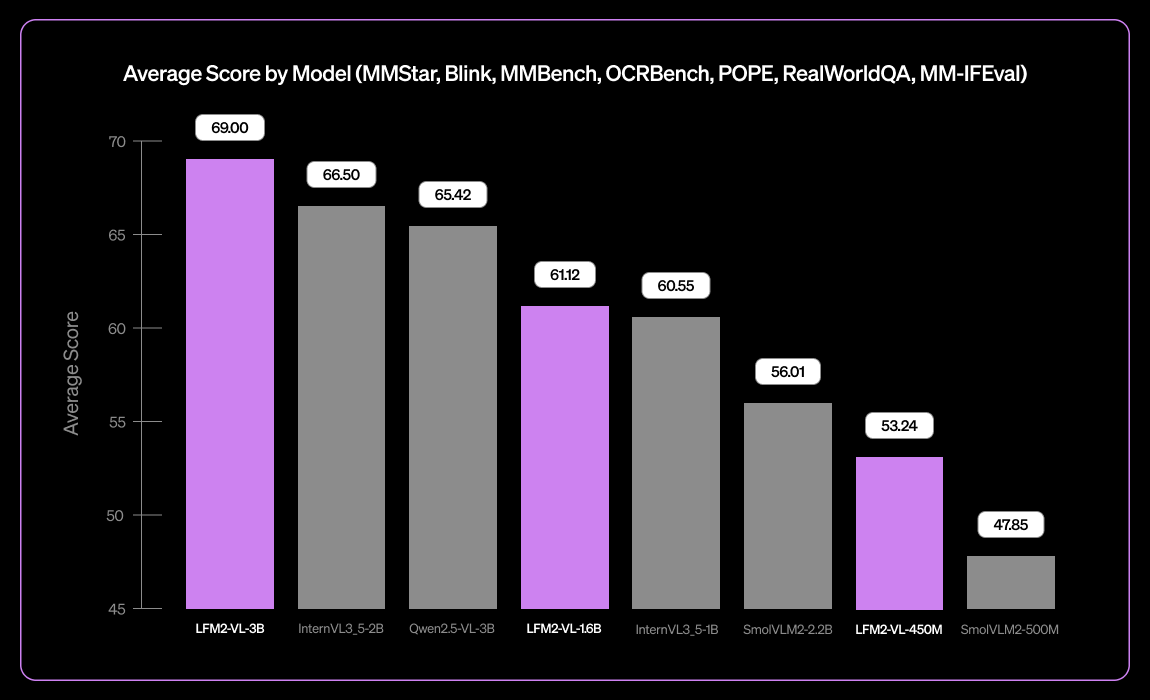
لا تضيع سنتين في محاولة فهم بناء نماذج الذكاء الاصطناعي من المصادر العشوائ��ة:
جامعة MIT أطلقت كورساً مكثفاً مدته 3 ساعات يشرح بناء الـ LLMs من الصفر مجاناً بالكامل.
الدورة تغطي العصب الأساسي للـ AI الحديث:
• التغذية والتدريب (Training)
• المعمارية الهندسية للنظام من الصفر (Architecture)
• قوانين التو��ع والقياس (Scaling Laws)
هذه التفاصيل التقنية هي ما تبحث عنه شركات مثل Anthropic وتدفع لأجله مبالغ طائلة لمهندسي الذكاء الاصطناعي.
احفظ التغريدة، أعطِ المحتوى 3 ساعات من وقتك👇
لكن، استخدام WCSS لوحده ما يعطي الصورة الكاملة عن جودة التجميع. وهنا يجي دور معدل درجة السيلويت (avg SIL).
درجة السيلويت تقارن مدى تشابه كل نقطة مع مجموعتها مقارنةً بالمجموعات الأخرى، وتعطي قيمة بين -1 و 1.
كلما كانت قيمة avg SIL أعلى، كلما كانت #K-Means
خوارزمية K-Means هي واحدة من أشهر خوارزميات التجميع (Clustering) في تحليل البيانات وتعلم الآلة، وتُستخدم لتجميع نقاط البيانات إلى عدد محدد من المجموعات k بناءً على درجة التشابه بينها.
الهدف الرئيسي من K-Means هو تقليل قيمة WCSS (مجموع المربعات داخل كل مجموعة) — وهو مقياس يوضح مدى تكتل النقاط حول مركز مجموعتها.
كلما كانت قيمة WCSS أقل، كلما كانت المجموعات أكثر تماسكًا وكانت النقاط داخل كل مجموعة قريبة من بعضها ومنفصلة بشكل أفضل عن المجموعات
#K-Means
تشتغل الخوارزمية عن طريق إنها تعيّن كل نقطة بيانات لأقرب مركز مجموعة (centroid)، وبعدين تعيد حساب مراكز المجموعات من جديد، وتكرّر العملية لحدّ ما تثبت التعيينات أو يصبح التحسّن قليل جدًا.
together.
It then auto-builds surveys, maps topic trends over time, and links clusters across fields.
It also supports semantic retrieval so newcomers get high-quality starting papers.
In expert pairwise tests the system achieves average rank 1.30 a
– arxiv. org/abs/2510.20809
New Nvidia + UC San Diego paper builds an automated way to read huge research fields and tell where to work. 😗
It automates high-quality field surveys and trend tracking.
Research moves too fast for humans to track 10,000+ papers a year.
The authors create Real Deep Research
produces, what it learns toward, and how it is trained.
For robotics it logs sensor, body, joint outputs, action space, and environment, which together describe how a robot senses, moves, and acts in the world.
It embeds these summaries as vectors so similar work clusters
, a pipeline that gathers papers from top venues, filters scope with targeted prompts, and turns each paper into a compact structured summary.
For foundation models it logs input, modeling, output, objective, and training recipe, which means data in, how the model works, what it
لبناء مستقبل ملموس. الميزة الكمومية اليوم ليست حلماً بعيداً، بل لغة جديدة (quantum language) تصل إلى أعمق بنى الطبيعة وتصوغ واقع الغد—في الاتصالات، الحوسبة، وحتى الفهم الفلسفي لماهية الوجود.
يوماً بعد يوم، يتبلور #عالم_الكمّ ليس فقط كحاجة نظرية بل كبنية تكنولوجية وثقافية. في الكُمّ، مفهوم "الزمن" و"المكان" و"الواقع" يُعاد تشكيله؛ ما نراه اليوم ليس فقط معماراً لذرات أو #خوارزمية، بل نقطة التقاء حيث تتحد الرياضيات الخالدة، الفيزياء التجريبية، والذكاء الاصطناعي العملي
🧬 From Static LLMs to Self-Evolving Agents: A Roadmap to Artificial Super Intelligence (ASI)
Large Language Models (LLMs) like GPT-4 have transformed what’s possible with AI — but they’re still static at heart. They don’t adapt on their own when facing novel tasks or evolving contexts.
📈 This comprehensive survey paper outlines the next frontier: Self-Evolving Agents.
🔍 Key ideas:
• Today’s LLM agents often rely on pre-trained knowledge and static toolchains. Self-evolving agents break this limit by learning in real time, adapting their models, memory, tools, and workflows as they operate.
• The paper organizes this emerging field around three core questions: What to evolve? When to evolve? How to evolve?
• What: Models, prompts, memory, tools, and agent architectures.
• When: Intra-test-time (real-time learning) vs. inter-test-time (learning from accumulated experience).
• How: Combining reward-based learning, imitation/demonstration, and evolutionary population methods.
• They highlight real-world applications — from self-improving coding agents to personalized tutors and adaptive healthcare bots.
• Crucially, they map out open challenges: safety, co-evolution in multi-agent systems, scalability, and the path to aligning these self-evolving agents with human intent.
🔬 Why it matters:
As AI becomes more agentic and autonomous, we’ll need robust frameworks to let these systems learn, adapt, and co-evolve safely — not just remain static models frozen in time.
In the Agentic AI Bootcamp, we explore the frontier of self-evolving agents — systems that learn, adapt, and grow beyond their initial training.
🔍 Dive into frameworks that answer what, when, and how to evolve LLM-based agents — and why this matters for the future of ASI.
🚀 Whether you're building adaptive tutors, coding copilots, or AI scientists — this bootcamp is your launchpad.
👉 Join now: https://t.co/qJFRt0GZG7
#AgenticAI #ASI #SelfEvolvingAgents #AIbootcamp #FutureOfAI #LLMAgents #AutonomousAI #AIAlignment #DeepLearning
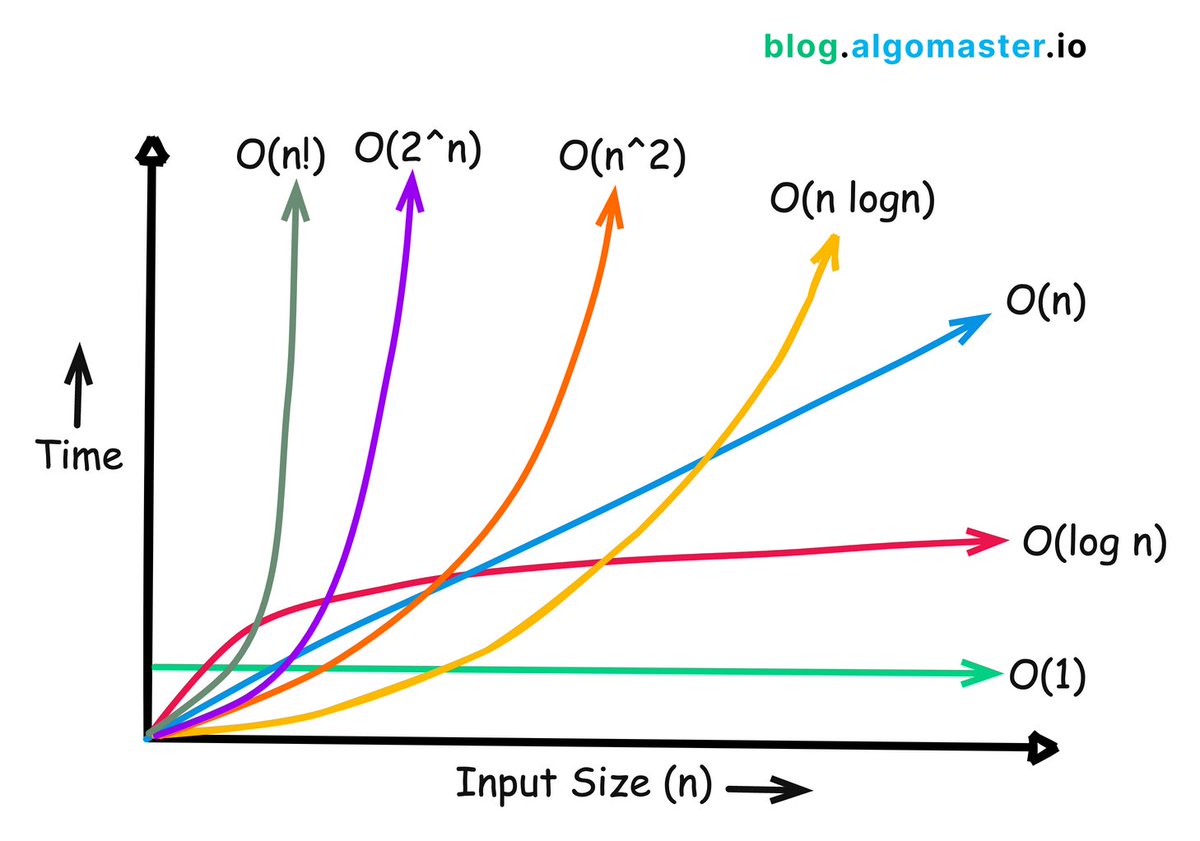
7 must-know runtime complexities for coding interviews:
1. 𝐎(1) - 𝐂𝐨𝐧𝐬𝐭𝐚𝐧𝐭 𝐭𝐢𝐦𝐞
- The runtime doesn't change regardless of the input size.
- Example: Accessing an element in an array by its index.
2. 𝐎(𝐥𝐨𝐠 𝐧) - 𝐋𝐨𝐠𝐚𝐫𝐢𝐭𝐡𝐦𝐢𝐜 𝐭𝐢𝐦𝐞
- The runtime grows slowly as the input size increases. Typically seen in algorithms that divide the problem in half with each step.
- Example: Binary search in a sorted array.
3. 𝐎(𝐧) - 𝐋𝐢𝐧𝐞𝐚𝐫 𝐭𝐢𝐦𝐞
- The runtime grows linearly with the input size.
- Example: Finding an element in an array by iterating through each element.
4. 𝐎(𝐧 𝐥𝐨𝐠 𝐧) - 𝐋𝐢𝐧𝐞𝐚𝐫𝐢𝐭𝐡𝐦𝐢𝐜 𝐭𝐢𝐦𝐞
- The runtime grows slightly faster than linear time. It involves a logarithmic number of operations for each element in the input.
- Example: Sorting an array using quick sort or merge sort.
5. 𝐎(𝐧^2) - 𝐐𝐮𝐚𝐝𝐫𝐚𝐭𝐢𝐜 𝐭𝐢𝐦𝐞
- The runtime grows proportionally to the square of the input size.
- Example: Bubble sort algorithm which compares and potentially swaps every pair of elements.
6. 𝐎(2^𝐧) - 𝐄𝐱𝐩𝐨𝐧𝐞𝐧𝐭𝐢𝐚𝐥 𝐭𝐢𝐦𝐞
- The runtime doubles with each addition to the input. These algorithms become impractical for larger input sizes.
- Example: Generating all subsets of a set.
7. 𝐎(𝐧!) - 𝐅𝐚𝐜𝐭𝐨𝐫𝐢𝐚𝐥 𝐭𝐢𝐦𝐞
- Runtime is proportional to the factorial of the input size.
- Example: Generating all permutations of a set.
♻️ Repost to help others in your network.
Join 28,501+ readers of our free newsletter: https://t.co/kPG9KUxfy6
Big O lets us compare algorithms performance based on input size. Intuition: If 1 operation takes 1s then here's how algorithms with different complexities would perform on input with size 100:
⚡️O(1) - 1s
🏎O(log n) ~ 7s
🚗O(n) ~ 1.5m
🚲O(n log n) ~ 11m
🐢O(n^2) ~ 2.7 hours
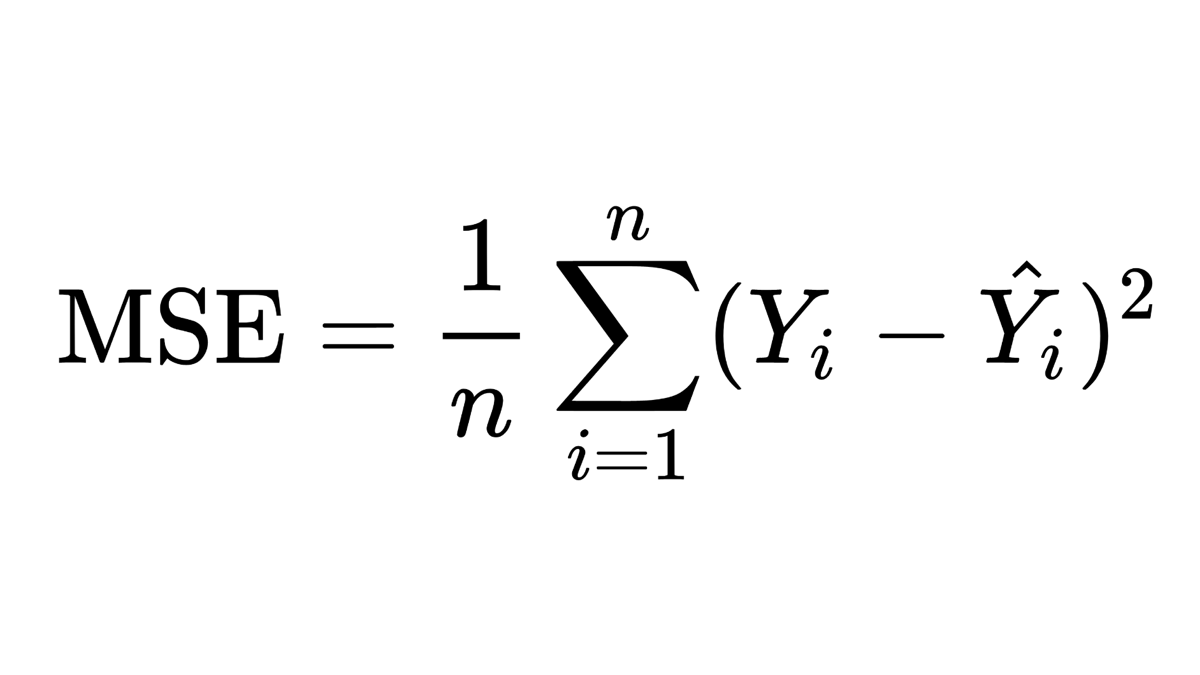
Machine Learning Formulas Explained 👨🏫
This is the formula for Mean Squared Error (MSE) as defined in WikiPedia. It represents a very simple concept, but may not be easy to read if you are just starting with ML.
Read below and it will be a piece of cake! 🍰
Thread 👇