@shazow I'm not sure we are gonna retrofit many homes and redo the distribution part of the grid in 15 years. Weather dependent generation being SOL on weather won't affect one or two people but a whole region, batteries get very expensive for those rare cases.
@shazow Agreed, now to your previous tweet, how would you resolve this tension?
> I'd want to empower/embrace/subsidize the latter, recognizing it weakens the former.
How do you guarantee power stability/quality and uptime then? At what costs?
@shazow@Alykkat 15-20% was for 3. transmission & aging infrastructure? I was counting a part of that (renewables-driven transmission) + section 2 "Policy-Driven "Cost Shifts" & Subsidies (12% to 30% of the Hike)".
@shazow@Alykkat And then the question comes back to what it is the best "utility" format to manage the grid. I lean towards something quite centralized with long term planning. I am not defending PG&E per say, I believe breaking it up is a step in the wrong direction.
@shazow@Alykkat I can see how wildfire mitigation and aging infrastructure is on PG&E, otoh NEM and renewables are/were public policies outside of their control? It almost look 50/50 wrt costs?
@shazow@Tpsmyth01@Alykkat Nothing would have beaten going electro-nuclear 50 years ago, but CA is ahead in the US when it comes to decarbonizing its electricity and, as far as I'm concerned I am to pay for that every single day rather than being on Coal & Gas.
@shazow@Alykkat FWIW: https://t.co/NctfhraS2d. Rate increases are from multiple factors, I'll point out that net energy metering & net energy billing weren't PG&E decisions, the CPUC is driving a lot of decisions. Re mismanagement Germany is a great example: it even helped Russia invade Ukraine.
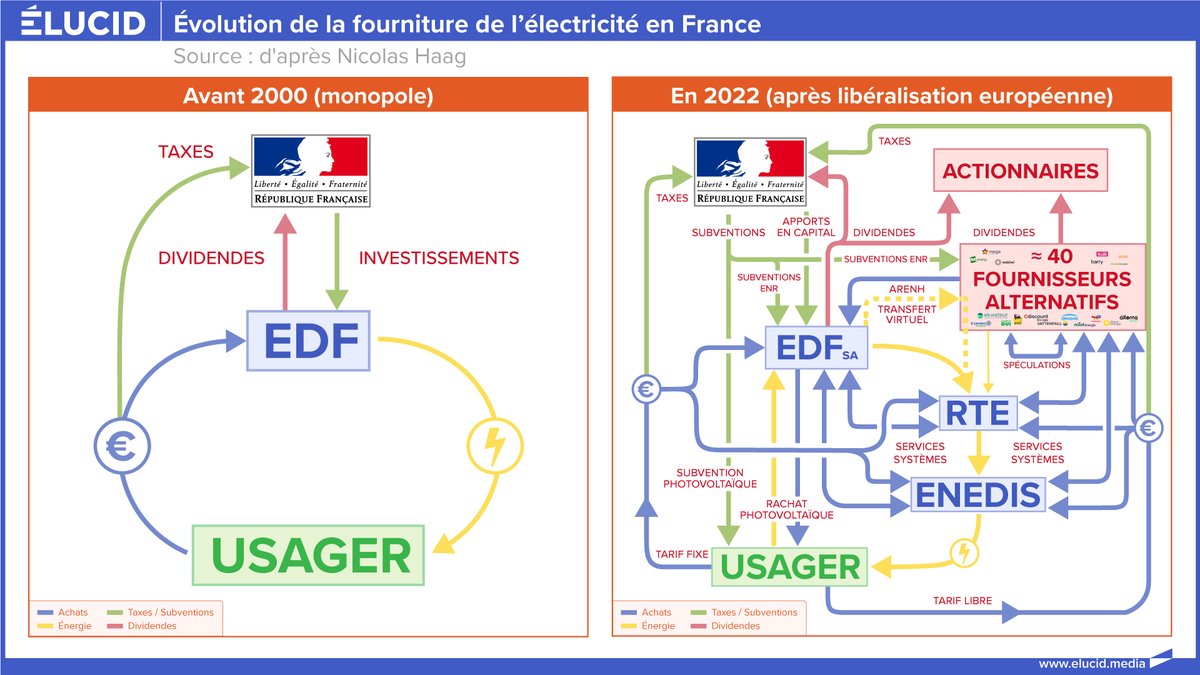
@shazow@Alykkat I think EDF under Marcel Boiteux's vision vs EDF under EU regulations is an example of how tearing down your (nationalized) energy monopoly gets worse and more expensive. Can we separate the topics of centralization wrt grid management & development from PG&E burning houses?
@shazow@Alykkat Or @shazow, if the idea is to have fully decentralized / disconnected "grid islands" then I would love to see the studies on how that's gonna be cheaper and more reliable. Personally I believe electricity is a common good and should be mutualized.
@shazow@Alykkat They already are primarily battery/solar/wind? (https://t.co/2FJ3ukNduY). Intermittent generation requires more transmission. How is breaking up PG&E gonna help?
@shazow@Alykkat Take a look at SF's energy mix, I'm not sure it's as local as you think (e.g. geysers, hetch hetchy): https://t.co/W26BDg8QGw. "The hookup doesn't need to be per household" → Transmission is really hard, and probably a case for federal involvement.
@shazow@Alykkat Which is all more expensive than a centralized model: "independent" communities still need/want a full grid connection for backup but pay less for the grid because they don't buy as much energy from it, they end-up being subsidized by the people who can't afford "independence".
@shazow@Alykkat I'm not saying it's optimal, e.g. in SF, I am happy to hear more about the city's idea to take over distribution from PG&E. I am also working on my comments for SF's IRP (https://t.co/1tNSWfP29J). The process is already pretty decentralized.
@shazow@Alykkat What do you call local redundancy? I don't think other countries are doing better, China is ahead wrt electrification but they love coal like the Germans… The EU's wish for "competition" (among other things) has been detrimental to EDF in France.
@shazow@Alykkat Electricity grid infrastructure is inherently better centralized because of its complexity, costs, lead times, and the fact that electricity cannot be easily stored while demand and offer have to be matched in real time 24/7/365.
@shazow@Alykkat The way I see it, PG&E operates within an ecosystem, it gets all the bad press, when responsibilities are actually shared. As far as I can tell, PG&E does its best and is pretty cooperative, they were ready to close DCPP due to public demand, even though it put us in danger.