Should you use email trackers when contacting professors?
Email trackers may tell you if a professor opened your email, but they also raise privacy concerns.
If you are still in university, my advice is to waste some time intelligently.
I mean it.
Take a course that has nothing to do with your degree. Join a student organisation. Try journalism and see if its something you’d like to do. Learn to code and discover you hate it. Volunteer somewhere. Start a small business that fails. Help organise an event. Contest an election if that is your thing. Go and sit in a lecture in another department. Make friends with people studying things you know nothing about.
University is one of the few periods in life when you can try many things badly without the consequences being too expensive.
Once rent, family, career and other responsibilities arrive, experimentation becomes more costly.
So experiment now.
But please don’t spend four years only experimenting either. At some point, start paying attention to the clues.
What do people repeatedly come to you for?
What do you seem to understand faster than others?
What kind of work can hold your attention for hours?
What have you done that made you think, I could actually become very good at this?
Follow those clues and start building some depth.
And before you graduate, have something outside your transcript that you can point to.
Not 27 certificates from webinars. Something you actually did.
Maybe you wrote five really good articles. Built a small app. Ran a business. Analysed a dataset. Led a student organisation well. Produced a podcast. Worked on a research project. Managed a campaign. Built a community. Interned somewhere and left evidence that you were useful.
Anything.
Just don’t arrive at graduation with a CV whose entire argument is: “I went to university.”
And while doing all of this, learn to respect process.
Don’t be in too much of a hurry to skip the boring parts. Sometimes you need to write the first bad draft, sit through the long meeting, do the internship, prepare the spreadsheet, organise the logistics, get corrected and do the work again.
There is a lot you only learn by actually doing the work.
You discover how things work, how people make decisions, where you are weak, what you are unusually good at, and why some things that look easy from the outside are actually difficult.
I think we sometimes want the outcome without spending enough time in the process that produces it. But that process is often where the real learning happens.
It is in doing the work that we mine gold.
Also, meet people.
Not the forced “networking” where everyone is trying to collect important people’s phone numbers. Build actual friendships. Your classmates will scatter into different industries, countries and institutions. Ten years from now, the person sitting beside you in an economics class may know something or someone you need, and vice versa.
Read too. Please read.
You have access to a university library and more intellectual freedom than you may have again for a while. Don’t spend all of it on TikTok and lecture notes.
And don’t panic because somebody in 300 level already has a startup, 14 certificates and “Founder & CEO” in their bio.
You are allowed not to have your life figured out at 21.
The goal is not to graduate with a perfectly designed career.
It is to leave university more curious, more capable, with some evidence of what you can do and a slightly better idea of where your abilities might take you.
And please enjoy university too.
Life will become serious soon enough.
#YouWillNotFail
I wrote down most of the key points dropped during this session.
I wasn’t able to jot down the social sciences session and personal stories because my phone died.
Feel free to go through these screenshots if you missed it and you can drop your notes too!✨
@powerfulbadeeu
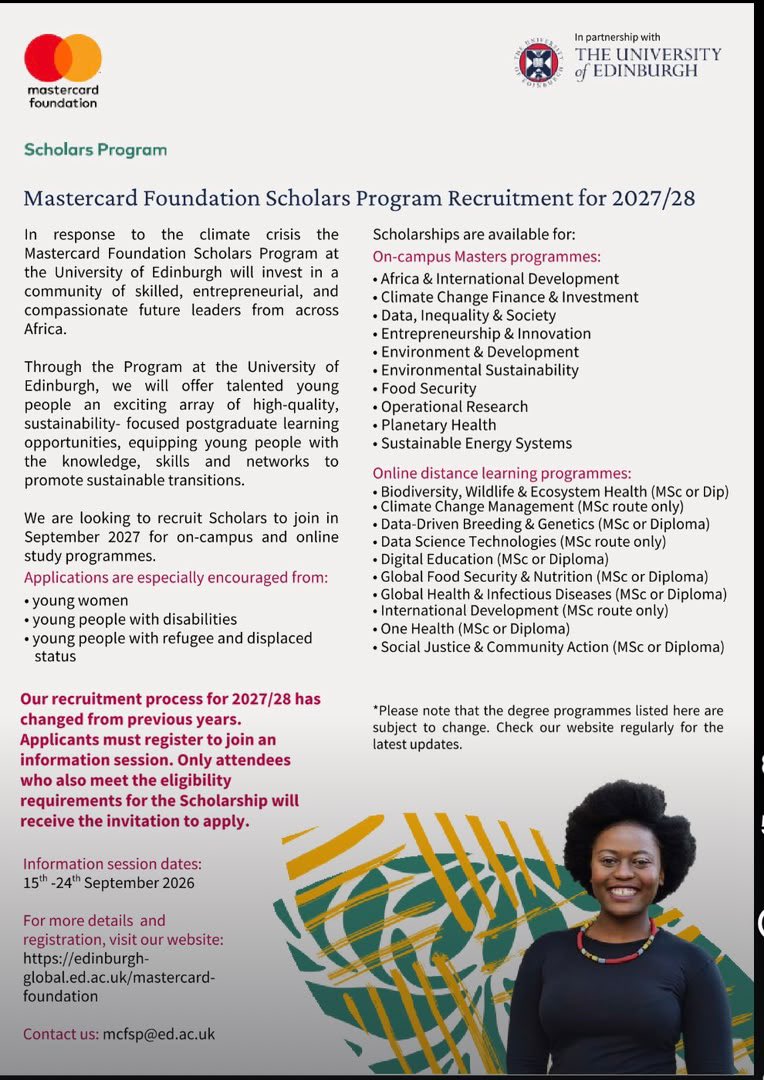
Fully Funded Mastercard Foundation Scholarship at The University of Edinburgh
You will need to have achieved the equivalent of a UK Second Class (Upper) Bachelor’s (Hons) degree or higher.
To be eligible to apply, you need to attend one of the virtual information sessions between 15 and 24 September 2026. Ensure you register here and check for more information here:
https://t.co/ATAi2BFN3B
We’re seeking highly motivated MSc & PhD students to join the Animal Cognition Research Group in Fall 2027! 🐦
All positions are funded:
MSc: 2.3 years
PhD: 5 years
Applications: Sept. 1–Dec. 1, 2026
https://t.co/14EGQeZ24Z
@Psych_UAlberta
1/2
Quality research can let you travel the world.
Undergraduates and Graduates, don't waste your research:
- Publish
- Develop abstracts
- Submit to conferences
- Partake in poster presentations
Amanfoɔ ’16 keyboardist Bright Banoenumah Mwinteribo plays the Prempeh College anthem, bringing back cherished school memories and the strong bond of brotherhood. For a moment, the alumni feel like they are young boys at school again. 🎹💚💛
Guysssssss, some just told me about a website you can showcase your research for freeeeeeee…… I’m coming, let me go and upload my work and put you guys on🤭
Jason Arday, the former University of Cambridge professor, has been found dead.
Mr Arday was found “unresponsive” at an address in Battersea, London, on Friday afternoon and later pronounced dead at the scene.
🔗 https://t.co/gM6vNStTFb
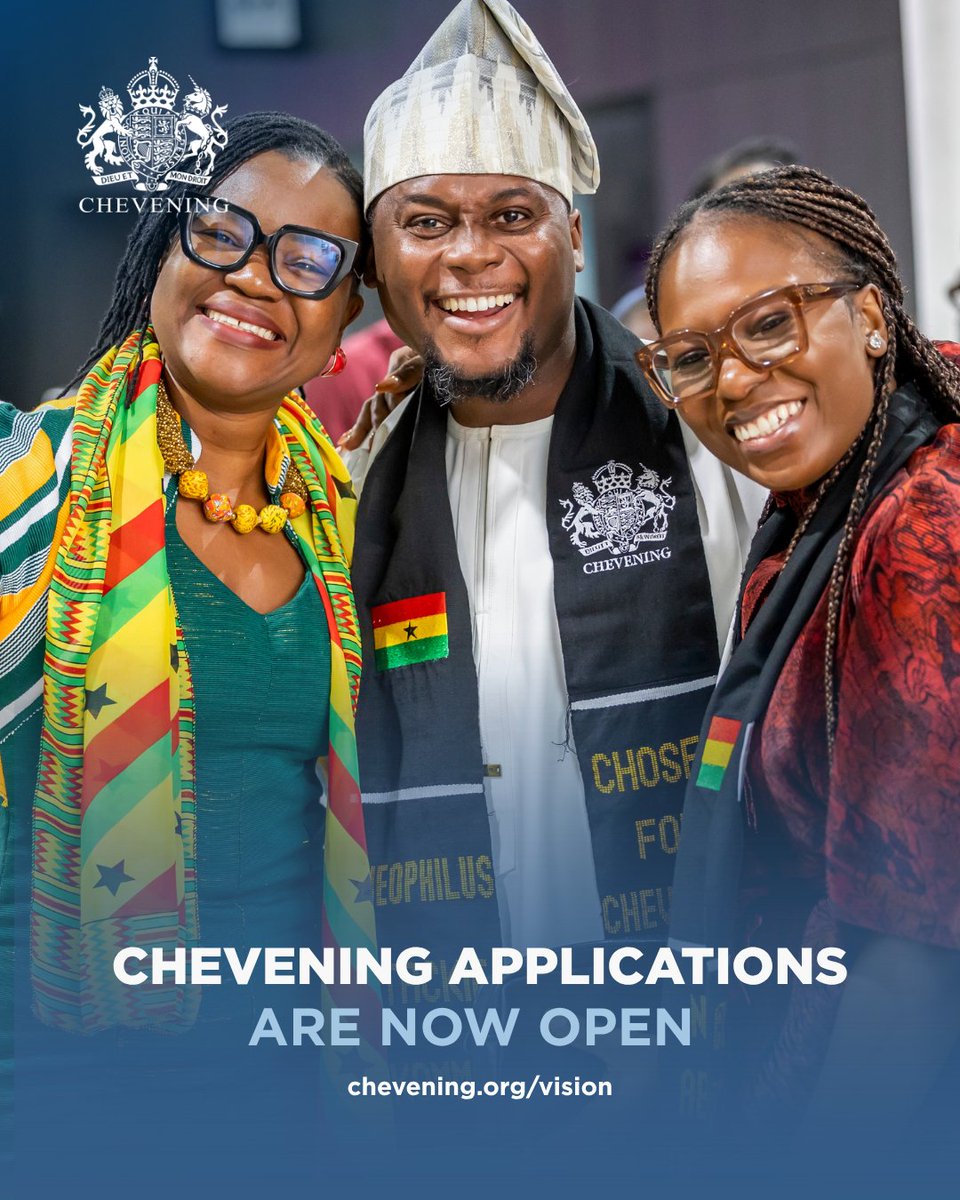
Applications for #Chevening Scholarships are now open!
If you’re a future leader who’s ready to influence positive change in areas of shared priority for Ghana and the UK, this could be the opportunity you’ve been waiting for.
With a Chevening Scholarship, you’ll gain:
🎓 A world-class education
🤝 A lifelong relationship with the UK
🌎 Access to a global network of influential leaders
Find out if you're ready to apply: https://t.co/P2M8YZs95m
Applications close on Tuesday 6 October at 11:00 (UTC).
#IAmChevening
Applications for #Chevening Scholarships are now open!
If you’re a future leader who’s ready to influence positive change in areas of shared priority for your country and the UK, this could be the opportunity you’ve been waiting for.
With a Chevening Scholarship, you’ll gain:
🎓 A world-class education
🤝 A lifelong relationship with the UK
🌎 Access to a global network of influential leaders
Find out if you're ready to apply: https://t.co/XW1AuQ4TJz
Applications close on Tuesday 6 October at 11:00 (UTC).
#IAmChevening
A lot of people don’t understand this sub, but it was the sub that won Portugal the game. They were already playing a 4-4-2 and Portugal became light in midfield. He couldn’t sub Ramos off again because he had just come on and was providing fresh energy.
So he had to correct the midfield balance. He brought on Ruben Neves for Ronaldo and switched back to a 4-3-3. Midfield balance restored.
From that moment, Portugal regained control of the game. Croatia could no longer play through the middle as easily, Bernado and Joao Neves had an extra body to help them, and Portugal started controlling territory again.
That’s the difference between reactive coaching and proactive coaching. Martinez recognized the problem wasn’t in attack anymore, it was the midfield being outnumbered. He made the difficult decision, fixed the balance, and Portugal eventually got their reward.
Tactical decisions like this often go unnoticed.
People blaming Ronaldo today simply have zero understanding of football. He did nothing wrong and was actually one of Portugal’s most involved players. The real issue was Portugal’s midfield, which was practically non-existent for most of the game. THEY CREATED NOTHING.
This Portugal team is extremely poor. It will take a miracle for them to win this World Cup. After such an incredible career, it feels like Cristiano Ronaldo has been unlucky to end up with a group of players who simply do not match his ambition and mentality.
It’s a real pity.
Many people are learning how to write better prompts. Fewer people are learning how to decide what AI should never touch.
That distinction is important.
AI fluency is knowing how to use them without surrendering your thinking.
I think serious AI use requires four skills:
① Delegation
Know what to hand to AI.
Use it for brainstorming, outlining, summarizing, drafting, or repetitive tasks.
Keep human judgment for sensitive work, high-stakes decisions, and final accountability.
② Description
Give the model enough context to help you well.
A weak instruction usually gives you a weak answer.
State the goal, audience, background, format, tone, and limits.
③ Discernment
Do not trust output because it sounds polished.
Check the logic.
Check the facts.
Check the citations.
Check whether the answer fits the task.
④ Diligence
Edit, verify, and stay accountable.
AI can support the work.
It cannot carry the responsibility for the final answer.
This is especially important in research, academic writing, medicine, public health, and policy work.
A clean answer can still be wrong.
A confident answer can still be fabricated.
A beautiful paragraph can still weaken your credibility.
The people who will use AI well are not the people who prompt the fastest.
They are the people who know when to pause, question, verify, and revise.
That is the real skill.
Save this as a simple AI fluency checklist.
—-
Framework adopted from Anthropic’s AI class.
Academic work needs good visuals.
A clean slide can help an audience remember the main point.
A good diagram can do what five paragraphs struggle to do.
Here are some tools researchers, students, and educators can use for academic illustrations and presentations:
→ https://t.co/Oe6AHbWRXF
↳ Turn documents into slide drafts
→ Plus AI
↳ Create structured presentation decks
→ Prezi
↳ Build zoom-style presentations
→ https://t.co/l8RNp46yQW
↳ Create clean presentation layouts
→ Tome
↳ Build story-based presentations
→ Mermaid
↳ Create diagrams from text or code
→ Gamma
↳ Draft presentation-style pages
→ Canva
↳ Design posters, slides, and visuals
→ Xmind
↳ Map ideas before you present them
→ Decktopus AI
↳ Create slide decks with interactive elements
The tool is not the work.
Your thinking is still the work.
But the right tool can help your ideas become easier to see, teach, and remember.
Which tool would you add to this list?