There is a fine line between “I want to use our internal data for context” and “I want the LLM to give me recommendations based on best practices.”
I always see this problem with legal projects. The AI system should be built in a way that both can coexist and reinforce each other.
Something important is about to change for passengers in #Europe.
In Europe, you’re entitled to up to €600 if your #flight is #delayed 3+ hours.
Now that rule is being challenged.
EU governments want to raise the threshold to 4–6 hours, eliminating most claims.
The European Parliament is pushing back to keep it at 3.
Negotiations are ongoing. Nothing is final yet.
But, the airlines are lobbying hard for the change, because this law costs them billions every year.
Raise the threshold, and most passengers stop qualifying.
If you’ve had delayed flights in the past 3 years,
it’s worth checking them now.
Because if the rules change, many of those #claims may disappear.
When not to use an AI Agent?
Start simple. If a problem has clear steps, a script or workflow is usually faster and more reliable than agents.
Agents add cost and latency - use them only when problems are complex, uncertain, or changing.
Workflows = predictability.
Agents = flexibility.
If you use agents, keep them minimal. Complexity hurts debugging and scale.
And always add logging, error handling, and retries - agency means more things can break.
I had a call with a junior dev who asked me for advice on programming. The advice I gave him was - "turn off chatgpt & claude and learn some CS fundamentals"
I still stand by this idea. It will save you a ton of time in the future and make you far more efficient.
In the AI hype, it’s easy to lose your mind over all these processes optimization and productivity boosts that “theoretically” help your business grow.
None of these make sense if you don’t solve real problems in your business. Start by examining your workflows
One important thing that I learned as a founder of AI agency is that your task is to have a vision, find right people and articulate your vision in the way that they implement it.
It’s not your task to implement vision, your task is to have a clear vision.
It’s harsh truth that you have to learn to scale your business/project
I still use a notebook and pen to design a software architecture. It still opens my creativity and problem solving skill by 100%.
No laptop, no phone, pure focus.
There is no competition between Google vs OpenAI vs Anthropic. There is a competition between Google vs Nvidia, TPU vs GPU. and that competition will shape the world.
At the end of the day, OpenAI and Anthropic are the end users of Nvidia’s products and they strongly depend on it but Google has some room for maneuvers
the hardest thing I found working at high-performance teams & building my company is hiring.
this's a funcking challenge to find the people that you want to work with and that you can rely on
Most companies think AI automation means replacing human touch in sales. Wrong.
The best AI-powered email campaigns I've built actually make outreach more personal, not less. Here's what I mean: instead of sending generic sequences, AI helps you identify the exact pain points each prospect mentioned in their content, then crafts emails that reference their specific challenges.
For B2B service companies, this approach typically generates:
- 40% higher open rates than standard sequences
- 3x more qualified discovery calls booked
- 60% less time spent on campaign creation
The secret? Using AI to analyze prospect behavior and trigger hyper-relevant follow-ups based on their engagement patterns, not just timing.
In such a competitive world, there is only one quality that makes a difference - it's being willing to take a risk
Fearlessly and courageously take a risk to accomplish what you have to, despite a lack of skills, knowledge, or expertise - just try
@apollonator3000 prompt engineering techniques. to say "generate me a person that yada yada yada" isn't enough to have a consistent image. We need to treat it as we usually do our coding tasks: details, explanations, references, etc
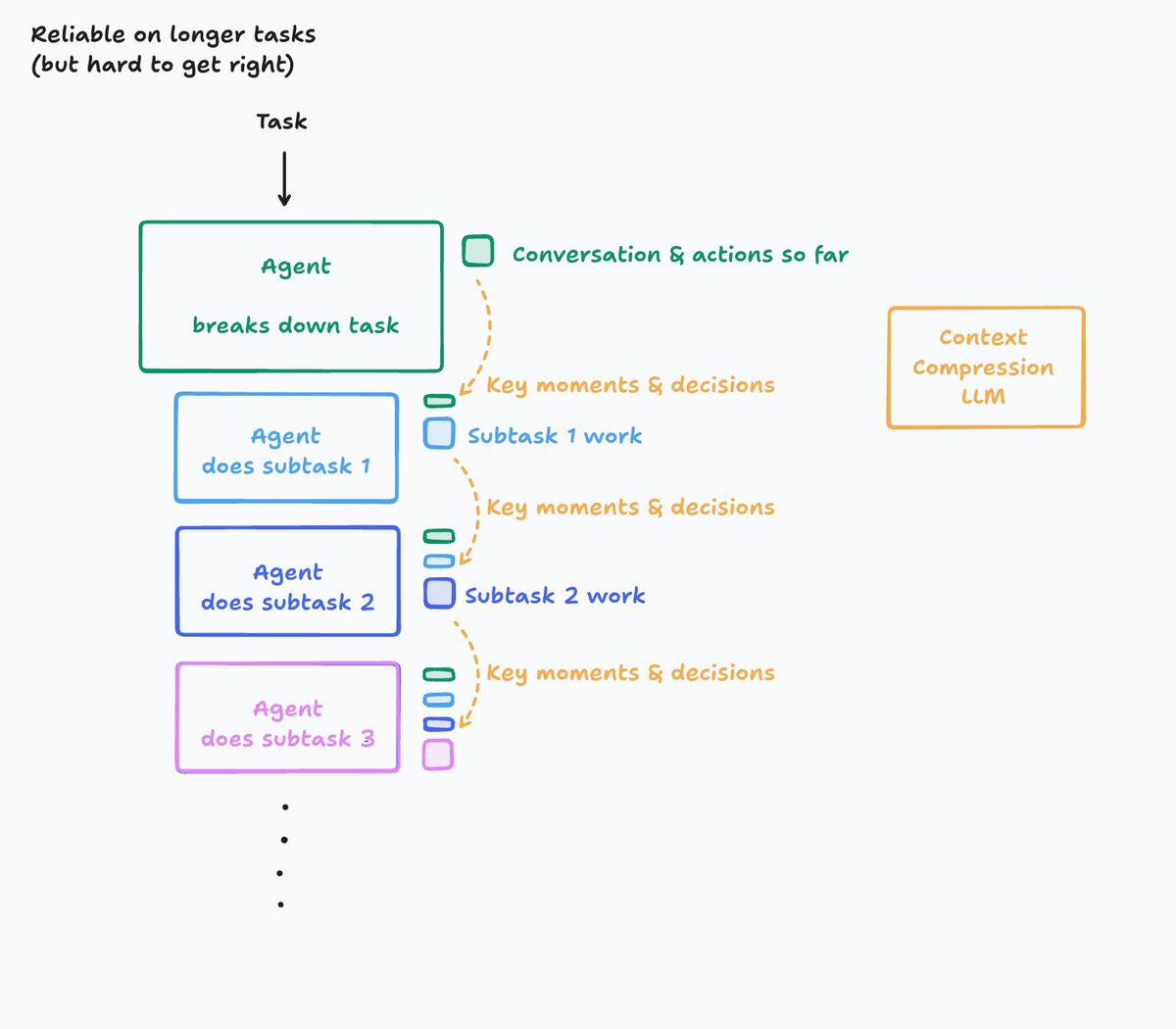
Why does your AI agent fail?
Lack of context. Conflicting decisions.
Multi-agent systems split tasks across sub-agents, but without full context sharing, they make inconsistent assumptions, and everything breaks.
The fix? Single-threaded agents. Share full traces, not just messages. Every step should build on the last.
It's less flashy than parallel agents, but it works.