Truth leads one to Paradise and virtue leads one to Paradise and the person tells the truth until he is recorded as truthful -Prophet Muhammad Ibn Abdullah
@benshapiro
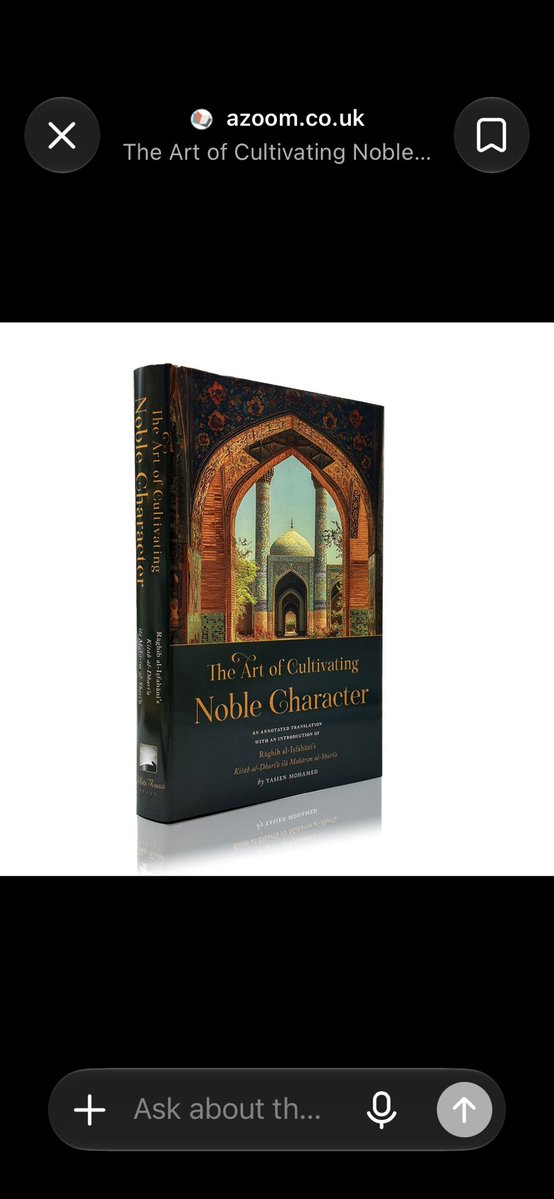
Imam al-Rāghib al-Iṣfahānī (d. c. 1108 CE) was a renowned Persian Muslim scholar, Qur’anic exegete, linguist, and philosopher. He specialized in Qur’anic vocabulary, Islamic ethics, and moral philosophy. His major works include Al-Mufradāt, a dictionary of Qur’anic terminology, and The Art of Cultivating Noble Character, a treatise on Islamic virtue ethics. His scholarship influenced later thinkers, particularly Imam al-Ghazālī.
His book The Art of Cultivating Noble is Character is arguably the best book you’ll ever read. But the west largely ignore Islamic golden-age polymaths, philosophers, logicians, theologians, metaphysicians, jurists etc. (Modern Europe and America). Even though Modern Europe and enlightenment era thinkers and philosophers were partly and even greatly influenced by Islamic law, theology and philosophy.
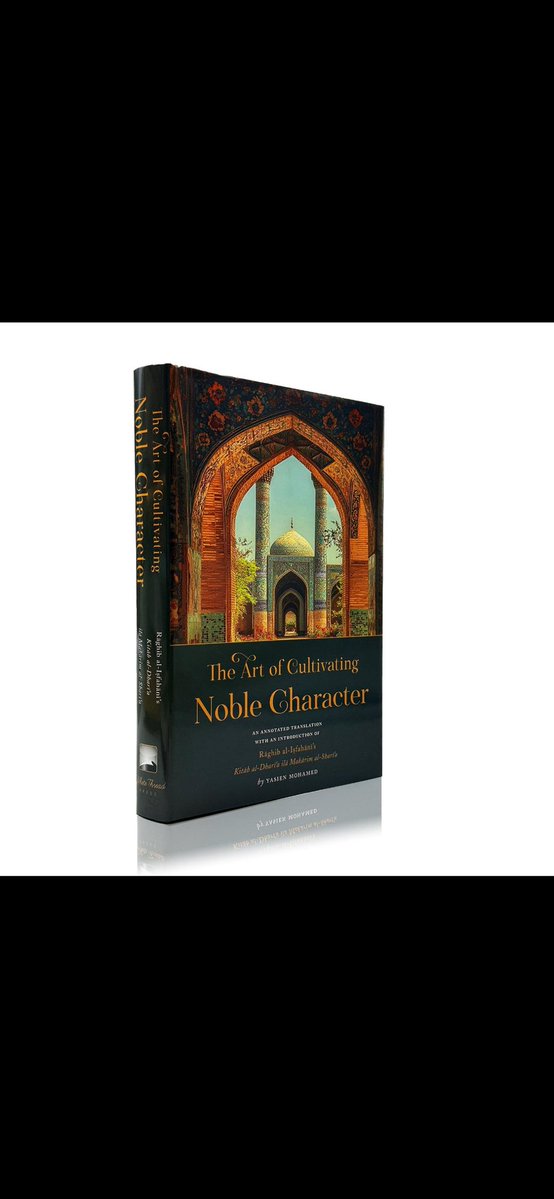
The Art of Cultivating Noble Character is the English annotated translation of Rāghib al-Iṣfahānī’s classical Kitāb al-Dharīʿa ilā Makārim al-Sharīʿa, a major work of Islamic virtue ethics. The book develops an account of moral and spiritual excellence that combines Qur’anic teaching, prophetic tradition, and philosophical reasoning.
Its central concern is how a human being becomes genuinely good, rather than merely how to obey individual rules. Al-Iṣfahānī examines the faculties of the soul, intellect and knowledge, desire, anger, justice, love and hatred, earning and spending, generosity, and human action, treating ethical life as the disciplined cultivation and proper ordering of these capacities.
A distinctive feature is the synthesis of reason and revelation. Al-Iṣfahānī engages a philosophical framework resembling classical virtue ethics—including wisdom, temperance, courage, and justice—but redirects human flourishing toward a specifically Qur’anic and ultimately otherworldly end; the Prophet Muhammad functions as the exemplary model of perfected character.
@benshapiro
Imam al-Rāghib al-Iṣfahānī (d. c. 1108 CE) was a renowned Persian Muslim scholar, Qur’anic exegete, linguist, and philosopher. He specialized in Qur’anic vocabulary, Islamic ethics, and moral philosophy. His major works include Al-Mufradāt, a dictionary of Qur’anic terminology, and The Art of Cultivating Noble Character, a treatise on Islamic virtue ethics. His scholarship influenced later thinkers, particularly Imam al-Ghazālī.
His book The Art of Cultivating Noble is Character is arguably the best book you’ll ever read. But the west largely ignore Islamic golden-age polymaths, philosophers, logicians, theologians, metaphysicians, jurists etc. (Modern Europe and America). Even though Modern Europe and enlightenment era thinkers and philosophers were partly and even greatly influenced by Islamic law, theology and philosophy.
The Art of Cultivating Noble Character is the English annotated translation of Rāghib al-Iṣfahānī’s classical Kitāb al-Dharīʿa ilā Makārim al-Sharīʿa, a major work of Islamic virtue ethics. The book develops an account of moral and spiritual excellence that combines Qur’anic teaching, prophetic tradition, and philosophical reasoning.
Its central concern is how a human being becomes genuinely good, rather than merely how to obey individual rules. Al-Iṣfahānī examines the faculties of the soul, intellect and knowledge, desire, anger, justice, love and hatred, earning and spending, generosity, and human action, treating ethical life as the disciplined cultivation and proper ordering of these capacities.
A distinctive feature is the synthesis of reason and revelation. Al-Iṣfahānī engages a philosophical framework resembling classical virtue ethics—including wisdom, temperance, courage, and justice—but redirects human flourishing toward a specifically Qur’anic and ultimately otherworldly end; the Prophet Muhammad functions as the exemplary model of perfected character. @benshapiro
Imam al-Rāghib al-Iṣfahānī (d. c. 1108 CE) was a renowned Persian Muslim scholar, Qur’anic exegete, linguist, and philosopher. He specialized in Qur’anic vocabulary, Islamic ethics, and moral philosophy. His major works include Al-Mufradāt, a dictionary of Qur’anic terminology, and The Art of Cultivating Noble Character, a treatise on Islamic virtue ethics. His scholarship influenced later thinkers, particularly Imam al-Ghazālī.
His book The Art of Cultivating Noble is Character is arguably the best book you’ll ever read. But the west largely ignore Islamic golden-age polymaths, philosophers, logicians, theologians, metaphysicians, jurists etc. (Modern Europe and America). Even though Modern Europe and enlightenment era thinkers and philosophers were partly and even greatly influenced by Islamic law, theology and philosophy.
The Art of Cultivating Noble Character is the English annotated translation of Rāghib al-Iṣfahānī’s classical Kitāb al-Dharīʿa ilā Makārim al-Sharīʿa, a major work of Islamic virtue ethics. The book develops an account of moral and spiritual excellence that combines Qur’anic teaching, prophetic tradition, and philosophical reasoning.
Its central concern is how a human being becomes genuinely good, rather than merely how to obey individual rules. Al-Iṣfahānī examines the faculties of the soul, intellect and knowledge, desire, anger, justice, love and hatred, earning and spending, generosity, and human action, treating ethical life as the disciplined cultivation and proper ordering of these capacities.
A distinctive feature is the synthesis of reason and revelation. Al-Iṣfahānī engages a philosophical framework resembling classical virtue ethics—including wisdom, temperance, courage, and justice—but redirects human flourishing toward a specifically Qur’anic and ultimately otherworldly end; the Prophet Muhammad functions as the exemplary model of perfected character.
@benshapiro I wonder if @benshapiro is going to cover this? Nah, it’s probably antisemitic or something to even talk about this. But let this have been a Muslim daycare.
https://t.co/1sDx8I5lAA
@benshapiro I wonder if @benshapiro is going to cover this? Nah, it’s probably antisemitic or something to even talk about this. But let this have been a Muslim daycare.
https://t.co/1sDx8I5lAA
@guy49747@GodLogic_GL Muslim scholar and former Christian Paul Williams discuss the VERY topic of the dead seas scrolls with Bart Earhmann
https://t.co/VLVP5osGRz
Deal with this. I wrote much of this from the lectures of Dr. Ali Ataie and other Muslim and Christian scholars.
Christian Dilemma 1:
When you ask a Christian, “Where did Jesus claim to be God?” 99% of the time, they quote the Gospel of John. They say:
“Before Abraham was, I am.” Or “The Father and I are one.” Or “I am the way, the truth, and the life!” Or “In the beginning was the Word, and the Word was with God, and the Word was God!”
These are NOT divine claims, and Matthew, who, according to Christian tradition, was a disciple, but Christian scholarship says he was NOT a disciple—but why doesn’t Matthew, who YOU claim was a disciple, and John wasn’t, record a SINGLE divine claim like the ones in John????
According to John, Jesus makes these statements in PUBLIC debates! Matthew is standing right near Jesus, according to Christians, and John is NOT! If Jesus made those statements with Matthew there, Matthew is a terrible reporter!
Matthew reported that Jesus rode a donkey into Jerusalem but recorded ZERO divine claims? All the authors are terrible reporters for not recording these statements, except for John!
Dilemma: Either they are terrible reporters, or John is a liar and Jesus never made those statements! No way out!
Dilemma Two:
In the Old Testament, it is CLEAR! GOD is not a man!
Numbers 23:19: “Anyone who says God is a man is a liar!”
Hosea 11:9: “Indeed, I am God and NOT a man!”
Deutero-Isaiah: God is incomparable, God is transcendent, and God is nothing like creation.
In the Torah, if a person commits blasphemy, like claiming to be God, the penalty is stoning to death!
Christians believe Jesus is God in the flesh of a man. The Jews pick up stones to stone him. He calls them the children of Satan!
DILEMMA: All the verses in the Old Testament are just lies! God is a deceiver! He set the Jews up for failure! God tricked the Jews! Or God is a very, very inefficient communicator! Those clear verses mean something else!
Either God is a liar or an ineffective communicator! No way out!
Early Christians couldn’t see a way out! A Christian preacher, Marcion, at the end of the 1st century, held the opinion that he couldn’t reconcile the Old with the New Testament!
His belief was that the God of the Old Testament was a DIFFERENT God, a son of perdition and a trickster god, a lesser god. He’s the God of the Jews, and the Jews are evil, while Jesus is the Son of the true God, who descended to teach us through Moses!
He was a bitheist. This was a very popular early Christian group in Rome.
Talk about anyone not being a serious person, you quite literally don’t know the consensus of your own Christian scholars and tradition.
Bro, are you seriously claiming no credible scholars acknowledge textual corruption in the New Testament? Bruce Metzger, a Christian and one of the most respected New Testament textual critics, documented scribal alterations and textual variants. Daniel Wallace, an evangelical Christian textual critic, openly acknowledges both intentional and unintentional scribal corruption, including changes motivated by theological concerns.
D.C. Parker, another prominent textual critic, argues in The Living Text of the Gospels that the Gospel texts underwent changes during their transmission. Even Bart Ehrman, who was trained as an evangelical Christian, extensively documents theologically motivated alterations in The Orthodox Corruption of Scripture.
And what about Mark 16:9–20 and John 7:53–8:11? These are substantial passages widely recognized by textual critics as later additions to the earliest recoverable texts.
You’re claiming scholarly consensus while contradicting established textual criticism. These scholars disagree about how extensively the New Testament was altered, but the existence of textual alterations isn’t even controversial. Bro, you’re confusing the historical existence of Christian beliefs with proof that those beliefs originated with Jesus. Those are two entirely different questions.
@guy49747@GodLogic_GL The Quran is not historically accurate according TO WHAT?
The corrupted New Testament which you cannot prove is historically accurate?
You are using circular reasoning. The New Testament is false and the Quran is actively correcting it.
@onlysnowski Pathetic. This dude is allegedly a Muslim, like myself. I hope he never proclaim or represents himself as one, publicly to other people.
Islam prohibits intoxicants and sexual immorality, gambling and it warns against environments that encourage sinful behavior.
The best PSA for people to stop drinking Alcohol!!!
Nothing good comes from alcohol, but a temporary illusion that wears off and your body tells you you are sick and dehydrated with a hangover. That’s your body telling you, stop consuming this poison.
But people are destructive and their own worst enemy.
@Tyduped@notCloutbay Exactly! It’s nothing but streaming of the most degenerate behavior. Drinking, gambling, club and party environments, people fighting and crashing out…. Broner needs help.
YOU HAVE ZERO ORIGINAL MANUSCRIPTS!!!!! ZERO!!!! NONE!!!!
Bro, the most glaring problem is that you claim we possess 10,000 original Gospel manuscripts. We don’t possess a single original autograph of any New Testament book. What we possess are manuscript copies, fragments, and later codices, many containing textual variants.
And your claim about 2,500-year-old original Torah documents is equally problematic. The Dead Sea Scrolls date primarily from the last few centuries BCE through the first century CE. They’re not Moses’ original writings.
You’re also conflating textual preservation with historical authenticity. Even if you could demonstrate that a particular Christian doctrine existed in the second century, that wouldn’t establish that Jesus actually taught it.
Furthermore, early Christianity wasn’t textually or theologically uniform. There were canonical and apocryphal Gospels, competing theological interpretations, and disagreements about Jesus’ identity.
And the biggest theological problem with your argument remains Qur’an 2:79. How can you insist that the Qur’an teaches written scripture cannot be corrupted when the Qur’an explicitly condemns people for writing scripture with their own hands and attributing it to Allah?
This is precisely why Dr. Ali Ataie’s objection deserves serious consideration. You’re treating the Qur’an’s affirmation of divine revelation as an unconditional endorsement of every surviving biblical manuscript.
The existence of ancient manuscripts doesn’t automatically establish divine authorship, historical accuracy, or theological truth. You’re assuming what you’re supposed to prove, bro.
I study Quranic Arabic and Grammar and morphology. I study Fiqh, Usul Al-Fiqh and Tafsir of Quran from classical and modern Islamic scholars who masters Quranic and Classical Arabic.
Dr. Ataie is fluent in Classical Arabic and teaches Quranic Arabic at Zaytuna College. He speaks Hebrew and Greek and Latin and Persian.
Thinking some random dishonest Christian apologist online has discovered something we haven’t— when we actually study the language the religion was preserved in and the relevant Islamic sciences required to derive rulings and understanding from the Quran or Hadith, is the most ridiculous ignorance combined with arrogance and delusion any human being could encounter!
@guy49747@GodLogic_GL Name a single Christian scholar or intellectual or academic at any university or college and r scholarly circle or academic institution on earth that accepts the Islamic dilemma as a valid argument?
Bro, your entire argument rests on a false premise. The Qur’an never affirms that every word of the scriptures possessed by seventh-century Jews and Christians was authentic revelation. You’re conflating Allah affirming the original Torah and Injil with endorsing everything subsequently attributed to them. The Qur’an explicitly accuses some among the People of the Book of distorting scripture (2:75), writing things with their own hands and attributing them to Allah (2:79), and concealing revelation (5:15).
You conveniently ignore that 5:48 identifies the Qur’an as muhaymin, the supreme authority over previous scripture. And 6:115 refers to Allah’s words, not the impossibility of humans corrupting manuscripts.
Furthermore, authentic hadith describe seventh-century Christians possessing and reading an Injil, including Sahih al-Bukhari 3392, which describes Waraqah writing from the Gospel in Hebrew. That doesn’t establish that his text was identical to the four canonical Gospels Christians possess today, nor does it prove it was different.
Your manuscript argument only establishes that certain Christian beliefs predate Islam, not that those beliefs originated with Jesus or constitute divine revelation. Ancient doesn’t automatically mean authentic. You’re assuming the very thing you’re supposed to prove. That’s circular reasoning, bro.