This man sees the future.
He predicted:
1) Dot-com Bubble (2000)
2) Great Recession (2008)
3) The COVID Bubble (2021)
Here is Howard Marks' latest warning: 🧵
Kaspa is the most decentralized network in all of crypto.
Here is why 👇
Nakamoto Coefficient measures the amount of control that a single actor or a small number of actors can have over the blockchain.
A network that has a larger Nakamoto Coefficient is more decentralized, meaning that more independent participants are needed to influence the system. Conversely, a lower Nakamoto Coefficient indicates that a small number of participants could undermine the consensus, security, or integrity of the network.
For proof of stake networks this includes nodes and if there is staking, the minimum number of staking entities needed to collaborate for control of the network.
For proof of work networks this is the total amount of pools/individual miners needed to collaborate in order to control the network.
Scores (highest to lowest):
$KAS - 1000+
$DOT - 132
$RUNE - 33
$AVAX - 24
$APT - 20
$SOL - 18
$SUI - 17
$HEX - 12
$NEAR - 11
$ALGO - 10
$EGLD - 8
$HBAR - 8
$ATOM - 7
$BNB - 7
$TIA - 7
$BLD - 6
$MATIC - 4
$DOGE - 3
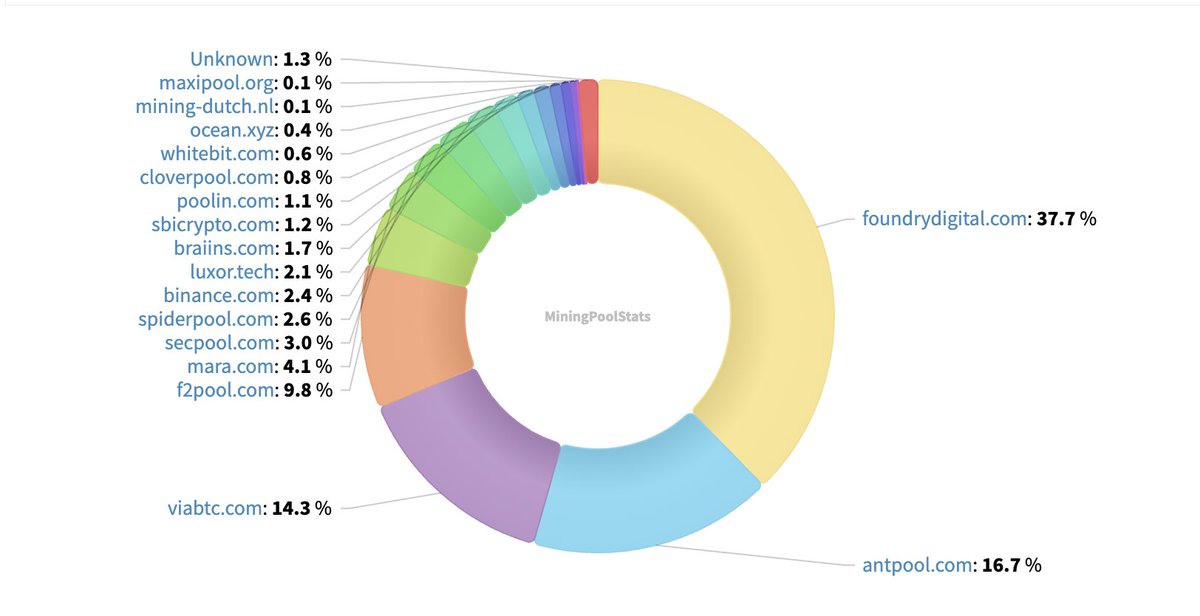
$BTC - 2
$ETH - 2
$BCH - 2
$LTC - 2
$ETC - 1
From my research @KaspaCurrency has the highest nakamoto coefficient of any major crypto network. It's actually difficult for me to get the exact score because major pools only represent about 40% of the network so the rest of the actors needed to combine to 'conspire' a network attack are solo miners in which you would probably need thousands more individuals to collaborate.
Below is Kaspa's hashrate distribution which has a 1000+ score next to Bitcoin's who's score is 2.
The reason to why Kaspa's score is much higher than other POW blockchains and even all of the POS blockchains is due to its block speed. Because kaspa currently has 1 block per second a solo miner is more often likely to hit a block and be able to make an income over time vs. a POW network with less frequent blocks.
Because of this, solo miners do not need to join a pool to make consistent income, and as you can see, they take up a majority of the network hashrate. Due to this, large pool miners distribution % of hashrate is much smaller than on other major proof of work projects - making it much more difficult to conspire an attack and pushing the coefficient higher.
When Kaspa's block creation rate increases 10x this quarter on main-net to 10 blocks per second, solo miners will be able to make an even more consistent income vs pool mining and Kaspa's nakamoto efficient will go much higher, in theory, trending towards infinity.
Kaspa is Nakamoto
CC: @elonmusk@saylor@fgthiel@jack@Grayscale