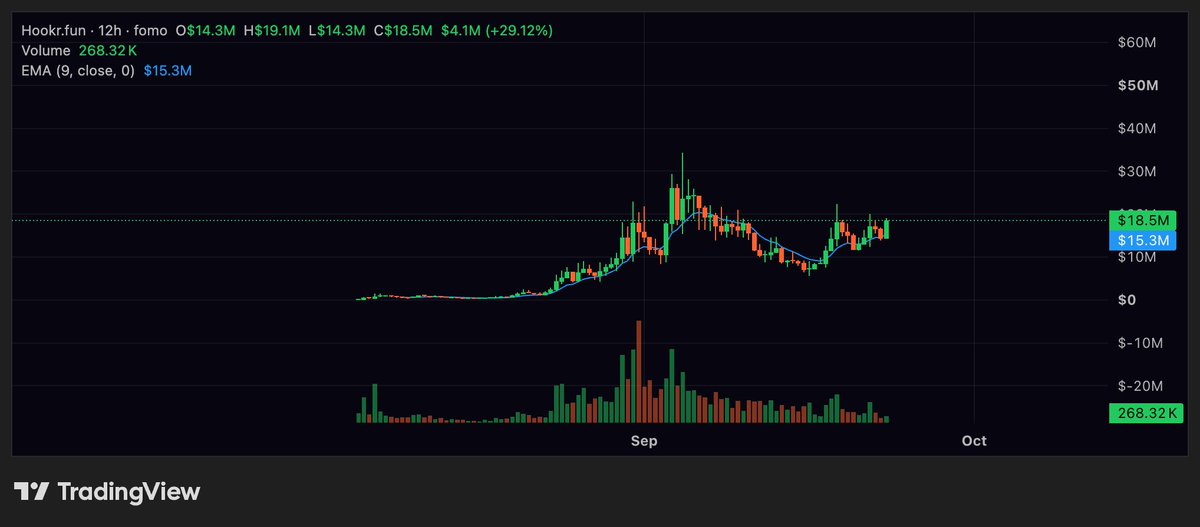
Why I'm so bullish robinhood:0x18e674231a58c239dc7daedcffe15ec3a24cff5c and think it'll trade at 200M+ in the coming months:
First, why do V4 hooks matter?
A Uniswap V4 hook is a contract the pool calls inside every swap. That means a pool can run its own rules: fees that react to volatility, anti-snipe protection, auto burns, LP rewards, MEV protection, limit orders, vesting, and much more.
Every launchpad pool today looks the same. Same fee, same opening chaos, same snipers, same MEV bots eating the value. Hooks change that. The pool's behaviour becomes the product.
The problem: writing, auditing and getting a hook routed is hard. Most teams can't do it. That's the gap Hookr fills.
So, what is Hookr?
Hookr is modular infrastructure for surfacing, composing and integrating Uniswap V4 hooks.
You don't write a hook from scratch. You pick Hook Blocks, tune them per pool, and launch. Or you remix them into a hook of your own.
They already offer 22 'Hook Blocks' and are integrating/building new ones on a weekly basis
(for the different hooks available go check their website, it's pretty fucking sick and game-changing)
And the part people are missing is that you don't have to launch on Hookr to use their tech.
In V4, a pool's hook is fixed when the pool is created. So a token that already trades is normally stuck without one.
Hookr solves it. One launch can open up to 8 hooked pools for a token that already exists, with no migration and no control over the token. Even Robinhood's tokenized stocks can sit in a hooked pool.
And the distribution part is also a big reason why people would want to launch or integrate into Hookr.
On Hookr you get:
> Distribution: every launcher can toggle your block on from the UI
> Revenue: the Hook Blocks Market lets builders publish blocks bonded in robinhood:0x18e674231a58c239dc7daedcffe15ec3a24cff5c, and every swap in a pool using one pays its usage fee
> Routing: Hookr's root hook is on Uniswap's allowlist, so the Uniswap app and API route through it out of the box
> Composability: your block stacks with anti-snipe, dynamic fees, burns and LP rewards on the same pool
That's why for example @whatthehookv4 built their arb recapture on Hookr instead of running it standalone.
It's literally becoming the backend for V4 markets.
More than 95% of trades on Hookr pools happen outside Hookr.
Uniswap, Relay, 0x, KyberSwap, LI-FI, OKX DEX, Velora and PFOF all route robinhood:0x18e674231a58c239dc7daedcffe15ec3a24cff5c flow.
And lastly, their ecosystem coin.
> Hookr never touches the base LP fee. It takes a share of the add-on streams (20% by default, capped at 50%, frozen per pool at creation) plus a cut of arb recapture profit.
> Every one of those protocol shares is swept to the treasury, used to buy back robinhood:0x18e674231a58c239dc7daedcffe15ec3a24cff5c, and burned. All visible onchain at the dead address.
Every new block, every new integrator, every new root profile adds another stream.
More hooked pools means more fees. More fees means more burns.
So tldr of the thesis:
Every liquidity pool on every launchpad will eventually run a V4 hook. The question is where those hooks get built, discovered, composed and routed.
Hookr is setting itself up as that place. Not another launchpad with hooks bolted on, but the distribution layer for the whole V4 hooks meta.
Launch here or plug in later. Either way, the hooked pool ends up on Hookr. And that fuels buyback and burns of robinhood:0x18e674231a58c239dc7daedcffe15ec3a24cff5c.
Generational.
robinhood:0x18e674231a58c239dc7daedcffe15ec3a24cff5c is the back-end/ecosystem for V4 hooks.
A solo hook only gets volume from pools its own team convinces people to open, and from traders who find those pools. Integrating through Hookr plugs the hook into several volume sources at once:
1. Every launch becomes a potential customer. Any launcher on Hookr can toggle a block on from the UI. A solo hook team has to go pitch each project; on Hookr the hook sits in the menu for every new launch.
2. Existing tokens can adopt it too. Normally a token that already trades can't use a new hook, since V4 hooks are fixed at pool creation. Hookr opens hooked pools next to the existing ones, so a hook can reach established tokens with real volume, not just fresh launches.
3. Uniswap routing. The Uniswap app and API only route through allowlisted hooks. Hookr's root already is, so trades from Uniswap's own front end and API can flow through pools using your hook.
4. Aggregators. Relay, 0x, KyberSwap, LI-FI, OKX DEX and others already route Hookr pools. That's where most volume comes from: 95%+ of Hookr pool trades happen outside HookrFun.
5. Other launchpads. Integrators use Hookr's SDK as their backend, so their launches can run your block too.
6. It stacks. In V4, every pool gets exactly one hook address. So if your hook only does one thing, a launcher who picks it gives up everything else: no anti-snipe, no dynamic fees, no LP rewards, unless you build all of that yourself.
On Hookr, your hook becomes a block. A launcher can run it alongside anti-snipe, dynamic fees, auto burn, LP rewards and 20+ other blocks on the same pool.
7. It pays per swap. Through the Hook Blocks Market, every swap in a pool that installs your block pays its usage fee. More pools adopting it means more volume through it means more revenue. Very attractive for hook builders to make their hook available on HookrFun.
Feel like $hookr is akin to $link in terms of integration scale, where protocols and developers are the power users.
Also is a big reason why a lot of people haven’t seen the vision yet. Same exact shit that happened w early chainlink. Infra doesn’t require marketing and attention to thrive, just needs to acquire the architects and the network effect does the rest of the work in due time
TAM seems parallel to a % of DEX + ca deploy revenues on all EVM chains using hooks
p positive we definitely will start seeing a lot of protocols that deal with the two start using the infra as a sort of middleware soon
“Powered by Hookr/x protocol”
The announcement the other day is a tell tale sign
Yep, this is a better way of articulating what I was getting at. My main pushback was against reducing the valuation to any single variable, especially buybacks/burns
as if that alone determines fair value.
VVV is ultimately a mix of several different utility/value-capture mechanisms, and the market will price the aggregate demand for those claims relative to supply. Add in the growth of the underlying AI/inference market and changing expectations around future adoption, and I think the valuation becomes considerably more multidimensional than a simple revenue → buyback → token price model.
@nikshepsv I appreciate the work that went into this, and I think you raise some legitimate concerns. But I also think part of the pushback you’re getting is understandable. You were one of VVV’s loudest bulls for months, repeatedly highlighting many of the same fundamentals that still exist today, then sold your position and almost immediately shifted to a framework that makes VVV look dramatically overvalued and went short.
That doesn’t make the new analysis wrong, and changing your mind when price changes is completely fair. But I think it’s worth acknowledging how abrupt the change in framing is. The bull case focused heavily on Venice’s growth, AI narrative, product adoption, DIEM, staking/token utility and future value accrual. The bear case now seems to reduce VVV much more heavily to current buybacks relative to market cap.
To me, that’s the central disagreement. Your data makes a strong case that price has run much faster than current value accrual. I’m less convinced it proves VVV is fundamentally overvalued, because I don’t think current burns alone capture the economic value of the token, I’m not sure you do either.
The $177 of market cap per $1 of annualized buybacks is a useful metric, and the corrected ~6x comparison with HYPE is worth considering. But that framework seems to implicitly treat buybacks as VVV’s equivalent of earnings. VVV also has staking, DIEM/inference utility, VVV being locked to mint DIEM, future declining emissions and potentially expanding value-accrual mechanisms. Those can create demand or reduce liquid supply without appearing in the current burn number.
DIEM is especially interesting to me. You correctly point out that providing inference has a cost to Venice, but the other side is that obtaining that recurring inference requires VVV to be acquired and locked. If DIEM/inference demand grows substantially, how does your market-cap-to-buyback framework capture that?
I also struggle with using HYPE’s buyback multiple as an implied benchmark for VVV. HYPE has exceptional direct token value capture, but they’re fundamentally different assets with different growth rates, utilities and token economics. Saying VVV trades at ~6x HYPE per dollar of current buybacks is factual; saying that means VVV has ~10 months of “perfect growth” priced in requires assumptions about what multiple VVV should trade at.
And ironically, much of the data in this post still supports the fundamental bull case you spent months making: ~15–20% monthly revenue growth, millions of users, relatively low paid conversion, strong direct traffic, limited marketing and obvious areas where Venice could improve conversion. If those numbers continue compounding, while DIEM/locking grows and Venice increases the percentage of economics accruing to VVV, today’s burn multiple could look very different surprisingly quickly.
I completely agree that the +88% price move, slower burn growth, emissions, vesting sales and leverage create meaningful short-term downside risk. That may be the strongest part of your argument.
But I think there’s an important distinction between “VVV has run ahead of its current fundamentals” and “VVV is fundamentally worth substantially less.”
To me the real valuation question is: How much total economic demand and value can Venice ultimately route through VVV—burns, DIEM, staking/locking, inference and future mechanisms—relative to dilution?
If revenue slows, DIEM adoption disappoints and value accrual remains where it is today, your bear case gets much stronger. If Venice continues compounding rapidly and more of that ecosystem value flows through VVV, valuing it primarily on today’s annualized burns could significantly understate what the token becomes.
I’d be genuinely interested in how you incorporate those non-buyback sources of demand/value into the model.
robinhood:0x18e674231a58c239dc7daedcffe15ec3a24cff5c is one of my cleaner bullish bets on the RH chain and that’s because tokenised stocks need liquidity built specifically for them, not regular AMM pools.
(1) a platform that can add things like compliance pauses
(2) fees that change with inventory
(3) rewards for LPs
(4) trading rules that AI agents can easily read has a better chance of keeping the volume
The potential flywheel will be strongest in my opinion👇
more custom pools → more volume → more fees / retained value → better LP economics → more builders and integrators
I see @Hookrfun becoming the default place to configure those rules which gives robinhood:0x18e674231a58c239dc7daedcffe15ec3a24cff5c a real monetary premium angle.
Yeah, I think that’s a good way to frame it. I’m not arguing that the current numbers don’t matter, they’re obviously useful for establishing what the business/token economics look like today. My point is more that markets rarely value growth assets solely on the current snapshot.
A meaningful part of the VVV thesis is essentially “skating to where the puck will be,” pricing some probability that Venice becomes a much larger player in private AI/inference and that usage, burns, network effects, etc. scale with it.
The interesting question is really how much of that future should reasonably be priced in today. That’s where I think reasonable people can arrive at very different valuations.
Our integration with @whatthehookv4 is already cooking.
At launch we initialized a small ETH/HOOKR pool w. our custom hook. In just a few days this pool retained ~2.5 ETH that would've otherwise been lost to external MEV bots 👀
In total, there were 961 arbs executed out of 3230 trades, which only shows how prominent arbitrage is and why retention is important.
To make things even better, we are now working on a new mechanic for our pool with the @whatthehookv4 team that will focus on trader incentives and bring back the good old DeFi days. You'll want to stay tuned...