Enjoy not knowing.
Not everything deserves your attention. You know where you are heading. You know what you want to achieve. If something lies on that path, learn it. If it does not, let it go.
People who are "productive" are not the ones who know everything, but the ones who know exactly what they do not need to know.
There is a quiet wisdom in choosing what to ignore and maintaining a better signal-to-noise ratio.
Productivity is driven either by curiosity or by fear.
If you think you are highly unproductive, pick up something you are curious about or induce an artificial fear - e.g., deadlines, irrelevance, or failure. It's not always comfortable, but fear can be a powerful motivator.
Doubt yourself every day. Imposter Syndrome is real and essential.
We keep looking for resources to overcome it, but to be honest, there is no real need. I let it hit hard, as it, pushes me to learn more, dig deeper, and explore concepts I would have otherwise overlooked.
But here's the critical part - this self-doubt should not erode your confidence as too much of it can devastate you completely, so you need to maintain a balance. So, every time you solve a problem, fix a bug, or implement a feature, take a moment to acknowledge it and reward yourself.
Remember, even most senior engineers face challenges that they are not equipped to handle. But, the difference is, they use their self-doubt as a push toward new learning opportunities.
Did I ever feel like an impostor in my career? yes; do I feel it today? absolutely. There were moments when I felt like an imposter and thought it was way over my head. But that feeling pushed me to learn more, work harder, and dig deeper.
Remember, the goal is not to eliminate self-doubt but to leverage it to find the growth areas and work on them.
Hope this helps.
Nobody knows what things will look like 4 years from now, and there isn't a single right answer. It is uncertain for everyone. But what I strongly believe is ...
Everyone has a thesis - or at least, it helps to have one - and then act on it in your own way. For example,
- if you think you might not have a job, money-max now
- if you believe SaaS is dead, and you work there, switch
- if you think fintech is going to stay, move closer
- if you think vibe coding tools won't last, don't join one
- if you feel depth beats breadth (or vice versa), go all in
- if you think distribution would be important, build one
You might be wrong - and that's okay. No one gets this perfectly right. What matters is taking the time to think it through and form your own view.
By the way, this is exactly how I made my last career move.
I had a view that fintech would keep growing in importance, and that being close to money movement and financial infrastructure would help me learn faster and stay close to AI (in the areas I care about). That's what led me to join Razorpay.
I could be wrong, and I am okay with that. I would rather make a thoughtful bet than stay unsure.
If you are feeling stuck, you are not alone. Millions are going through the same right now. To me, it often just means you have not formed a clear point of view yet.
Take your time. Build one. Then act.
True, the gap is massive.
I know a 2 YOE guy pulling 1.5Cr+
and even a fresher at 2.4Cr remote role.
And more folks like this in my network.
At the same time, plenty of 8 to 10+ YOE folks stuck at 12-25 LPA in service-based or low-growth setups.
The real differentiators:
- Awareness: Knowing what’s possible (https://t.co/7iINBM9N82, Blind, targeted upskilling in AI/ML/Systems/Quant) and actively job hunting every 1.5–2 years.
- Deliberate effort: Grinding LeetCode/HLD/ system design, building depth in high-demand areas, shipping visible impact, and getting comfortable with interviews.
Luck plays a role (right company at the right time, good manager, market boom), and yes; some high earners lack insane depth but rode the wave well. But the low-salary high-experience group often stays in comfort zones, avoids interviews due to anxiety, or sticks to loyalty in places where raises are 4-8% max.
The original post nails it: switching smartly compounds way faster than tenure in one place. Most people underestimate how much consistent action + market awareness moves the needle.
What has bee your biggest salary jump factor - switching, upskilling, or something else?
A few years back, I was 30 years old and stuck in an MNC doing Linux support work, wasting years on night shifts for a significantly lower salary than I deserved.
I had come from an NIT(reputed college) and was stuck in this level of work while my college mates climbed the success ladder.
Some worked in the US/UK, and others enjoyed senior-level positions at big companies and all the shiny glamour of a successful career.
I was working on a Platform support role, which people looked at with pity(including myself)
I was working the night shift and providing on-call support on weekends.
I had no work-life balance, and my health was getting worse due to lack of sleep.
I was stuck in a horrible comfort zone, scared of the change.
Imposter syndrome and a severe lack of self-worth were constant companions, and I had zero confidence in myself.
To make matters worse, I got married.
I was under a lot of presure financially and started getting panic attacks due to the fear of getting laid off, as I lacked the skills to do anything other than support work.
After many sleepless nights, I realized something.
If you change nothing, nothing will change.
I decided to make a career switch to Devops as it was something related to work I have been doing for years as a Linux and AIX support engineer.
I started researching online about the devops roadmap, and it was no help as all the posts talked about learning a plethora of tools, and learning all of them felt impossible.
So I turned to YouTube to find better guidance for devops and stumbled upon a channel, Techworld with Nana. It was good and gave me some confidence.
I decided to focus on essential tools for devops and mastering them.
One cloud platform: AWS
One infrastructure as code tool: Terraform
Version control tools: Git and GitHub
One CICD tool: GitHub Actions
Scripting: Python
Containers: Docker & Kubernetes
I started deep-diving into the above topics by watching YouTube videos and reading Medium blogs on all these topics.
I followed the resources and did a lot of hands-on work with these tools. I also went through AWS and Terraform documentation.
After one month of hard work, I started getting some confidence.
I realized that I needed to get some real-world working experience.
I spoke to a few of my friends who worked as devops engineers. I asked them about their day-to-day work and the kinds of work they do.
I cut all distractions and removed social media apps. I studied for two months straight until 6 AM daily(12 am to 6 am after work).
My newlywed wife supported me even though I was not giving her any time
I created real projects based on advice from DevOps friends:
- 3-tier architecture on AWS with Terraform
- Deployed Flask apps on ECS with Terraform and GitHub Action
- Some good Python automations
- Lambda functions and S3 management
- Kubernetes microservices deployments
- Kubernetes troubleshooting scenarios
After 3 months, I updated my resume and started interviewing. The first few were brutal, but I kept learning from each rejection.
I also understood that I cannot switch to devops without showing any relevant experience.
I added 2.5 years of devops experience and curated the devops experience using my friend's resumes.
I updated my LinkedIn and Naukri profiles.
After one week, I started getting a lot of calls for various roles around devops.
I crapped my pants in the first few interviews as they asked the question that only an experienced devops engineer would answer.
I did not let it discourage me, as I knew it would happen. I used the questions the interviewers asked and prepared for the topics around them in depth.
After three/four interviews, I started getting better.
Shortly, I received two offer letters from relatively small companies.
I continued giving more interviews and got three more offer letters from reputed companies.
It changed my life completely. I had everything.
A handsome salary with a bunch of great benefits.
Respected designation at a reputed company.
Day working hours, free weekends, and work-life balance.
Confidence, self-worth, and motivation to do more.
I am inspired to take my career to another level.
I used these offer letters and negotiated a good package(2.5x of my current CTC).
My life changed completely:
- Handsome salary with great benefits
- Respected designation at a reputed company
- Day working hours and work-life balance
- Improved health and confidence
If you're stuck in a career that drains your soul, remember: the first step is the hardest but also the most important.
And remember: If you change nothing, nothing will change
This was the start of what I am today.
Best YouTube Channels To Learn AI in 2026 (No BS)
1. Fundamentals – 3Blue1Brown
2. Deep Learning – Andrej Karpathy
3. AI Research – Yannic Kilcher
4. Practical AI – AssemblyAI
5. LLMs – AI Explained
6. ML Theory – StatQuest
7. Papers Simplified – Two Minute Papers
8. GenAI – Matthew Berman
9. AI Agents – Nicholas Renotte
10. Applied ML – Krish Naik
11. PyTorch – Aladdin Persson
12. Math for ML – Serrano Academy
13. Industry Insights – Lex Fridman
14. Real-world AI – DeepLearningAI
As a man, be strong physically, mentally and emotionally!
Build the body.
Build the mind.
Build the discipline.
Because life doesn't go easy on anyone; and no one's coming to save you. Be strong enough to carry your dreams and your failures.
Conquer whatever you set your eyes on.
The goal isn't to be too rich or too famous, the goal is to be able to look up myself in the mirror and know that I never compromised on my ethics and helped people whenever I was capable of.
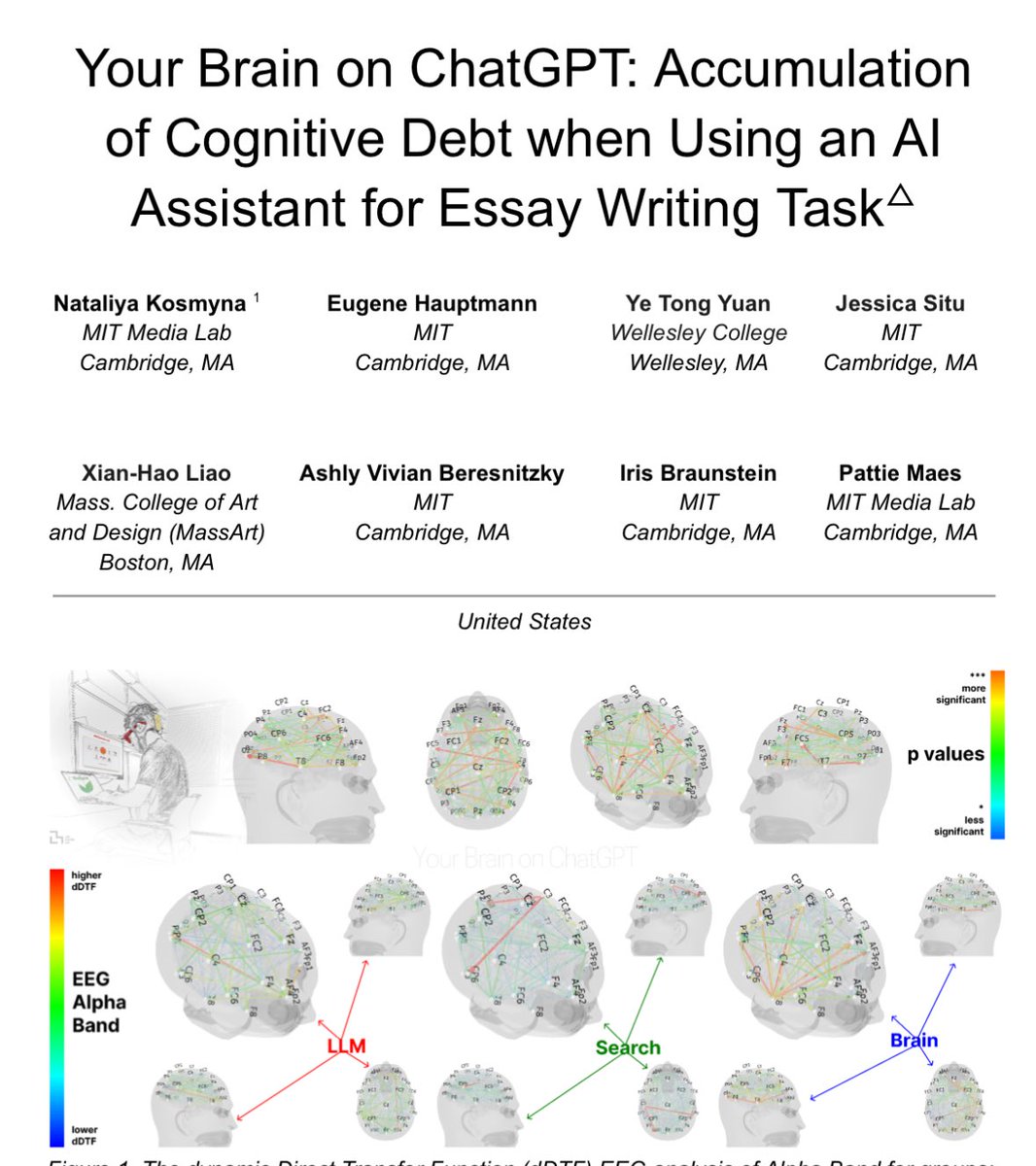
this is in fact true. MIT did a complete research on the effect of AI on your cognitive abilities and i’ve never looked at AI the same way since then:
> LLM use accumulate cognitive debt
> the more you rely on AI the worse you get at thinking without it
> you stop exercising cognitive muscles, they grow weaker, you get lazy
the goddamn thing is worse than narcotics if you really think about it. i hope this research is wrong.
If you don’t feel motivated enough, you should probably take out a day completely to ask fundamental questions to yourself and note down their answers, and try to create 2-3 easy routines to slowly move towards the goals.
Example questions: What do I want to achieve by date X, why is date X so important, why do I really want to achieve this thing, what would change in my life if I work on this thing, what will I miss out on, is the opportunity cost low enough to ignore other things.
The goal here should be to be 100% sure of what, why, when, how. Without this you are just a stupid person doing things that you yourself are not sure of and then you feel miserable everyday.
Example routines: Start your day by doing that thing for just 1 hour everyday, define a focus time of some hours in your day everyday, cut out the low priority stupidity actively everyday, write down the progress towards a goal everyday.
Read this if you are from a tier 3 college or struggling with job opportunities.
There's a reason I always vouch for DSA/CP-- not just to crack a FAANG offer, but to actually build problem-solving muscle. Especially if you're from a tier 3 college, this stuff matters.
It's not just survivorship bias but have seen it play out hundreds of times.
Many of the most active folks in my own discord community were students from tier 3 colleges. Struggling with CP, having big dreams but lacking opportunities.
Today most of them are placed in FAANG or top tech companies! no on-campus, no paid courses. Just pure grind.
For instance every single mod of the community started from scratch. They learned, taught, built with the community-- and flipped their career trajectories.
All without fancy credentials. Just discipline, curiosity, and DSA.
So if you're sitting around blaming your college tag just stop cribbing (I know am gonna get hate for saying these facts).
Tier 3 isn't your barrier. It's just your excuse.
You're far more likely to stick to a hard routine if you write it down and track your progress.
Keeping it all in your head makes it easier for your subconscious to manipulate you-- to delay, to justify, to forget.
Journaling brings structure, clarity, and accountability.
Your discipline deserves a logbook.
Three of my favorite data structures when i was into competitive programming!
---
1. Segment Tree: The Universal Range Tool
While the Fenwick Tree (BIT) is elegant and space-efficient, it has a major limitation: it primarily works for invertible operations like addition or multiplication. If you need to find the Range Minimum Query (RMQ) or Range GCD, a Fenwick Tree struggles.
A Segment Tree is a binary tree where each node stores information about a specific interval [L,R]. The root represents the whole array, and its children represent the left and right halves.
Why it's better: It can handle almost any associative operation (Sum, Min, Max, GCD, Bitwise OR/AND)
The cool fact: With Lazy Propagation, you can perform range updates (e.g., add X to every element from index i to j) in O(logN) time.
---
2. Disjoint Set Union (DSU) & Graph Connectivity
DSU is perhaps the most interesting data structure in CP. It manages a collection of disjoint sets and tells you if two elements belong to the same set.
Core Operations: find(x) (who is the leader of x's set?) and unite(x, y) (merge the sets containing x and y).
Efficiency: Using Path Compression and Union by Rank, the complexity is effectively O(α(N)), where α is the Inverse Ackermann function which is basically constant (less than 5) for any value of N that can fit in a computer.
The cool fact: This is the backbone of Kruskal’s Algorithm for finding a Minimum Spanning Tree (MST). It’s also used to detect cycles in undirected graphs or count connected components in real-time as edges are added.
---
3. Sparse Table: The O(1) Range Trick
If your array is static (meaning no updates, just queries), the Sparse Table is a masterpiece of precomputation. It uses the idea of binary lifting - storing answers for ranges of length 2k.
The Magic: For operations that are idempotent (like Min, Max, or GCD), you can answer any range query in exactly O(1) time by overlapping two precomputed power-of-two ranges.
Precomputation: It takes O(NlogN) to build, which is a small price to pay for instantaneous queries. It is significantly faster than a Segment Tree in practice when updates aren't required.
---
The best things about these data structures is that once you get to understand the workings, you can use the theory in many other adhoc places when deriving the solutions from first principles.
What are you favorite ones?







![0xlelouch_'s tweet photo. Three of my favorite data structures when i was into competitive programming!
---
1. Segment Tree: The Universal Range Tool
While the Fenwick Tree (BIT) is elegant and space-efficient, it has a major limitation: it primarily works for invertible operations like addition or multiplication. If you need to find the Range Minimum Query (RMQ) or Range GCD, a Fenwick Tree struggles.
A Segment Tree is a binary tree where each node stores information about a specific interval [L,R]. The root represents the whole array, and its children represent the left and right halves.
Why it's better: It can handle almost any associative operation (Sum, Min, Max, GCD, Bitwise OR/AND)
The cool fact: With Lazy Propagation, you can perform range updates (e.g., add X to every element from index i to j) in O(logN) time.
---
2. Disjoint Set Union (DSU) & Graph Connectivity
DSU is perhaps the most interesting data structure in CP. It manages a collection of disjoint sets and tells you if two elements belong to the same set.
Core Operations: find(x) (who is the leader of x's set?) and unite(x, y) (merge the sets containing x and y).
Efficiency: Using Path Compression and Union by Rank, the complexity is effectively O(α(N)), where α is the Inverse Ackermann function which is basically constant (less than 5) for any value of N that can fit in a computer.
The cool fact: This is the backbone of Kruskal’s Algorithm for finding a Minimum Spanning Tree (MST). It’s also used to detect cycles in undirected graphs or count connected components in real-time as edges are added.
---
3. Sparse Table: The O(1) Range Trick
If your array is static (meaning no updates, just queries), the Sparse Table is a masterpiece of precomputation. It uses the idea of binary lifting - storing answers for ranges of length 2k.
The Magic: For operations that are idempotent (like Min, Max, or GCD), you can answer any range query in exactly O(1) time by overlapping two precomputed power-of-two ranges.
Precomputation: It takes O(NlogN) to build, which is a small price to pay for instantaneous queries. It is significantly faster than a Segment Tree in practice when updates aren't required.
---
The best things about these data structures is that once you get to understand the workings, you can use the theory in many other adhoc places when deriving the solutions from first principles.
What are you favorite ones?](https://pbs.twimg.com/media/G96TsKlbgAASVPN.jpg)


