Today, we're launching the 2067 Journal, a journal of Canadian consciousness. A new home for serious writing about the country Canada is and what it could be. Politics, philosophy, culture, history. Edited & founded by @BenWoodfinden and @1TrueCuencoism:
https://t.co/5yKsYWeRid
The team’s slogan for the tournament put it plainly: Our Game Now.
But, is it our game now?
A slogan is easy to print and hard to make true.
...The second is a matter of identity: to make Canadians care about the game as something of their own, rather than as something they follow on behalf of the countries they or their parents and grandparents came from.
In my first essay for @2067Journal, I wrote about Canadian's men's soccer. In short, I ask, is it "our game now?"
In many ways it's a microcosm of two challenges Canada faces - building durable institutions, and thick loyalties and identity. This is what's needed to make the game our own, and it's a lesson writ large about the Canadian experience not just in soccer or sports, but across all sorts of industries and facets of our national life.
For this World Cup, Canada chose the slogan "Our Game Now." But is it our game now? This week, co-editor @BenWoodfinden writes about what men’s soccer tells us about the challenges of building institutions and national identity in Canada.
https://t.co/hDU2Ie8EEP
Michael Cuenco’s (@1TrueCuencoism) Confederation as Useful History" is exactly the kind of essay we started @2067Journal to publish, with more on the way. See his thread below on the essay here and the link. Head over to the site and subscribe for free to get essays in your inbox (my first piece will be out tomorrow).
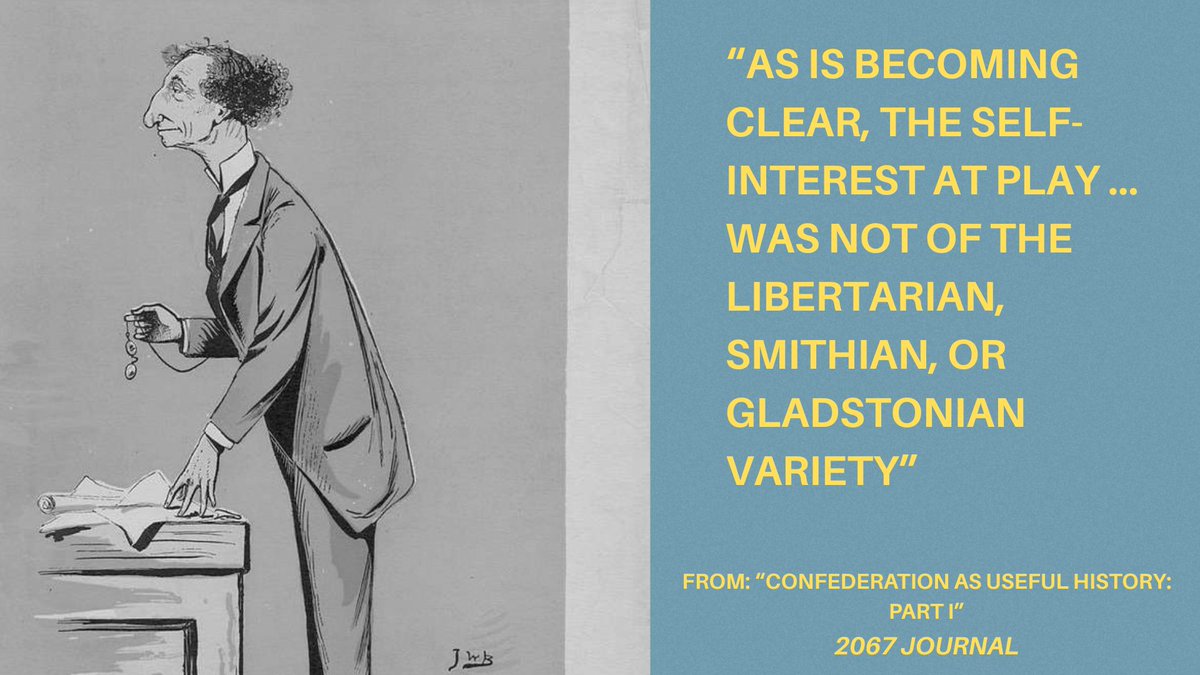
Most Confederation history in this country is either a prosecution or a parade. The prosecution treats 1867 as something to apologise for and move past, a founding with nothing left in it worth keeping. The parade version leans on Macdonald as a stand-in for the whole project, which is fine as far as it goes, but it tends to leave out the mess: the patronage, the City of London debt, the sheer improvisation that got the thing built at all. Cuenco isn’t interested in either. He reads the Fathers as what they were, ambitious, practical men trying to build a country with no guarantee it would hold together, and that’s a harder story than either side usually tells.
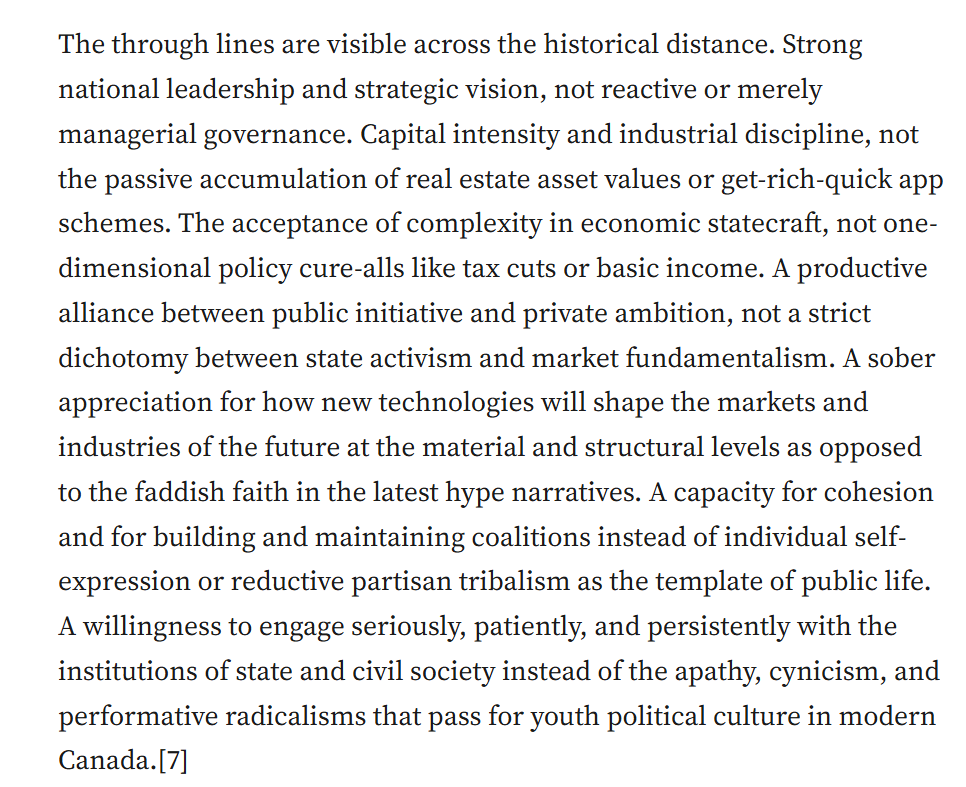
But it's not just an essay about historiography, there is a very important generational argument here as well. Cuenco draws the line straight from the pre-Confederation colonial class, young, underemployed, boxed in by an old order that had stopped delivering, to young Canadians right now looking at a country that isn’t holding up its end of the bargain either. The Fathers didn’t inherit a nation. They built one because the alternative was watching things drift.
Part II, on the country the Boomers built out of that founding and what it cost, is coming.
Young Canadians have been taught to see Confederation as a crime, a symbol or nothing at all. But the parallels between that generation and frustrated young Canadians today are striking. It's time for them to recover this history, writes @1TrueCuencoism
https://t.co/hbxPEYGhvY
McLuhan replied to someone who said TV didn't affect him because he didn't own one: "You merely suffer the consequences of TV without enjoying it." That was the 1960s. The same goes for smartphones, social media, and AI, writes @Andrey4Mir:
https://t.co/lBtsWs0dOJ
Peter Dormaar went to speak at Calgary city hall in favour of the city's rezoning and got shut down before he finished. So he went and tracked who actually shows up to oppose housing and why they look nothing like the cities they claim to represent.
https://t.co/gHDLTlBiA3
For your weekend reading, check out @Andrey4Mir fantastic essay on Marshall McLuhan. We mostly remember McLuhan for one line, the medium is the message, and leave it at that. Mir suggests this is a bit of a misunderstanding, and that McLuhan never really fit the television age he was writing in. Instead, he fits our present and future moment much better.
In 1964, McLuhan described the final extension of man as "the technological simulation of consciousness." He was talking about electric media, but it’s hard right now not to read this a description of AI.
Or take the global village: “But television only made people watch the same news together. Social media took it much further by exposing people not just to the same news but directly to one another. That is real village life on a global scale: everyone watching, judging, and reacting to everyone else in real time. McLuhan’s “Global Village,” which was only a metaphor in the TV era, has come to life in social media feeds.”
McLuhan is more relevant today than he ever has been before, and at @2067Journal we will be publishing frequently essays that draw on McLuhan’s thinking.
Grasping the idea of extension, you can’t help but come up with strikingly McLuhanesque conclusions.
A rocket ship is the ultimate extension of the foot, and the nuke is the ultimate extension of the fist.
Is AI the ultimate extension of humankind? (The answer is “yes.”)
https://t.co/aXoaxgaaiM
Most of us think in McLuhan’s terms without even realizing it. For example, it was hard to analyze the effects of television separately from the content of TV shows. But now nearly everyone sees that social media polarize users regardless of the specific content circulating there. It’s the algorithmic maximization of engagement, not the content, that drives polarization. That’s what “the medium is the message” means.
1/3
Two-thirds of Canadians are homeowners. Principal-residence assets dwarf every other form of non-pension wealth. The people who benefit from housing scarcity are the same ones who show up to entrench it, writes Peter Dormaar.
https://t.co/gHDLTlBiA3
McLuhan’s ideas were too advanced for the television age. They were built for ours. He described “the technological simulation of consciousness” in 1964 — sixty years before we built it and called it AI, writes @Andrey4Mir.
https://t.co/lBtsWs0dOJ