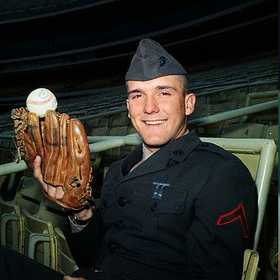
Leo Lomski dies on November 12, 1975.
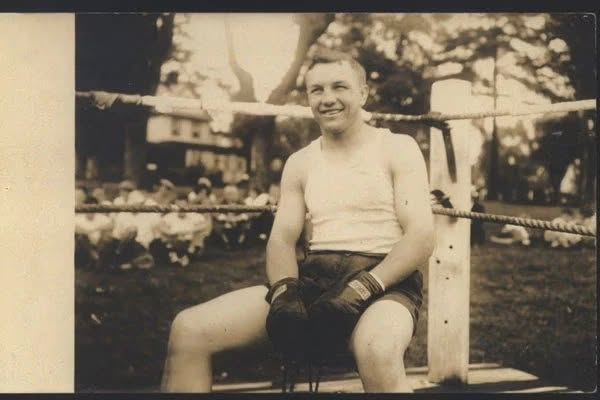
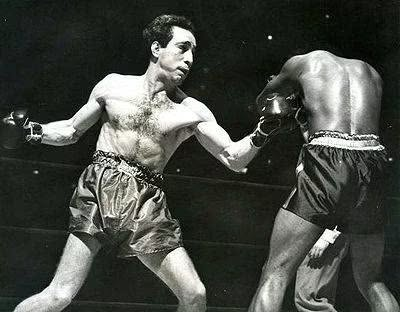
Leo Lomski is the original hard-luck fighter, perhaps, having come oh-so-close to capturing the glory of winning a championship belt only to fall just short.
Fate would have it that Leo Lomski would never become a world champion, but he came about as close as any man could have on the 6th of January in 1928, when he had Light Heavyweight Champion Tommy Loughran down for two 9-counts in the 1st round at Madison Square Garden.
Lomski would floor Loughran early in the opening round and, mindful of the recent Tunney-Dempsey long count incident, he would collide with the referee while beating a hasty retreat to a neutral corner.
The referee later admitted that Loughran had been on the canvas for well over ten seconds before getting back on his feet.
The challenger would immediately deck Loughran again but disaster had struck; Leo Lomski had broken his right hand during his first round onslaught.
Lomski later related that he felt his hand "crunch" when he dropped Loughran the second time in that opening round.
Lomski managed to finish the bout but Loughran, who'd courageously rode out the opening round storm, would retain his title via 15-round UD.
After that bout, Loughran said that Lomski was the "toughest man I have ever fought."
To Lomski's chagrin, he and his manager Eddie Eicher clamored for a rematch but Loughran refused to again risk his crown against the fists of the "Aberdeen Assassin", even despite a Ring magazine editorial penned by editor and owner Nat Fleischer that Loughran should give the deserving Lomski another title shot.
Maxie Rosenbloom would soon hold the Light Heavyweight Title (he and Lomski had gone 2-2-2 against each other by then) and never gave him a shot despite Lomski having had wins over Jim Braddock, Tiger Flowers and Rosenbloom.
103-27-16 with 40 KO's, Leo Lomski would become a Merchant Marine after his boxing days ended and, upon his death in 1975, his ashes were reportedly scattered at sea.
Poster for the Joe Bugner-Jimmy Ellis heavyweight bout, at the Empire Pool in Wembley, held on November 12, 1974.
Bugner wins a 10-round points decision.
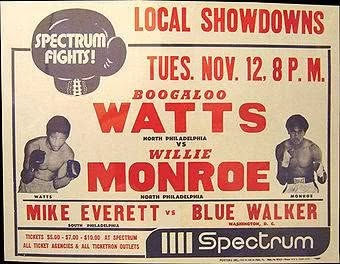
Bobby "Boogaloo" Watts wins a 10-round unanimous decision over Willie "The Worm" Monroe, on November 12, 1974 at The Spectrum in Philadelphia.
"I waited too long to get started and you don't do that with a good boxer. You don't start out too late. You have to start out fast." said Monroe in the post-fight.
The UPI report on this bout read:
"Bobby 'Boogaloo' Watts said he was scared in the opening round Tuesday night, but he began to ease up as he upset Willie 'The Worm' Monroe with a 10 round unanimous decision in a middleweight contest. "I was scared and tense," Watts said after both Philadelphia middleweights started out with right and left exchanges. But Watts erupted with rights and lefts to gain control of the match. Watts got Monroe with a short right to the nose causing it to bleed. In a last effort in the 5th round Monroe tried to knock out his opponent but lacked the power. Monroe stayed with Watts until the 8th when he caught a left hook cutting him above the right eye."
Monroe had been unbeaten (9-0-1) in his past ten fights and would rebound from this loss with five straight wins, including a 10-round UD over Marvin Hagler, before losing again.
Watts, who went to 26-3-1 with the win over "The Worm', was in the midst of his own win streak, thirteen in a row, that also included a decision over Hagler.
Ironically, both Watts and Monroe would have their winning streaks ended by a boxer named David Love out of San Diego, a fighter known for his frequent use of the lead right hand; "Now a fighter isn't supposed to lead with the right all the time like David does. But he's so darn fast, he can get away with it. He has the fastest right hand for a middleweight I've ever seen." said Angelo Dundee, Love's manager, after his 1977 TKO of Watts in the infamous Don King USBA Boxing Championships. Love had also TKO'd Monroe in his previous bout, stopping both quality middleweights in the 4th round which makes his 32-21-1 (12 KO's) career record, factor in that Love also decisioned another Philly bruiser, Bennie Briscoe in 1979, all the more puzzling. And, of course, we will get into David Love at a future date.
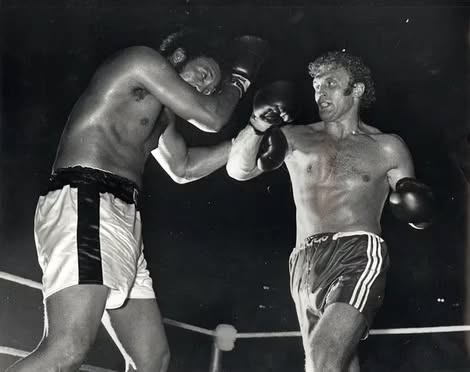
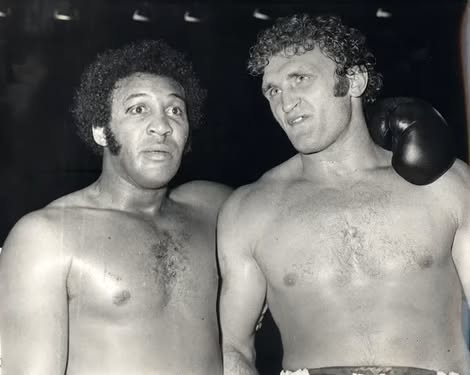
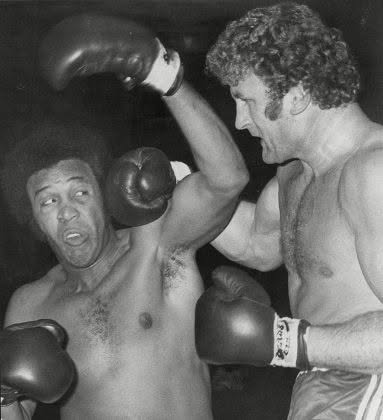
Joe Bugner wins a 10-round points decision over former WBA Heavyweight Champion Jimmy Ellis, at the Empire Pool in Wembley, on November 12, 1974.
From the AP:
"Britain's Joe Bugner, the European heavyweight champion, fought to a grueling 10 round decision over former WBA titleholder Jimmy Ellis of Miami, Fla., at Wembley Pool Tuesday night. Bugner was looking for an impressive win over 34 year old Ellis in order to gain a shot at Muhammad Ali's crown. Bugner scored a 100-96 victory on British referee Sid Nathan's card after dropping Ellis midway through the last round. Ellis was floored by a vicious right to the body. he got up before the count started."
"Bugner is a good, rough, tough fighter. Some guys would have been finished after taking the Sunday punch I landed in the 1st round. But Bugner kept going and I've got no complaints." said Ellis in the post-fight.
This was Ellis' third loss in four fights; he'd dropped decisions to Boone Kirkman and Ron Lyle, and fought a draw with Larry Middleton, preceeding this bout. He'd fight only twice more, being stopped in nine rounds by Joe Frazier in March of 1975 before retiring following a 1st round KO of Trinidad & Tobago's Carl Baker in May of that same year.
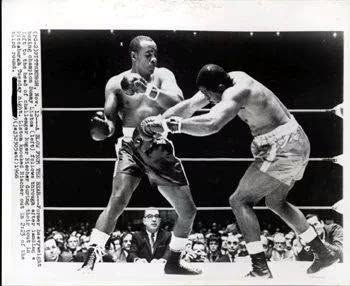
Former Heavyweight Champion Sonny Liston (left) continues his winning ways, scoring his 11th straight win since "The Phantom Punch" rematch with Muhammad Ali in Lewiston, Maine with a 3rd round KO of Roger Rischer on November 12, 1968 at the Pittsburgh Civic Arena.
From Pittsburgh News accounts:
"Sonny Liston, former world heavyweight champion, bombed Roger Rischer out at 2:23 of the 3rd round Tuesday night in a nationally televised benefit fight. The victory was Liston's 43rd and 11th straight in a comeback he hopes will net him a match against either Jimmy Ellis or Joe Frazier. It appeared a question of only when Liston would win, even as the two fighters listened to referee Buck McTiernan's pre-fight instructions. Rischer, squirming, bobbing and weaving, got himself caught against the ropes in the 1st round and Liston deposited him on the canvas with a right uppercut. In the 2nd, Rischer back-pedaled away from Liston then stopped quickly, popped an overhand right and left hook to Liston's face. Liston then backed Rischer against the ropes in the 3rd round and dropped him for the count with a left hook to the body."
"A quick knockout." -Sonny Liston's post-fight reply, when asked what he saw in Rischer's eyes during the pre-fight instructions.
On October 26, 1970, Roger Rischer, out of Oakland, 29-11-2 as a pro, was shot five times in an Oakland hotel and died a few weeks later in the hospital. He was shot four times in the back and once in the head. Rischer's last fight had been a 4th round KO loss to Mac Foster in January of 1969. He had losses to Archie Moore, Eddie Machen, Zora Folley, Cleveland Williams and Thad Spencer, among others, but had a decision win over Henry Cooper in 1964.
Program for the Billy Walker-Thad Spencer heavyweight bout, held on November 12, 1968 at the Empire Pool in Wembley.
Spencer, continuing his stunning spiral out of contention; he'd once been the favorite in the eyes of many to win the WBA Heavyweight Title Elimination Tournament, is stopped, via TKO in the 6th round, for the third of four consecutive times following his 12-round UD win over Ernie Terrell in August of 1967 in the tournaments opening round of fights.
The AP, which had the bout scored 4-0-1 in rounds for Walker at the time of the stoppage, would report:
"Billy Walker, 29 year old British heavyweight, stopped Thad Spencer of San Francisco in the 6th round of a scheduled 10 rounder Tuesday night with a fiery flurry of right hand punches. The crowd of about 8,000 at London's Wembley indoor stadium cheered as the Briton hammered away from the start and had the 25 year old Spencer staggering around the ring. British referee Roland Dakin stopped the fight after 2:04 in the 6th round to save Spencer from further punishment."
"Spencer didn't have anything, no reflexes, no nothing." said Willie Ketchum, Spencer's manager, in the post-fight.
From Boxing Report on the stunning fall of Thad Spencer, once a favorite to claim the WBA Heavyweight Title:
A series of impressive victories over contenders Amos Lincoln, Doug Jones, and Billy Daniels landed Spencer in the heavyweight elimination tournament following Muhammad Ali's problems with the United States draft board in 1967. In August 1967 he met former WBA World Heavyweight Champion Ernie Terrell in the opening round of the tournament. Spencer shocked the boxing world with a one-sided 12 round decision over the favored Terrell. In the 2nd round, Spencer's lightning combinations even sent the 6 foot 6 inch Terrell to the canvas. Spencer became the toast of the boxing world. He was trained briefly by former World Heavyweight Champion Joe Louis. Louis picked Spencer, as did most experts, to win the WBA elimination tournament.
Spencer was rated Number 1 by the WBA and Number 2 in the world by the The Ring magazine. He was featured on the cover of the November 1967 issue of The Ring.
During his training in early 1968 for his fight with Jerry Quarry in the semi-finals of the WBA Tournament, Spencer was arrested for a "driving problem." Spencer, a 6-to-4 favorite, was easily defeated by Jerry Quarry, losing via TKO at 2:57 of the 12th and final round. Ketchum blamed Spencer's upset knockout loss to Quarry on a "lack of training and proper conditioning."
Spencer claimed he was then going to rededicate himself to his promising career. At 25, and rated 5th in the world, experts still believed he could capture the vacant title.
Spencer traveled to England in the Spring of 1968 to fight the Number 9 rated Eduardo Corletti. However, Corletti suffered a sprained ankle, and the Number 10 rated Leotis Martin came in as a substitute. Again, Spencer was the favorite, but in the very first round was decked for a 3-count. Things got worse, and by the 3rd round, Spencer had lost his speed. He rebounded in the 8th round to cut Martin's eye, but Martin came out in the 9th to knock out Spencer in yet another shocker.
Spencer tumbled to 8th in the world. His backers claimed a party-lifestyle was ruining Spencer's promising ring career. Spencer brushed aside his critics and signed to fight Billy Walker and Mac Foster. Against Walker, Spencer came out flat-footed and decided to slug it out with a fighter noted for slugging. It proved his downfall, and by the 6th round, the fight was halted. A dejected Willie Ketchum told the world press: "What's the use, it's not there anymore. Fast living has caught up with Thad, and he knows it now."
Spencer went on to meet undefeated former marine Mac Foster, who was 17-0 with 17 knockouts. Thad Spencer still had a name and set a Fresno record, when 5,100 fans paid $29,718 to see his bout with Foster on May 20, 1969. Again, Spencer decided to slug it out, and after being rocked several times, he was knocked out by a left hook to the temple in the first round.
The loss to Foster ended Thad Spencer's days in big-time boxing. Manager Ketchum left him, and Spencer found himself traveling about the U.S. and South America, picking up fights where he could. He dropped decisions to prospect Tony Doyle, and was destroyed in two rounds by heavyweight hope Jose Luis Garcia in October 1970, who was then managed by Spencer's old manager, Willie Ketchum.
Spencer ended his career losing 10-round nods to future heavyweight challenger Ron Stander and Tony Doyle in 1971.
In the mid 1970s, any hopes Spencer had of returning to the ring were ended when he was twice wounded in separate shootings. He survived, but disappeared from the fight scene. He reappeared at a Muhammad Ali get-together, and later went into promoting in California and Vancouver, Washington in the 1980s and 1990s.
Thad Spencer never became world heavyweight champion, but for six months in 1968, he was the #1-ranked heavyweight contender in the world.
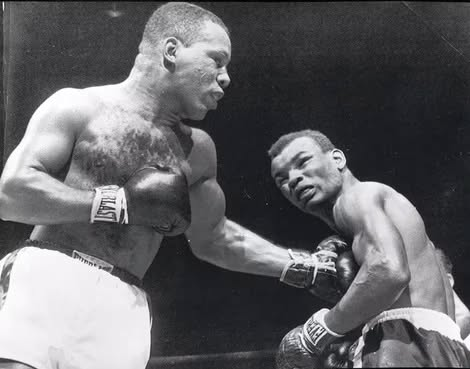
Middleweights Ralph "Tiger" Jones (left) and Hector Constance (22-5-7 coming in) meet on November 12, 1954 at Madison Square Garden with Jones scoring a 10-round UD win.
Constance, out of Trinidad & Tobago, once promising, would finish his career at 34-40-14, and soon fade into opponent status and dot the resumes of many 1950's and 60's era welterweight and middleweight contenders.
Ralph "Tiger" Jones, no easy touch for any middleweight out there, fought almost every name middleweight of his era, and also defeated Johnny Bratton, Bobby Dykes, Joey Giardello, Charles Humez (on a disputed decision), Chico Vejar, Kid Gavilan, and Rory Calhoun, among others. The biggest was his stunner over Sugar Ray Robinson in January of 1955. His win over Dykes was spectacular, in that he was well behind on points, but came back to floor his opponent twice in the tenth round and stop him.
52-32-5 for his career, with only 13 KO's, Jones would suffer losses to Rocky Castellani, Johnny Saxton, Kid Gavilan, Joey Giardello, Bobo Olson, Gene Fullmer, Charles Humez, Del Flanagan, Paul Pender, Rory Calhoun, Joey Giambra and, in his last career fight, to three-time Olympic Gold Medal winner (1948,52 & 56 who was also undefeated as a pro at 27-0-2) Laszlo Papp in 1962.
Not a big puncher, Jones had a fan-friendly, aggressive style, with smooth defensive moves also at his disposal. He was only stopped once in his 89-fight career, in his 10th pro fight by a fighter named Henry Burroughs, who Jones had previously decisioned, on cuts despite facing six world champions during his career and just about every middleweight in the top ten for a decade.
Jones was managed by Bob Melnick and trained by Gil Clancy.
Undefeated Gil Turner (24-0-0 coming in) TKO's Bernard Docusen (on cuts) in the 6th round at Philadelphia Arena on November 12, 1951.
The Associated Press reported:
"Gil Turner won his 25th and most convincing triumph of an unbeaten career last night when he threw so many punches at Bernie (Big Duke) Docusen, the clever little Filipino decided discretion was the better part of valor and quit in his corner. Docusen told ringside physician Dr. W.G. Terry he had had enough. Docusen, who won the 2nd round, stood in the center of the ring and matched punch for punch with Turner for a while. So much leather was tossed that you couldn't keep track of the punches. But the Big Duke, bleeding from a closed left eye and a slashed right eye, soon tired of being hit and called it quits."
Sid "Straitjacket" Peaks (pictured with his manager, Dutch Reese) loses a 10-round unanimous decision to the still dangerous Jimmy Bivins, at Chicago Stadium, on November 12, 1947.
The AP report on this bout read:
"Jimmy Bivins, cagey heavyweight veteran of Cleveland, although outweighed 24 1/4 pounds, hopelessly outclassed heavyweight newcomer, Sid Peaks, Charleston, Ind., in their 10 rounder. Peaks, with a record of six consecutive knockouts against minor opponents, was too inexperienced for Bivins' speed and ring shrewdness. Peaks spent most of the time after the 4th round with his long arms wrapped around the shorter Bivins in a protective clinch."
The young and talented Peaks will rebound from his loss to the wily veteran and, then, just as quickly, fade away into boxing obscurity (though he will never be forgotten here at 20thCB:IM&M).
From the Louisville Courier-Journal of March 24, 1948 on heavyweight prospect Sid "Straitjacket" Peaks:
John Roxborough, manager of Joe Louis, present champion, stated that "Peaks is the fellow who, in three soft exhibitions, softened up the champ for Joe Walcott."
Manny Seamon, then Louis' trainer would add in that same article that "Peaks is the best looking prospect I've seen."
So, you may ask, how did a guy considered the best looking prospect in the division in early 1948, coming off of TKO wins over the likes of Lee Q Murray and Johnny Shkor, fall virtually off the map like Sid Peaks did?
It's hard to figure other than bad management as Peaks was put in with very capable guys like Colion Chaney (who'd go on to train future light heavyweight titlist Marvin Johnson), Bivins and Murray before his 20th pro bout. That same 1948 Louisville Courier-Journal article references Peaks contract being bought out by a Louisville management group led by Paul Karem.
Paul Karem was a powerful businessman and also a sportsman that helped build Louisville into a noted boxing town, sponsoring young golfers and other athletes, and was best buddies with the likes of Bear Bryant. After his death the 'Best Fighter' in the Golden Gloves received the ‘Paul Karem Award’—one of the winners being a kid named Cassius Clay.
Things just appeared to go off the rails for Sid Peaks after his 2nd round TKO of the aforementioned Johnny Shkor in May of 1948.
He'd drop a 10-round decision to Colion Chaney for the Indiana State Heavyweight Title in his next bout and, then, get KO'd twice in a row by Rusty Payne. Payne's career would soon freefall, as well, and we have gone over him before here.
Sid Peaks would reel off a few wins following the two devastating losses to Payne, but his time had come and gone as Ezzard Charles, Joe Walcott and Joey Maxim had ascended in the rankings right by him. A KO loss to a spent Elmer "Violent" Ray, Ray wouldn't win another bout, and a decision loss to Kid Riviera followed; and though Peaks rebounded somewhat, scoring wins over Murray and a finished Jimmy Bivins in 1950, a 5th round TKO loss to a young, undefeated (14-0) Bob Baker in May of 1950 put an end to any miraculous rescuscitation of the career of Sid Peaks.
Going 10-8 in his final eighteen bouts, Peaks would finish his career filling out the resumes of Harold Johnson and a young (then 11-1-0) Ernie Terrell in 1957-58. In a remarkable collapse, Peaks went 18-20 after his big wins over Murray and Shkor in 1948.
Once considered the "best prospect" in the heavyweight division, Sid "Straitjacket" Peaks would finish his career at 42-20-0 with 35 KO wins.
In the kind of matchup between solid, veteran, contenders that we rarely (if ever) see these days, as managers and fighters rarely take even the slightest chances any more, lightweight Allie Stolz (left) wins a tough 10-round unanimous decision (the fight went to supplemental scoring - meaning the ref had it a draw) over Willie Joyce, on November 12, 1945 at MSG.
Joyce, 63-14-8 coming in, had been the 1939 National AAU Champion at Bantamweight. During his excellent career, Joyce won bouts with world champions Lew Jenkins, Leo Rodak, Henry Armstrong, Ike Williams, Chalky Wright and Jackie Wilson. He fought for the World Junior Welterweight title twice, losing 12-round unanimous decisions to Tippy Larkin in 1945.
Stolz, 60-8-2 coming in, also fought twice for world titles in his career. He lost one in 1942, to Sammy Angott, in a very highly disputed decision and the other, in the final fight of his career, on a 13th round KO to Bob Montgomery in 1946.
Joyce would turn the tables in 1946, winning a 10-round split decision over Stolz, also at MSG.
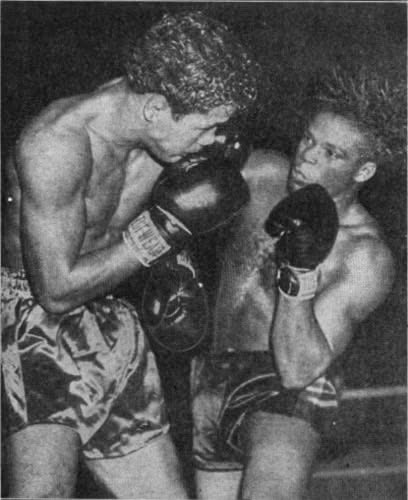
Jake LaMotta (left) wins an unpopular 10-round split decision over an aging Fritzie Zivic, on November 12, 1943 at Madison Square Garden.
The United Press scored it, unofficially, 6-4 for Zivic while AP saw it 6-4 for the 'Bronx Bull'.
From the UP report:
"Ancient Fritzie Zivic may be rematched today with Jake LaMotta, who won an unpopular split decision over Fritzie last night in their 10 round 'rubber match' at MSG. Promoter Mike Jacobs would like to toss them into the Garden ring again on Dec. 17 to satisfy the fans who witnessed last night's brawl, and who voiced their disapproval of the verdict with lusty booing. Zivic had complete command in the first half of the fight, giving LaMotta a boxing lesson in most of the first five heats. But Zivic tired in the later going and his younger, heavier opponent came on with a persistent body attack to win 4 of the last 5 sessions. There were no knockdowns but Fritzie staggered LaMotta with a straight right to the chin in the 3rd. Jake had Fritzie on wobbly pins in the 7th, after landing a hard left hook to the body and a right to the face. LaMotta suffered a gashed left brow in the 3rd round and Zivic had an old cut reopened under his left eye in the 7th."
They'd rematch in January with LaMotta winning a 10-round UD in Detroit.
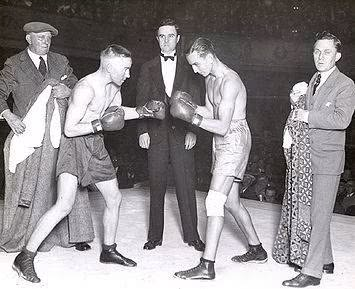
Jimmy McLarnin (left) and Jackie Fields square off, on November 12, 1925 at the Olympic Auditorium in Los Angeles, before the "Belfast Spider" (McLarnin) scores a 2nd round KO in a scheduled 10-round featherweight bout.
The Fresno Bee will report on this bout:
Fields had a good first round, having an edge over McLarnin. In the 2nd, McLarnin caught Fields with a right to the chin, that spun him around and down against the ropes. Field rose, but he was knocked down three more times by right hands. Fields was out on his back while being counted out, and remained there for five minutes.
Fields (5-0-1 coming in) is handed his first defeat - following an amazing amateur career that was capped by his winning of the Gold at Featherweight in the 1924 Olympic Games at the age of 16 - of a great pro career that will see him capture the Welterweight Title two times.
Born Jacob Finkelstein, Jackie Fields had competed in the pre-Olympic AAU Nationals in 1924. In his earlier days as an amateur in Los Angeles, he had been tutored by Jack Blackburn who would later go on to great fame as the trainer of Heavyweight Champion Joe Louis.
Despite a broken hand, he reached the semifinals and a place on the Olympic team as an alternate. On the boat ride to the 1924 Summer Olympics, Fields defeated two other Olympic candidates to make the team.
He was only 16-years-old when he captured the Olympic Featherweight Gold Medal, the youngest athlete ever to win an Olympic boxing gold.
But everybody has a Mom, and when young Finkelstein got home from the Olympics his mother actually spanked him for stepping into a boxing ring. Jackie Fields' Olympic triumph was made into a 1939 movie called 'The Crowd Roars' for you old film buffs.
From Fields Bio:
In July 1929, Fields faced defending champion Joe Dundee for the world welterweight title, and won the match after Dundee fouled him with a 2nd-round low blow. Fields totally dominated the abbreviated fight. He floored Dundee once in the first round and four more times in the first part of round 2. After the fifth knockdown in that round, "Pal Joey" crawled across the ring on his hands and knees until he got right in front of Fields and sucker punched him in the groin. Fields nailed the issue succinctly: "That bum and his buddies had bet money on the fight." Dundee knew he was a goner and he also knew if the fight ended on a foul, all bets were off.
In May 1930, Fields lost the title to Jack Thompson in a 15-round fight. Fields retired after the fight, but returned to the ring two years later fighting for the welterweight world title against Lou Brouillard, who had won it from Thompson. Fields regained it, winning in 10 rounds, in January 1932.
In 1932, he was involved in a car accident from which he suffered a detached retina and lost sight in one eye, although he did not tell anyone about it at the time.
In February 1933, Fields lost the title in a 10-round decision to Young Corbett III in San Francisco. The referee, Jack Kennedy, admitted to Jackie's manager Jack Kearns after the fight in the dressing room: "I made a mistake," and told him he had raised the wrong hand. Kearns hit Kennedy, sending him sprawling to the floor and knocking him out.
Fields fought only one bout after his loss to Corbett, because his eye injury had become too troublesome.
He retired with a professional record of 74 victories (31 knockouts), 2 draws, 9 losses, and 1 no-contest.
(Me: boxrec lists Fields record as 72-9-2 with 31 KO wins)
In 1996 Fields was inducted into the Southern California Jewish Sports Hall of Fame making him yet another fine champion of the past (it's just a plain disgrace how many greats the IBHOF has ignored) that the IBHOF has not rightfully honored.
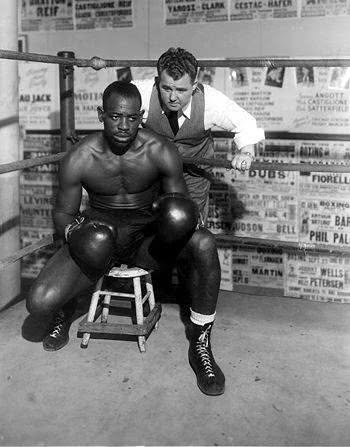
One could reasonably argue that on November 12, 1917 two of the greatest heavyweights to ever step between the ropes, Sam Langford and Harry Wills, met at the Toledo Coliseum in Ohio.
And if you had a buck and a dime you'd have been lucky enough to get a ticket.
They were certainly two of the best, if not THE BEST, boxers to (unfairly) never fight for the Heavyweight Championship of the World.
On this day in 1917, they met for the World 'Colored' Heavyweight Championship and they fought to a 12-round draw.
They were no strangers to each other. For back in the day and age of the 'color bar' no Heavyweight Champion, not even Jack Johnson, had chosen to meet either of them for the world title.
Wills had already decisioned Langford twice in 1917; a 6-round newspaper decision in Philadelphia in May, and a 10-round decision for "The Black Panther" (Wills) in September in Brooklyn, New York for the title.
They had also met four times in 1916, three decisions going to Wills and Langford scoring a `19th round KO to capture the 'Colored' title.
With all the rightfully deserved praise for Langford, the fact is that Wills got the better of him in their 22-fight rivalry, going 6-2- with 14 no decisions (often times in that era decisions were not allowed).
To be fair, Langford was already 15 years into his legendary career by 1917 while Wills was just approaching his prime.
After losing on a 7th round TKO to Battling Jim Johnson in February of 1917, Harry Wills would go over five years without a loss, not getting a world title shot despite clearly being the best heavyweight in the world without a title belt.
He beat both Langford and Sam McVea twice each in 1918, stopping McVea in both bouts, then added wins in 1919 over Langford again, Joe Clark and the great Joe Jeannette.
In 1920, Wills would TKO one-time top-rated challenger to Jack Dempsey (and Jess Willard) Fred Fulton (who also never got a title shot) in three rounds.
Wills first loss in five years would occur in early 1922 when he was DQ'ed for hitting journeyman Bill Tate (19-25-3) on the break in the 1st round.
It would be 1926 until Wills lost another fight, now past his prime, on a DQ against Jack Sharkey in 1926, making his record 49-1-3 since the loss to Johnson in 1917 (the only loss on that DQ).
It's one of the great injustices in heavyweight history, indeed in the history of the sport, that Wills was not allowed to challenge for the world title.
History buffs, note that Wills is referred to as the "Bear Cat" on this poster. I've never read of him referred to by that nickname in my own searches for info.
----------------------------------------------------------
There's been a lot of speculation, and innuendo, over the years about just why Dempsey-Wills never came off, but I'll rely on one of my favorite sources, from The Fight City, written by Sean Crose in 2023, for their take on what may have been a great World Heavyweight Title fight:
Back during that awful time when for five long years it seemed Floyd Mayweather and Manny Pacquiao would never, ever meet in the ring, pundits and historians mused as to whether “MayPac” might be the biggest potential fight in boxing history to never materialize. Of course it did materialize and then many of us wished it had not, but in truth, if it hadn’t, it would have simply joined a long list of great matches that failed to take place. For example, what might have happened had iconic heavyweight champion Jack Dempsey and longstanding top contender Harry Wills ever clashed we will never know. Dempsey vs Wills will forever be the heavyweight superfight that never was.
Safe to assume it would have been one hell of a battle. Yet Dempsey was almost modern in his inactivity. After winning the title by beating the tar out of Jess Willard in 1919, he competed just five times through the next five years. To put that into perspective, Danny Garcia, a contemporary often criticized for his lack of activity, has fought twice as often in the same span of time.
What Dempsey lacked in a full schedule, however, he made up for in ferocity and raw talent. For here was a new kind of fighter, a vicious ring assassin who set a savage pace, advancing relentlessly in his awkward crouch, which in fact made him deceptively hard to hit. Dempsey may not have been invincible – like Jack Johnson before him, he tasted defeat before winning the heavyweight crown – but he was a legitimate ring great with a wealth of hard-earned experience to support his high reputation. For example, after powerful Luis Firpo punched him out of the ring in the opening round of their savage brawl, Dempsey came back and knocked Firpo down and out the following round. He was a force to be reckoned with, no doubt.
Enter one Harry Wills, a Louisiana native known as “The Black Panther.” A man with a rectangular frame, Wills kicked around the heavyweight division for years, hoping to get a chance at the world title. He fought the great Sam Langford on many occasions and had also gotten the better of men who had likewise faced Dempsey, including the dangerous Firpo. And it’s worth noting that while Dempsey had to recover from a knockdown against “The Wild Bull of the Pampas,” Wills defeated the Argentinian with relative ease a year later.
But there was a major stumbling block to this worthy challenger meeting Dempsey in the ring, that being the simple fact that Wills happened to be black.
From our particular vantage point in history, where people actually make sport of pretending to be offended by the innocuous, it’s hard to imagine blatant and public prejudice being tolerated, yet the racism of that day was very real. But ironically enough, Wills became so renowned and respected that even white America took a shine to him. Eventually people, including those in the media, started asking aloud what was so wrong about giving a deserving challenger a crack at the heavyweight crown.
In truth, Dempsey himself appeared willing to take Wills on, and for a whole lot of money, too. Those who argue that “The Manassa Mauler” drew the color line might be interested to know he did in fact sign a contract to meet Wills, and that he had fought black opponents before. The match, however, was simply not meant to be. The closest it may have come to actually occurring was in 1925. An agreement was reached with Wills getting fifty grand, a sizable purse at the time, but Dempsey’s much larger payment never came through. And thus neither did one of the most anticipated matches in history.
Instead, Dempsey fought and lost to Gene Tunney twice, the second time in insanely controversial fashion, while Wills went on to close out his career without a world title shot. To be sure, the “Phantom Title Fight,” Dempsey vs Wills, serves as a warning as to what happens when outside pressures and interests interfere with competition. Could Wills have bested Dempsey? It’s a good question. Had the two met in 1925 or 1926, which was the time when the match came closest to happening, Wills likely had a real chance. Then again …
To be sure, matters like this make for uncomfortable discussions. It’s not fun contemplating the widespread racism of the past, but it’s also difficult to grasp that things are not always as black and white as they may at first appear (pardon the pun). The truth is a number of factors prevented a Wills vs Dempsey match from taking place, one of them being Jack Johnson. “The Galveston Giant,” famed for his arrogant ways and his openly consorting with white women, so outraged white America during his turbulent reign that he virtually guaranteed that no title shot would be given to a black man for many years after.
Additionally, Wills likely hurt his cause by refusing to face Gene Tunney in a lucrative title eliminator that could have put even more pressure on those who could have made the fight happen. Reportedly Tunney was open to the match, but Wills turned it down. In the end, one thing is clear: both Wills and Dempsey were willing to face off in the ring. It’s easy to cast Dempsey as the villain here and think it was all too easy for him to avoid the match, but the evidence – including his signature – proves otherwise.
(Note from BW: Dempsey fought four black fighters during his career. Tunney, zero)
Years later, Dempsey told interviewer Peter Heller that the real obstacle was finding a venue. Presumably, there was simply too much widespread objection on the part of the people who had the means to stage the bout.
“They wouldn’t let you fight no place,” Dempsey told Heller in 1970. “Rickard wanted to make [it], but there was no place that you could put it on. … I wanted to fight him. … [But] they wouldn’t let you fight no place.”
It’s hard not to feel bad for Wills in all this. While Dempsey went on to iconic status, “The Black Panther,” despite his being an all-time great, is now largely forgotten. Though perhaps that was always meant to be the case. Perhaps Dempsey would indeed have prevailed had the two met in the ring. The fact we will never know is a blemish on the history of the sport. One brief side note: Wills reportedly ended up doing quite well for himself post-boxing in the real estate business. The man always regretted, however, the fight that never was. And in that, he was not, and still isn’t, alone.