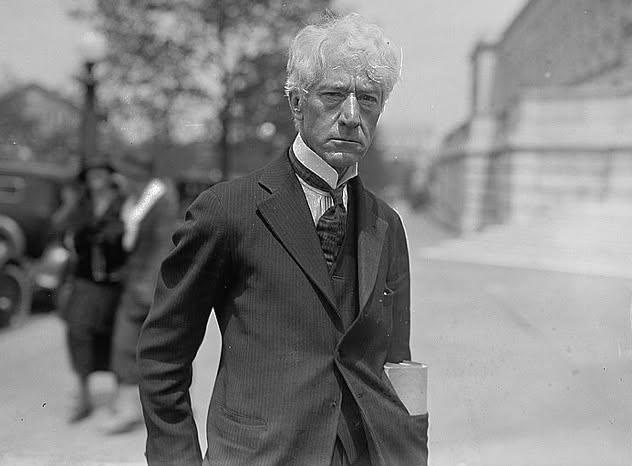
On November 12, 1920 Major League Baseball owners unanimously elect Kenesaw Mountain Landis Commissioner for seven years.
The selection of the tough-minded jurist is seen as a move by the owners to restore the public’s faith in the national pastime after being tarnished by the 1919 World Series scandal, a transgression that involved eight White Sox players who were paid off by professional gamblers to throw the Fall Classic against Cincinnati.
Landis reluctantly accepted the role, while remaining a federal judge (with his $7,500 federal salary deducted from the baseball salary of $50,000). Under the terms of the contract, Landis could not be dismissed by the team owners, have his pay reduced, or even be criticized by them in public. He also had nearly unlimited authority over every person employed in the major or minor leagues, from owners to batboys. Otherwise known as absolute power.
Handing over absolute power was difficult for the owners, but by 1920 another scandal broke out after on August 31st.
Throughout September although baseball has having a marvelous season gambling and fixed games were on fans minds.
Through late September, the 1920 American League season had been one of the most exciting on record, with the White Sox, Cleveland Indians, and New York Yankees dueling for the league lead.
By September 28, the Yankees were close to elimination, but the White Sox and Indians were within percentage points of each other. On that day, however, the eight players, seven of whom were still on the White Sox, were indicted. They were immediately suspended by White Sox owner Charles Comiskey. The Indians were able to pull ahead and win the pennant, taking the American League championship by two games over Chicago.
By 1919, the influence of gamblers on baseball had been a problem for several years. Historian Paul Gardner wrote:
Baseball had for some time been living uneasily in the knowledge that bribes were being offered by gamblers, and that some players were accepting them. The players knew it was going on, and the owners knew it was going on. But more important, the players knew that the owners knew—and they knew the owners were doing nothing about it for fear of a scandal that might damage organized baseball. Under such conditions it quite obviously did not pay to be honest.
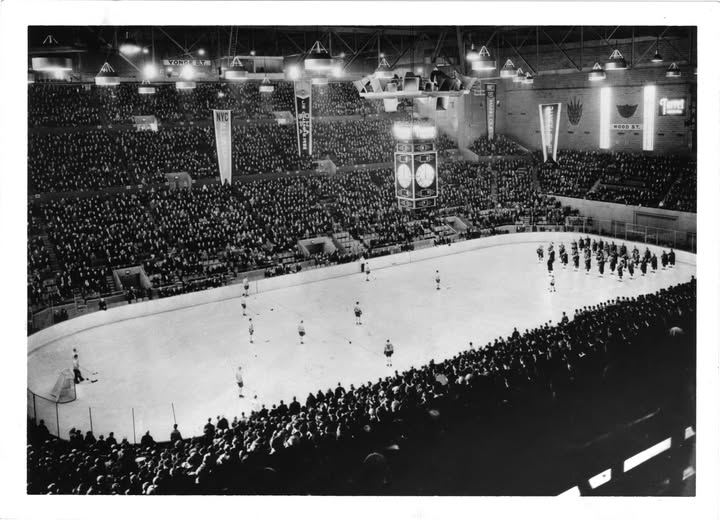
Bob Cousy (14) and Nat Clifton (#8) scramble for a loose ball on November 12, 1955 at Madison Square Garden during a 96-95 Knicks win over the Celtics.
New York goes to 3-0 while Boston drops to 2-1 on the young season.
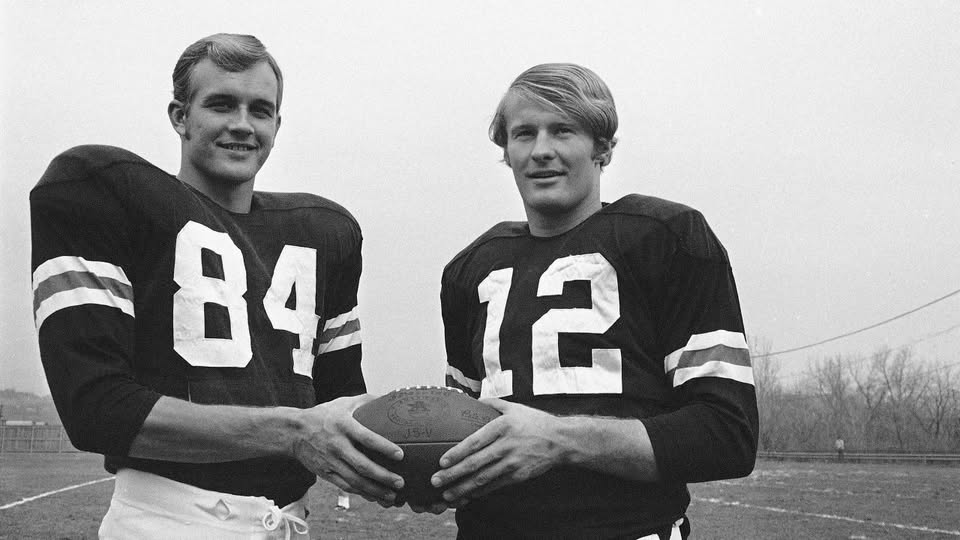
Tight end Bob Trumpy and QB Greg Cook, of the Bengals, pose together on November 12, 1969.
Cincinnati is 4-4-1 after a 31-31 tie in Houston against the Oilers on the 9th. The Bengals will lose their remaining five games.
Trumpy will catch 37 passes with 9 TD's and in 1969 he was selected by The Sporting News as the AFL's All-League tight end.
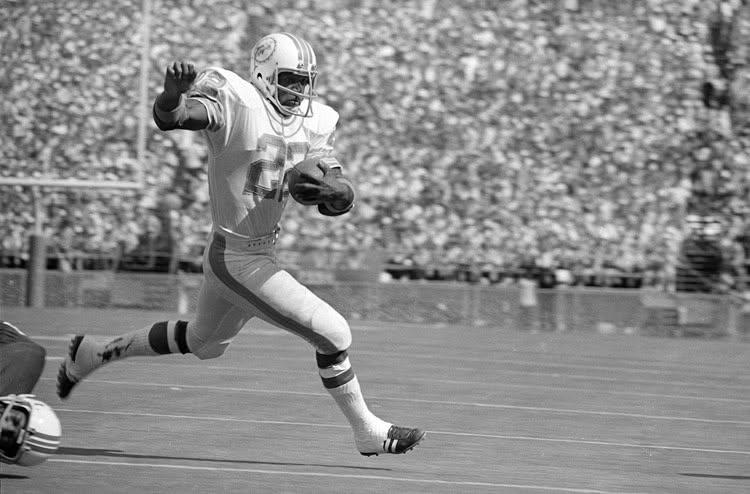
Mercury Morris scores 3 TD's in a 52-0 Dolphins' win over the New England Patriots on November 12, 1972, at The Orange Bowl.
Morris runs 16 times for 90 yards and catches 2 passes for 35 yards as Miami goes to 9-0.
Lefty QB Jim Del Gaizo, backing up Earl Morrall, tosses two 4th quarter TD passes in mop-up duty. Marlin Briscoe catches 4 passes for 128 yards and 2 TD's as well for Miami.
Eddie Lee Ivery set a National Collegiate single‐game rushing record of 356 yards and scored three touchdowns this day, as he led Georgia Tech to a 42‐21 victory over Air Force, in bitterly cold Rocky Mountain weather, on November 12, 1978.
Ivery's record, which came on 26 carries, surpassed the previous mark of 350 yards set by Eric Allen of Michigan State against Purdue in 1971. The senior tailback scored on broken field runs of 73, 80 and 57 yards.
Ivery's final touchdown, a 57‐yard sprint round left end, broke the back of the Falcons, who were only 7 points behind at the start of the final period.
Ivery's performance overshadowed a brilliant effort by a Falcon freshman receiver, Cormac Carney, who caught 10 passes for 171 yards and two touchdowns. His scoring receptions were good for 48 and 5 yards.
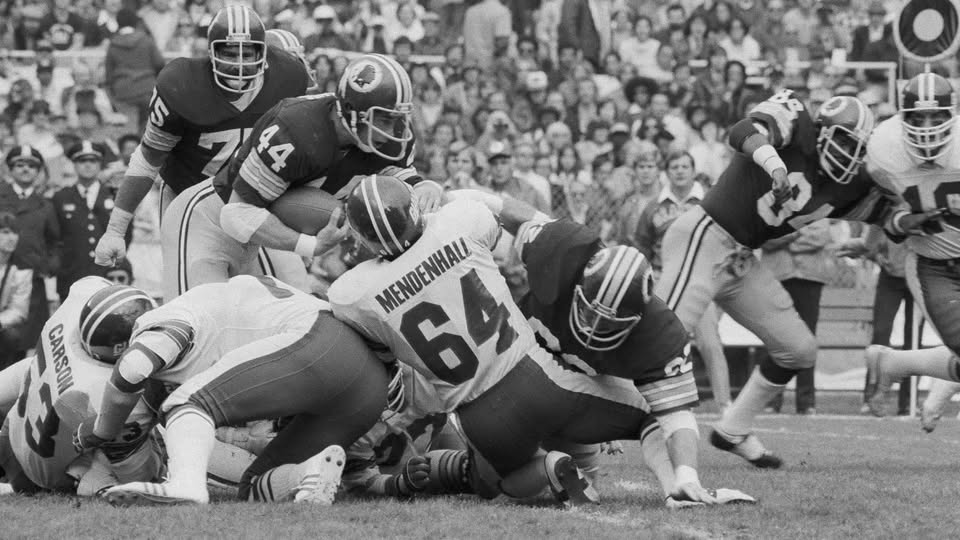
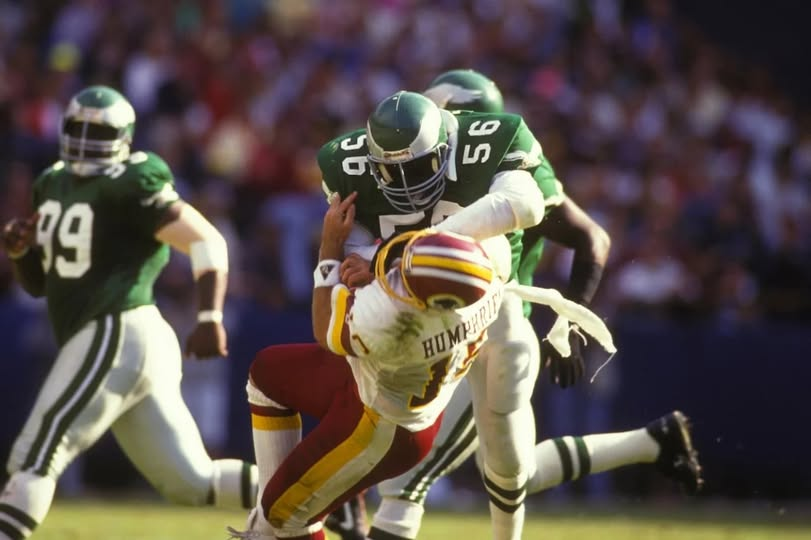
On November 12, 1990 in "The Body Bag Game", after Eagles coach Buddy Ryan threatens beating the Redskins so badly that "they'll have to be carted off in body bags", the Eagles defense scores 3 touchdowns in winning, 28–14, knocking 8 Redskins out of the game in the process.
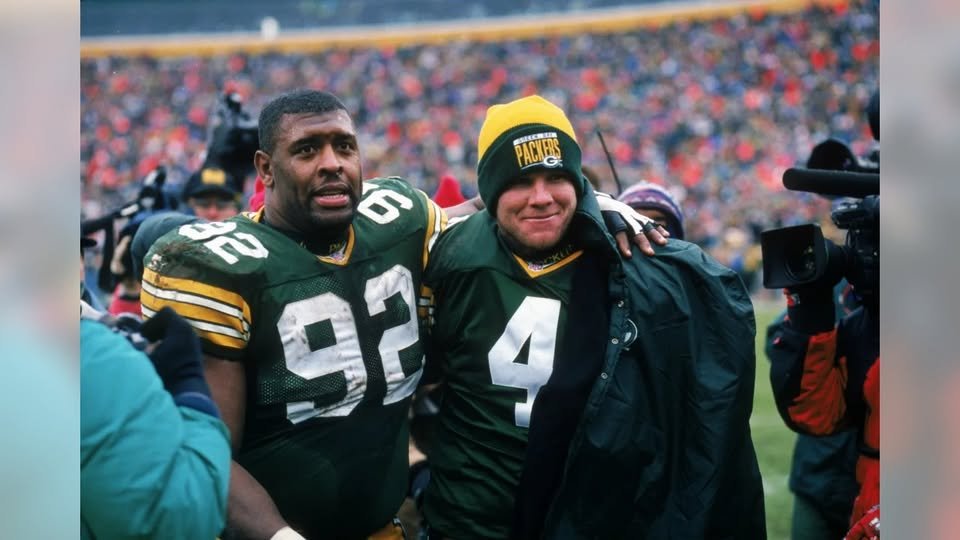
Reggie White and Bret Favre, on November 12, 1995 savoring a 35-28 win over the Bears, at Lambeau Field.
Both teams end the day at 6-4, as Favre goes 25-33 for 336 yards and 5 TD's.
Ray 'Merciless' Mercer enlisted in the U.S. Army and rose to the rank of Sergeant.
He first put on boxing gloves at the age of 23 while stationed in West Germany (Schweinfurt and Baumholder), taking a deal to spar as a shortcut to skip a 30-day field exercise.
He won Battalion, Brigade, VII Corps novice and open championships, and three USAREUR (U.S. Army, Europe) crowns representing V Corps (He and I served together during that time).
Mercer won the 1988 United States amateur heavyweight championship, earned a spot on the U.S. Olympic team, and captured the heavyweight gold medal at the 1988 Summer Olympics in Seoul, South Korea.
He turned pro in 1989, later winning the WBO heavyweight title and notching notable victories against fighters like Tommy Morrison and Francesco Damiani.
Happy Veterans Day!
South African President Nelson Mandela playfully spars with former Middleweight Champion Marvin Hagler in Capetown on November 12, 1997.
The "Marvelous One" is in country for a boxing card in Pretoria that weekend.
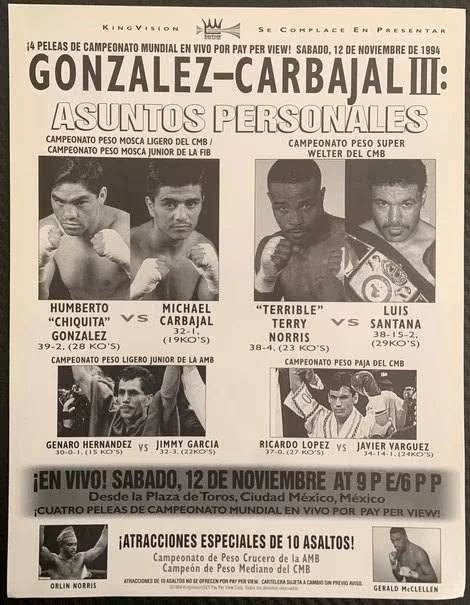
Fight poster for Humberto Gonzalez-Michael Carbajal fight held on November 12, 1994, for the IBF and WBC Light Flyweight Title.
Gonzalez would win a 12-round majority decision in their 3rd meeting. Carbajal had won their first fight on a 7th round TKO, Gonzalez would win a split decision in a rematch, in one of the lower division's best rivalries.
Humberto Gonzalez, 43-3-0 with 30 KO's for his career, is one of the best fighters to ever come out of Mexico. He had a record of 15-3 (7 KOs) in World Title fights and a record of 9-3 (3 KOs) against former or current world champions.
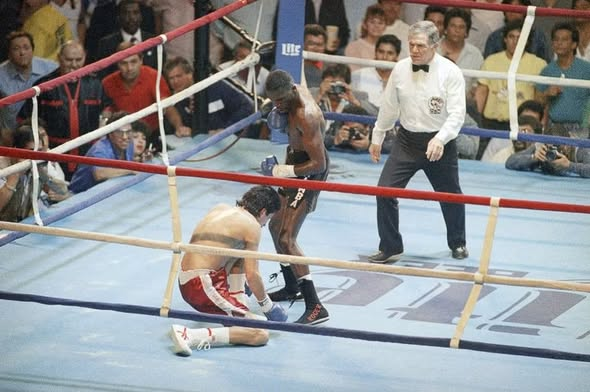
"The Black Mamba", Roger Mayweather, TKO's WBC Super Lightweight Champion Rene Arrendondo (40-3-0) in the 6th round, on November 12, 1987, at the LA Sports Arena.
This was the first defense of Arredondo's second reign.
He had also lost the title (on a 1st round KO to Tsuyoshi Hamada) in the first defense of his first reign as champion. Rene was the younger brother of former WBC Super Featherweight Champion (1971-74) Ricardo Arredondo.
It's Mayweather's second title. His first world title was the WBA Super Featherweight Championship, which he held from 1983 to 1984. He won that title from Samuel Serrano by an 8th-round TKO and lost it in his third defense to Rocky Lockridge by a 1st-round KO. He'd lose this title to Julio Cesar Chavez in 1989.
Mayweather was known for having good boxing skills, a long reach and a very good right hand. Unfortunately, however, he had what most considered a very suspect chin.
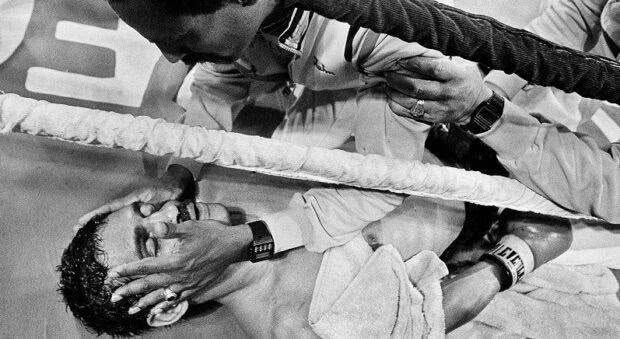
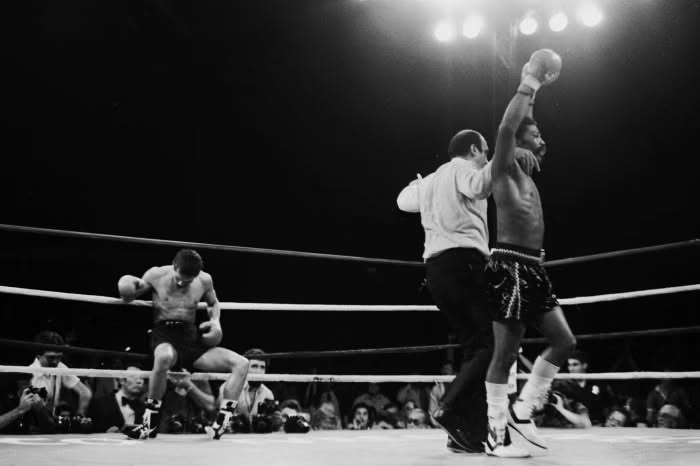
Alexis Arguello on the canvas, on November 12, 1982, after being TKO'd by WBA Junior Welterweight Champion Aaron Pryor in the 14th round, in The Ring magazine's "Fight Of The Decade."
Aaron Pryor raises his arms in victory, on November 12, 1982, after scoring a 14th round TKO of Alexis Arguello to retain his WBA Junior Welterweight Championship.
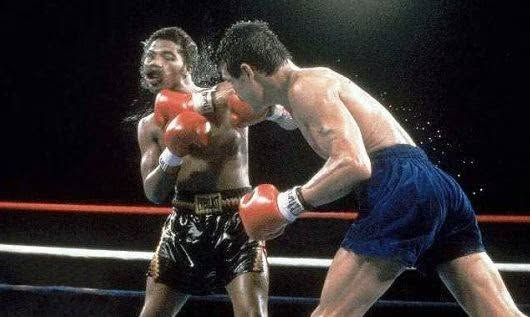
WBA Junior Welterweight Champion Aaron Pryor denies Alexis Arguello a world title in his 4th weight class, on November 12, 1982 at The Orange Bowl in Miami, scoring a 14th round TKO in one of the greatest title fights of all time.
So much has been written about this bout; from Pryor's "chip on the shoulder" (And deservedly so on his part, he was virtually ignored at times it seemed early in his reign) about his lack of attention and respect, Arguello's class and sportsmanship, to the non-stop action, the ebbs and flows, to the sudden, and then suddenly controversial ending, to the tie-ins with Panama Lewis and his later crimes in the ring, that it's hard to really add anything new.
If you're a member of this group then you don't really need me to recap it for you.
And I know that passions run high on the controversies surrounding it. So keep it polite if you disagree with someone please.
I'll only add that after the fight, there was controversy over a black water bottle used by Pryor's trainer, Panama Lewis, between rounds 13 and 14. Arguello, himself known for coming on strong late in fights, had stunned Pryor with a big right hand in the 13th round.
Microphones caught Lewis telling cutman Artie Curley, "Give me the other bottle, the one I mixed." It seemed to revive Pryor, who had seemed to be tiring just as Arguello had been rallying a bit.
Coming out quickly for the 14th round, Pryor landed a barrage of unanswered blows before the referee stopped the fight.
Many have speculated, none of us have absolute proof, that there was something illegal in the bottle, but nobody checked the contents and the Miami Boxing Commission, inconceivably, failed to administer post-fight urine tests to both of the boxers.
Lewis and Pryor steadfastly denied that there was anything illegal in the bottle. Curley said the bottle contained peppermint schnapps to settle Pryor's upset stomach.
In the 2008 documentary Assault in the Ring, former Lewis-trained boxer Luis Resto revealed that Lewis would break apart anti-histamine pills and pour the medicine into his water, giving him greater lung capacity in the later rounds of a fight.
Lewis would later be charged, convicted and incarcerated for tampering with the boxing gloves of Luis Resto in June of 1983. Admittedly, it's rather difficult to give him the benefit of the doubt with his track record.
It was, however, as good a fight as I'd guess that most of us have ever seen.
Alexis Arguello lands a big right hand on WBA Junior Welterweight Champion Aaron Pryor, on November 12, 1982 but falls short in an attempt to capture a world title in his 4th weight class, losing on a 14th round TKO at The Orange Bowl in Miami, Florida.
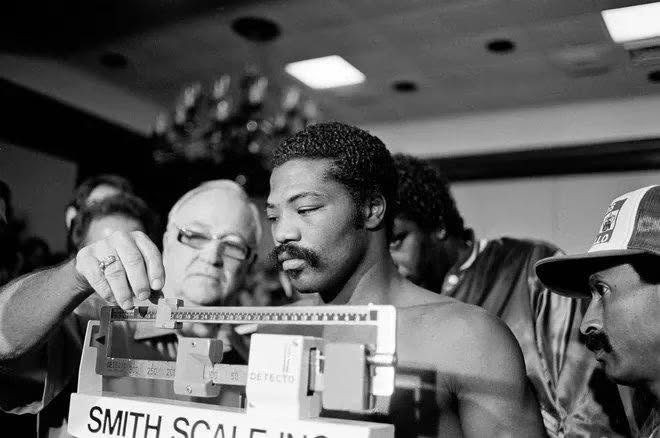
WBA Junior Welterweight Champion Aaron Pryor weighs in, at 140 pounds even, for his title defense against Alexis Arguello, at The Orange Bowl on November 12, 1982.
While it was the working home of Chris and Angelo Dundee, Miami had some other notable fights in it's past along with Pryor-Arguello.
----------------------------------------------------------From The Sweet Science:
If you happen to find a poster for this fight with the name Muhammad Ali on it, don’t buy it. It’s bogus. Liston met up with Muhammad Ali in their second fight. In their first encounter, Liston opposed Cassius Clay.
Clay’s Louisville sponsors, after a brief flirtation with Archie Moore, settled on Angelo Dundee as his trainer. Angelo operated out of his brother Chris Dundee’s gym located at the corner of 5th Street and Washington Avenue in Miami Beach. The fighter who took the name Muhammad Ali trained here and kept a home in Miami for most of his first six years as a pro.
Clay/Ali was 22 years old and had only 19 fights under his belt when he was thrust against heavyweight champion Sonny Liston at the Miami Beach Convention Center. Liston was riding a 28-fight winning streak after back-to-back first-round blowouts of Floyd Patterson.
In a UPI survey, 43 of 46 boxing writers picked Liston. “Clay has no more chance of stopping Liston than the old red barn had of impeding a tornado,” wrote Nat Fleischer, the publisher of The Ring magazine.
This would be the first of many famous fights for Muhammad Ali who emerged victorious when Liston quit after the sixth frame citing an injured shoulder. What is not widely known, however, is that the fight, which was shown on closed-circuit in the U.S. and Canada, was a bust at the gate. The 16,448-seat Convention Center was only half full.
The expectation that Liston would take the lippy kid out in a hurry depressed sales, as did sky-high ticket prices ($250 tops when $100 was the norm). And there may have been more subtle factors. “This may not be the best place for a fight between two Negroes,” wrote Robert Lipsyte of the New York Times, cognizant that people of color were not welcome as guests at the ritzy beachfront hotels along Collins Avenue.
A big fight, as I define it, doesn’t have to be a blockbuster. An important fight that produces an upset automatically becomes a bigger fight in hindsight. The Sharkey-Stribling fight of 1929 didn’t draw an immense crowd by Jack Dempsey standards, but the turnout, reportedly 35,000, far exceeded expectations and the fight – which preceded Miami’s first Orange Bowl football game by six years — really established Miami as a potentially good place for a big sporting event.
Promoted by the Madison Square Garden Corporation, the bout was originally headed to a dog racing track but it quickly became obvious that a larger venue was needed. A stadium was erected on a Miami Beach polo field, taking the name Flamingo Park (not to be confused with the thoroughbred track of the same name).
Slated for 10 rounds, the bout was conceived as one of two “eliminators” to find a successor to Gene Tunney who had retired. What gave the fight it’s primary allure, however, was the North-South angle. Sharkey, born Joseph Zukauskas, hailed from Boston. Stribling, born into a family that traveled the fair circuit with a variety act, was from Macon, Georgia.
The fight, which aired on the NBC radio network, was a dud, a drab affair won by Sharkey who had the best of it in virtually every round. Both went on to fight Max Schmeling for the world heavyweight title. Stribling, dubbed the “King of the Canebrakes” by Damon Runyon, lost by TKO in fight that was stopped late in the 15th round. Sharkey took the title from Schmeling on a split decision after losing their first meeting on a foul.
Young Stribling died in a motorcycle crash at age 28, by which time he had engaged in 251 documented bouts, the great majority of which were set-ups. Jack Sharkey lived to be 91.
The strong earnings of the Sharkey-Stribling bout inevitably drew the Madison Square Garden Corporation back to Miami for an encore. On Feb. 27, 1930, Jack Sharkey opposed England’s “Fainting” Phil Scott. Four years later, on March 1, 1834, Primo Carnera defended his world heavyweight title here against former light heavyweight champion Tommy Loughran, the Philadelphia Phantom.
Both bouts were big money losers, as were the great majority of major fights during this period. Eight months after the Sharkey-Stribling cash cow, the stock market crashed, plunging the United States into the Great Depression. Few Americans could afford to vacation in Florida, let alone travel anywhere for a big fight.
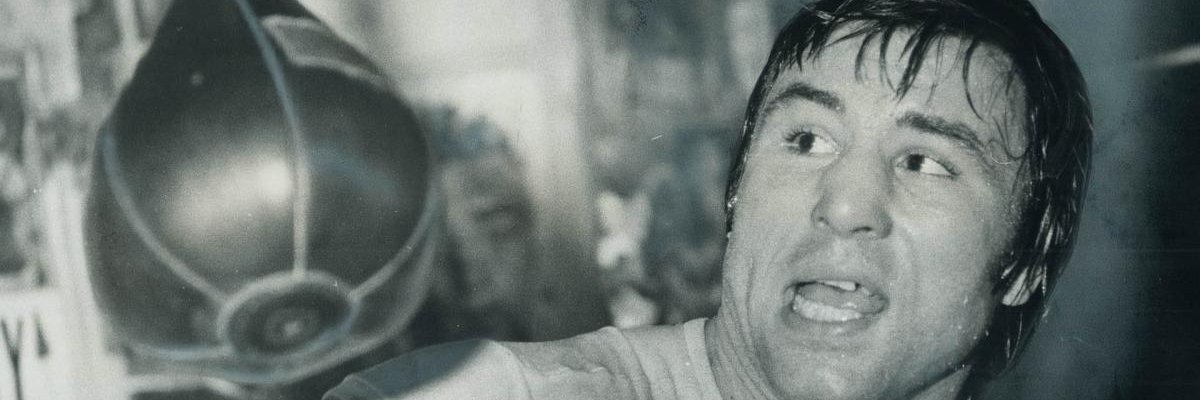
John 'The Heat' Verderosa goes to 14-0 with a 7th-round TKO of Felix 'Kid' Perez (15-3-2) on November 12, 1980 in a lightweight bout at The Felt Forum.
Verderosa won two New York Golden Gloves Championships; the 1975 118lb Open Championship and the 1976 126lb Open Championship.
Verderosa went 27-3-0 (17 KOs) from 1979-84. He had TKO wins over Nicky Perez and Sean O'Grady, and a TKO loss to Cornelius Boza-Edwards.