Director of the Center for Teaching Excellence @OLLUnivSATX | Research Ast @TXSuccessCenter | SAC Adjunct faculty | PAC 24’, outstanding former student
I feel like everyone is obsessed with looking cool.
No one wants to be excited for anything anymore, they’re obsessed with being nonchalant.
Life is too short so just have fun bro.
Science suggests you don’t need a long vacation to recharge. A 24-hour break that interrupts your routine—and puts you into a flow state—can be hugely restorative. https://t.co/5RhH9Os5Qg
Artificial intelligence is shaping the technological boom in education and it's already having an impact in classrooms nationwide. https://t.co/2VrXGgfqDR
Long-running language agents may work better if they periodically stop to consolidate memory.
The problem is that today’s transformer agents get slower and more expensive as their context grows, because attention has to keep checking more past tokens.
The usual fix for long context is to keep more tokens nearby, but that turns every next-token prediction into a larger search through the past.
The sharper idea here is that memory is not only storage.
Sometimes the hard part is converting a messy stretch of experience into a state that can actually be used later.
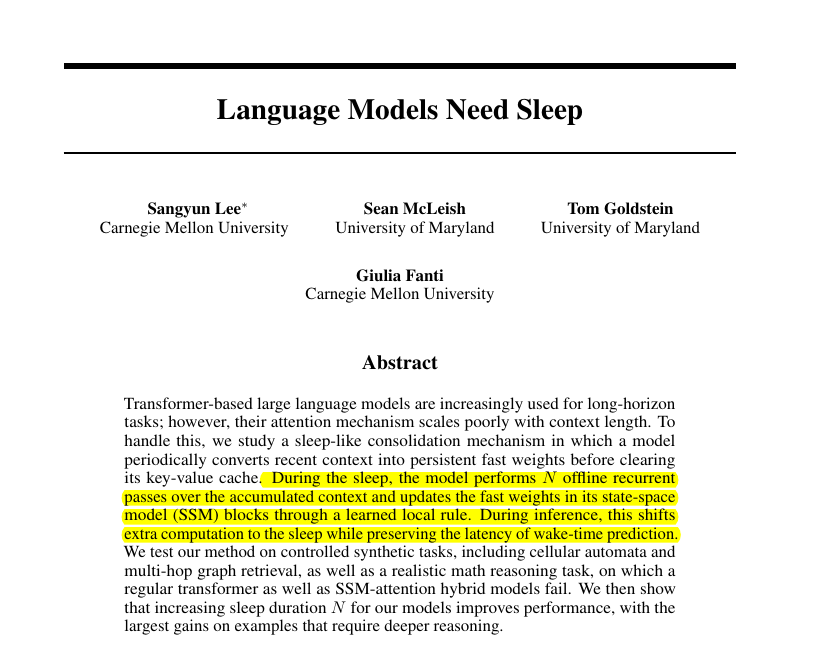
So the paper’s idea is to add a sleep phase, where the model pauses, rereads recent context several times, writes the useful information into fixed-size memory layers, and then clears the short-term attention cache.
During sleep, the model runs several offline passes over recent context, writes the result into fast weights inside its state-space blocks, then clears the attention cache.
This means the model pays extra compute while sleeping, not while answering, so normal prediction can still happen with 1 forward pass.
The authors test this on cellular automata, graph lookup, and GSM-Infinite math problems, where the model must use old information that is no longer sitting in its attention cache.
The main result is that longer sleep improves performance, especially on harder cases that need deeper reasoning rather than just remembering a fact.
The big deal is that long-horizon agents may not need to carry bigger and bigger raw context forever, because they can consolidate the important parts and safely forget the raw tokens.
----
Link – arxiv. org/abs/2605.26099
Title: "Language Models Need Sleep"
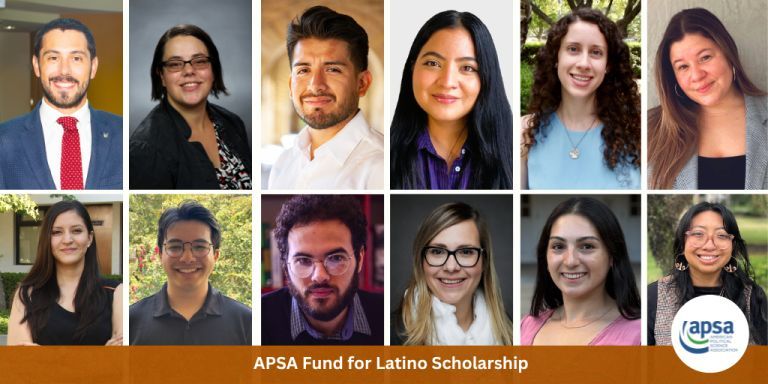
One month left to submit your 2026 APSA Fund for #Latino Scholarship applications! The program supports teaching, research and publishing activities of #polisci faculty whose area of focus is Latina/o politics.
Apply by June 15th! https://t.co/OE5L9OdVn4
AI doesn't run on abstractions. It runs on fiber laid by technicians, power connected by electricians, and systems maintained by skilled tradespeople — hundreds of thousands of them that America doesn't currently have.
Today Meta is launching America's Workforce Academy, which provides paid training, certification and a job for Americans of all backgrounds.
→ Zero cost. Meta covers tuition, travel, lodging, and a daily stipend. → Guaranteed job on completion. Not a maybe — an offer before day one of training.
→ No experience required. Veterans, high school graduates, career changers – all are welcome. → Only weeks from application to job site. Portable, industry-standard credentials.
$115 million initial investment. Starting in Louisiana, Ohio, Indiana, and Texas in partnership with @ABCNational and @CBRE. We're calling on our industry peers to join us. The demand will only grow.
The NHC appears to be paying attention to the AI model which still shows a small bit of potential for the system over Mexico to re-emerge over the NW Gulf near the Texas coast, and try to develop some. I don't think the chance is very high right now, but we'll see.
Univ of Texas paper shows AI agents can slowly become less reliable after deployment, even when the model itself does not change.
The problem is that agents are often judged when they are fresh, but real agents keep changing because they summarize old chats, store more memories, update facts, and go through maintenance.
An agent that remembers you across weeks is really a small operating system wrapped around a language model: it writes notes, compresses them, retrieves them, updates them, and occasionally cleans house.
Every one of those steps can quietly rot.
A medication dose can become “a daily medication,” two similar clients can blur into one, a canceled subscription can remain active, and a schedule can vanish after a maintenance pass.
The uncomfortable finding is that the agent may still sound competent while becoming less exact.
The proposed AgingBench, a benchmark that checks whether an agent stays reliable across many sessions instead of only checking one clean starting point.
It studies 4 ways agents age: summaries can drop key details, similar memories can get mixed up, updated facts can stay stale, and maintenance can suddenly break memory.
The deeper lesson is that “give it more memory” is often the wrong repair.
If the fact was never written, retrieval cannot save it.
If the fact was written but crowded out, better summarization will not fix it.
If the fact is present but unused, the problem is not storage but the agent’s decision to trust or ignore what it retrieved.
This paper reframes deployed agents less like static models and more like aging infrastructure.
----
Link – arxiv. org/abs/2605.26302
Title: "Your Agents Are Aging Too: Agent Lifespan Engineering for Deployed Systems"
"Texas AI Awareness Training"
Government Code Section 2054.5191 mandates that state and local government employees and officials complete a certified AI awareness training program.