@bentendo85@IvyfulWorld Sorry, I don’t really use Twitter. What do you mean by “Japanese-style character”? Does it have anything to do with your hometown?
@JeremyMusser2@CallofDuty That’s right—matches that are on your level are the most fun. I agree with you; the same goes for everything in life: you should always stay within your capabilities so you don’t feel overwhelmed.
@Stretch112821@shouq_al90149@Jennifer55gt I totally agree with you. Personally, I think age is just a number—it’s all about your mindset. As long as your mindset stays young, you’ll always be young at heart. What do you think?
27-year-old man suffered a heart attack because he would not stop using his nasal spray.
Young man had a heart attack and presented to the emergency room in cardiac arrest. He was revived, but the cardiologists could not find a cause, until they learned about his frequent use of a nasal decongestant spray, 10 sprays in the last 2 hours, taken for nasal congestion.
This is one of the most dangerous adverse effects of nasal sprays. Understanding how this happens, and why nasal decongestant sprays should be used cautiously, is something everybody needs to know.
(Images from public domain)
Morbidly obese diabetic young male with NSTE ACS.
Diffusely diseased LAD, D1, and high OM/ RI.
Then, there was cath induced non flow limiting LMS dissection.....
We performed Syracuse’s/Upstate’s first BASILICA (Bioprosthetic or native Aortic Scallop Intentional Laceration to prevent Iatrogenic Coronary Artery obstruction)-facilitated transcatheter aortic valve implantation (TAVI) in an end-stage renal disease patient, who was deemed inoperable and had low left main stem (coronary) ostium. Her sinuses were not large enough, and simply performing TAVI without BASILICA would have occluded the left main stem ostium (and resulted in cardiac arrest on the table). In the appended Video, you will see the following (clockwise from top to bottom):
1. Gooseneck snare in the left ventricular outflow tract.
2. An electrified guidewire perforating the left cusp leaflet of the aortic valve.
3. Lasso creation (by snaring the guidewire that perforated the leaflet into the other guiding catheter) prior to electrifying a “flying V” to lacerate the aortic scallop.
4. “Flying V” ready to lacerate the aortic scallop.
5. Successful laceration as the “flying V” cuts through the left cusp leaflet.
This was followed by concluding the TAVI procedure. The second video demonstrates pre- and post-procedure hemodynamics with the final valve position on the transesophageal echocardiogram. The patient is extubated and doing well, and we anticipate discharge on post-operative day 1.
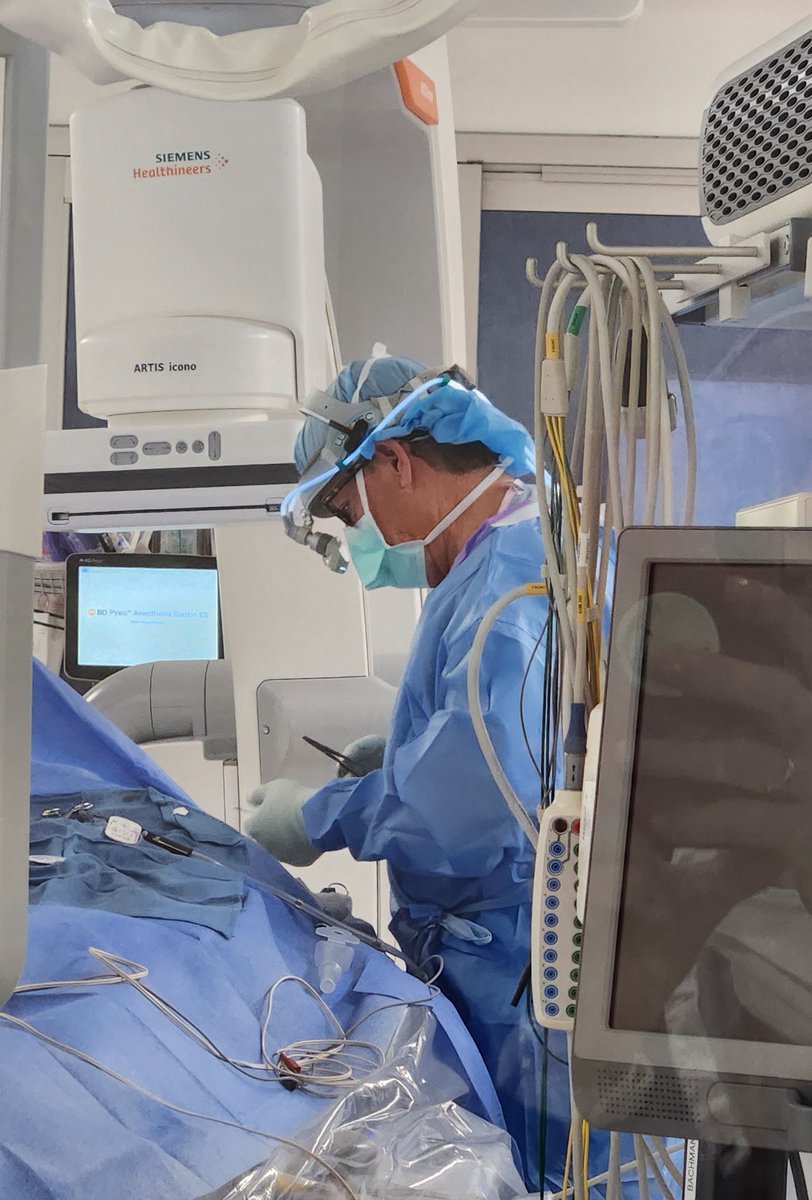
@lopatinmd@doctorwes@EndeavorHlth Thank you for your significant contributions to the medical field. You can now enjoy your retirement with peace of mind. How long have you been working in the medical field?
42 yrs of medicine, the last 25 at @EndeavorHlth. The last scrub, the last pacer, the last ablations, the fantastic team, wonderful pts. Lucky indeed. Will miss it.