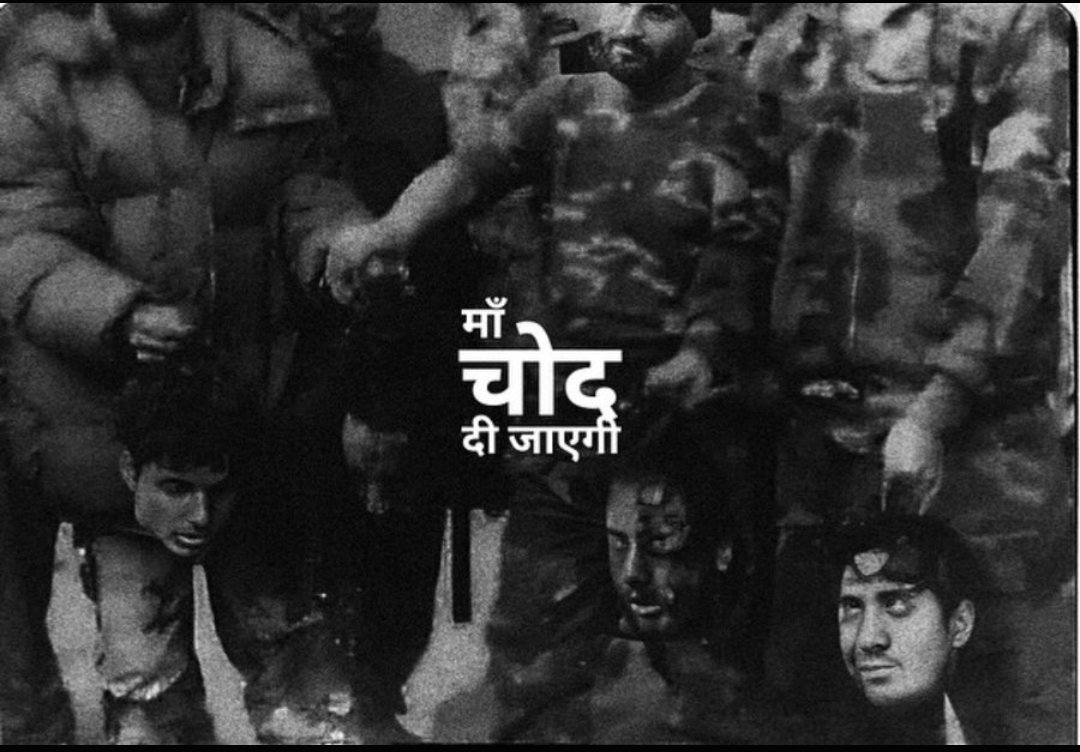
We are hunters, and the enemy is our prey.
We are masters of violence, while you are nothing but mercenaries.
India 🇮🇳 9 Para Special Forces (Para SF) wrote these words in the enemy blood on the wall of an enemy bunker beyond the Line of Control (LoC).
Found a lovely pix of IAF assets!
Spoilt for choice as far as aerial refuelling is concerned 😝
Il-78MKI refuels a Jaguar and Su-30MKI while a Su-30MKI refuels a Mirage 2000.
Great photo though!! Apologies but the photographer is unknown to us but we assume it's an official IAF pix.
A Para SF operator and a terrorist lay side by side after one of the most brutal hand-to-hand combat engagements.
The operator was reportedly shot five times by the terrorist with AK rounds, yet still closed in and engaged him in hand-to-hand combat.
The story of #RandoriBehak deserves to be remembered for generations.
Let's play a small game today name the aircraft that you think will enter active service first.
1- Chengdu J-36
2- HAL Tejas MK-1A.
My bet is on Chengdu J-36.🐰
Bangladesh Army Tank Explodes During Firing Exercise
A Chinese-origin Type 59 tank reportedly exploded in Hathazari, Chattogram.
2 crew members killed
1 officer injured and taken to Chittagong CMH.
Cause remains unconfirmed.
کتنا بے رحم منظر ہے۔ پتہ نہیں کس ماں کے لاڈلے بیٹے تھے، جو یوں بے وارث پڑھے ہے! یہ جو ایسے بے فکری سے سڑک پر سے گزر رہے ہے، کاش ان میں سے کسی میں بھی انسانیت ہوتی ، انکے اوپر چادر ڈالتے اور انکو ہسپتال تک پہچنے کا بندوبست کرتے، لیکن انسانیت مر چکی ہے۔ 💔
BLA and BLF forces have released a short trailer documenting the bloody battle following yesterday’s attack. The trailer contains intense and dangerous scenes, including footage of fierce clashes during the fighting.
Here's the FPV of the daring rescue by the Avn elements of @firefurycorps !⚡️
No words, shocked that the aircraft was able to even take off with the pilots given that both were having balls of steel...🫡
I thought the photograph was dramatic enough. Then the pilot sent me his own account. It was worse.
After my post on the 1992 Panch Chuli V rescue, Gp Capt Pankaj Jaiswal, who flew the mission with then Sqn Ldr Pravin Kumar Sharma, shared his photographs and a wonderfully detailed first-hand account of what actually happened at 18,372 ft.
Some details deserve to be added to the story.
On 24 June, they searched through worsening cloud for almost the entire day and found nothing. They returned the next morning. After refuelling at Dharchula, they began following footprints in fresh snow up the glacier.
Then the footprints disappeared beneath the debris of a massive avalanche. They pressed on. The tracks eventually reappeared.
Through a break in the cloud, far up the glacier, they finally saw what Jaiswal remembers as “three black spots on a white sheet of paper”. The tent, and the two men beside it. Relief lasted only until they got closer.
The tent was perched on a tiny clearing on a roughly 30-degree snow slope. At over 18,000 ft, they were attempting an out-of-ground-effect hover with almost no visual reference except the tent and two mountaineers. The canopy kept misting up. The pilots were having to exchange control of the helicopter so that each could periodically take oxygen. Cloud was drifting through the area. And there was nowhere to land.
They first signalled the mountaineers to uproot the tent and move it. One of them then had to sit on the tent to stop the rotor wash blowing it into the helicopter.
Jaiswal and Sharma tried approaching from both directions several times, attempting to place just one skid on the tiny ledge while simultaneously keeping the tail rotor clear of the mountain.
Jaiswal's description of what they could see from the cockpit is wonderfully understated, “Main rotor blades were appearing hopelessly close to the slope, but that had to be endured”.
Eventually, one skid was planted on the tent ledge. Jaiswal held the Cheetah steady while Sharma opened the door. That was when another problem began.
Stephen Venables was a large man, wrapped inside a sleeping bag, with badly broken legs. Victor Saunders had to somehow lift and push him uphill into the tiny Cheetah cabin. Venables was screaming in pain. The pilots could not help because keeping the helicopter balanced on that single skid required both of them.
Meanwhile the cloud was coming back, the canopy was still misting, they still needed oxygen, the rotor blades were swishing frighteningly close to the slope and, as Venables was pushed and pulled aboard, the entire helicopter was being shaken. Finally Saunders forced Venables' legs inside and slammed the door shut.
They lifted away. The unit recommended both pilots for decorations and was apparently told, “Boys, cas evac is routine for choppers”.
Only after accounts of the rescue began appearing in the foreign press did their new CO, Wg Cdr Sanjiv Mishra SC, VM, take up the case again. Both pilots were awarded the Vayu Sena Medal in 1994.
Venables later remembered looking into the Cheetah during those moments on the slope - “Suddenly I began to feel very very frightened... the rotor blades chopping so close to our heads and the faces of the two men inside, tense with concentration”.
The reply was simply, “It is God we must thank”.
Some photographs become considerably more remarkable once you know what was happening outside the frame.
Additional Sources
1. The Times - Saturday Review (01 August 1992) - Back from the brink - George Hill
2. American Alpine Journal - Incident on Panc Chuli V - Stephan Venables
3. Climber and Hill Walker - (September 1992) - Freddy in the mountains- Victor Saunders
#IAFHistory @IAF_MCC
If any Western Army had pulled something like this off for a casevac in a vintage helicopter manufactured in the 60s, their entire state machinery would’ve gone bonkers praising their own & would’ve called it the sortie of the century. Most folks don’t fully realise that the probability of not coming back from such a flight for the pilots is more than a safe return. Next time in an airshow near you, try if you can get a glimpse of the Cheetah’s cockpit. A Maruti Swift dashboard has more components on it.
And yet, our warriors go on and on. Probably landed back, made a good night call home & went to sleep, woke up today for business as usual. Probably both pilots in their late twenties or thirties. Unreal commitment to duty & professionalism. Indian Army for you.
Air Marshal (Retd.) AK Bharti clears that mid Jinnah enthusiast who called liberalism and secularism as the gravest sin that one can commit in their lifetime.
He is the real face of Bihar.
This pic helped change the air war over Kargil. An IAF MiG-25 Foxbat took it in the third week of June 1999. And there is a reason to tell that story today. On 17 Aug 1981, 45 years ago, No. 102 Sqn was raised, beginning the MiG-25’s career in the IAF.
18 years later, the Foxbat was called upon to solve one of the most critical problems confronting the IAF in Kargil: accurately finding targets. It is also an important part of Safed Sagar that @NetflixIndia largely ignored.
Identifying Pakistani positions and fixing their precise coordinates had become a serious problem. The Army’s maps were dated and inadequate for extracting accurate coordinates. Newer Survey of India maps would only reach the troops towards the end of June.
The IAF therefore needed vertical aerial photography. It had the Avro 748, Jaguar, Canberra and MiG-25 available, but each had limitations.
The Avro was unsuitable for a hostile environment. Jaguars with Vicon cameras produced excellent low-level imagery, but operating low over Kargil meant exposure to SAMs. A No. 106 Sqn Canberra had already been struck by an Anza missile on its first reconnaissance sortie.
That left the MiG-25.
The Foxbat normally operated above 20 km at around Mach 2.4. Its 72-inch focal-length cameras offered enormous photographic coverage, while its Peleng-DM navigation system could associate accurate positional information with the imagery.
But at its normal altitude, the resolution was insufficient to identify small bunkers, sangars and concealed positions in Kargil. The Foxbat had to come down.
At around 8 km, the imagery was superb, but the aircraft would be dangerously exposed to shoulder-fired missiles. A 13–14 km profile offered greater safety, but required minimum reheat and pushed the aircraft to about Mach 1.3.
The eventual compromise was remarkable for a Foxbat: around 10 km and Mach 0.9. It gave roughly 5 km of vertical separation from the missile belts while allowing an effective fighter escort. The MiG-25 had no RWR, flares or chaff.
Two MiG-29s provided top cover, with two Mirage 2000s accompanying it. If seriously threatened, the escape plan was pure Foxbat: maximum afterburner, climb to 20 km, accelerate to Mach 2.4 and get out.
Navigation accuracy was equally critical. The Peleng-DM, like any inertial system, could drift. Its feed was integrated with the RSBN beacon system, and Wg Cdr P.J. Thakur went a step further, borrowing a handheld GPS from No. 7 Sqn to verify that the positions being generated were accurate.
The MiG-25 was ferried to Adampur on 18 June. Weather ruled out operations on 19 and 20 June. On 21 June 1999, Wg Cdr P.J. Thakur flew the first operational photo-reconnaissance mission over the Drass–Kargil sector.
Mirage 2000s flown by Wg Cdr S. Chhabra and Wg Cdr Rohit Verma accompanied the mission, while MiG-29s led by Wg Cdr S. Harpal Singh provided top cover.
Two Pakistani F-16s approached during the photographic run. The MiG-29s deterred them, and the Foxbat stayed on task.
The exposed film was then flown back to Bareilly for processing. When the photographs reached Western Air Command and Air HQ, the impact was evident. Tololing. Muntho Dhalo. Tiger Hill.
Positions that had been difficult to locate with confidence were now clearly visible. Enlargements revealed bunkers, sangars and camouflaged positions. Crucially, the imagery could be tied to accurate coordinates.
Strike crews could now study their targets before take-off, see how they would appear from release height, fix their coordinates and plan the direction of attack.
Look again at the photograph. In the Kargil mountains, where locating a small position could be almost as difficult as attacking it, imagery of this quality mattered enormously.
The MiG-25 went on to fly four more missions over Kargil–Drass, besides reconnaissance over Rajouri–Poonch and a sortie to establish the situation around Gultari.
The Foxbat is remembered for Mach 2.4 and the stratosphere. Over Kargil, it made a critical contribution by doing almost the opposite: coming down to 10 km and slowing to Mach 0.9 so its cameras could see what mattered.
Happy birthday, No. 102 Squadron! #IAFHistory @IAF_MCC
80वें स्वतंत्रता दिवस पर,
आइए स्वतंत्रता की भावना और
इसे संभव बनाने वाले बलिदानों को नमन करें।
तिरंगा सदा ऊँचा लहराए और हमारी एकता सदा प्रखर रहे।
स्वतंत्रता दिवस की हार्दिक शुभकामनाएं! 🇮🇳✨
On the 80th Independence Day,
let us salute the spirit of freedom
and the sacrifices that made it possible.
May the tricolour always fly high,
and our unity shine brighter than ever.
Happy Independence Day, India! 🇮🇳✨