@cremieuxrecueil Psychologists call this the "Theory of Symbolic Self-Completion" (Wicklund & Golwitzer). Definitely worth a read. All time favourite psych theory!
Linke Femistinnen: Männer beherrschen alles, wir sind Unterdrückt
Auch Feminstinnen: Tja Männer wir kriegen ÖRR Rundfundgeld und ihr könnt nichts dagegen machen
Sie merken nichts oder?
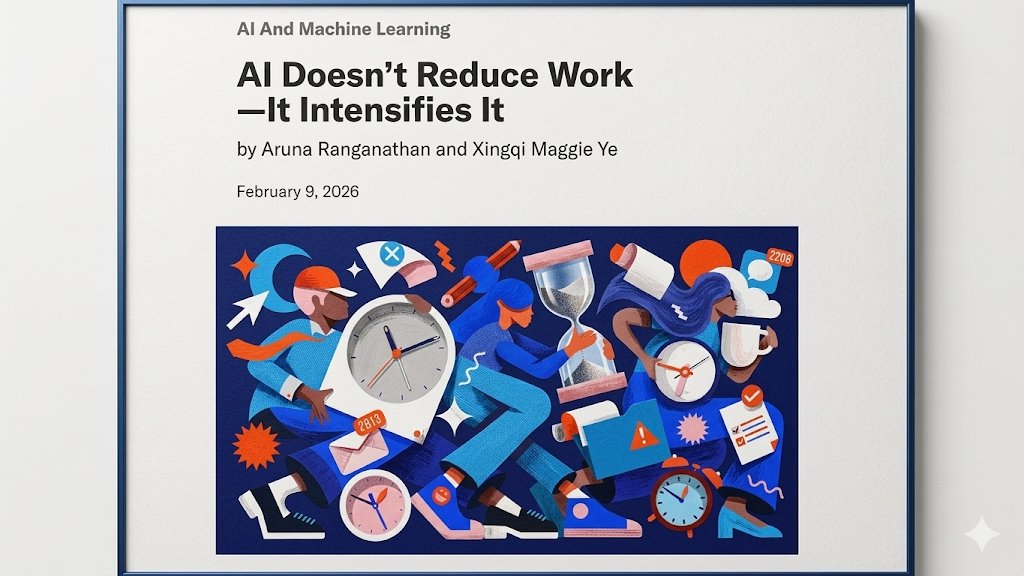
🚨BREAKING: Berkeley researchers spent 8 months inside a tech company watching how employees actually use AI.
The promise was simple: AI will save you time. Do less. Work smarter.
The opposite happened.
Workers didn't use AI to finish early and go home. They used it to take on more. More tasks. More projects. More hours. Nobody asked them to. They did it to themselves.
The researchers sat inside the company two days a week for 8 months. They watched 200 employees in real time. They tracked work channels. They conducted 40+ interviews across engineering, product, design, and operations.
Here's what they found. AI made everything feel faster, so people filled every gap. They sent prompts during lunch. Before meetings. Late at night. The natural stopping points in the workday disappeared. People ran multiple AI agents in the background while writing code, drafting documents, and sitting in meetings simultaneously.
It felt like momentum. It felt productive. But when they stepped back, they described feeling stretched, busier, and completely unable to disconnect.
83% said AI increased their workload. Not decreased. Increased.
62% of associates and 61% of entry-level workers reported burnout. Only 38% of executives felt the same strain. The people doing the actual work absorbed the damage while leadership celebrated the productivity numbers.
Then came the trap nobody saw coming. When one person uses AI to take on extra work, everyone else feels like they're falling behind. So the whole team speeds up. Nobody formally raises expectations. But the new pace quietly becomes the default. What AI made possible became what was expected.
The researchers gave it a name: workload creep. It looks like productivity at first. Then it becomes the new baseline. Then it becomes burnout.
AI was supposed to give you your time back. Instead it's eating more of it. And the worst part? You're doing it to yourself. Voluntarily.
It's over. Karpathy just open-sourced an autonomous AI researcher that runs 100 experiments while you sleep.
You don't write the training code anymore.
You write a prompt that tells an AI agent how to think about research.
The agent edits the code, trains a small language model for exactly five minutes, checks the score, keeps or discards the result, and loops. All night. No human in the loop.
That fixed five-minute clock is the quiet genius. No matter what the agent changes, the network size, the learning rate, the entire architecture, every run gets compared on equal footing. This turns open-ended research into a game with a clear score:
- 12 experiments per hour, ~100 overnight
- Validation loss measures how well the model predicts unseen text
- Lower score wins, everything else is fair game
The agent touches one Python file containing the full training recipe. You never open it. Instead, you program a markdown file that shapes the agent's research strategy.
Your job becomes programming the programmer, and this unlocks a strange new loop:
1. Agents run real experiments without supervision
2. Prompt quality becomes the bottleneck, not researcher hours
3. Results auto-optimize for your specific hardware
4. Anyone with one GPU can run a research lab overnight
The best AI labs won't just have the most compute.
They'll have the best instructions for agents who never sleep, never forget a failed experiment, and never stop iterating.
Universities are still policing AI like it's a plagiarism problem.
Meanwhile, the gap is widening.
The researchers who figure out AI isn't for writing papers, know it's for accelerating research, filling knowledge gaps, handling the grunt work that blocks breakthrough thinking. They're already pulling ahead.
By the time your institution finalizes its "AI detection policy," those researchers will have published twice as much, explored ideas you're still stuck researching manually, and freed up mental space for the work that actually matters.
You can spend your energy hiding AI use, or you can spend it mastering AI as leverage.
One of those paths leads somewhere.
@mz_storymakers Es heisst "green house gas" nicht ohne Grund. Die Welt wird messbar grüner durch CO2. Warum das doch schlecht für die Welt ist, möge der SRF seinem verblödeten Publikum doch näher erläutern 😉
https://t.co/MqDsj9F3Xj
https://t.co/GvFICG7sYa
Meine neue Kolumne zum Frall des Dokumentationsarchiv des Österreichischen Widerstands. Die Einrichtung, die nachweislich Statistiken über Rechtsextremismus wohl mit Absicht entgegen ihrer wahren Aussage uminterpretiert und propagandistisch umgedeutet hat, gehört sofort geschlossen und mit politisch unabhängigen Mitarbeitern neu gegründet. Offenbar ist diese wichtige Einrichtung in die Hände von links-woken postmodernen Marxisten gefallen.
Den beiden Diskursschauspielerinnen in diesem Video geht es natürlich nicht um mich. Ich diene nur als Projektionsfläche für ihre Verachtung gegenüber Millionen von Menschen, von deren Leben sie keine Ahnung haben und die sie meinen, bekämpfen zu müssen. Diese herablassende Feindseligkeit ist ein guter Antrieb, weiter für eine menschenfreundliche und liberale Politik zu kämpfen. WK
@psyop_observer3@UniBasel Ja, das lässt sich eigentlich nur ideologisch erklären. Ist ziemlich lustig, auf bluesky hat @unibas so ungefähr einen Like in 24h 😂 wer immer für deren social media zuständig ist, wird mal vermutlich nicht nach Leistung bezahlt 😉
https://t.co/KobcaRhxxE