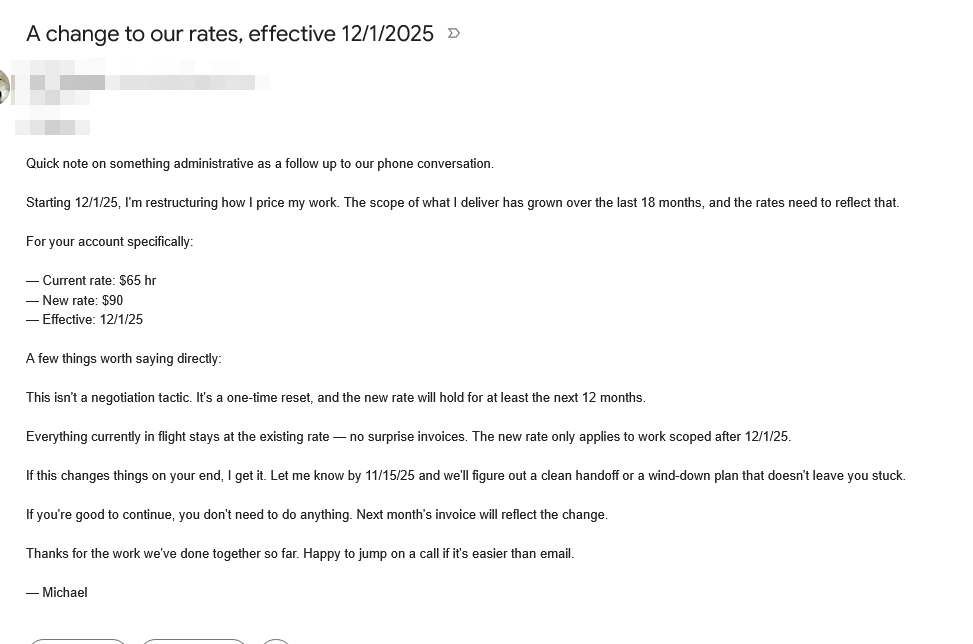
I raised my rates 40% last year and kept 87% of my clients.
Not because I'm special — because I sent the right email.
That email is in FreelancePro Toolkit, along with:
• 4 pricing frameworks
• 8 lawyer-reviewed contracts
• 9 invoice templates
• Onboarding + breakeven calculators
$29. One payment. Yours forever.
https://t.co/OO6sqILkdI
I started carrying a binder to my mom's appointments because the doctors kept asking questions I couldn't answer fast enough.
It worked. So I built it into something other caregivers can use.
Caregiver Binder — because the people doing this work shouldn't also have to be record-keepers from memory.
https://t.co/8VsJBHHYzo
The hidden tax on freelancing isn't taxes.
It's the 47 days between finishing the work and the wire clearing.
Net 30 means net 45. Net 45 means net 60. Every "quick payment" question you don't ask up front costs you a month of cash.
Get paid like a business. Invoice on day one.
The most expensive 48 hours in freelancing are the two days after a client says yes.
Most freelancers spend them celebrating.
Good ones spend them sending a kickoff email that locks down three things: scope, payment terms, and the first deliverable date.
No email = no project. Send it before the contract dries.
Freelancers think discovery calls are about pitching.
They're not. They're about disqualifying.
First question I ask now: "What's gone wrong with the last person who tried to do this?"
If they don't have an answer, they've never hired anyone. Triple the rate.
If they have a long answer, they're the problem. Walk.
Here's the actual rate-raise email — word for word.
No upsell to read it. If you want the other 8 contracts, 4 frameworks, and 9 invoice templates, the link is in the tweet above.
I raised my rates 40% last year and kept 87% of my clients.
Not because I'm special — because I sent the right email.
That email is in FreelancePro Toolkit, along with:
• 4 pricing frameworks
• 8 lawyer-reviewed contracts
• 9 invoice templates
• Onboarding + breakeven calculators
$29. One payment. Yours forever.
https://t.co/OO6sqILkdI
The most expensive thing in freelancing isn’t unpaid invoices.
It’s the client you should have fired six months ago.
Bad clients block better ones. The math is simple.
Most freelancers think saying 'no' kills the deal.
The opposite. Saying no to scope creep is what separates a vendor from a contractor.
Vendors say yes to keep the deal. Contractors hold the line to keep the price.
Guess who gets paid more?
Three things on the workbench, two getting close to ship, one parked. Studio page now lists five. The trick isn't building more — it's resisting the pull to start a sixth before the fifth is done.
Family branding for related products. Distinct branding for unrelated products. Most one-person studios get this backwards — they slap one logo on everything because consistency feels professional. It's not. It's lazy positioning.
Been building small software for people who work alone.
Shipped the first one last month. Pricing, contracts, client ops — the stuff freelancers shouldn't have to learn by losing money. https://t.co/Xt0M9VbEOJ
Next one is in design. Systems, not software. More soon.
https://t.co/d4CbT9v5VD
The fix isn't working more hours.
The fix is raising your rate so 25 billable hours covers the income you need.
That's the entire game. game/set/match.
If you charge $50/hr and work 40 "billable" hours a week, 50 weeks a year:
You'd make $100k. Nice.
Except nobody actually bills 40 hours a week. The real number is ~25.
So your $50/hr is actually $31/hr of take-home reality.
Price accordingly.
Shipped something new today.
I went to replace my furnace filter last winter and realized the internet doesn't actually answer "what size filter does my system take" — it answers "here are 47 affiliate-spam articles about furnace filters."
So I built the tool I wanted.
https://t.co/jFffuioALK — free, no signup, 10 seconds.
Freelancer pricing hack most people miss:
When a client asks "what's your rate?" — don't answer.
Ask "what's the budget for this project?"
You just moved from being compared on hourly rate to being evaluated on value.
Different conversation entirely.