Uganda Doesn’t Need Comforting Statistics. It Needs Honest Answers.
Whenever Ugandans raise concerns about the country’s direction, the response is often the same: a list of numbers comparing today to decades ago.
Yes, there has been progress.
More schools. More roads. More dams. More hospitals.
But numbers are not the same as outcomes.
The real question was never “How many?”
It has always been “How well?”
A country isn’t judged by how many schools it built, but by what those schools actually teach.
Not by how many kilometres of road were laid, but by whether those roads are maintained, marked, and safe.
Not by how many hospital buildings stand, but by whether doctors, medicine, and equipment are actually inside them.
Development is not counted.
It is felt.
Citizens don’t live inside statistics.
They live inside reality.
If electricity generation has grown, why do power bills still hurt and blackouts still occur?
If roads keep expanding, why does traffic still steal hours from people’s lives?
If healthcare is improving, why do families still empty their pockets searching for medicine that public hospitals should already have?
If taxes keep rising, where is the equivalent rise in the quality of public services citizens receive?
Comparing Uganda today to 1986 provides historical context.
It cannot keep serving as the answer.
Not in 2026.
Not after four decades.
Citizens have every right to judge leadership by today’s challenges and tomorrow’s promises, not only by yesterday’s starting point.
Honest criticism is not disrespect.
It is service.
The greatest gift anyone can give a leader is not applause.
It is the truth, spoken plainly, especially when that truth is uncomfortable.
So let this be said clearly.
Uganda does not need comforting statistics.
Uganda needs practical policies.
Policies that make transport affordable, not just available.
Policies that lower the true cost of doing business.
Policies that improve the quality of education, not just enrolment figures.
Policies that ensure hospitals have medicine, equipment, and enough healthcare workers.
Policies that place the ordinary Ugandan, not the statistic and not the slogan, at the centre of every national plan.
History will remember the numbers.
The people will remember whether their lives got better.
That is the only scoreboard that has ever mattered.
#Uganda #GoodGovernance #PublicPolicy #Development #PeopleFirst
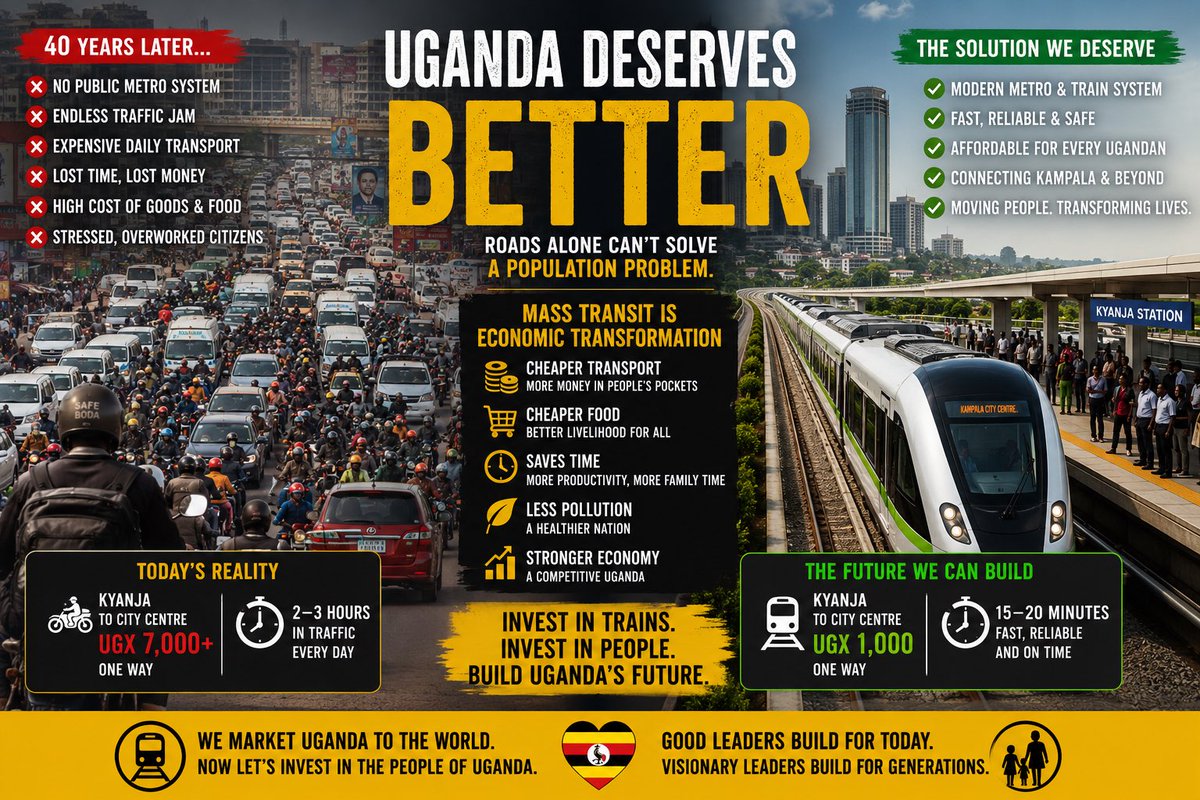
Forty years later, and Kampala still has no modern public metro or urban rail system. That should trouble every Ugandan.
We keep celebrating new roads, flyovers, and wider highways as symbols of progress. But building four lanes, six lanes, or even ten lanes will never permanently solve traffic congestion if the number of people and vehicles keeps growing every year. Roads alone cannot keep up with a rapidly expanding population.
The boda boda industry has become the transport system that millions rely on, not because it’s the ideal solution, but because there has never been a serious long-term alternative. Instead of treating this as a national transport challenge that requires investment in mass transit, governments have largely managed the symptoms while leaving the root problem untouched.
Imagine if Uganda had invested in a proper metro or commuter rail network years ago. Imagine reliable trains connecting Kyanja, Ntinda, Bweyogerere, Entebbe, Nansana, Mukono, Wakiso and the city centre. Imagine major rail corridors stretching from Kampala to Masaka, Jinja, Mityana and other regional towns, supported by efficient feeder buses.
A commuter who spends UGX 7,000 or more every day could instead pay around UGX 1,000 to reach the city quickly and safely. That difference isn’t just spare change. It is money that could go toward school fees, food, rent, healthcare, or savings. Multiply that by millions of journeys every month and the impact on household incomes would be enormous.
Mass transit is not just about moving people. It is an economic policy.
Farmers would transport food to Kampala more cheaply. Businesses would lower distribution costs. Workers would spend less time trapped in traffic and more time with their families or earning a living. Companies would become more productive. Pollution would fall. Fuel consumption would decrease. The entire economy would become more competitive.
Instead, we continue asking ordinary Ugandans to carry the burden through expensive transport costs, endless traffic jams, and daily uncertainty.
A country that truly prioritizes its people invests in infrastructure that improves everyday life, not just infrastructure that looks impressive in photographs. Cities around the world learned long ago that roads alone cannot solve congestion. They invested in trains, metros, trams, and integrated public transport because they understood that moving large numbers of people efficiently is what keeps a modern economy alive.
Uganda has incredible tourism potential. We proudly market our country to the world. But shouldn’t some of the wealth generated from tourism and national development also be invested in the people who make this country function every single day?
The boda boda rider, the teacher, the nurse, the market vendor, the mechanic, the security guard, the student, and the office worker deserve a transport system that respects their time and their income.
Development should not be measured only by the number of roads we build. It should be measured by whether an ordinary Ugandan can afford to move around, save money, and improve their quality of life.
Ugandans deserve more than endless traffic, rising transport costs, and promises. They deserve a transport system built for the future.
A modern metro and commuter rail network should no longer be treated as a luxury. It should be seen as a national priority. #UgandaTraffic #PublicTransport #MassTransit #MetroForUganda #UrbanPlanning #Infrastructure #TransportReform #RoadSafety #MobilityMatters #EconomicDevelopment #SustainableCities #BetterUganda
A dictatorship does not arrive with a drumroll. It arrives with applause.
It begins with roads emptied because one man’s convoy must never slow down.
It grows when criticizing the powerful becomes increasingly risky, and silence becomes the safest language.
It matures when the military’s presence stretches beyond the barracks and into the daily machinery of civilian government.
It hardens when civilians can once again face trial before military courts, not because justice demands it, but because power permits it.
It whispers to journalists before it shouts at them. A suspended newsroom here. A threatened reporter there. A headline rewritten. A story never published. Eventually, censorship no longer needs an order. Fear does the editing.
Then comes succession. Not through open competition, but through careful preparation. A son spoken of in whispers today, expected tomorrow, as though a republic were an heirloom to be inherited instead of a trust bestowed by citizens. History has always warned us that liberty is rarely stolen in one spectacular act. It is negotiated away, one exception at a time. One emergency. One amendment. One justification. One salute.
We study countries where uniforms overshadow constitutions and ask, “How did they get there?”
The more uncomfortable question is this:
When a nation normalizes military influence in civilian life, shrinking civic space, fear of criticizing those in power, and the concentration of authority, at what point does it admit what it has become?
Or will Uganda wait until the final announcement, when someone simply declares martial law and everyone pretends they never saw it coming?
“Freedom is rarely taken overnight. More often, it is surrendered one compromise at a time, until the extraordinary becomes ordinary.” #uganda #PLU #muhoozi #museveni #northkorea #Korea
They’re saying Anita Among could be taken to court. If that’s true, the real question is: are we fighting corruption or just choosing who to sacrifice?
For decades, billions disappeared before social media ever exposed government spending. Will everyone who stole public money be held accountable, or only a select few?
Uganda’s biggest problem isn’t one individual. It’s an oversized government, duplicated offices, too many MPs, poor accountability for public funds and foreign aid, expensive electricity despite the dams, and endless waste of taxpayers’ money.
Selective justice won’t fix Uganda. Equal accountability and cutting government waste will.
Chairman @norbertmao you’ve gone unusually quiet lately.
Do you have the courage to condemn the continued delay of justice for Dr. Kizza Besigye and Dr. Hajj Obeid Lutale, and now Salongo Lukwago, or is your voice only loud when you’re in the opposition?
Justice delayed is justice denied.
#UgandaJudiciaryExhibition #muhoozi #ugandaisbleeding
There will be no justice here, and it’s time we call a spade a spade. You cannot keep asking for fairness from the same system that deliberately chained these people in the first place. It makes no sense praying to the same devil that created the problem and expecting salvation. The decision was likely made long before anyone entered that courtroom. Instead of wasting time pretending institutions are independent, maybe it’s time people start thinking seriously about a real way forward beyond the illusion of justice.
@BalaamBarugahar history has never been kind to those who spend their time defending power instead of standing with truth. Today you may feel protected by the system, but remember this: leaders come and go, regimes change, and the consequences of blind loyalty often outlive the people making these decisions. If not you, future generations connected to this era will carry the burden of explaining why so many chose praise over principle. Power is temporary. Accountability has a longer memory.
Good that @UN@UN_Spokesperson finally noticed Uganda, but spare the fake concern. Where was this outrage when Israel hit Iran and Lebanon, or when USA bombed Iran?
In 2026, the UN still survives on statements while people die. No action, no accountability, just press releases and selective morality.
At this point, many see the UN less as a peace body and more as a machine that watches chaos, because somehow instability in places like Democratic Republic of the Congo and Sudan always seems to keep certain interests very comfortable.
This is genuinely commendable. Government exists first and foremost to serve and protect its citizens, and seeing Ugandans safely brought home is the kind of leadership people expect. Hopefully this sets the standard for all other government agencies, because citizens should always come first, not last on the priority list. Public service should actually mean serving the public… revolutionary idea, apparently.
So if these talks succeed, what happens to the families who buried their children, the cities turned into dust, and the thousands of innocent lives lost? America helps light the fire, watches the world burn, then suddenly wants credit for bringing peace. Quite the business model. Maybe instead of calling the US the world police, we should start asking whether it has become the world’s most efficient manufacturer of chaos. #IranWar
Interesting logic. So if drug abuse exists, blame foreigners. By that same reasoning, should gun violence be blamed on Russia and United States because they manufacture most of the guns? The real issue here is failed education, weak institutions, and leaders feeding people convenient scapegoats instead of solutions. If the rest of Africa ever decided to isolate South Africa economically, they’d quickly realize continental solidarity works both ways. You can’t benefit from Africa while treating fellow Africans like a problem.
Interesting words. Yet while talking youth opportunities, NMG closure alone wipes out 300+ jobs, investors keep getting scared off by policy unpredictability, imports face layers of taxation that choke businesses before they even breathe, infrastructure gaps remain embarrassing, and electricity costs punish anyone trying to manufacture locally. Exactly how do agro-industrialization and entrepreneurship thrive under these conditions? Speeches are cheap, the economy unfortunately is not.
Since we are discussing 250 years of American innovation and freedom, maybe also explain the innovation behind supporting leaders who protect American interests while millions of citizens remain trapped under systems that deny them actual freedom. If what happened to Nicolás Maduro can happen when Washington decides enough is enough, what makes certain leaders here think history can’t repeat itself? Freedom seems to travel with conditions attached. The double standards deserve their own anniversary too.
Legacy is a funny thing. Some leave behind schools, hospitals and inspiration. Elly Tumwine left behind fear, bloodstained history, and a masterclass in how power can outlive conscience. But sure @TheeNinjaC , defend it proudly, not everyone gets to inherit such… unforgettable contributions to the country.
Quick question to the summit… did Uganda’s CDF @mkainerugaba attend? Because Africa surely can’t miss out on learning these revolutionary new security tactics: arresting old women, intimidating civilians, and somehow calling that national defense. It would be selfish not to share such groundbreaking expertise with fellow CDFs.
The bigger question here is whether @DaudiKabanda can actually read and comprehend the attached reference, judging by that O-Level result slip that recently surfaced. Because quoting ‘from now on, ALL media will follow the rules’ is easy… understanding the laws that already exist seems to be the real exam, and some people have apparently been failing those for years.
Indeed, it all comes down to priorities. You have a country with over 80 ministers and state ministers, hundreds of MPs all consuming billions in salaries, allowances, convoys, fuel, workshops and the endless buffet of government spending… then somehow we’re told decent housing for the very officers expected to enforce law and order is a luxury.
If government simply cut that bloated structure by half, the savings over time would run into trillions of shillings, money that could go into proper housing, better welfare and dignified living conditions for security personnel.
You can’t keep preaching patriotism to officers while housing them like temporary construction materials. The issue has never been lack of money. In Uganda, sadly, it has always been about where those in power choose to put it.