She is Dr Vatsala Agarwal.
In August last year, she was appointed Director General Health Services of Delhi. She wasted no time and immediately started buying medicines and equipments at highly inflated rates by allegedly manipulating the tender processes, misusing hundreds of crores in public funds. By the time the Delhi police arrested her today, she had already allegedly created a health scam worth 600 crores.
Almost everyone in govt service, from top to bottom, seems to make massive money whenever an opportunity arises. Imagine the scale of systemic corruption if a single official can siphon off 600 crore rupees in less than a year. And it's not like she was honest for her 30 years of service till now, and suddenly turned corrupt; she only got caught now. Her life long scam would be much more than 600 crores.
It is truly surprising that India continues to grow despite such staggering leaks in the system.
The hotel Flourish Stays in Malaviya Nagar, where the fire incident has killed 21 people so far, had permission for only 6 rooms but was operating 25. It didn't have fire safety clearance either.
No surprises. I'm sure 90% of hotels operate like this. MCD knows, they come for inspections, take their cut, and leave. It's only after such tragedies that these irregularities make the news.
Will the police arrest any MCD officials responsible for ensuring that hotels operate as per the norms? No way. They'll probably arrest the hotel's restaurant cooking staff because the fire apparently started in the kitchen.
An old man in our neighborhood died today. He was hospitalized with chest pain three days ago, underwent angioplasty, but passed away in the ICU. His wife had died during the COVID wave, and he had been living alone since then.
His only son lives in Australia and couldn’t come to see his father. Now, I’m not saying that the son is uncaring or abandoned his parents. I don’t know him. Maybe he is really a nice man. The elderly couple used to visit him every year and spend a few months with him. But maybe once you build a life outside, you can’t really come back. Life, distance, responsibilities, things become complicated.
The son hadn’t come to India in nearly 10 years. He couldn’t come for his mother’s last rites due to COVID travel restrictions, and I don’t even know if he’ll be able to come now or will have to arrange his father’s last rites from there itself.
This has stayed with me all day. To think of an old man spending his final years largely alone, losing his partner, and then leaving this world without his son by his side. Even as an unrelated observer, the whole thing feels unbearably sad.
Brigadier VK Joshi, 70, served the Army for three decades, survived war and multiple counterinsurgency operations, but lost his life to a stray bullet in a pointless clash between a group of urban dehatis.
A Delhi-registered Fortuner overtook a Scorpio N on Mussoorie Road in Dehradun, which hurt the ScorpioN occupants ego. The ScorpioN occupants gave chase. When the Fortuner didn’t yield, the ScorpioN group of urban dehatis pulled out a pistol and started firing.
At that very moment, Brigadier Joshi was out on his morning walk. A bullet from that reckless exchange found him. His friends rushed him to the hospital, but he was declared dead on arrival.
A life of service ended by someone else’s arrogance. As far as the urban dehatis are concerned, I'm sure they'll be out on bail in no time.
Ethanol producers have urged the govt to increase ethanol blending from E20 to E30.
A country of selfish, opportunistic, greedy people. Except for maybe a few BMWs, no vehicle in the country is designed to run on E30.
Logic says the govt should bluntly tell the ethanol lobby to shut up and stay in their lane, but since we’ve already seen them push E20 without phasing out non-E20 vehicles, I won’t be surprised if they start considering the E30 demand.
Going by appearances, he looks like the boy next door. An ordinary, middle-class, soft-spoken, sincere, studious, well-behaved young man.
That is the unsettling part. Someone so ordinary, so indistinguishable from thousands of other students, allegedly living a parallel life online, using Gen-Z platforms like Discord, Session and Instagram to propagate ISIS ideology and the idea of establishing a caliphate in India.
He is Haris Ali, a second-year BDS student from a dental college in Moradabad, arrested by the UP ATS. Investigators allege he was linked to an ISIS module and was mobilizing people through social media and encrypted apps.
Another quiet addition to the comforting theory that education can eliminate terrorism.
These are the students who were evacuated by the Indian embassy from the war epicenter in Tehran to a safer city on taxpayers’ money.
And now they want India to evacuate them urgently to India, despite fully knowing that the airspace is closed.
See their body language. I want to say a lot about this level of entitlement, but what’s the point? The govt doesn’t see these things the way the rest of the world handles such situations, but as an opportunity for good PR for themselves. So I’m sure they have already seen these videos and are now planning how to go about the evacuation ASAP.
Deeply saddened by the tragic loss of Tarun Kumar in Uttam Nagar. It’s heartbreaking that something as small as a child throwing a water balloon during Holi could escalate into such violence. Humanity should never fall to this level. Prayers for his family and hope the culprits face the strictest punishment.
Consistently India’s most valuable player. Ice in the veins, surgical precision in the hand. Match after match, always works, almost no bad days.
Hats off, Jasprit Bumrah! A bowling superstar in a country obsessed with batting.
The Iranian women’s football team refused to sing the regime’s anthem, and fans waved Shah-era flags at the Asian Cup opener last night.
Strange! Don’t they follow Afra, Ravish, Rathee types? They have been saying that regime is good for them. Aren’t they supposed to be mourning and wearing black bands in support of the regime?
So many Indian liberals and feminists keep lecturing Iranians on what they should feel, yet Iranians don’t seem to be taking instructions.
White LED modified headlights are not “cool”, they are dangerous.
These high-intensity beams blind oncoming drivers for a few critical seconds. At highway speeds, even 2–3 seconds of glare can mean a fatal crash. Two-wheelers, elderly drivers and pedestrians are at highest risk.
This is not styling, it’s a safety hazard.
Government must ban such illegal modified lights across India before more lives are lost.
Joyride collapsed at the Surajkund Mela, Faridabad. Two killed, twelve injured.
Another reminder to never, ever do adventure rides or sports in India. Here, most adventure rides are temporarily assembled, poorly audited, and run on jugaad, not engineering. Safety checks are formality; accountability starts only after deaths and ends with a few suspensions or temporary arrests, some compensation, some condolences and the announcement of a “high-level inquiry."
Saw attempts to dehumanise Yuvraj Mehta by claiming that he was drunk and overspeeding. Why? To dilute institutional liability?
Idk whether he was drunk or overspeeding, but even if that’s true, it changes nothing. He had the same right to be rescued.
Even if a person is negligent, reckless, or at fault, the state does not get the right to abandon him. Law functions on two separate principles: responsibility for the act, which is decided later through due process, and the right to life and rescue, which is unconditional and immediate.
A drunk driver is still entitled to emergency response, rescue services, and medical aid. If negligence cancelled those rights, accident victims would be denied treatment, suicide attempts would not be saved, and helmetless riders would be left to die.
Civilised systems do not function this way. Even if Yuvraj Mehta made a mistake, the authorities’ duty began the moment his life was in danger, not after judging his character. Punishment comes after survival, not instead of it. A society that debates a dead man’s morality instead of questioning institutional failure has already lost its moral compass.
Never imagined I’d share the stage with my childhood hero #SonuNigam Bhaiya♥️
Co-singing #GharKabAaoge the very song he sang 27 years ago is a moment I’ll carry with me forever. ♥️
This is for my country ! ♥️🇮🇳
On Dec 17, at #KGMU (Lucknow), a female resident doctor accused a male colleague, Dr. Rameezuddin, of hiding his marriage, exploiting her, and pressuring her for religious conversion.
The KGMU administration was meant to be her first line of support but failed to act in time. But once the issue moved beyond the university walls, the Yogi govt acted promptly and decisively.
An FIR was registered, a ₹50,000 reward was announced on the absconding accused. Soon the accused and some family members were arrested, property-attachment notices were issued, and the STF was tasked with probing the forced-conversion angle. The speed and clarity of the response stood in sharp contrast to the institutional delay.
This approach aligns with UP’s broader crackdown on alleged #lovejihad and illegal conversion networks. With a stringent anti-conversion law enacted in 2020/2021 and strengthened through amendments, the state has consistently enforced the law, registering thousands of cases and making large numbers of arrests, signalling that deception and coercion will not be tolerated.
By the way, the STF has today found this accused doctor Rameezuddin’s link with the Delhi Red Fort blast organiser doctors as well.
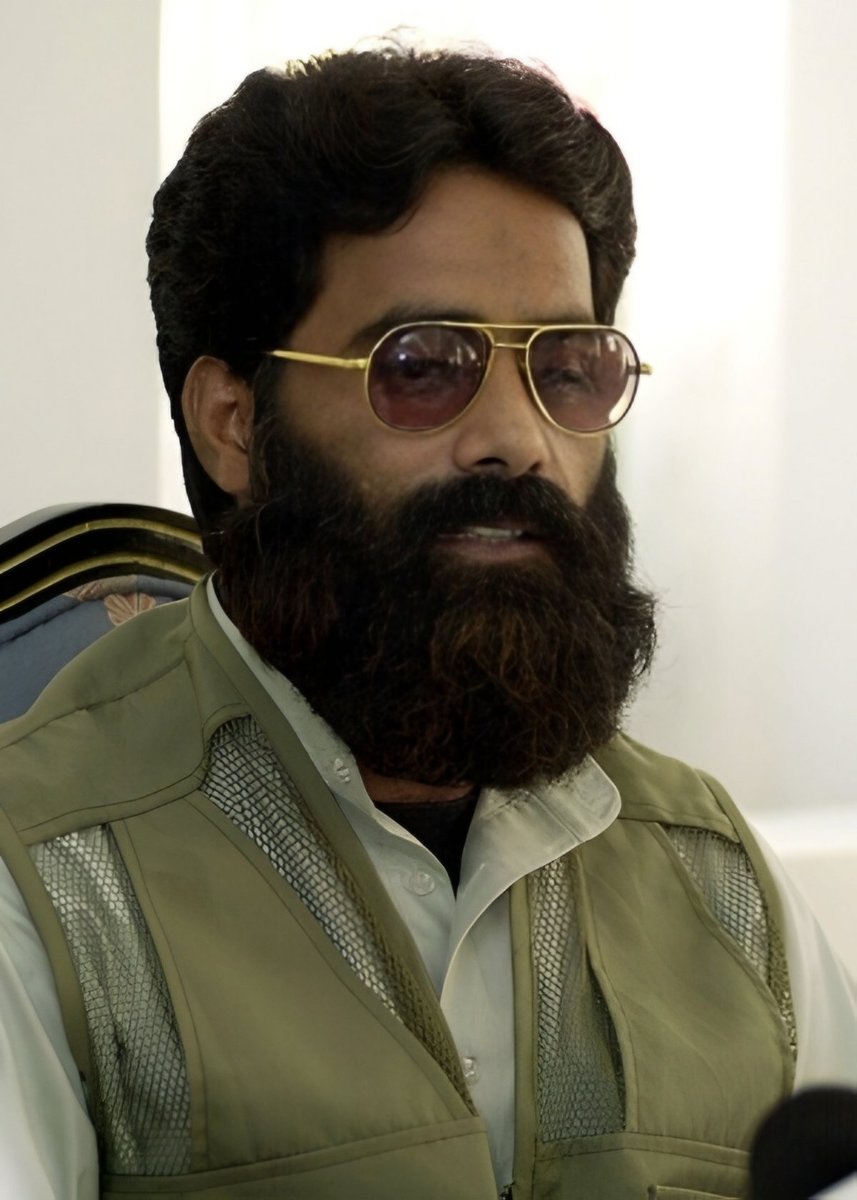
He was Ilyas Kashmiri, a Pakistan Army SSG operative turned terrorist.
In the early hours of 27 Feb 2000, he led a 25-member team of Pakistani soldiers and terrorists in a cowardly assault on an Indian Army post of 17 Maratha LI in the Nowshera sector. The post was tactically indefensible, surrounded on three sides by Pakistani positions. The CO had flagged this fatal flaw and sought permission to pull the post back but was denied by his superiors.
Seven Indian soldiers paid with their lives. After killing them, Kashmiri beheaded Sepoy Bhausaheb Maruti Talekar. The severed head was carried across the LoC, paraded as a trophy before a cheering crowd, and then kicked around like a football.
For this act of medieval barbarism, Pakistan’s then president, Pervez Musharraf, publicly honoured Kashmiri and rewarded him with ₹1 lakh Pakistani for bringing back the head of an Indian soldier.
Sepoy Talekar was cremated in his village without his head. His sister begged to see her brother’s body last time. The Army obviously refused.
This is who we are dealing with: a religiously radicalised army-state that celebrates sadism, institutionalises hatred, and teaches its men that the more brutally they butcher their enemies, the greater their reward, on earth and in heaven.
And yet, sitting comfortably on this side of the border, protected from every real consequence of war, are elite idiots who romanticise this force as “professional soldiers just following orders.”
“Kaun dushman?” My foot.
Avyaan was six months old.
He was born this year after ten years of waiting, prayers, hope, and countless visits to infertility clinics by his parents. For the family, his arrival was pure joy.
Avyaan was healthy, but his mother could not produce breast milk due to a medical reason. She was advised to give diluted cow’s milk. Ideally, infant formula is the substitute for breast milk, but because of cost, some families choose cow’s milk. In such cases, doctors may advise diluting it with boiled and cooled water.
I don't know who advised the family or what exact instructions were given, but it is entirely possible that, out of ignorance, cow’s milk was mixed with tap water, instead of boiled-cooled water. People tend to trust municipal water supplies, often the only thing they believe the govt will provide honestly.
Five days ago, Avyaan developed fever and diarrhoea. The family took him to a doctor and medicines were prescribed. They believed it would pass. Instead, his condition worsened steadily, and he died on Monday.
Only later did the truth emerge. The water supply in Bhagirathpura, Indore, was contaminated with sewage. Several others died as well. The family realised, too late, what may have poisoned their child. They are numb, trapped between disbelief and unbearable guilt, replaying every small decision and wondering what they missed.
Could boiled and cooled water have saved him? Maybe. Maybe not. Many bacterial toxins are heat-stable, and sewage can also contain heavy metals, nitrates, and other contaminants that are not removed by boiling.
Will anyone in authority be held accountable for this institutional, negligent killing? Will this tragedy lead to any real improvement? Will even one person step down, accepting moral responsibility?
Kailash Vijayvargiya’s response to NDTV already answers all of that:
“Ghanta.”
A 22-year-old woman residing alone in a gated apartment complex in Bengaluru hosted a small, quiet get-together with a few friends at her own flat. There was no loud music or disturbance.
But the gathering drew the attention of “society uncles,” who were probably keeping a watch on her daily routine, and who confronted her late at night, questioning her conduct and her right to have guests. They told her that bachelors aren’t allowed in the society and asked her to call the owner of the house. When she calmly told them that she herself was the owner of the flat and was not violating any rule, the situation escalated further, with several committee members entering her home without consent, accusing her of drinking and smoking.
Parts of this confrontation were captured on CCTV cameras installed inside her flat for safety, footage that later became central to her case. The society members eventually called the police, but after verifying that no nuisance was being created and that the woman owned the flat, the cops took no action.
Rather than letting the episode pass, she chose to pursue legal remedies, sending notices for harassment, trespass, and intimidation. An urgent society meeting was called the same evening, where video footage from her living-room camera was screened before residents. Following this, the accused members were removed from their positions on the society board and fined Rs 20,000 each for violating bylaws. A written apology was issued to her.
She was not letting it pass this easy though. Next, she filed a ₹62-lakh civil suit, seeking compensation for mental trauma and reputational harm, along with a permanent injunction to prevent further interference.
I hope she wins. This case will be landmark in India because it legally challenges the unchecked authority of RWAs, clearly establishing that society committees have no right to police personal behaviour inside a privately owned home. By treating moral policing as actionable civil harassment with financial consequences, it will set a deterrent precedent and strengthen individual residential autonomy.