President Boko presses ahead with his ambitious agenda for radical economic transformation and diversification, undeterred by the opposition’s austere and conservative views.
The Ministry of Youth and Gender Affairs has officially unveiled the Youth Entrepreneurship Development Programme (YEDP). Approved by Cabinet on 28 October 2026, the comprehensive framework replaces the traditional one-size-fits-all approach of the former Youth Development Fund (YDF) with a tailored, ecosystem-driven model designed to build enduring, job-creating enterprises across Botswana.
At the heart of the new programme is the recognition that young Batswana aged 18 to 35 do not all start from the same socioeconomic footing. Consequently, the YEDP introduces a structured profiling system that matches beneficiaries to six distinct financial and developmental packages based on their readiness, location, and business scale.
https://t.co/mHRloUJBDU
President Boko, quoting the book of Mark Chapter 4 verse 30 to 32, likens Botswana and its people to the Mustard seed which is the tiniest of seeds yet grows into a large garden plan. A message of hope and growth that despite our humble stature, we strive for greatness.
President Boko emphasized during his State of the Nation address that Infrastructure is central in making Botswana attractive for foreign investment and highlighted key areas of infrastructure development advancing his drive for industrialization of the nation.
After enduring an economic contraction of 2.8 percent in 2024 and 0.7 percent in 2025, gross domestic product showed signs of stabilization, recording an 8.7 percent year-on-year expansion in the second quarter of 2026. This headline rebound was heavily tilted toward a temporary 81.7 percent surge in mining and quarrying, while the non-mining domestic economy contracted by 0.2 percent. The real challenge lies in public finance. Diamond revenue revisions and compressed Southern African Customs Union receipts—which fell 9.4 percent—have sustained pressure on the national budget, yielding a projected 2026/27 fiscal deficit of 8.9 percent of GDP and pushing public debt to a projected 44.7 percent of output.
https://t.co/2BtMlHaX4w
The point now is to change the world!
President Boko at the Parliament Leadership Retreat today emphasized that poverty is alienation. Boko posits that available data on societal inequality should be leveraged to formulate ways to increase resources available as opposed to debating and deliberating over how the scarce resources should be used. He calls for productive transformation from parliament.
President Boko during his public lecture on children’s protection and children’s rights discussing the common law rule that an unwed biological father is, under Roman Dutch common law, the equivalent of a third party without rights or say over the child. He discusses it in the context of the case of Mfundisi v Kabelo. He also touches on the principle of constitutional avoidance practiced by the Courts in Botswana.
Expanding on his broad vision for child protection and social justice, President Duma Boko has called for a national debate on the fundamental legal and physical definition of a "school," arguing that socio-economic status must never dictate the quality of learning infrastructure or basic welfare provided to children in Botswana.
Speaking during his masterclass address, the President shifted focus to socio-economic rights, urging the nation to establish and enforce clear minimum standards for educational facilities and nutritional support.
Rethinking What Constitutes a "School"
President Boko challenged existing disparities in educational infrastructure, asserting that the term "school" cannot merely refer to four walls and a roof, but must guarantee a dignifying environment equipped with baseline facilities regardless of geographic or economic setting.
https://t.co/u9FU2KTSUk
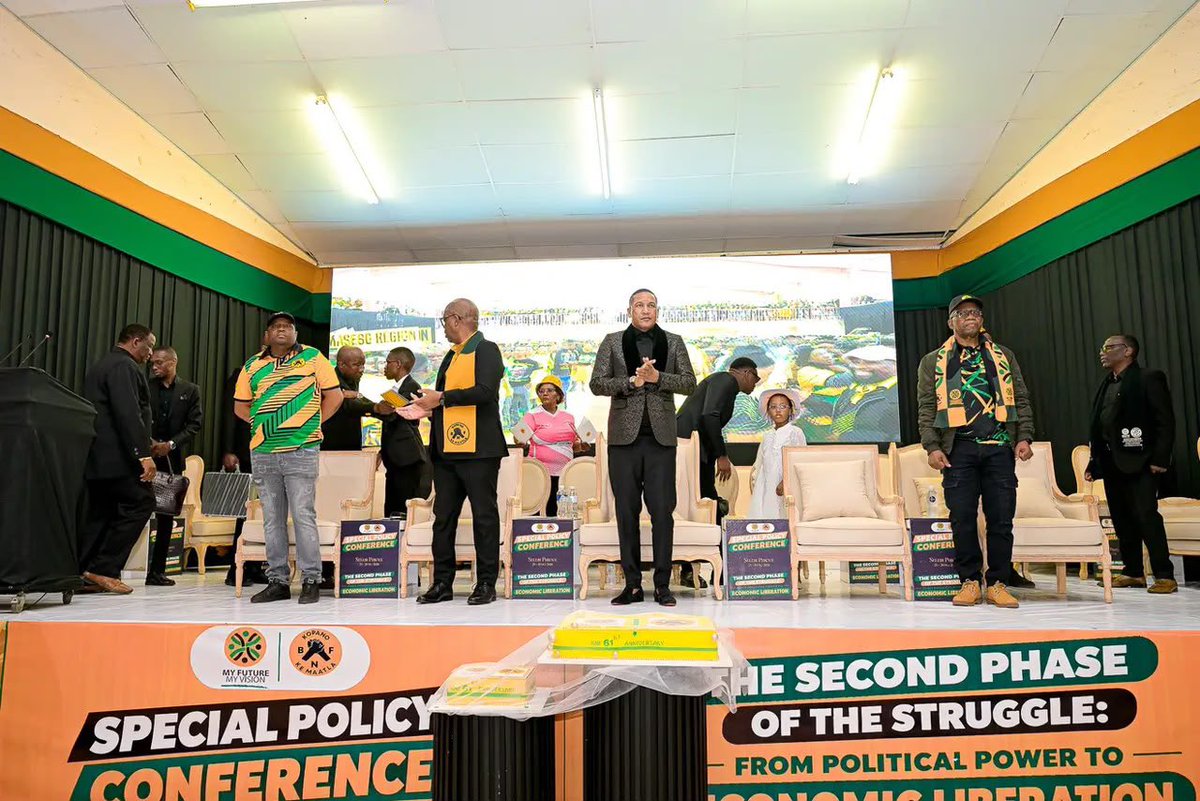
President Duma Boko called for policy reforms aimed at driving economic transformation during the Botswana National Front (BNF) Special Policy Conference held on Saturday.
The conference brought together party members to deliberate on the party’s policy direction, review existing positions, and consider proposed changes aimed at strengthening its approach to key national issues.
Boko’s call for reforms placed economic transformation at the centre of the discussions, highlighting the importance of reviewing policy frameworks to ensure they supported Botswana’s development ambitions and responded to the needs of Batswana.
https://t.co/agT9yN9uZ6
A high-stakes legal battle over the resuscitation of Botswana’s public service collective bargaining machinery has reached a definitive conclusion. In a judgment delivered by Justice B. Maripe in the High Court of Botswana, the National Amalgamated Local and Government and Parastatal Workers Union saw its comprehensive legal challenge against the Director of Public Service Management (DPSM) and several other trade unions dismissed with an order for costs. The ruling effectively protects the newly minted Public Service Bargaining Council (PSBC) Constitution and validates the transitional structures created to operationalise it, dealing a blow to the applicant union's attempts to tear down or rewrite the labor framework.
Summarizing the Dispute and the Ultimate Outcome
The core controversy arose as a direct sequel to earlier litigation before Justice Lekorwe, centering on the legality of a January 2026 meeting and subsequent decisions made regarding the administration of the newly revived PSBC. The applicant union launched a two-pronged legal attack via a Notice of Motion. Under its primary claim, the union sought declarations confirming the validity of the PSBC Constitution and its own status as a founding member, while simultaneously asking the court to nullify a January meeting, strike down the appointments of the newly appointed Secretary and Deputy Secretary, and compel the convening of a specific meeting under strict court-ordered parameters. In the alternative, under what was dubbed by counsel as the "nuclear option," the applicant demanded that the entire PSBC Constitution be declared incurably bad, null, and void, which would have sent all negotiating parties entirely back to the drawing board.
https://t.co/u4VkFC4tO0
The primary purpose of a trade union is both noble and simple: to champion workers’ rights, negotiate fair wages, improve workplace conditions, and protect employees from arbitrary exploitation. Historically, organized labor in Botswana has served as an indispensable pillar of social justice. In recent times, however, a noticeable shift has taken place across the national landscape. Trade unions increasingly appear to be stepping away from workplace advocacy and stepping into political power plays, casting doubt over whether they remain authentic representatives of the workforce or have morphed into self-serving political instruments.
The Politics of Endorsement and Public Feuds
The politicization of organized labor is far from a new phenomenon in Botswana, but its manifestations have become increasingly overt. A defining milestone in this trend occurred when Johnson Motshwarakgole, the longtime unionist and chief executive voice behind the National Amalgamated Local, Central Government and Parastatal Manual Workers Union, publicly backed former President Mokgweetsi Masisi. His famous declaration that "Masisi o ka nwega moro"—implying that Masisi was a leader worth rallying behind—sent shockwaves through both the labor movement and the political establishment. Critics inside and outside union structures argued that such an explicit political endorsement compromised the movement’s prized neutral stance, effectively binding workers' collective identity to the electoral fortunes of a single politician.
https://t.co/eYJWYmbQlf
Indigenous rights activist Roy Sesana has been conferred an honorary Doctor of Letters (Honoris Causa) by the University of Botswana. The ceremony, attended by President Advocate Duma Boko, celebrated a lifetime spent defending the rights, heritage, and ancestral lands of the San people of the Central Kalahari Game Reserve (CKGR).
For decades, Sesana’s life was defined by intense legal and political resistance against the state. His recognition marks a profound shift from decades of marginalisation toward national validation of Indigenous rights.
https://t.co/B0tOMdjyEW
The Gaborone High Court dismissed with costs an application by the National Amalgamated Local, Central Government and Parastatal Workers’ Union (Manual Workers Union) challenging the governance arrangements of the Public Service Bargaining Council (PSBC).
In a statement released on October 16, 2026, the Office of the President confirmed that the court dismissed the application in its entirety, upholding the legality of the PSBC Constitution and key aspects of the council’s governance structures.
https://t.co/k6Fg5CoGjU
Botswana moved to unlock new trade opportunities in China, with citrus exports emerging as a key focus area during President Advocate Duma Boko’s first State Visit to the Asian economic powerhouse at the invitation of Chinese President Xi Jinping.
The visit signaled Botswana’s ambition to expand its agricultural export footprint, strengthen bilateral economic cooperation, and position local producers to capitalize on China’s vast consumer market.
https://t.co/4Lcl8qSIyd
President Duma Boko’s State Visit to the People’s Republic of China marked a key milestone in his administration’s effort to pursue strategic international partnerships aimed at accelerating Botswana’s economic transformation, strengthening bilateral relations, and unlocking new opportunities for sustainable development.
President Boko and his delegation traveled to China following an invitation from Chinese President Xi Jinping. The visit was focused on deepening strategic cooperation and advancing shared priorities for the mutual growth and development of both nations.
The engagement reflected Boko’s progressive leadership approach, which places international cooperation at the center of Botswana’s ambition to diversify its economy, attract foreign investment, and establish new pathways for industrialization.
https://t.co/ahugWgwEMf
Court documents in the criminal case involving former Cabinet minister and Botswana Democratic Party (BDP) president Mpho Balopi have provided further details of allegations of fraud and money laundering involving millions of pula in Citizen Entrepreneurial Development Agency (CEDA) funding.
Balopi who was recently charged, appeared this morning at the Regional Magistrates Court before.
According to the charge sheet, Balopi, several companies and other individuals are accused of allegedly making false representations to CEDA in connection with projects for which funding was sought.
One of the allegations concerns P837,302.64, which prosecutors allege was unlawfully obtained after CEDA was allegedly led to believe that the money would be used for construction and advertising-related activities.
https://t.co/Ez6cPHRfby
Former Minister of Transport and Public Works Eric Mothibi Molale has been added as the eighth accused in a corruption case involving the controversial P1.45 billion Ghanzi-New Xade road tender.
The Directorate on Corruption and Economic Crime (DCEC) announced on Tuesday that Molale has been charged with one count of abuse of office, contrary to Section 104 of the Penal Code (Cap. 08:01).
https://t.co/UqpwELj8af
Just days after its official unveiling, the newly launched Duma Boko Primary School in Block 7 is already facing heightened fears of heavy oversubscription, as preliminary indications reveal that parent interest and prospective student registrations have far outstripped the facility's designated capacity.
Designed to accommodate approximately 380 learners across standard and reception classrooms, the state-of-the-art campus has generated unprecedented demand from local residents drawn to its modern infrastructure, STEAM-oriented curriculum model, and advanced digital learning tools. Education authorities and community leaders now worry that the massive influx of applications will leave hundreds of hopeful families turned away, underscoring the severe deficit of modern educational infrastructure in urban centers like Gaborone.
https://t.co/7pTiwqvW3d
Following the official launch of the state-of-the-art educational facility in Block 7, discussions have been held indicating an intention to begin the recruitment process for school staff starting this coming Monday. The recruitment drive marks the next critical phase in operationalizing the newly established Duma Boko Primary School, as authorities move rapidly to prepare the institution for its first intake of learners.
Once the initial hiring process concludes, selected educators and support staff are expected to undergo targeted retraining programs designed to align their teaching methods with the government’s vision for Science, Technology, Engineering, Arts, and Mathematics (STEAM) education. Education officials have indicated that there is a strong possibility the Block 7 facility will serve as a premier pilot school for this upgraded STEAM curriculum, establishing a blueprint for modern learning across the public education sector.
The facility is uniquely positioned to lead this educational model, coming fully equipped with advanced digital and structural infrastructure. The campus features smart boards in classrooms, dedicated computer labs, a modern library, and individual tablets provided for learners to support digital literacy from an early age. To ensure a safe learning environment, the school is also secured with comprehensive CCTV security camera coverage and biometric access controls at the main entrance gates.
https://t.co/IOUvkrPg8P
Energy giant Jindal Power has officially committed to financing the construction of additional schools across Botswana, expanding its social investment portfolio in the country. The first of these newly funded facilities is slated for placement in the Mookane region, a strategic choice that coincides with the area where Jindal is actively developing its 700MW power facility.
The project will operate under a innovative public-private partnership framework designed to accelerate infrastructure development without straining public finances. Under this model, the government’s role is restricted to availing land and establishing standards and compliance benchmarks for the construction. Once these regulatory frameworks are set, African Hero, powered by its Gabane-based manufacturing hub Afri-forge, will handle the production and supply of prefabricated paneling materials and execute the full construction of the facilities.
Upon completion, Jindal Power assumes the financial responsibility of the project, taking on the cost of maintaining the facilities in top condition for at least 20 years. This long-term commitment ensures that the schools do not suffer from the rapid dilapidation that traditionally affects public infrastructure. Under the agreement, the government incurs no capital or maintenance costs, bearing only the operational responsibility of staffing and administering the educational institutions once opened.
https://t.co/0v6JI8tpxT