how to launch anon on 2deep:
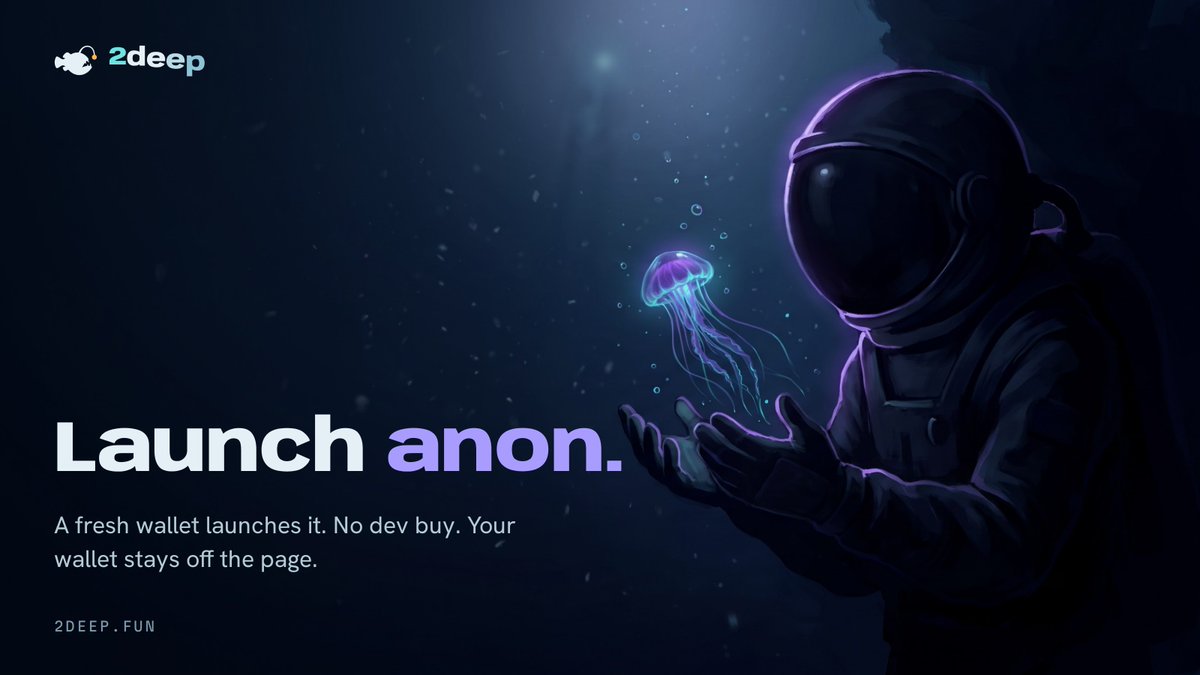
1. go to https://t.co/kvBQKGjzak and set Dev to Anon
2. name, ticker, image, pick your floor and where your fees go
3. sign. it costs 0.05 SOL, paid from your private balance (if that's empty your wallet tops it up first)
4. optional: tick the box and it goes live at a random moment in the next 10 min
then a fresh wallet launches it. no dev buy. the page says Anon dev and your wallet isn't anywhere on it.
after launch: if you picked Keep or Split, your share of the fees goes to your private balance, not a public wallet. if something fails, the 0.05 comes back the same way.
how it usually goes: you find a new token, some wallet already holds 40% of it, and you're the exit.
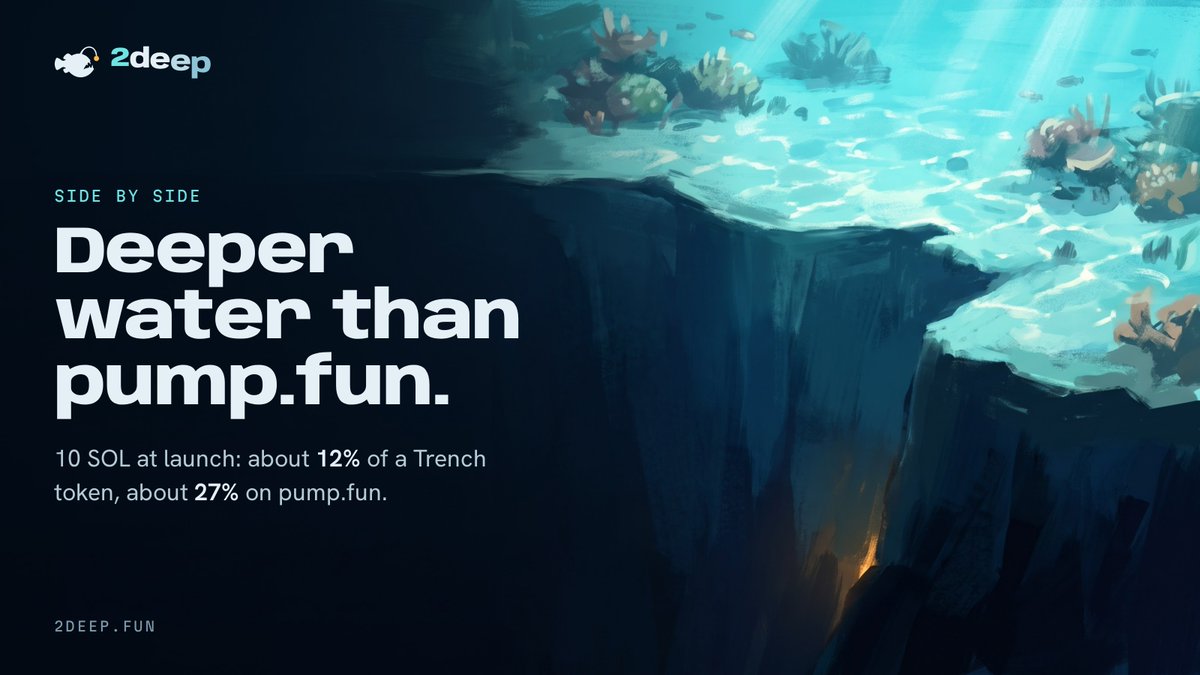
here 10 SOL at launch gets you about 12% of a Trench token. on pump it's about 27%.
yeah, 2deep is bad at turning 2 SOL into a 5x.
doubling from launch takes roughly 30 SOL of buying here. on pump it's about 12.
that's the whole idea. one wallet shouldn't be able to shove the chart around.
old sailor move: throw cargo overboard to lighten the ship.
pick Jettison at launch and your creator fees buy your own token every day and send it to the incinerator. gone for good.
a dev who picks this is telling you something.
you can launch on 2deep without showing your wallet now
Dev trackers are part of the game. The second a known wallet deploys, people either pile in or run, depending on who it is.
Some devs like that. A lot don't. Maybe your last token went badly and you don't want this one judged by it. Maybe you just don't want your main wallet tied to everything you do.
So there's an Anon option on the launch form. Here's what actually happens when you pick it.
A fresh wallet launches the token. We make a new one for every anon launch, and that's the wallet that signs. Your wallet isn't the creator on chain and isn't shown anywhere on 2deep.
You pay privately. It's about 0.05 SOL, paid from your private balance on Helius Privacy Rings. If that balance is short, your wallet tops it up first.
Your share of the fees still reaches you, the same private way. You still pick Keep, Split, Deepen or Jettison like any other launch.
There's no dev buy and no dev allocation. None at all. The token page shows an Anon dev badge so traders know exactly that: nobody bought at launch.
That last part is the deal. You get privacy, and traders get a launch where the dev didn't load up first. We think that's fair both ways.
A few honest notes:
Our server knows which wallet started the launch. It has to, so it can pay you. We don't publish it anywhere.
Timing can give you away. If your token goes live three seconds after you paid, a careful person can match the two. The form lets you go live at a random moment in the next 10 minutes to blur that.
An anon dev can still buy later from another wallet, like anyone else. The promise is about the launch, not forever.
SOL pairs only for now.
Same floor, same fees, same locked pool at graduation as every other 2deep token. Just no name on it.
the floor, explained the way I'd explain it to a friend
On a normal bonding curve every step of the way up is the same depth. The same SOL moves the price the same amount from the first buy to graduation.
That's also why a token can get dumped straight back to where it started. There's nothing in the way.
On 2deep we make a few stretches near the start of the curve deeper than the rest. Think of a river with one deep pool in it. Deep water holds more SOL, so it takes more buying to get through it on the way up, and more selling to get back down through it.
That deep band sits between roughly 80 and 170 SOL of market cap on every token. The launcher picks how deep:
Shelf, 2x deeper than the rest of the curve
Reef, 4x
Trench, 8x, and it's the default
Real numbers, for a token paired with SOL:
Selling back through the floor takes about 49 SOL on Shelf, 65 on Reef and 79 on Trench.
Doubling the price from launch takes about 29, 33 or 36 SOL. On https://t.co/SFc8QS8vfv it's about 12.
Going 5x takes about 81, 87 or 92 SOL. On https://t.co/SFc8QS8vfv it's about 37.
So when someone apes in and then decides to dump on everyone, they run into the deep part and slow down instead of sliding to zero in two candles.
A question we get a lot: if the floor sits at a low market cap, can't someone just buy most of the supply cheap in there?
No. Every floor still sells about 75% of the supply for the same 100 SOL. A deeper floor sells more of those tokens at one middle price instead of handing the bargain to whoever showed up first. On Trench, 64% of the supply is sold inside the floor, so most holders come in at a similar price.
10 SOL at launch gets you about 12% of a Trench token. The same 10 SOL on https://t.co/SFc8QS8vfv is about 27%.
What the floor doesn't do, so nobody's surprised later:
It slows selling down. It doesn't stop it. Enough selling still goes through.
It only helps once the price is above it.
It belongs to the curve. After graduation the curve is finished and the locked pool takes over.
It's not a price guarantee. Tokens still go to zero.
The shape is set when the token launches and written into the pool. Nobody can change it afterwards, us included.
The full numbers, with the real curve drawn out for each floor: https://t.co/PFzibynria
What one buy at launch gets you. 10 SOL is about 27% of the supply on pump and about 12% on a 2deep Trench token. 20 SOL is about 43% against about 23%. One wallet just can't take as much of a token cheaply here.
What it takes to move the price. Doubling from launch takes about 12 SOL on pump and 29 to 36 SOL on 2deep, depending on the floor. Going 5x takes about 37 SOL there and 81 to 92 here.
That cuts both ways, and we'll say it. If you want a token that rips 5x off a couple of SOL, 2deep is worse at that, on purpose. If you want one that doesn't get bundled and dumped in the first minute, it's better.
The first minute. 2deep tokens start with a 50% fee that falls to normal over 60 seconds, and those fees go back to traders, not to the dev.
The platform's money. 2deep pays at least 40% of what it earns back to traders every day, and posts every number.
The dev side. You pick the fee (1 to 10%), the floor, and where your share of the fees goes. You can also launch anon, with no wallet shown and no dev buy.
Neither one guarantees anything. Different shape, different tradeoffs. Pick the one that fits the token you're making.
Not to poop where I eat, but I was scrolling the timeline yesterday and saw a comment @toly made about the Pump Fun bonding curve being "nearly optimal"
As we have done with mutual respect in the past, I challenge Toly on this as I believe his perspective is incomplete. I believe he's thinking like an engineer would on a specific system without taking into account "the whole"
My question would be "optimal for who?"
For Pump Fun, yes. For the fastest wallet in the block, also yes.
For everyone else, not so much.
1. Almost 80% of token supply is sold for 85 SOL (a little over $6,000 at today's SOL price)
2. The first 20% of token supply costs about $500
3. The average price paid across the curve is only 26% of the graduation price. Only 4% of the supply was issued within 25% of graduation price. Almost nothing was bought near the price people see at graduation, so there is no support underneath it.
4. At graduation, curve buyers hold tokens marked at 326(ish) SOL. But the pool only has 85 SOL in it. If they all want to sell, it pays out only 67(ish) SOL. That's 21 cents on the dollar of "value", and much less than they collectively put in.
This is what I mean by "the whole". The curve doesn't end at the graduation, it literally sets the stage for everything that comes after it.
To be fair, this issue isn't unique to Pump Fun. A less than optimal (in my opinion) bonding curve exists on almost every major launchpad.
Credit where it's due: burned LP, no presale, instant liquidity - those are all improvements over what came before.
I just haven't been able to get this comment out of my head since I read it and would love a respectful reply on the topic, @toly .
I am open to my mind being changed when presented with new information. Or - it's also plausible that we are both right, coming at the topic from different points of view.
What do you think, Toly - can you help me understand? I've got stuff to do, and this question floating around my head is distracting.
Love and respect
🫡 🐋
we built 2deep because launchpads keep most of what they make
Every memecoin launchpad takes a cut of every trade. That part is fine. Somebody has to pay for servers, RPC and the people building the thing.
What always bugged us is where the rest goes. The volume comes from traders. The fees come from traders. And almost none of it ever comes back to them.
So we wrote the split into the code.
2deep takes 0.24% of each trade on its curves. Out of what it earns it can spend on three things, and each one has a ceiling:
buybacks, up to 30%
product and UX, up to 15%
marketing, up to 15%
Whatever those three don't use goes back to the wallets that traded. Every day. That's at least 40%, always, and when marketing has a quiet day the part it didn't spend gets paid back that same day instead of piling up somewhere.
You don't claim anything. If your swaps paid 1% of all the fees on 2deep pools that day, you get 1% of what's paid back, in SOL, about two hours after midnight UTC. Splitting into ten wallets gets you nothing extra. It goes by fees paid, not by how many wallets you have.
The other half of 2deep is about liquidity.
Every token gets a floor: a band of deeper liquidity early on its curve that takes a lot more selling to break back down through. The launcher picks how deep it is. Shelf, Reef or Trench, which is 2x, 4x or 8x deeper than the rest of the curve.
Every token graduates at 100 SOL into a Meteora pool, and that liquidity is locked forever. Nobody can pull it. Not the dev and not us.
It all runs on Meteora's programs. We didn't write some custom curve contract you have to take on faith. Once a pool exists we can't change its fee, its floor or its lock, even if we wanted to.
That's really it. Deep pools, and most of the money going back to the people who actually make the volume.
Every day's numbers are public on the returns page: what came in, what each line spent, what got paid back and to how many wallets. The numbers are small right now. We're putting them up anyway, because the whole point is that you can check.
Launch a Solana token in a couple of minutes, on Meteora.
Every token gets a floor you choose: a band of deep liquidity that's hard to sell back through.
Bots pay a 50% fee in the first minute, and that money goes to traders.
You can launch anon. No wallet shown, no dev buy.
155ENqUMyzFwCnPYLpPqydUtddq9cocPkiah8WeF2dp