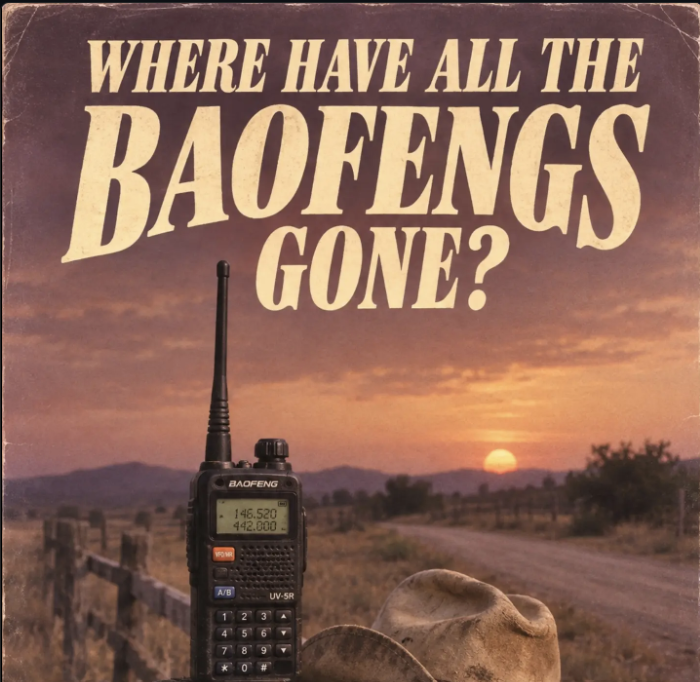
Where the hell have all the Baofengs gone?
If you've been shopping for radios lately, you may have noticed something strange. A bunch of those cheap Baofeng handhelds have suddenly disappeared from Amazon. Listings are vanishing, orders are reportedly being canceled, and people are wondering what the hell is going on.
Well, there's actually a reason.
On October 13, new FCC rules took effect that put more responsibility on online marketplaces to verify that radio equipment requiring certification is actually authorized for sale in the United States. That means FCC identification numbers, equipment compliance, and a closer look at radios capable of transmitting outside authorized frequencies.
And guess what? Some of those inexpensive Chinese radios aren't exactly known for playing nicely with FCC regulations.
Now, before everyone starts screaming about some grand government conspiracy, understand that this doesn't mean Baofeng radios have been universally banned. Some models are still perfectly legal to sell and operate. Others have certification issues, particularly those capable of transmitting across multiple radio services without the proper authorization.
Personally, I think people ought to be paying more attention to something considerably more important than where their favorite $25 radio went.
How the hell are you going to communicate with your family when the cellular networks stop working?
Most people have become so dependent on that little rectangle in their pocket that they've forgotten communication doesn't have to involve a cell tower, an internet connection, or a monthly subscription.
For the average family, I'd seriously consider GMRS. You can use handhelds, mobile radios, external antennas, and repeaters to expand your coverage.
Just understand that range depends on terrain, antennas, and whether repeaters are available. Don't believe the ridiculous 30- or 50-mile claims printed on some radio packaging.
Amateur radio opens up even more possibilities, particularly for longer-distance communication, but it requires additional licensing and a willingness to actually learn something.
The point isn't to panic-buy a pile of radios. It's to have a plan, understand your equipment, and practice using it before you need it.
Because when communications fail, that fancy smartphone becomes a very expensive flashlight.
And the middle of an emergency is a piss-poor time to discover nobody in your family knows how to reach anyone else.
First, thank you for sharing this. Your post has reached many people in Japan and helped us understand what is happening in the United States.
I understand your concerns. In Japan, however, radio equipment has long been subject to technical standards and the necessary regulatory procedures. From that perspective, I can see why restrictions like these may be necessary.
Of course, if they also prevent people from obtaining equipment they intend to modify and verify for compliant use, that deserves discussion. But if the main argument is price, I assume the intended use does not involve spending time and money on modifications and measurements.
These regulations serve a purpose: protecting other communications. Amateur radio operators should understand the importance of spectral purity. I am not claiming that all these radios fail to meet the standards. But neither a low price nor modern technology tells us whether a particular radio complies. For the average buyer, equipment approval is an important indicator of compliance.
I agree that family safety and emergency communications matter. Precisely because they matter, if a radio is essential to protecting your life or supporting your daily needs, you should choose equipment approved for its intended use and treat the necessary expense as part of being prepared.
Acknowledging that regulation limits some opportunities does not justify disregarding it for personal benefit. If a rule is flawed, we should seek to improve it. But necessity and affordability alone do not justify setting aside the impact on other spectrum users.
I agree with your advice to plan ahead, understand your equipment, and practise before an emergency. That preparation should also include choosing equipment you can legally operate, building or modifying equipment within the applicable rules, and exploring other ways to communicate.