Smooth liars get away with it for a pretty boring reason.
most of us are barely better than a coin flip at catching them.
In 2006 Charles Bond (Texas Christian University) and Bella DePaulo (UC Santa Barbara) published "Accuracy of Deception Judgments" in Personality and Social Psychology Review. They pooled 206 documents covering 24,483 judges.
People watched or listened to someone lying or telling the truth and made the call on the spot.
They got it right 54% of the time. Guessing gets you 50.
And the misses lean one way. People called 61% of truths honest but caught only 47% of lies. We mostly default to believing, which is useful for everyday life and great news for anyone smooth.
Now the tell everybody trusts.
A separate study asked 2,320 people in 58 countries how you spot a liar. About 64% gave the same answer: they won't look you in the eye.
A 2003 review of 158 possible cues found eye contact was basically identical for liars and truth tellers.
What did differ was small. Liars gave a bit less detail and their stories hung together a little worse.
So you get an awkward result. The calm person who holds your gaze sails through, and the honest nervous one staring at the floor gets doubted.
Worth knowing: most of this comes from lab studies where little was at stake. And a 2011 analysis by Maria Hartwig and Bond suggests our judgments track the real cues fairly well. There just isn't much difference between liars and truth tellers to pick up.
So when a lie would actually cost you, like money or a relationship, stop studying their face. Check the story against something you can verify.
The Jensen Huang story is a live test of three behavioural science ideas. Each points to a different outcome for Nvidia.
1. Huang → Power and motivated reasoning. Power can make it easier to miss how others see a decision. Motivated reasoning can make a reassuring explanation feel more convincing. Those are possible mechanisms, and Huang’s motives remain unknown. The outcome to watch is trust. His apology opens the door to rebuilding it. If the review finds that people felt unable to raise concerns, rebuilding it will take changes to how employees can speak up.
2. Investors → Ambiguity. Decision neuroscience finds that people can value choices differently when the odds themselves are unclear. A credible succession plan and clear answers on customer financing could ease some of the uncertainty weighing on Nvidia. If customers start delaying orders or financing commitments change, the concern shifts to future growth.
3. The board → Threat rigidity. Behavioural science suggests that groups under threat can consider fewer alternatives. Neuroscience also shows that acute, uncontrollable stress can impair working memory and flexible thinking. The board could double down on a familiar leader or rush to replace him. Setting evidence thresholds for keeping him, putting him on leave or replacing him would give directors a firmer basis for the decision.
@elonmusk, here’s the test I’d use. If Jensen were unavailable for 90 days, which decision would stall first at Nvidia?
Nvidia shares fell more than 8% after hours on Wednesday after reports that its board was weighing Jensen Huang’s future. That selloff raises a question every founder-led company should ask before a crisis forces it to answer.
How much of the business can run without the person everyone calls when the stakes are highest?
As of Nov. 12, Huang has publicly acknowledged being unfaithful and pledged to cooperate with Nvidia’s independent investigation. The board said on Nov. 8 it had no reason at that point to believe national security or company secrets had been compromised. Independent directors have since retained outside counsel, and Reuters reported that the board met to weigh Huang’s future. The outcome is still publicly unconfirmed.
Three ways to read what’s happening.
1. Jensen Huang and the blind spots of power
In lab experiments, people put in a high-power mindset were less likely to spontaneously take someone else’s perspective. In a founder-led company, there’s another mechanism worth considering. The more authority someone has, the more it can cost a colleague to say, “I think you’re misreading this.”
One possibility is that a powerful executive sees a decision as private and manageable while overlooking how it looks to people with less power or more to lose. Motivated reasoning can reinforce that gap. Once you want to believe a situation is under control, the evidence that lets you keep believing it gets easier to accept.
Huang’s motives are unknown. His apology shows that he publicly accepted responsibility for his infidelity. The board has a different set of questions to answer. What was disclosed, when, and to whom? Did anyone have a safe way to raise a concern? If the separately reported relationship with a direct report is substantiated, could that employee or others on the team have questioned a decision without risking their careers?
2. Nvidia investors and the price of an unknown successor
Reuters reported that some Nvidia customers fell while chip rivals AMD and Broadcom rose. One concern investors raised was whether a successor would keep financing AI infrastructure customers on the same terms.
Decision neuroscience makes a useful distinction here. In lab studies, choices with missing probabilities can engage valuation systems differently from choices with known odds. That’s ambiguity. Investors can model the effect of a smaller financing budget. It’s harder to price who will set that budget, which commitments they’ll honour, and how counterparties will react.
A crowded trade can amplify the move. Some investors may sell because their view of Nvidia’s strategy changed. Others may cut exposure because volatility rose or because they hold the same AI bets elsewhere. The price alone can’t tell you which is driving the move.
If Nvidia gives customers and investors credible answers on leadership, the product roadmap and financing commitments, some of that uncertainty could ease. If customers start delaying commitments or the company changes its funding strategy, the selloff could start to reflect a change in expected growth. Those are different developments to watch.
3. Nvidia’s board and the risk of deciding under pressure
Organisational research suggests that threat can narrow the information a group considers and concentrate control. Neuroscience research also finds that acute, uncontrollable stress can impair working memory and flexible thinking. In a boardroom, the practical risk is that one urgent question crowds out the others.
Directors could lean too heavily on decades of success with Huang. They could also give Wednesday’s share price too much weight. I’d ask every independent director to write down, before debating, what evidence would justify keeping him, placing him on leave, or replacing him. Then ask who could run Nvidia tomorrow under each scenario, with explicit authority over the chip roadmap, customer commitments and capital allocation.
Nvidia’s independent directors have already hired outside counsel. They can test the succession plan while that investigation proceeds. Customers need to know who can make a commitment. Engineers need to know who can settle a roadmap decision. The board needs to know whether those answers hold if Huang is unavailable.
@elonmusk, I’d be curious where you think this read is wrong. If Jensen were unavailable for 90 days, which would be hardest for Nvidia to carry forward: the technical roadmap, the trust of its biggest customers, or the judgment about where to put billions of dollars next? What would you look for to tell?
@PopBase Catfish trained a generation to fear the wrong lie.
Cornell's Toma and Hancock weighed and measured 80 online daters. 81% had fudged a profile stat. The average weight lie? Just 5.5%.
Nobody gets an MTV episode for a slightly generous height.
#psychology#Neuroscience
@PopCrave Red hurts for a reason you can see on a scan.
Rutgers' Helen Fisher put 15 freshly dumped people in an MRI with a photo of their ex, and areas tied to cocaine craving lit up.
Is the 10-minute All Too Well therapy for fans, or a relapse?
@MarioNawfal Refined palates are easier to fool than this caption thinks. Bordeaux's Morrot and Brochet dyed a white wine red, and 54 oenology students described it with red wine aromas.
The energy drink guy might be the more honest taster.
Would those coffee pros survive a blind test?
@SpaceX Smart to say favorable and skip the percentage. Gigerenzer's Max Planck team asked 750 pedestrians what "30% chance of rain" means, and only in New York did most get it right.
Every European city voted the correct answer least appropriate.
Do launch odds get misread too?
The original that made small talk look guilty: Mehl, Vazire, Holleran & Clark 2010, Psychological Science https://t.co/Kq7krpAinC
The bigger retest where the small-talk part fell apart: Milek et al. 2018, Psychological Science https://t.co/MPtWeCdkQk
Psychology or Nonsense? "Small talk is killing your happiness."
That claim came from a real study. Then the scientist behind it helped knock half of it down.
In 2010, University of Arizona psychologist Matthias Mehl and colleagues published "Eavesdropping on Happiness" in Psychological Science. They had 79 college students wear an audio recorder for four days. It caught 30 seconds of sound every 12.5 minutes, 23,689 clips in total.
The numbers looked damning for small talk. The happiest students had about a third as much of it as the unhappiest (10.2% of their conversations vs 28.3%). They also had twice as many deep conversations (45.9% vs 21.8%).
That result got plenty of attention outside the field.
In 2018, Mehl's own team, led by Anne Milek, checked it again. They pooled the original students with three new groups: women with breast cancer and their partners, healthy adults in Atlanta, and people who had just separated from a spouse. 486 people in all.
Small talk? Nothing. Pooled across everyone, its link with life satisfaction was r = .05, a correlation you can't tell apart from zero. The authors said the original small-talk result looks like a false positive.
The deep-talk half held up. People with more substantive conversations were more satisfied with their lives (r = .23, and still .18 after accounting for personality). A bit smaller than first reported, but there.
Verdict: half nonsense. Small talk is off the hook. Having too few real conversations still looks bad.
One honest catch. Both studies are correlational, so nobody knows the direction yet. Happier people might just pull others into deeper chats.
Example: a coworker asks "Good weekend?" Don't skip it to seem deep. Answer it, then go one layer down: "Pretty good. What's been taking up most of your head lately?"
#psychology #Neuroscience
Going solo is the worse bet, and history has receipts. McCurdy reanalyzed all 90 members of the Donner Party.
Those traveling without family died at twice the risk after adjusting for age and sex.
Rue picked the right strategy. Just the wrong arena.
#psychology #Neuroscience
Pastrana's brain probably stretched that fall afterward. Eagleman's Baylor team dropped volunteers 31 m into a net.
They judged their own fall 36% longer than others', yet read a flashing wrist display no better than people on the ground.
Did it feel slow up there, or only later?
His teammates know what they're doing. Berkeley's Kraus and Keltner timed celebration touches in one early game for all 30 NBA teams.
Teams that won most of their next five had touched for 23.79 seconds. Losers, 16.14.
Was sitting him back down a joke, or the best play tonight?
@onlypreneurs She's onto the regret that lasts. Cornell's Davidai and Gilovich asked people to name their single biggest regret.
76% named a dream or goal they never fully went for, not a duty they missed.
What's the one you're still holding back on?
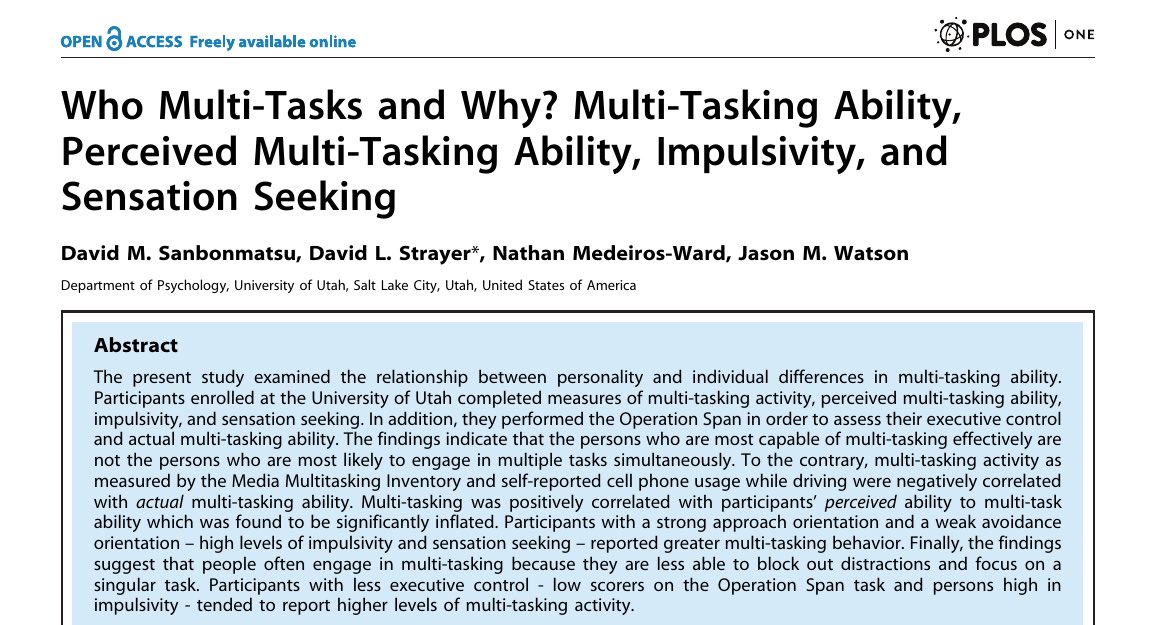
Source: Sanbonmatsu, Strayer, Medeiros-Ward & Watson (2013), "Who Multi-Tasks and Why?", PLOS ONE 8(1): e54402. Free full text: https://t.co/cUWnhO5vgN
The number that should embarrass all of us: confidence and actual test score correlated at r = .08, basically nothing. Correlational study, college sample, small effects.
Psych myths #5: "Don't worry, I'm good at multitasking."
Nearly 70% of students in a University of Utah study rated themselves above-average multitaskers. Their confidence didn't predict their real score at all.
The paper is "Who Multi-Tasks and Why?" by Sanbonmatsu, Strayer and colleagues, PLOS ONE, 2013. 277 students reported how much they juggled media and how often they used a phone while driving. Then they took the Operation Span, a test where you solve math problems while holding a string of letters in memory. Two jobs at once, scored for real.
193 of the 277 said they were better than average at multitasking. Only 54 admitted to being below. Somebody's wrong.
Worse, the pattern ran backwards. The people who multitasked the most tended to score lower on the test, not higher. Same for phone use behind the wheel. And the strongest personality link was attentional impulsiveness, meaning trouble holding focus on one thing.
The authors' read is uncomfortable. A lot of multitasking may come from struggling to block out distractions. Skill doesn't look like the driver.
Example: a colleague answers Slack all through your project call and swears they caught every word. In this study, that kind of certainty told you nothing about actual ability.
Try this on your next call. Close the inbox tab and say, "I'm off email for this one so I actually hear you." Then notice how much more you remember afterward. That's my advice, not something this study tested.
Honest limit. This is one correlational study of college students, and the links are small. A 2018 PNAS review found many media-multitasking studies show no difference at all. Nobody has shown that multitasking causes weaker focus.
#psychology #neuroscience
@elonmusk@bot Careful with "hardest." In a Harvard-led study of 758 BCG consultants, GPT-4 lifted quality over 40% on tasks it could handle.
On a task just past its limits, AI users were 19 percentage points less likely to get it right.
How will @bot flag when it's out of its depth?
@elonmusk Regulators said yes.
Drivers are a harder sell, and the bar they set is unfair. In Peng Liu's Tianjin University survey of 499 people, robot cars only became tolerable once they were four to five times safer than human drivers.
Does FSD already clear 5x in Europe?
@PopBase Drake's jacket has the data on its side. Carlsmith, Wilson and Gilbert let students punish a free rider in a money game.
The punishers ended up in a worse mood than people who couldn't, and kept thinking about him. Revenge was supposed to feel good.
#psychology#neuroscience
@IGN Cage is right to fear the overplay. Montoya's team pooled 268 repeated exposure curves from 81 papers, and liking climbed, peaked, then fell once people saw the same thing too often.
Was one season of Spider-Noir the peak, or did the cancel rob it of season two?