@adamyounggolf - solid data visualization software
- reference numbers from professionals (ideally labeled with their names)
- percentiles/rankings to see where one fits relative to subsets of other players
- heatmaps of impact factors, spin rates, launch angles based on face strike location
The pressure dependence of the Tc in N-doped Lutetium Hydride, as presented in Professor Hemley's talk at the APS March Meeting 2024. The red solid circles and triangles denote measurements conducted by the Hemley group at UIC, while the open circles represent data from our publication in Nature. Remarkably, there exists a high degree of concurrence between the results obtained by two distinct research groups, employing disparate experimental setups and working with different samples. This convergence underscores the robustness and reliability of our findings.
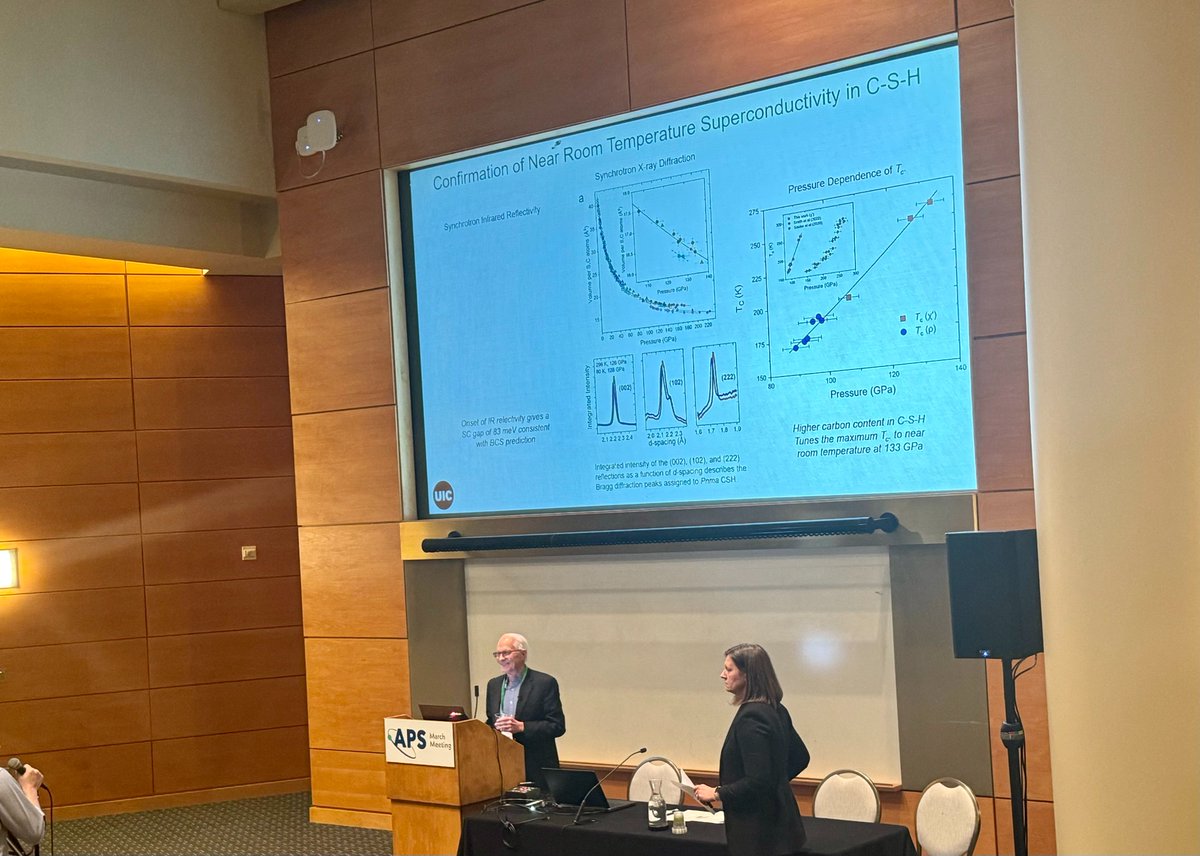
Confirmation of our Carbonaceous Sulfur Hydride (CSH) work. This work was conducted at both the Argonne National Laboratory and the Brookhaven National Laboratory, and the findings were presented at the APS March Meeting 2024.
@rdias495 Can you shed some light on Unearthly Materials? I'm wondering what kind of laboratory space you have, how funding looks, and how many others are working with you on high temperature superconductors.
Is this a lab in Rochester that is completely separate from the university?
@rdias495 I’m still trying to sort all of this out. Could you address the student’s concerns raised in #2 and #4?
You previously mentioned that there isn’t much processing to do with this type of data, which I am still a little confused about.
@rdias495 Could you update us on the status of the replication attempts from the other research group?
I saw one student post a video of a resistance measurement like this one, but never heard about what happened. I read some comments about how the wires might’ve been coming apart.
@rdias495 So the students say “No treatment procedures were carried out on the commercially purchased samples used to produce most of the data within the LuH Paper.”
Is this just a simple misunderstanding on their part?
@rdias495 Sounds like a difficult problem to solve.
From the coauthor letter, I read that the most of the samples used were commercial samples, which made me curious about whether or not the company will be able to patent the material.
@rdias495 Well I’m glad we’re in the same boat! Seems odd that the journal and the students couldn’t clarify the real issue.
What does the other PI think about the whole thing? I imagine they are also frustrated with the constant attacks.
@rdias495 Oh I was under the impression that data processing an issue. The retraction notice makes it seem like that was the case.
So, according to the people that signed the letter, what is the issue exactly?
@rdias495@Perpetualmaniac I was able to open up the data and gave it a shot at transforming it to look like that other superconductor you shared.
After Googling a bit I made some progress, but I couldn’t figure out why there were two frequencies. What do those correspond to? Are they important?