https://t.co/61yEIPxHiL
For anyone considering buying a Tesla and are on the fence about it, please do a test drive. That’s what convinced me to make the jump.
If you have the same thrill as I had and are ready for a whole new driving experience, here is my referral code!
😀
Here’s my referral code for your new Tesla.
This week:
• V14 Lite began rolling out to HW3 owners
• Production Cybercabs (no steering wheel/pedals) started public road testing in Austin
• Tesla reported its best-ever Q2 vehicle deliveries
• Model Y L launched in the U.S.
• Tesla Robotaxi service launched in Miami (Unsupervised)
Well well well. On the LOOONG weekend where things keep happening. I was on the way home from grabbing some takeout before heading to work tomorrow, and look what I stumbled into testing on Chucks Unprotected Left Turn in Jacksonville FL. The Cybercab! It had a driver in the drivers seat and was most likely collecting data. But this is further indication that this @Robotaxi thing is going to explode before we know it.
Its coming. Get ready. @Tesla_AI
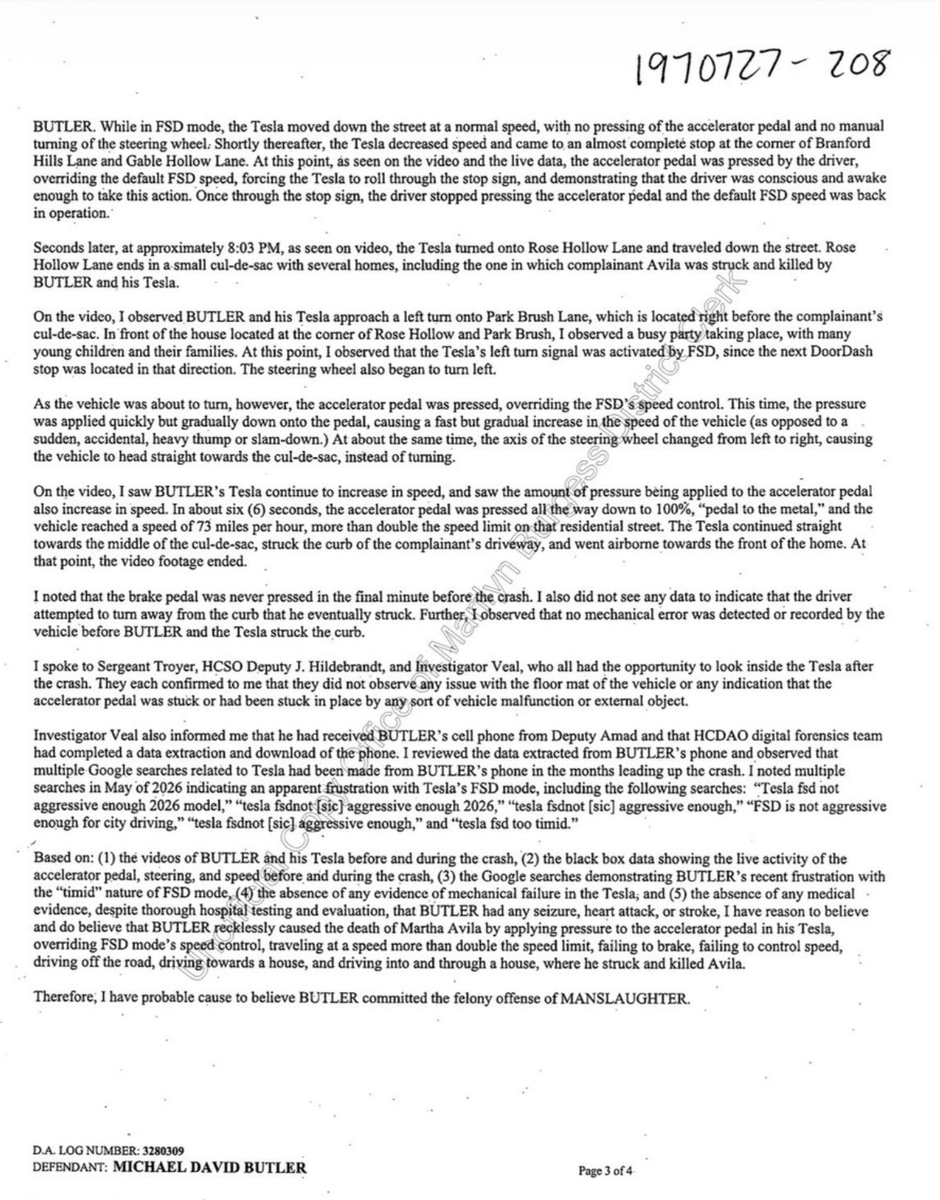
The driver of the Model 3 in the Texas house crash a couple of weeks ago has been charged with Manslaughter, and officials say he made Google searches in May about FSD not being aggressive enough.
"As the vehicle was about to turn, however, the accelerator pedal was pressed, overriding the FSD's speed control. This time, the pressure was applied quickly but gradually down onto the pedal, causing a fast but gradual increase in the speed of the vehicle (as opposed to a sudden, accidental, heavy thump or slam-down). On the video, I saw BUTLER's Tesla continue to increase in speed, and saw the amount of pressure being applied to the accelerator pedal also increase in speed. In about 6 seconds, the accelerator pedal was pressed all the way down to 100%, "pedal to the metal," and the vehicle reached a speed of 73 miles per hour, more than double the speed limit on that residential street. The Tesla continued straight towards the middle of the cul-de-sac, struck the curb of the complainant's driveway, and went airborne towards the front of the home. At that point, the video footage ended.
I noted that the brake pedal was never pressed in the final minute before the crash. I also did not see any data to indicate that the driver attempted to turn away from the curb that he eventually struck. Further, I observed that no mechanical error was detected or recorded by the vehicle before BUTLER and the Tesla struck the curb.
I spoke to Sergeant Troyer, HCSO Deputy J. Hildebrandt, and Investigator Veal, who all had the opportunity to look inside the Tesla after the crash. They each confirmed to me that they did not observe any issue with the floor mat of the vehicle or any indication that the accelerator pedal was stuck or had been stuck in place by any sort of vehicle malfunction or external object.
Investigator Veal also informed me that he had received BUTLER's cell phone from Deputy Amad and that HDAO digital forensics team had completed a data extraction and download of the phone. Multiple Google searches related to Tesla had been made from BUTLER's phone in the months leading up the crash. I noted multiple searches in May of 2026 indicating an apparent frustration with Tesla's FSD mode, including the following searches: "Tesla fsd not aggressive enough 2026 model," "Tesla fsd not [sic) aggressive enough 2026," "FSD is not aggressive enough for city driving," and "tesla fsd too timid."
Based on: (1) the videos of BUTLER and his Tesla before and during the crash, (2) the black box data showing the live activity of the accelerator pedal, steering, and speed before and during the crash, (3) the Google searches demonstrating BUTLER's recent frustration with the "timid" nature of FSD mode, (4) the absence of any evidence of mechanical failure in the Tesla; and (5) the absence of any medical evidence, despite thorough hospital testing and evaluation, that BUTLER had any seizure, heart attack, or stroke, I have reason to believe and do believe that BUTLER recklessly caused the death of Martha Avila by applying pressure to the accelerator pedal in his Tesla, overriding FSD mode's speed control, traveling at a speed more than double the speed limit, failing to brake, failing to control speed, driving off the road, driving towards a house, and driving into and through a house, where he struck and killed Avila.
Therefore, I have probable cause to believe Bulter committed the felony offense of MANSLAUGHTER."
After a few days with FSD v14 Lite being on the streets it seems for the few that have it, the results have been a pleasant surprise and an overall improvement in FSD performance on HW3 vehicles.
While this version cannot meet the same performance standards of FSD v14.x on HW4, what has been demonstrated is that real-world AI models can be distilled to work at lower levels of performance based on the hardware available.
Just like you can't run a 40B active parameter GLM 5.2 model on your Macbook Pro with 64 GB of RAM with any level of performance, you can't run a higher level real-world AI model without the latest hardware. The FOMO cycle of hardware will continue as these real-world AI models improve. BUT..
With this latest deployment of FSD v14 Lite, @Tesla_AI has demonstrated in real-world safety critical operational domains, that distillation is possible and should only get better over time. Any purchase of @Tesla hardware today will continue to get improvements over time even if not at the frontier level.
Bravo Zulu @Tesla_AI
Drove Tesla FSD v14 Lite for an hour tonight on my M3 HW3 Tesla
WAYYY better than v12.6.4.
I know smoother is often the word used to describe a great build, but it just it fits for this update, very smooth.
Tested HWY, residential, and back roads. All great!
The parking feature worked exactly the same as using it with the Cybertruck. This v14 lite, on a HW3, feels as good as v14 to me on an AI4 vehicle.
Very impressive @Tesla_AI — superb engineering feat! Thank you again for bringing the older fleet up to par 🙏
Just completed a couple of hours of driving with @Tesla FSD V14 Lite in my HW3 Model Y. Here are some thoughts:
• Much improved smoothness and intelligence overall.
• Starting from park, reversing, and parking at destinations is a game changer.
• Steering and acceleration are way smoother than before.
• Parking lot performance is miles better. It reverses for pedestrians and other cars if you are in the way.
• Lane changes, especially on highways, are way more fluid.
• The ability to park at a Supercharger is a game changer for road trips.
• Parking performance and accuracy were great.
• It parked on my driveway PERFECTLY multiple times.
Since it’s an early build, it is very cautious, especially in busy parking lots. On the road it feels relaxed, avoids frequent lane changes, and simply takes its time. I suspect speed and assertiveness will ramp up quickly as V14 Lite scales. In Hurry Mode, the car maxed out at 76 mph on the highway for me. I did some testing at Costco, and was honestly shocked how well it handled the mayhem. It was able to park and all handle crowds better than HW3 ever could.
How does it compare to HW4?
It feels exactly how Tesla describes it: a distilled version of HW4 V14. HW4 thinks quicker, reacts quicker, and feels more locked in. It wouldn’t be fair to say they’re on the same level, because they’re not. It’s distilled. The core functionality of V14 is there (starting from park, destination options, reinforced learning, etc.). Remember, Tesla accomplished this on ~7 year old hardware. The way they achieved this performance on it is absolutely incredible.
Coming from FSD V12, you will be so happy. It makes the car feel new. Before this, I would always choose my Model 3 with AI4 for road trips or long drives. Moving forward, I will have no problem taking my Model Y with V14 Lite, even on a road trip. That says a lot.
I can’t wait for HW3 owners to get this update! It’ll change your ownership experience.
Feel free to ask any questions in the comments. I’ll do my best to answer.
v14 Lite Release Notes:
– Distilled the intelligence from HW4 V14 into HW3. This allows HW3 to directly learn how to handle scenarios using HW4 V14 as a guide. This process unlocks the improvements that have been made to HW4 including Reinforcement Learning (RL) and offline models for HW3.
– Improved both proactive and reactive responsiveness across a wide variety of categories including navigation handling, merges and forks, pedestrian interactions, traffic lights, and vehicle cut-in scenarios.
– Improved general comfort in nominal scenarios through fewer false slowdowns, smoother steering and more consistent lane centering.
– Introduced parking, unparking, and reversing capabilities.
– Added Arrival Options for you to select where FSD should park: in a Parking Lot, on the Street, in a Driveway, or at the Curbside.
– Speed Profiles are now available at all times, to further customize driving style preference.