La guerre, ça se fait à deux. Entre deux camps capables de se battre
Là, ce n’est pas une guerre
C’est une exécution
L’Europe n’a aucune souveraineté sur l’IA, pas un fondeur de pointe, pas un seul designer de GPU qui est le moteur de toute l’industrie
On possède la machine la plus critique de la chaîne (ASML) et on n’a strictement rien construit dessus
Non, il ne va pas falloir « faire la guerre »
Il va falloir brosser dans le sens du poil
Accepter qu’on a dix ans de retard. Et être humble
Et peut-être, peut-être, qu’on pourra un jour commencer à fabriquer nos propres armes
Ce jour-là, ce ne sont pas les politiciens qu’on remerciera
Ce sont nos ing��nieurs et nos experts. Ceux que vous n’avez pas écoutés
Vous avez fermé les yeux pendant dix ans
Vous les rouvrez aujourd’hui, à l’acide
Bon courage
@Lolo_De_43@NCheron_bourse Oui mais disons que vu que le volume est plus faible, le prix est plus facilement manipulable. Donc oui sa reflète l'anticipation de prix dans l'intension du marché, mais pas de manière extrêmement précise au niveau du prix
@Lolo_De_43@NCheron_bourse C’est hyperliquid une plate-forme crypto leverage donc ouvert 24/24, du coup le volume est bien plus faible mais c’est toujours interessant de regarder pour le premarket ou lors de gros évènement notamment pour le pricing de l’info
A French engineer who lives quietly in Paris has spent 30 years writing software that the entire internet now runs on without knowing his name.
He wrote the code that streams every YouTube video, every Netflix show, every TikTok clip. He wrote the code that runs the virtual servers underneath AWS, Google Cloud, and Microsoft Azure. He calculated more digits of pi than anyone in history. He has no Twitter. He has no marketing. He just keeps shipping.
His name is Fabrice Bellard.
Here is the story, because almost nobody outside the systems programming world knows what one man has built.
Fabrice was born in 1972 in Grenoble, France. He studied at École Polytechnique, the top French engineering school. He never went to Silicon Valley. He never built a startup empire. He just wrote code.
In 2000 he started a project called FFmpeg, an open-source multimedia framework for encoding, decoding, and streaming video. He was 28. The project did one thing nobody else had done well. It handled every video and audio format that existed, in one library, on every operating system. He led it himself for years.
Today FFmpeg is the invisible engine of the internet. YouTube uses it. Netflix uses it. VLC uses it. Chrome and Firefox use parts of it. Every Android phone, every iPhone, every smart TV, every video editing tool you have ever touched runs FFmpeg somewhere underneath. If you have watched a video on a screen in the last 20 years, Fabrice's code processed it.
He was not done.
In 2003 he started QEMU, a machine emulator and virtualizer. He wrote it solo until version 0.7.1 in 2005. QEMU lets you run any operating system on any other operating system. It became the foundation of modern virtualization. KVM, the Linux kernel hypervisor, runs on top of QEMU. Every major cloud provider, AWS, Google Cloud, Microsoft Azure, IBM Cloud, runs virtual machines on infrastructure built around it. The Quick Emulator is the most cited piece of cloud infrastructure code on Earth.
He kept going.
In 2001 he won the International Obfuscated C Code Contest with a small C compiler that grew into TCC, the Tiny C Compiler. TCC can compile and boot a Linux kernel from source in under 15 seconds. In 2004 he calculated the most digits of pi ever computed at the time, using a personal desktop computer and an algorithm he derived himself called Bellard's formula. In 2011 he wrote a complete PC emulator in pure JavaScript that runs Linux in your browser, a project called JSLinux that engineers still cannot believe is real.
In 2019 he released QuickJS, a small but complete JavaScript engine that fits where V8 cannot. In 2021 he released NNCP, a neural network based lossless data compressor that immediately took the lead on the Large Text Compression Benchmark.
Then he turned his attention to large language models. He built TextSynth Server, a web server with a REST API for running LLMs locally. He released ts_zip and ts_sms, compression utilities that use language models to compress text and short messages at ratios traditional algorithms cannot reach. He released TSAC, a very low bitrate audio compression system. In December 2025 he released Micro QuickJS, a new JavaScript engine for microcontrollers, separate from QuickJS, designed for environments with almost no memory.
Fabrice co-founded a telecom company called Amarisoft in 2012, where he serves as CTO. Amarisoft builds 4G and 5G base station software used by carriers and labs around the world. He has been running it for over a decade while continuing to ship personal projects from his own home page at bellard dot org
He has no Twitter. He has no Instagram. He gives almost no interviews. His personal website is a flat list of projects with no styling, no fonts, no marketing copy. Just titles and links.
A quiet French engineer who never moved to Silicon Valley wrote the code that quietly runs the internet.
He is still shipping.
$SIVE already connected to the AI optical I/O trend through Ayar Labs and NVIDIA’s ecosystem.
The US side already knows the need for optics in AI infrastructure. $SIVE
But what if Europe wants to keep this strategic layer at home? 🇪🇺🇸🇪🇳🇱
What if $ASML looks at Sivers and says:
Europe already owns lithography.
Why not own the laser layer too?
That would make $SIVE a outstanding story 🚀
Not just $NVDA ecosystem exposure.
What if Europe connects the dots?
European semiconductor sovereignty optionality.
$SIVE $ASML $NVDA
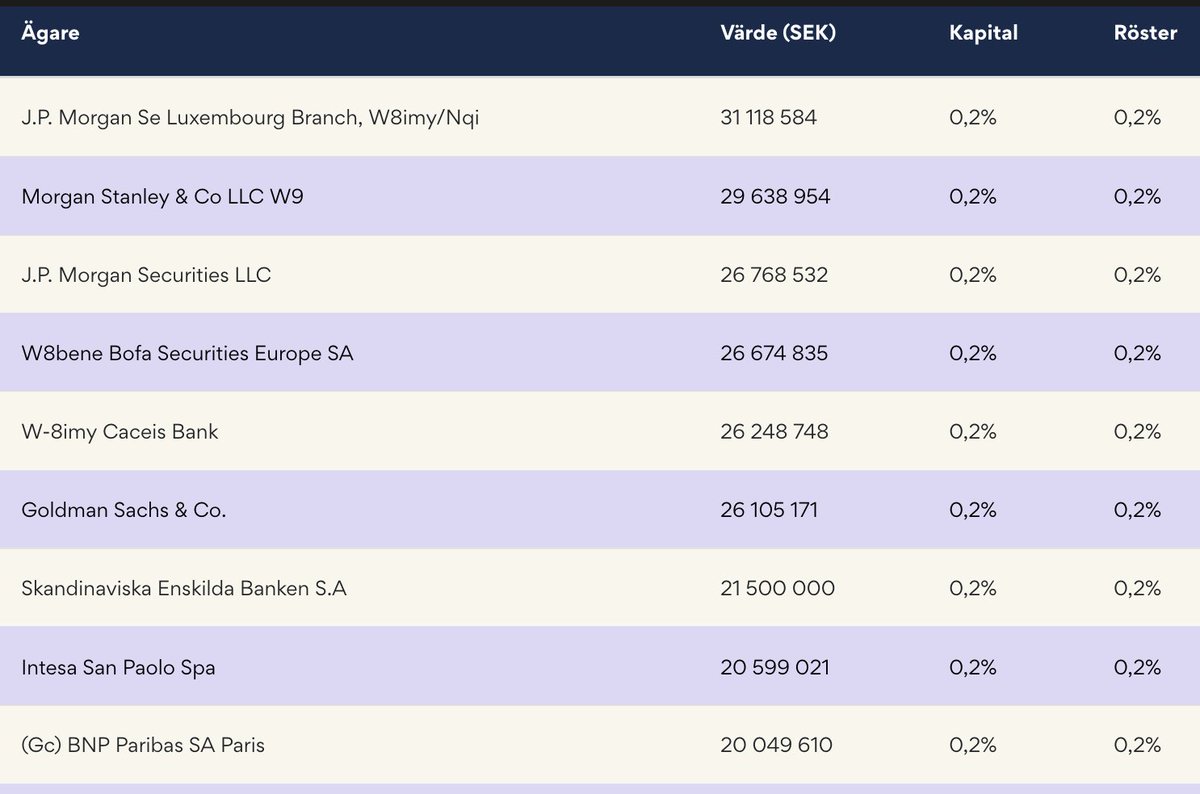
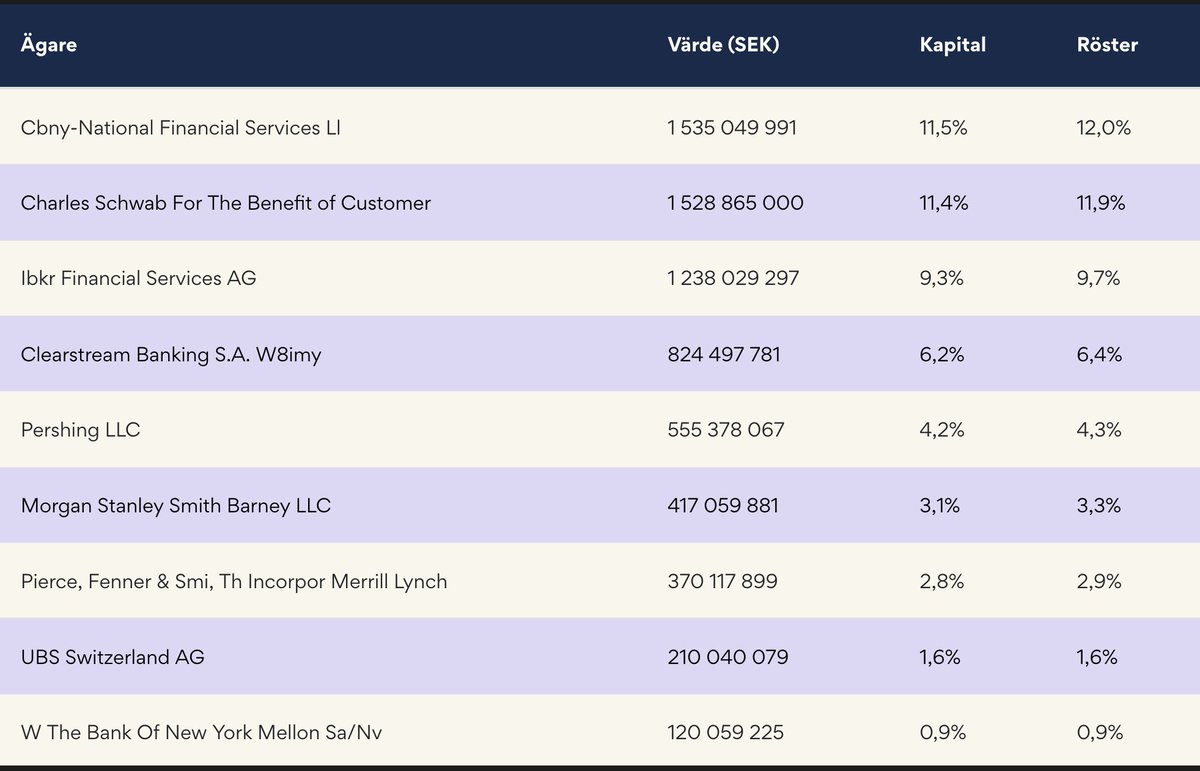
The US/West now controls majority of the shares of $SIVE.
With Goldman Sachs/JP Morgan/Morgan Stanley and other US institutions entering.
US/West 46.8%:
- Fidelity: 11.5% (retail)
- Charles Schawb: 11.4% (retail)
- $IBKR: 9.3% (primarily retail)
- BNY Mellon: 4.2% (retail)
- Morgan Stanley Smith Barney: 3.1% (Retail/Wealth management)
-Bank of America: 2.8% (retail/Wealth management)
- BNY Mellon: .9% (institutional)
- Morgan Stanley Client Assets: .7% (institutional)
- Bank of New York Mellon: .5% (institution)
- JP Morgan: .5% (institutional)
- J.P. Morgan Securities Plc: .4% (institutional)
- Citibank New York: .3% (institutional)
- JP Morgan SE: .2% (institutional)
- Morgan Stanley: .2% (institutional)
- JP Morgan Securities: .2% (institutional)
- BoFA Securities: .2% (institutional)
- Goldman Sachs: .2% (institutional)
- Goldman Sachs International: .1% (institutional)
- Cbny-Rja-Client Asset - .1% (retail/wealth)
Large % now owned US retail shareholders (eg. $IBKR on behalf of clients, probably majority retail some institutions).
The new but smaller JP Morgan Goldman Sachs, and Citibank % positions are likely hedge funds or other institutions trying to build positions.
Europe & Switzerland: 11.3%
- Clearstream: 6.2%
- UBS Switzerland: 1.6%
- Six SIS: 0.8%
- Euroclear Bank: 0.8%
- Saxo Bank: 0.6%
- BNP Paribas: 0.6%
- Caceis Bank / Intesa San Paolo: 0.2% each
- KBC / LGT / Julius Baer: 0.1% each
Swedish ~8.49%:
Försäkringsaktiebolaget Avanza Pension - 4.76%
Nordnet Pensionsförsäkring - 2.73%
Skandinaviska Enskilda - .2%
SEB Life International - .1%
Nordea Bank Abp - 0.7%
Canada/UK/Middle East ~.6%:
First Intl Bank of Israel - .3%
Royal Bank of Canada - .1%
Royal Bank of Canada - .1%
HSBC - .1%
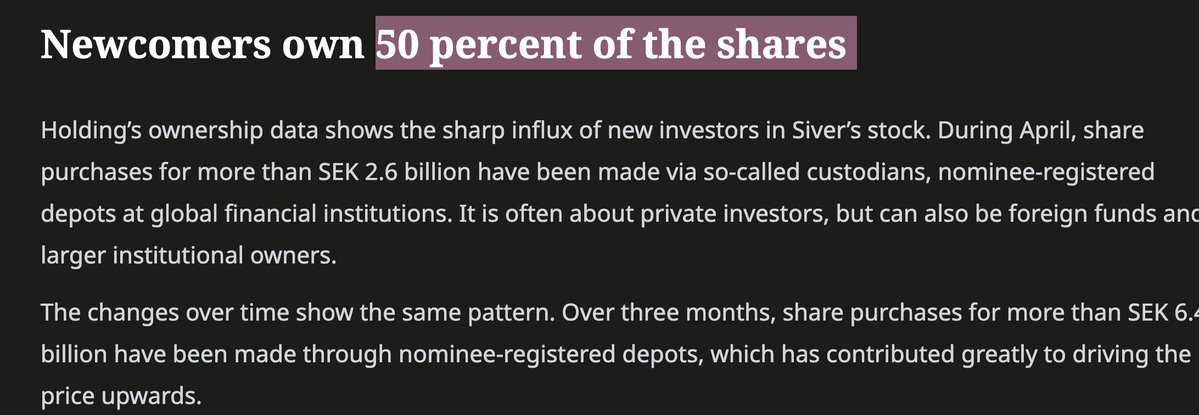
A special thank you to the Swedish Media doing the work of US institutions:
The West now has ~58.7% ownership. Swedish is now down to 8.49% due to local media.
I wonder if they realized what they've done now scaring off local investors now that it's changed hands to US institutions/investors?
The West have now acquired majority of the float before the CPO supercycle.
You can also start to see US institutions like JP Morgan or Goldman Sachs building start positions (on behalf of institutional investors), probably off of US retail taking profits. This is likely after $SIVE reached a certain MC threshold for fund mandates.
But a large % of it is still owned by US retail on places like $IBKR and Fidelity. (this is what I call frontrunning the institutions)
TLDR:
$SIVE went from majority:
-> Swedish retail ownership
-> US retail ownership
-> gradual US Institution ownership as US retail takes profit or sells (if they figure out a way to scare off US retail like the Swedish media did).
JP Morgan 5% threshold FI flagging notice for $SIVE.
Has anyone identified the holder behind this filing?
Could be:
• Institution
• Family office
• High-net-worth/private investor/retial
Before jumping to conclusions, it's worth understanding who actually triggered the flag.
Anyone looked through the details yet?
#SIVE
https://t.co/HLVuuT68zi
Well well well. What do we have here.
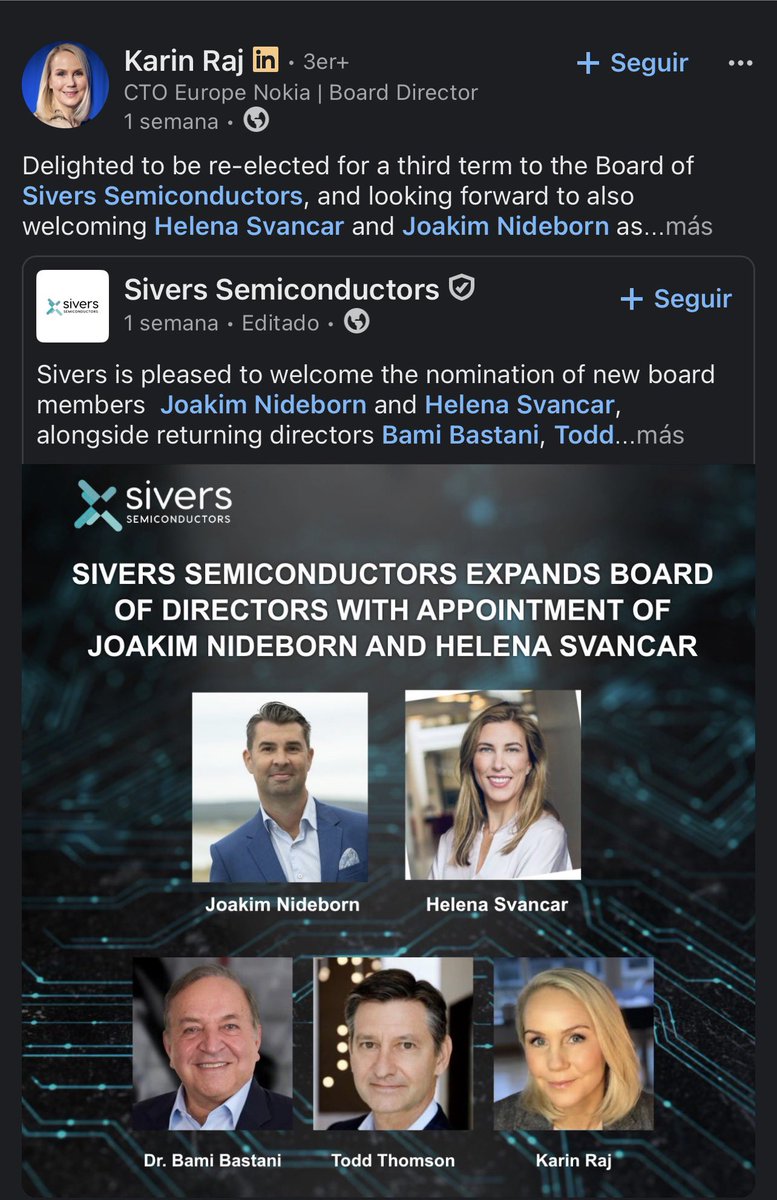
Karin Raj, CTO of Nokia Europe, was just re-elected to the Board of Directors of $SIVE Sivers Semiconductors for a third term. Third term. She keeps coming back.
At the same time, look at what Sivers just disclosed in their latest investor presentation.
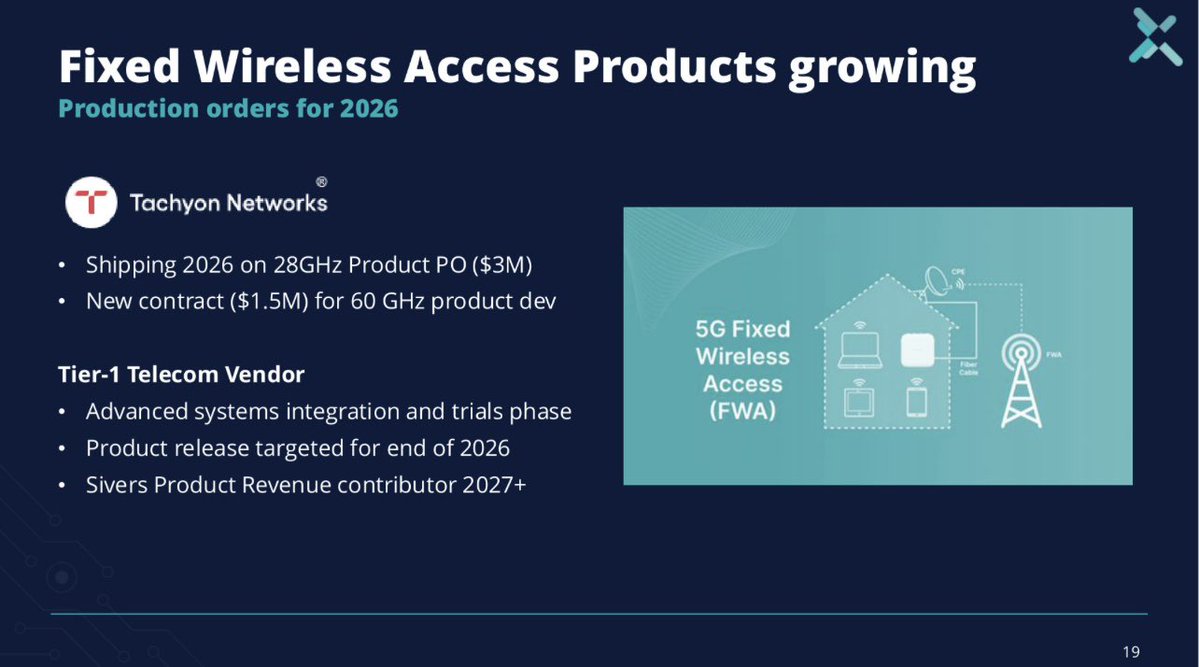
Fixed Wireless Access products are growing, with two live engagements:
Tachyon Networks -- $3M production order for their 28GHz product shipping in 2026, plus a brand new $1.5M contract for 60GHz product development. Two stacking contracts, two frequency bands, same partner.
A Tier-1 Telecom Vendor
- who’s identity might be impossible to infer - is currently in advanced systems integration and trials phase. Product release targeted for end of 2026. Sivers revenue contribution starting 2027.
A Tier-1 Telecom Vendor.
Now I am not saying anything. I am just saying that the CTO of Nokia Europe sits on the board of a company that just disclosed a Tier-1 Telecom Vendor engagement expanding from 28GHz to 60GHz FWA.
Nokia is the world's largest telecom equipment company. Nokia has a massive 5G Fixed Wireless Access product line. Nokia's European CTO has now chosen to be on this board three times.
You connect the dots.
$SIVE is not just a photonics and InP laser story. The Wireless segment is building its own multi-year revenue line quietly in the background while everyone watches the CPO thesis.
Two segments. Two catalysts. One stock.
Bullish $SIVE.
Thank you for your strong interest in my SIVE article.
I believe that after reading it, you will be able to look at the company from a more objective perspective.