Yes, I still like and will defend $AAOI despite the "shitco" claims from the level 1 NPCs on X:
- AOI recently signed a $1B to $1.5B 3Y contract with a hyperscalers
- Majority of people missed this part, but there's another $5-$7B contract expected to be signed in weeks.
This is very large scale relative to current valuations, and gives AOI more visibility for the future. However, the risk I see here is that hyperscalers prefer CPO/NPO laser procurement over pluggables.
So that's probably part of the reason they're not doing pre-payments or take/pay like they would for $LITE or $MU capacity expansion.
- There's only single digits amount of companies in the world that probably have 300mW-400mW CPO laser capabilities (one of which is the "shitco")
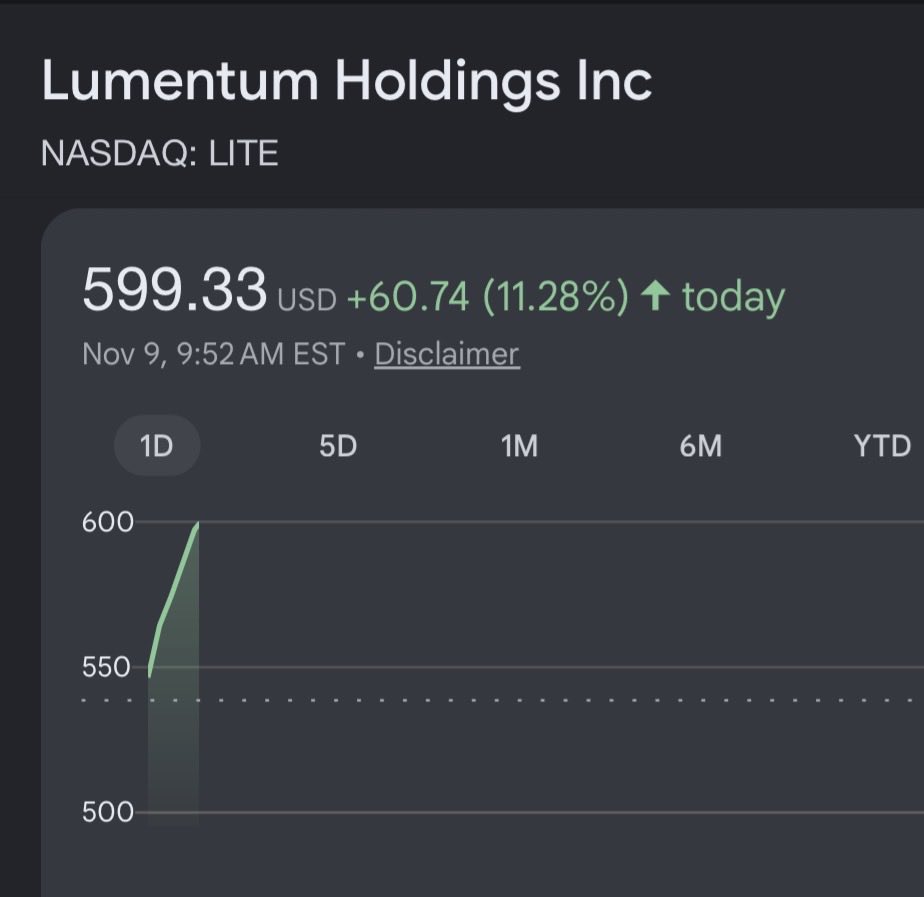
This was also a large reason why $COHR got $20B agreements, $LITE $5B agreements + $NVDA investments (UHP lasers).
I'd argue they should focus on merchant high end lasers than using their own capacity toward 800g pluggables. And just source lasers from merchant market
That would change their valuation premiums overnight IMO, given they have a lot of optionality from end-to-end supply chain manufacturing.
_
In terms of valuations, they deserved to be compressed from their infinite $600M ATMs that they used earlier (that they now stopped abusing).
And since timelines slipped a few months from DSP bottlenecks and equipment procurement/installation.
Then you have macro overhang too + overall AI selloff.
As for the operational side of things, it's not eternity and relatively out of their hands... but I wouldn't conflate it as failing qualifications or facing order cancellations.
Building up US supply chains like $INTC is always going to be more difficult than easy-mode Asia manufacturing in Malaysia as well.
I'd argue this same execution risk they're being punished for over in Texas (like Intel foundry), will turn into a premium once US capacity scales into revenue
Not always right on timing, but I'm pretty confident long term they'll play out.
Just look at $AXTI, everyone thought it was a dead company last year and InP substrates were a commodity.
-> Q4 2025 gross margins: 20.9%
-> Q1 2026: 29.6%
-> Q2 2026: 44.9%
-> Q3 2026: 56.0%
-> Q4 2026: 60%+ est.
With legacy memory like $ESMT, I did guess earnings correctly, they made a whopping $331M+ net income relative to $1.9B MC
But stock still dropped somehow... but eventually as time passes out I'm personally confident majority will play out directionally right.
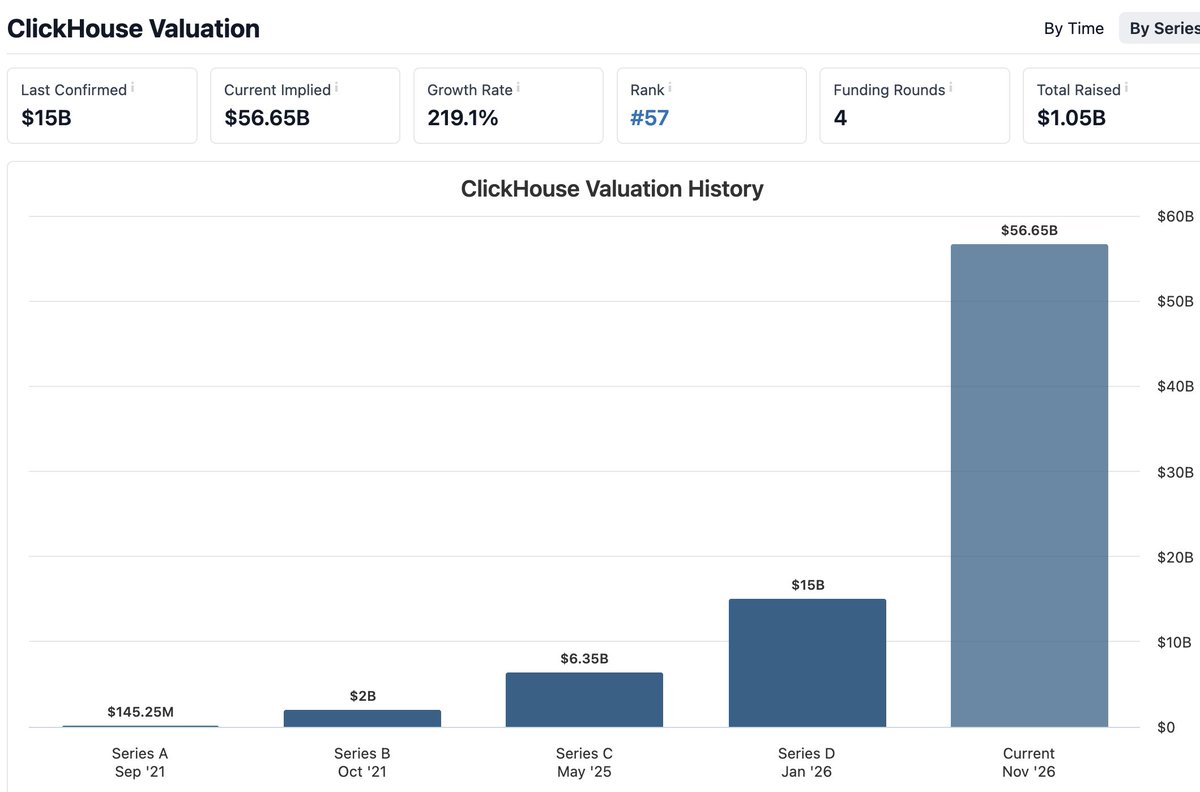
This aged pretty well, when I said this last year in 2025, Clickhouse was a $6.7B company...
Now as an update, their secondary valuation sits around ~$50B, which $NBIS owns 25%+ of.
I've always liked Nebius the most because sum of parts, with all their lesser known subsidiaries growing alongside their core neocloud business.
Including Avride (self-driving), Clickhouse, Toloka, and other subsidiaries that they owned.
This year Nebius also acquired:
- Tavily (web search and retrival)
- Clarifai (Inference orchestration)
Which scale independently as well (the others were integrated into Nebius Token Factory).
Hard to view $NBIS as just another neocloud when it has billions in scaling value outside its core infrastructure business.
clickhouse is pretty OP, but haven't made an individual analysis on that yet since $NBIS only owns 28%.
But i could definitely see clickhouse becoming a $50B company one day, i'll probably made a follow up post and cover all sum-of-parts to help people understand nebius value proposition
Let's fking go $ANT
This is how you sell the future of AI... by entering an "Age of Miracles," not human extinction.
I still think Anthropic is overvalued, but even I'm getting hyped by this IPO teaser.
$ANT IPO at $1.4T valuation is now multiple times oversubscribed.
After trying to raise $57.8–64.4B… pushing total Anthropic IPO funding closer to $100B.
I guess the pool of capital is infinity in America if you can cure cancer with AI in 5–10 years?
@MarkusOOTP Anthropic CEO said it himself. Europeans last year were making fun of him last year over Dario’s predictions that AI might essentially write all code in 2026
Look where we’re at now
$ANT IPO at $1.4T valuation is now multiple times oversubscribed.
After trying to raise $57.8–64.4B… pushing total Anthropic IPO funding closer to $100B.
I guess the pool of capital is infinity in America if you can cure cancer with AI in 5–10 years?
There's a lot of news about WT (3036) introducing their first CW DFB laser line card.
More significant than people think for medium-long term. For economic impact and what revenue looks like:
- $SMTC generated 74% of its revenue through distributors. $AMBA as another example, ~60-70% of their 2026 revenue went through this company.
- With WT in specific, if you look at even a large company like $AVGO scaled:
-> 13% of Broadcom revenue went through WT in 2020
-> 18% (2021)
-> 20% (2022)
-> ~21% (2023)
-> ~28% (2024)
-> now possibly up to ~46% (they stopped naming)
Just showing how important the largest distributors in the world become to semi companies.
Given how WT chairman attributed rapid growth coming from AI photonics demand (eg. DSPs to optical module makers):
It becomes more interesting for a certain company that WT introduced their first CW DFB laser line card during an industry bottleneck.
You heard 10x demand for compute > supply from $CRWV today.
Hearing from $TSM today on Nikkei Forum:
"The demand on our leading node [most advanced] silicon is insatiable"
Customers "want to get [their] hands around any compute capability they can have. It's truly an insatiable environment."
Q: Whether AI demand was slowing?
A: "we did not see any sign of slowdown"
Q: How demand compared with TSMC’s ability to supply
A: "the demand actually is still far above our capability today to supply."
TSMC identified power and substrates as bottlenecks customers were encountering.
On the mid-to-high-50s annualized growth estimate for AI accelerator revenue from 2024 to 2029. Wei said "it probably will be higher."
Describing things as "insatiable" from a traditionally conservative company... doesn't quite look like any collapse in AI demand.
$CRWV ER and read through for $NBIS and other Neoclouds:
“We have 10x as much qualified demand as available capacity”.
- interest in 2028 capacity already amounts to several times what CoreWeave has available
- CoreWeave raised prices by 25% in July, +10% later in Q3, and more to come in Q4
- Ampere and Hopper rental pricing rose 30–50% quarter over quarter (older GPUs)
- better financing conditions (higher prepayments, lower interest 7–7.5% for new loans)
- positive adjusted net income in the first half of 2028.
So we’re seeing higher pricing esp. for older GPUs…better financing mechanics, and extreme demand imbalance where you have 10x demand > supply.
Same issues are there for this company in specific with interest rates, but I’d argue other Neoclouds are in a better spot.
But it’s wild to witness AI infrastructure names crash while demand keeps growing
@TimeToCompute Coreweave did say they’re getting 100% contract value prepayments, which is kind of insane.
So that sends a positive message for the other Neoclouds like $NBIS and $IREN
$CRWV ER and read through for $NBIS and other Neoclouds:
“We have 10x as much qualified demand as available capacity”.
- interest in 2028 capacity already amounts to several times what CoreWeave has available
- CoreWeave raised prices by 25% in July, +10% later in Q3, and more to come in Q4
- Ampere and Hopper rental pricing rose 30–50% quarter over quarter (older GPUs)
- better financing conditions (higher prepayments, lower interest 7–7.5% for new loans)
- positive adjusted net income in the first half of 2028.
So we’re seeing higher pricing esp. for older GPUs…better financing mechanics, and extreme demand imbalance where you have 10x demand > supply.
Same issues are there for this company in specific with interest rates, but I’d argue other Neoclouds are in a better spot.
But it’s wild to witness AI infrastructure names crash while demand keeps growing
It’s pretty wild to see $NVDA crash -25% and lose close to $2T in valuation
After projecting 70% supply-constrained growth FY2028.
Also probably one of the worst times for $ANT to IPO at $1.4T ahead of Thursday…
Are there still people out there interested at that price?
New commentary today from SoftBank on Elon Musks post 4 days ago:
“SoftBank is defaulting on their turbine orders”
Analyst Question: “Any comment on that?”
SoftBank CFO Yoshimitsu Goto: “this is simply not correct at all. There is no such default”
This also mirrors what $GE CEO Scott Strazik stated about seeing no procurement cancellations or counterparty financing difficulties.
Pretty damaging allegations about the company financing $SPCX competitor (OpenAI + Stargate).
I wonder if there’s any more nuance these claims or if it’s false.
Some industry commentary regarding a few claims recently on memory + Softbank Turbine defaulting.
- On claims that LTAs are "meaningless while prices fall":
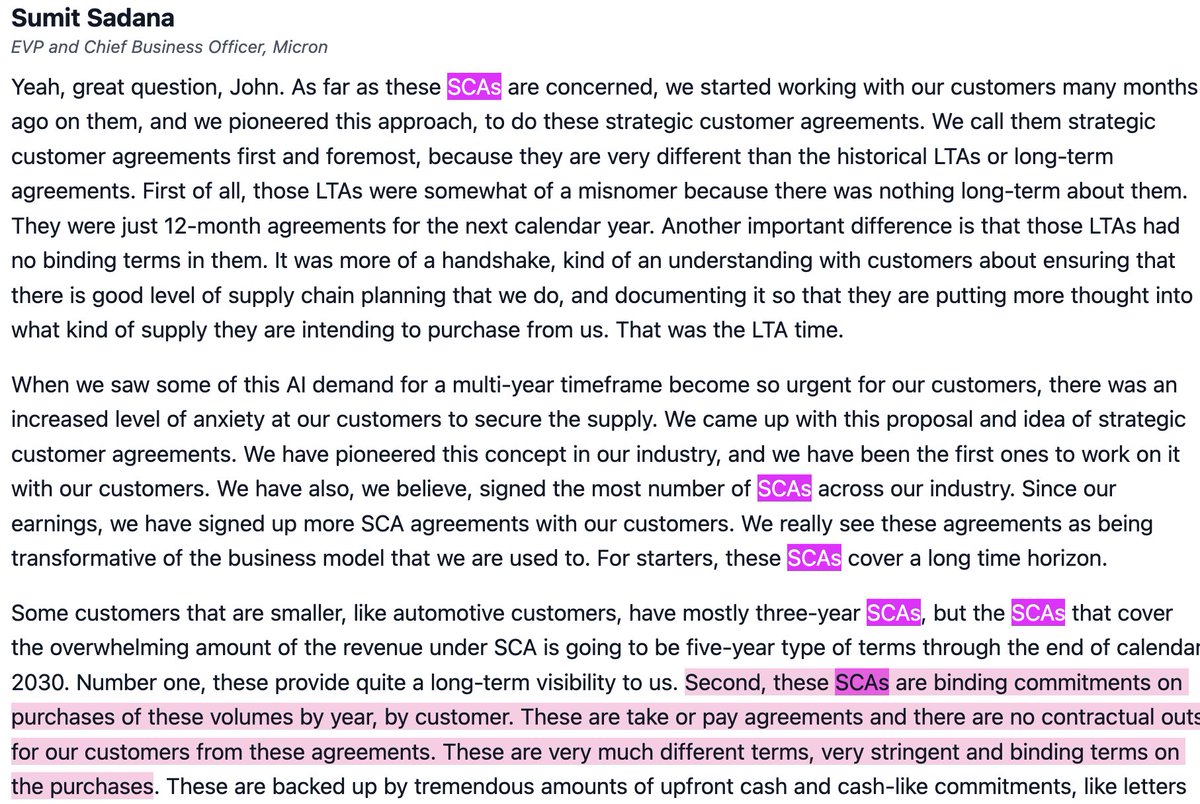
$MU: "strategic customer agreements cannot be unilaterally canceled. Customers are obligated to pay for their committed volumes whether they take delivery or not"
"These are take or pay agreements and there are no contractual outs for our customers from these agreements"
Regarding historical contracts breaking: "These LTAs that we used to have never had any binding terms." The new SCAs contain extensive contractual obligations
Regarding Elon's claims on Softbank defaulting on Turbines:
Question from Morgan Stanley to $GE Vernova CEO on whether they see cancellations or financing difficulties with counterparties on their turbine orders:
“No… we are not”
TLDR:
- Micron states LTAs/SCAs are noncancellable take/pay (where counterparties are hyperscalers). And that these types are different from historical memory cancellations.
- On Softbank turbine orders, GE Vernova CEO Scott Strazik said it wasn't seeing customer financing disruptions, requests to exit turbine reservations, or slowdowns.
Maybe Elon's claims are more narrow, but should be evaluated more closely given competitive interests vs. Softbank/OpenAI.
If you look at CW laser ASPs for AI data centers, the pricing differences are pretty substantial:
70mW: ~$3–4
100mW: ~$4–6 (Source Photonics channel checks).
With some premiums apparently going up to $7-$9 range with the recent shortage for pluggables.
120–150mW NPO: ~$15–20
350mW UHP CW: ~$40 (Nomura)
400mW UHP CW for NPO/CPO: ~$50–75 (Mizuho)
With former communication laser chips going from 20-50 cents.
The pricing and gross margins of these players go up with each architectural shift (60%+ for CPO lasers).
And go up even more depending how far down the stack you go (selling ELSFP was ~2.5x revenue content)
In terms of how I see the landscape now:
- $COHR is probably the best risk adjusted laser player now, for people who don't like uncertainty. Their new $20B LTA is very substantial.
- $LITE pretty negative now given the valuation overhang from $MRVL acquisition. Operationally very opsitive.
- $AAOI has extreme demand visibility (likely $6-$9B in new LTAs from just 1 quarter), but credible execution uncertainty.
They've also been focusing on pluggables + bottlenecked by DSPs, rather focusing on UHP CPO laser merchant markets.
But I think if markets see a new $5B-$7B LTA that they're in late stage discussion for... and see the $4.4B MC. Pretty sure that's a catalyst for recovery.
The demand doesn't disappear but timeline shifts back a few months.
AOI also signaled DSP as the main bottleneck, last quarter it was TIAs, so other different component players that are interesting.
- $SIVE has extreme capacity expansion (300m laser capacity targeted in total).
The economic implications that they won't disclose are likely enormous relative to their MC, even if they sell $3 70mW lasers to China pluggable players.
But there's a qualification uncertainty to fill the gap,
that markets have punished the company for. Especially when management communication amplifies uncertainty, despite the ongoing shortage.
Right now entire AI trade is going up and down together though.
One nuance worth adding for the semi specialists reading the $AAOI section:
The 720M to 1.44B annual diode figure off the 180,000/year Yunnan Germanium 4-inch wafer contract reflects gross standard pluggable die candidates. Once you apply real-world III-V epitaxy,facet-coating, and 5,000-hour burn-in yields (~45% to 55% net known-good dies), factor in dual-use export license buffers, and account for the ~5x die-area penalty on 300mW to 400mW CPO cavities, $AAOI's net shippable output scales toward ~180M to 300M+ high-speed lasers per year as Texas Phase 2 ramps.
Roughly 80M to 95M of those net dies get absorbed internally just feeding $AAOI's 1M/month transceiver target, leaving ~100M to 200M+ merchant diodes for external buyers inside a 650M to 1B+ combined scale-out and scale-up market. Even if both $AAOI and $SIVE hit full utilization in 2028, merchant Western supply stays structurally short.
Every AI name in Taiwan from Mediatek to Winbond looks like its limit up.
TAIEX: +4.94%, its 2nd largest daily gain in history.
I guess the market is impressed by $NVDA’s Jensen Huang vitality at his age?
Every AI name in Taiwan from Mediatek to Winbond looks like its limit up.
TAIEX: +4.94%, its 2nd largest daily gain in history.
I guess the market is impressed by $NVDA’s Jensen Huang vitality at his age?
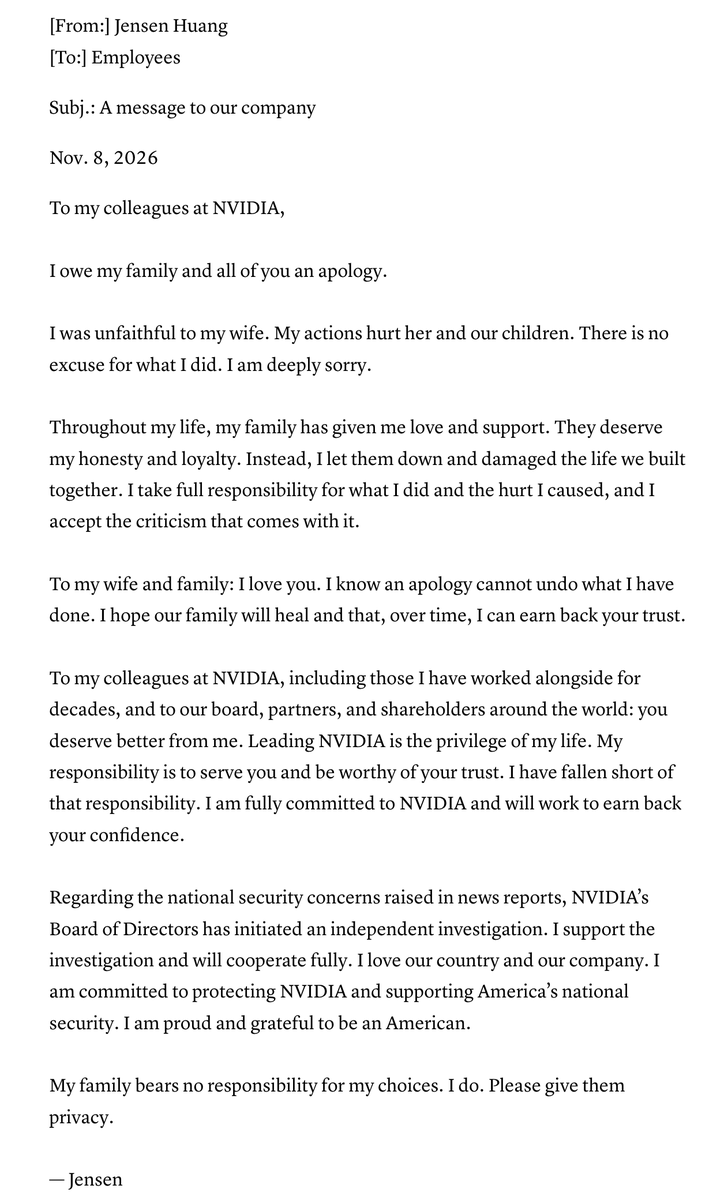
I fully support $NVDA and Jensen Huang through this time.
Even the most legendary figure in the AI industry is human.
Trump, Clinton, Bezos, Gates, and many others have faced scrutiny over their personal lives.
It takes courage to own up to it publicly and move forward
Various commentary from Qualcomm, Arm, to Meta executives this week during the AI selloff:
$LITE CEO: "You had a comment from the CEO of $IREN and I'd second that. There's a massive disconnect in what we're seeing in our demand books.
And what the markets are showing. And yet you're seeing a massive, massive selloff." (Fri, Nov 6)
$AMD CEO CNBC: "We're at the very beginning of the adoption cycle, where people can see where AI and superintelligence will take us"
"We are seeing demand being higher than supply" (Wed, Nov 4)
$ARM CEO regarding a debate whether AI infrastructure spending is about to peak:
"I think in some states where it gets harder, other states may pick it up to make it easier, but I do believe strongly that if the US hesitates in any way shape performance in terms of data center buildout...
"The rest of the world is ready and willing. There is just huge demand for this capacity. And I think globally the US really wants to be able to compete against China. China is not slowing down at all." (Thu, Nov 5)
$APLD CEO: Bank construction lending, project financing and bond markets remain available, although interest rates and credit spreads have risen
"The big risk is delivering on time." "The demand picture is extremely robust." (Mon, Nov 2)
$QCOM CEO: "It's not demand bound. It's a supply bound."
"We're short on wafers, we're short on substrate, we're short on assembly. Everything is short because demand is very, very high."
"I think what the market is reacting to is what is the speed of the compute build out."
$META on political risk: "We did have a governor that won last night who did make data centers a big part of the platform.
Say as soon as we get past the inauguration, let's meet because we don't want to lose this investment in our town. We don't want these jobs to go elsewhere." (Wed, Nov 4)
Even politicians campaigning against data centers are negotiating. But Meta's president also emphasized that starting new US DCs will become more difficult.
TLDR:
-> Extremely bullish commentary from accelerator players, networking, and semi companies
-> DC developers report strong pricing/demand, but increasingly emphasize financing, permitting and execution risks (more cautious)
-> Politicians that previously campaigned against DCs are showing cooperation
There's an important difference between demand disappearing and demand being delayed by the inability to build fast enough.
Despite the severity of the selloff, I'm not seeing evidence of widespread AI demand destruction in commentary.
It think it's stupid that "AI Bubble" gets used over and over. In infra names you have:
- 1-3x fwd P/E memory companies from Samsung to $ESMT. With HBM players now having hyperscaler multi-year price floor LTAs.
- Optical companies like $POET traded -$97M under net cash. Valuing the operating business very negatively, not even at $0.
- While AI companies with larger premiums continue to record demand over the next 3-5 years. Such as the new $20B LTAs signed w/ $COHR to $5B LTAs signed w/ $LITE.
Can someone in the media honestly see negative EV high-beta optical companies, where 2 years of burnrate would still value the company below $0.
or single digit memory companies with contracted demand + price floors years out and say that's a bubble?
Many of these names are extremely profitable today...
But obviously there's other elements inside the theme, such as:
- Certain startups like Instinct that look like a private valuation bubble.
- Leveraged Neoclouds that didn't finance properly
- and AI lab valuations and commitments, which should be viewed cautiously.
But everything gets grouped into one with the boogyman of "leverage" or "debt".
Yes, valuations can compress or correct from macro, potential regulatory uncertainty, or potential capex reductions.
But for the companies physically powering the AI buildout, it looks more like the Great AI Deleveraging of 2026...
Than anything like fundamental demand destruction.
As more earnings come out and free cash flow accumulates over time.
I'm confident in a recovery, especially in bottlenecks, and for markets to eventually discern durability + growth over frothy valuations tied to AI.
The two things I'm excited about are Gen G vs. T1...
and new NASA's $10 Billion contract to begin settling on the moon. NASA selected:
- $SPCX (SpaceX)
- Blue Origin
- $FLY (Firefly)
- $LUNR (Lunar)
- $LMT (Lockheed Martin Space)
- $NOC (Northrop Grumman Space)
- $VOYG (Voyager)
- iSpace US
to compete for future lunar delivery missions
- $1.3B in launch and orbital transportation orders awarded to Arrow Science, Blue Origin, and Impulse Space.
- $94 million for Blue Origin to deliver NASA's nuclear powered PROMISE rover
- Existing CLPS 1 contract ceiling raised from $2.6B to $4.2B.
- NASA also announced awards to Honeybee Robotics, a Blue Origin company, $RDW for a lunar power and communications tower