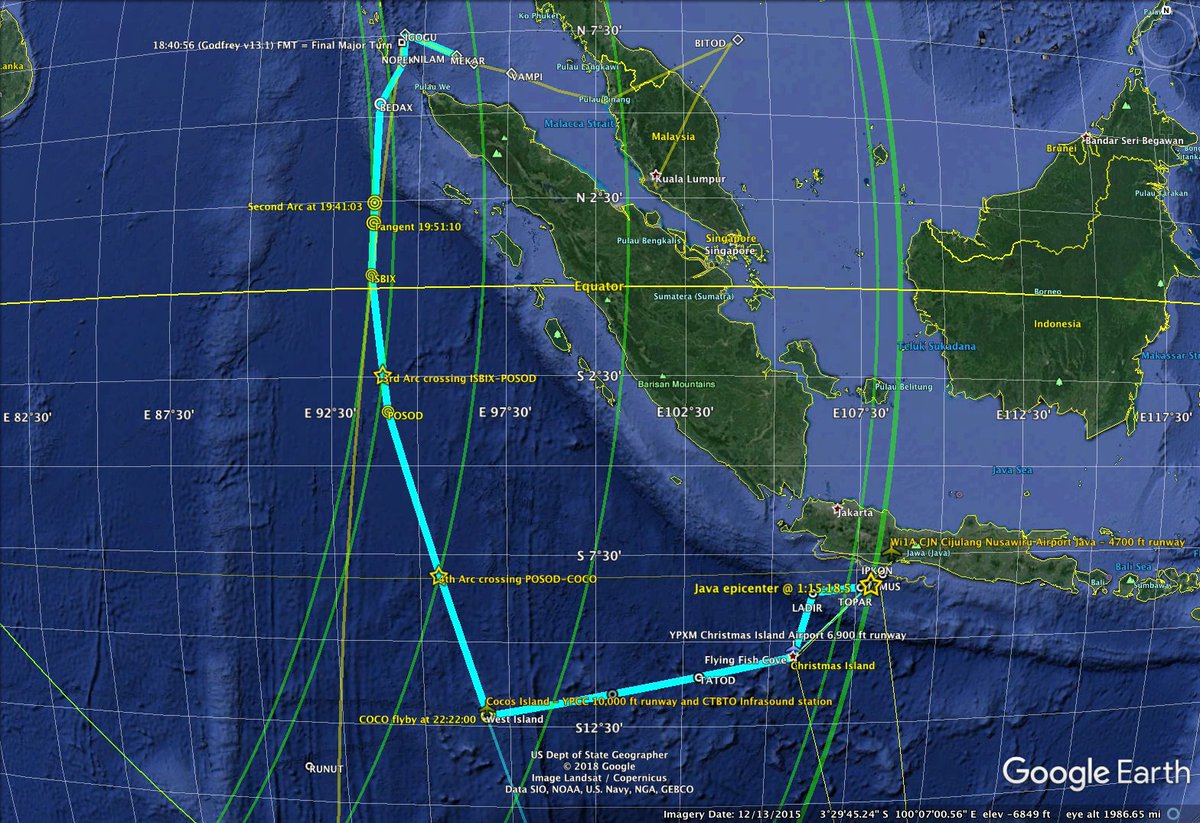
To locate missing flight MH370, I'm analyzing acoustic data. Detected sounds may be debris sinking right on the 7th Arc off Java, matching all factual evidence.
@VirginRadioUK Reanalysis of hydrophones and seismometers pinpoints a crash site directly on the 7th Arc, 39 miles off the coast of Java. Fitting all of the hard evidence, the anomalous loud noise is consistent with a large section of sinking #MH370 hitting the seabed.
https://t.co/zjjuozW8RQ
I've suggested that myself. After exhausting the previous search sites, there's a growing consensus among the IG experts that the crash site is likely very close to the 7th Arc, and also north of 25S. I suggested that OI might start a search centered on the 7th Arc starting in calm waters at Java and move southward and back. As my site is directly on the 7th Arc, it might be found right at the outset.
@adxtyahq@Ocean__Infinity just "concluded" their search due to rough seas, with a contract for $70M open until June. There remains a viable acoustic candidate site near Java in calmer tropical waters. See:
https://t.co/HPOXlyimhb
@tonytheegoon It's a rare day that I don't think about MH370. I've put thousands of hours into locating the plane using hydrophones and seismometers. My candidate site near Java matches all the hard evidence but remains unsearched. See: https://t.co/HPOXlyimhb
Please check out my https://t.co/SiXJ6cAzpO site. The 2019-02-23 report includes a custom simulation by a drift model author, starting at the Java site. It's a very good match. Also see the most recent article on barnacles with photo analysis showing flaperon barnacles grew on top of abrasions from beaching. That shifts the assumptions used in previous drift conclusions.
I found references to over 600 recovered locations on Shah's simulator. Nothing in the Edge article says within 2 weeks, and it's a quote of a quote of a removed article.
It's now known that suspicious "deleted" locations near the Andaman Sea and SIO and most others were automatic temp files. Not saved or deleted. Look up analysis by Mick Gilbert. It's most likely Shah was simulating emergency returns and fuel dumps for his next flight to Jeddah.
Regardless, Shah's simulator and pilot intent have nothing to do the with Java Anomaly or acoustics. The possibly incorrect assumption of a flight to oblivion is what sparked the accusations, and such speculation has been of no help whatsoever in locating the #MH370 crash site.
@PeteCain@RadiantPhysics p.s. I'm not aware that Diego Garcia was closed after MH370 went missing, but several governments were scrambling aircraft and ships in the region for the massive search and rescue operation.
Peter, you appear to be referring to acoustic reports by Usama Kadri, who got quite a bit of media coverage by pushing conspiracy theories (not unlike 4orbs). Had Kadri read the original 2014 Curtin studies, he would have seen that his "military ops" were actually air cannons on seismic survey ship near Exeter, tracked in the Curtin report to validate the CTBTO array accuracy. There were in fact two ships on site, and one reported the Java event. Kadri miscalculated a bearing in the opposite direction toward shallow waters near the Seychelles which blocks distant SOFAR sounds.
There was a brief outage on the HA08 hydrophone, during which Kadri somehow detected events. It came 3 hours after #MH370 crashed, and over an hour after the Java event was heard at Diego Garcia. The outage was an instrument error, showing a large DC offset damped by its internal filters.
Before Malaysia took over the investigation, I helped review Kadri's early papers privately for the ATSB. He has declined to correct major flaws that still fuel misinformation.
@RadiantPhysics Many thanks, Victor, for highlighting the Java site. We know that OI has given your credible search sites priority, and your blog posts get regular coverage in the media. This may be just what it takes to continue the #MH370 search.
It is sad that Ocean Infinity has concluded the current search for #MH370. I believe that OI has until June before the $70M contract runs out, and there are still viable candidate sites along the 7th Arc.
My acoustic candidate site off the coast of Java is in relatively calm tropical waters, 42 miles off the coast of Java, at 8.36S 107.92E directly on the 7th Arc. When the Armada vessels go through the Sunda Straight, they pass just 200 miles from the 7th Arc site. The epicenter is very specific, likely accurate to within 2-3 km. A single Hugin AUV could search the broader area in an afternoon.
Here is some background detail since this has never been covered by the news media:
The site is indeed over 800 miles from any previous aerial/surface/seabed searches, yet it is an exact match for the SATCOM BTO values and a good fit for all other hard evidence. That may seem impossible, but those previous searches were based on a fundamental assumption that MH370 made no turns shortly after leaving radar, even though it clearly was navigating between waypoints for the previous hour. The assumption is understandable, because optimizing for a single path that best matches the satcom BTO/BFO doesn't work with additional turns. It opens up too many possibilities without new evidence.
This post got too long! Anyone interested in more background details please see the full content here:
https://t.co/UHFmgTHRIw
Some experts have expressed hope that the Java site would eventually be searched, and it has been added to the CAPTIO-N search map. https://t.co/f9T4GBw8dL
OI, Malaysia, and the ATSB are aware of the Java candidate site but until there is media coverage, it may go unsearched.
If the debris field is eventually found at the site, ICAO Annex 13 responsibility for recovery and investigation would shift to Indonesia. They might request help again from Australia who has the resources, with Christmas Island only 200 miles away.
Now 12 years on, thoughts are with the NOK, and hope that MH370 can be found to bring closure for us all.
More detailed technical reports are at: https://t.co/SiXJ6cAzpO
@Ocean__Infinity
Please consider taking a detour to calm tropical waters before the #MH370 contract expires in June to search the Java acoustic candidate site on the 7th Arc. Some experts have vetted the new evidence and expressed hope that the site would be searched after their priority areas.
Over a dozen hydrophones detected an event, and some 40 regional seismometers pinpoint the epicenter precisely on the 7th Arc at 01:15:18Z, 56 minutes after the last ping. The timing is consistent with a large section of sinking MH370 debris impacting the seabed within 2-3 km of 8.36S 107.92E, 70 km from the coast of Java.
All previous searches were based on an assumption that there were no turns made shortly after the plane left radar. Instead there is a low and slow flight path at holding speed toward daylight that passes by the only two island airports in the SIO and matches all of the SATCOM ping arcs.
Photo analysis of the flaperon barnacles at La Reunion shows that they were growing on top of abrasions from beaching. That moves the arrival timeline for previous drift studies earlier by months.
With your advanced AUV deployment, the broader Java candidate site could be searched in less than a day.
The Java site is compatible with all the hard evidence, including hydrophone detections mentioned in the 2018 ATSB Final Report, BTO arcs, multiple drift studies, yet no aerial/surface/seabed searches within 1300 km of the site.
I am confident that the site will eventually be searched, as it is so specific that any team with a submersible capable of 3,400 m depth and sonar could survey the site.
Detailed reports are at https://t.co/SiXJ6cAzpO
https://t.co/J2nEu6BV8y
I fully agree that the search contact should be extended until #MH370 is found, and include any other search team to acquire the $70M bounty.
There is a viable candidate site in calm tropical waters near Java that can be quickly searched by Ocean Infinity any time before the contract expires in June.
Over a dozen hydrophones and 40 seismometers detected a noise event 56 minutes after the last ping, with an epicenter exactly on the 7th Arc. That is consistent with a large section of sinking #MH370 hitting the seabed. Previous searches were all based on a possibly flawed assumption that there were no turns shortly after MH370 left radar.
Because the epicenter is accurate to within 2-3 km, OI could search the site in less than a day en route to another operation.
There is no dispute among experts that an uncatalogued Java Anomaly event was detected, only that it may have been geological. Not only is the event 10x stronger on hydrophones than even M5.4 quakes in the Java trench, but the epicenter is at seabed depth. All previous nearby quakes for the last century were deep in the subduction zone, usually at a depth of 30-90 km.
Detailed reports are at https://t.co/SiXJ6cAzpO
Thoughts are with the NOK on this 12th anniversary. It is hoped that they can find ways to move on, regardless of our various technological efforts to locate the crash site and bring closure for us all.
The facts may seem like a weird puzzle, until they fit a plausible hypothesis.
I agree, low and slow with tentatively detected flybys past two island airports at Cocos Keeling and Christmas Islands makes no sense with a pijack scenario.
A pilot bent on hiding the plane would not have flown over Butterworth AFB, instead avoiding all radar by going east.
Barnacle growth analysis from multiple sources was dismissed because it didn't fit with a cold water crash site, but it's a good match for a crash site in tropical waters.
The facts can fit well with the proper context. Forcing them into the wrong scenario creates paradoxes.
There is a viable candidate site in calm tropical waters that can be searched by OI any time before the contract expires in June. Over a dozen hydrophones and 40 seismometers detected a noise event 56 minutes after the last ping, with an epicenter exactly on the 7th Arc. That's consistent with a large section of sinking MH370 hitting the seabed.
Previous search areas were based on a fundamental assumption that the plane made more turns shortly after leaving radar coverage, where it has been previously following waypoint paths.
New evidence also includes photographs of flaperon barnacles growing on top of abrasions from beaching. This radically changes by months the timeline of various drift studies that could only fit if the flaperon was discovered within days after it arrived at La Reunion. The chemical barnacle temperature growth curves match the sea surface temp curves at Reunion in mid-May vs the discovery on Jul 29.
Details are at https://t.co/SiXJ6cAzpO
There is a viable candidate site in calm tropical waters that can be searched by OI any time before the contract expires in June. Over a dozen hydrophones and 40 seismometers detected a noise event 56 minutes after the last ping, with an epicenter exactly on the 7th Arc. That's consistent with a large section of sinking MH370 hitting the seabed. Previous searches were all based on a possibly flawed assumption that there were no turns shortly after MH370 left radar.
There is an MH370 search candidate site near the coast of Java in tropical waters that can be searched in any season. It is based on hydrophone and seismic detections with an epicenter directly on the 7th Arc. Experts have vetted it and expressed hopes that it will be searched after their southern candidate sites. Dozens of hydrophones and at least 40 seismometers pinpointed an event exactly on the 7th Arc, 56 minutes after the last ping. This is consistent with a large section of sinking MH370 debris hitting the seabed. The site is at -8.36S 107.92E at 01:5:18Z. Recent seismic analysis on the same seismometers shows a weaker matching event at 1.2 Hz just 6 minutes after the 00:19:37 last ping that could be a sinking dense engine core.
Photographic evidence shows the flaperon barnacles growing on top of beaching abrasions. This disruptively shifts the assumptions in the various drift analysis forward by months.
Detailed reports are at https://t.co/SiXJ6cAzpO
No, 22S is on the 7th Arc, not far from the Rolston, Chillit, Heil, and ULB Ping detection sites, also near the 7th Arc.
I believe it was not uncommon for pilots in 2014 to use ForeFlight on an iPad (launched 2010), as a way to avoid a suitcase full of manually updated paper Jeppesen airport charts.
The iPad software utilized live GPS to plot along a flight path and aeronautical charts. It didn't depend on anything working in a B777, but would allow a pilot to input headings into a working autopilot, or simply hand-fly a heading.
I see no issues with a knowledgable crew continuing to fly between waypoints after a major electrical failure (oxygen bottle?) that took out nav and comms.
My low and slow scenario matching the ping rings takes into account a descent to oxygen level to avoid hypoxia.
The current search has been called off due to weather, but there is a viable acoustic candidate in tropical waters that can be searched by OI any time before the contract expires in June. At least 14 hydrophones and 40 seismometers detected a noise event 56 minutes after the last ping, with an epicenter exactly on the 7th Arc. That is consistent with a large section of sinking MH370 hitting the seabed (not the surface). The candidate site has been vetted by experts. Previous searches were all based on a possibly flawed assumption that there were no turns shortly after MH370 left radar.
Detailed reports at https://t.co/SiXJ6cAzpO
There is a viable candidate site in calm tropical waters near Java that can be quickly searched by Ocean Infinity any time before the contract expires in June. Over a dozen hydrophones and 40 seismometers detected a noise event 56 minutes after the last ping, with an epicenter exactly on the 7th Arc. That is consistent with a large section of sinking #MH370 hitting the seabed. Previous searches were all based on a possibly flawed assumption that there were no turns shortly after MH370 left radar.
Because the epicenter is accurate to within 2-3 km, OI could search the site in less than a day en route to another operation.
There is no dispute among experts that an uncataloged event was detected, only that it may have been geological. Not only is the event 10x stronger on hydrophones than even M5.4 quakes in the Java trench, but the epicenter is at seabed depth. All previous nearby quakes for the last century were deep in the subduction zone, usually at a depth of 30-90 km.
And what are the odds of an anomalous event happening on the 7th Arc as MH370 was sinking, with an accuracy better than the SATCOM BTO that defines he 7th Arc?
Detailed reports are at https://t.co/SiXJ6cAzpO
There is a viable candidate site in calm tropical waters near Java that can be quickly searched by Ocean Infinity any time before the contract expires in June. Over a dozen hydrophones and 40 seismometers detected a noise event 56 minutes after the last ping, with an epicenter exactly on the 7th Arc. That is consistent with a large section of sinking #MH370 hitting the seabed. Previous searches were all based on a possibly flawed assumption that there were no turns shortly after MH370 left radar.
Because the epicenter is accurate to within 2-3 km, OI could search the site in less than a day en route to another operation.
There is no dispute among experts that an uncataloged event was detected, only that it may have been geological. Not only is the event 10x stronger on hydrophones than even M5.4 quakes in the Java trench, but the epicenter is at seabed depth. All previous nearby quakes for the last century were deep in the subduction zone, usually at a depth of 30-90 km.
Detailed reports are at https://t.co/SiXJ6cAzpO