Building a SaaS company is full of small wins that nobody around you understands: your first $1K MRR, your first annual plan, your first month with zero churn, your first hire.
Now there's a place to share them with people who know exactly what they mean. Post your milestone, and the community will celebrate with you.
Because the wins matter too, not just the problems.
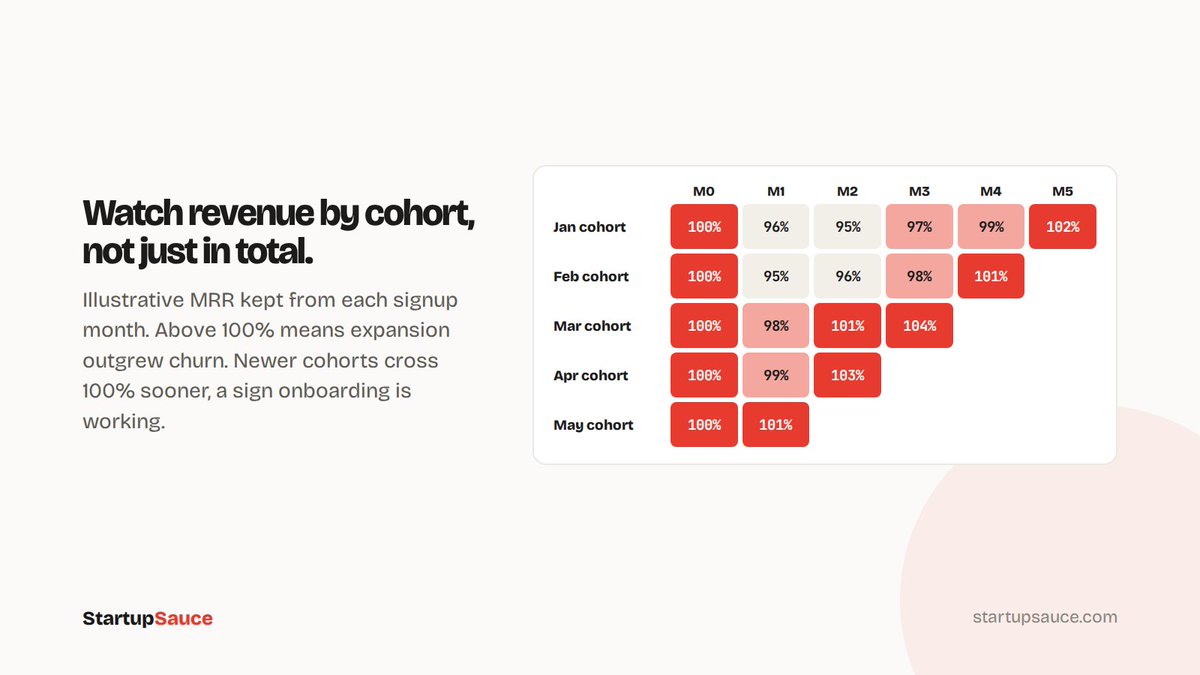
Total MRR can hide what's really happening. Cohorts show it.
In this illustrative table, each row is a group of customers who signed up in the same month, and each cell shows how much of their starting MRR is still there. The January cohort dips to 95% before recovering to 102% by month five. Newer cohorts cross 100% much faster: March by month two, May by month one.
That's a sign onboarding and expansion are improving.
Track it monthly. It tells you whether your business is getting healthier, not just bigger. 📊
Total MRR can hide what's really happening. Cohorts show it.
In this illustrative table, each row is a group of customers who signed up in the same month, and each cell shows how much of their starting MRR is still there. The January cohort dips to 95% before recovering to 102% by month five. Newer cohorts cross 100% much faster: March by month two, May by month one.
That's a sign onboarding and expansion are improving.
Track it monthly. It tells you whether your business is getting healthier, not just bigger. 📊
Translating your website isn't the same as entering a new market. 🌐
Localization for SaaS includes more than language: local currency and payment methods, date and number formats, examples and case studies that feel relevant and support in the right time zone.
Before investing heavily, test demand. Run a small campaign in the new market, see who signs up and talk to the first customers there.
Several members found that one well-chosen market grew faster than trying five at once.
Translating your website isn't the same as entering a new market. 🌐
Localization for SaaS includes more than language: local currency and payment methods, date and number formats, examples and case studies that feel relevant and support in the right time zone.
Before investing heavily, test demand. Run a small campaign in the new market, see who signs up and talk to the first customers there.
Several members found that one well-chosen market grew faster than trying five at once.
Your first customer success hire is often more valuable than your next engineer. 🙋
Once you have dozens of paying customers, someone needs to own onboarding calls, check-ins, renewals and the early signs of churn. When the founder does it alone, it's the first thing to slip when things get busy.
Look for someone who is patient, curious about customers' businesses and comfortable spotting upsell opportunities without being pushy.
Give them clear metrics from day one: activation rate, churn and expansion revenue.
Your first customer success hire is often more valuable than your next engineer. 🙋
Once you have dozens of paying customers, someone needs to own onboarding calls, check-ins, renewals and the early signs of churn. When the founder does it alone, it's the first thing to slip when things get busy.
Look for someone who is patient, curious about customers' businesses and comfortable spotting upsell opportunities without being pushy.
Give them clear metrics from day one: activation rate, churn and expansion revenue.
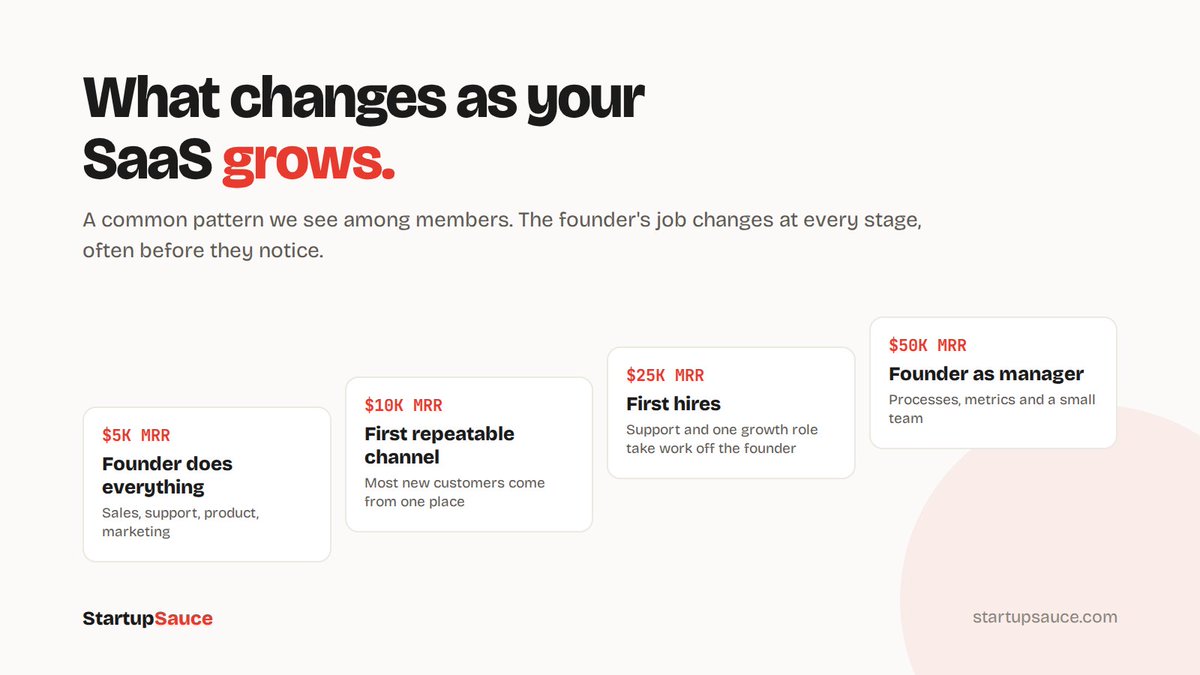
Your job as a founder changes as your SaaS grows, often before you notice.
A common pattern among members: at $5K MRR, the founder does everything: sales, support, product and marketing. Around $10K, one repeatable channel starts bringing most new customers. By $25K, the first hires in support and growth take work off the founder's plate. By $50K, the founder is becoming a manager: processes, metrics and a small team.
The skills that got you to one stage aren't always the ones that get you to the next. 📈
Your job as a founder changes as your SaaS grows, often before you notice.
A common pattern among members: at $5K MRR, the founder does everything: sales, support, product and marketing. Around $10K, one repeatable channel starts bringing most new customers. By $25K, the first hires in support and growth take work off the founder's plate. By $50K, the founder is becoming a manager: processes, metrics and a small team.
The skills that got you to one stage aren't always the ones that get you to the next. 📈
Save the date: the next StartupSauce in-person meetup will be in Berlin in spring 2027. 🇩🇪
After Lisbon, members asked for another city that's easy to reach from across Europe. Berlin fits: a great SaaS scene, and plenty of places to talk until late.
Two days of workshops, live teardowns of pricing and onboarding and long dinners with founders who are building the same kind of companies you are.
Members can register interest in Slack. Final dates will be announced in January.
Save the date: the next StartupSauce in-person meetup will be in Berlin in spring 2027. 🇩🇪
After Lisbon, members asked for another city that's easy to reach from across Europe. Berlin fits: a great SaaS scene, and plenty of places to talk until late.
Two days of workshops, live teardowns of pricing and onboarding and long dinners with founders who are building the same kind of companies you are.
Members can register interest in Slack. Final dates will be announced in January.
Selling SaaS internationally? Sales tax and VAT can surprise you long before you feel "big enough" to worry. 🌍
Many countries and US states expect digital services to charge tax once you pass certain thresholds, and rules differ for business and consumer customers. Several members discovered this only when an accountant flagged back taxes.
Practical steps: track where your customers are from day one, use a billing system that can calculate and collect tax automatically and review your obligations with an accountant once a year.
This isn't tax advice. It's a reminder to ask one early.
Selling SaaS internationally? Sales tax and VAT can surprise you long before you feel "big enough" to worry. 🌍
Many countries and US states expect digital services to charge tax once you pass certain thresholds, and rules differ for business and consumer customers. Several members discovered this only when an accountant flagged back taxes.
Practical steps: track where your customers are from day one, use a billing system that can calculate and collect tax automatically and review your obligations with an accountant once a year.
This isn't tax advice. It's a reminder to ask one early.
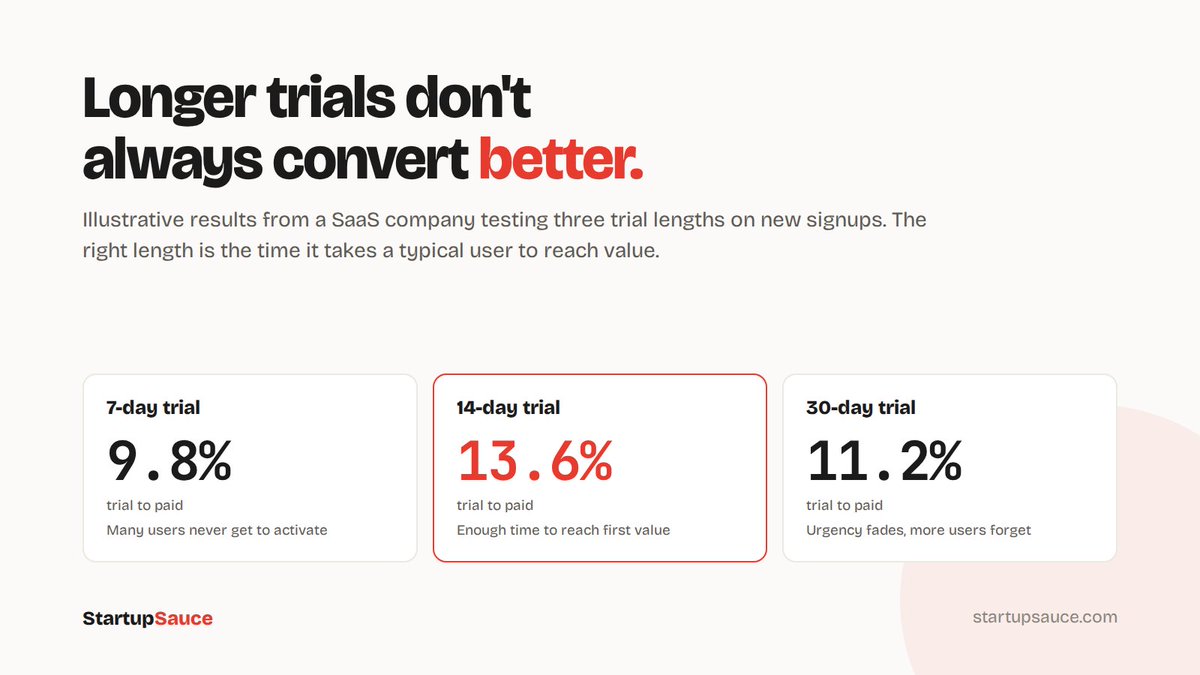
Longer trials don't always convert better.
In this illustrative test on new signups, a 7-day trial converted 9.8% of users to paid, because many never had time to activate. A 14-day trial converted 13.6%. A 30-day trial dropped back to 11.2%: urgency faded, and more users simply forgot.
The right trial length is roughly how long it takes a typical user to reach real value, plus a little buffer.
Measure time to first value first. Then set the trial around it. ⏳
Longer trials don't always convert better.
In this illustrative test on new signups, a 7-day trial converted 9.8% of users to paid, because many never had time to activate. A 14-day trial converted 13.6%. A 30-day trial dropped back to 11.2%: urgency faded, and more users simply forgot.
The right trial length is roughly how long it takes a typical user to reach real value, plus a little buffer.
Measure time to first value first. Then set the trial around it. ⏳
Your happiest customers are your best salespeople. Most SaaS founders never ask them to sell. 🤝
A customer referral program is different from affiliates. It's for people who already use and love your product. Give both sides something meaningful, like a free month or account credit, and make sharing a one-click action inside the product.
Ask at the right moment: right after a customer reaches a milestone, leaves a great review or tells support how much the product helped.
Referred customers usually trust you faster and stay longer.
Your happiest customers are your best salespeople. Most SaaS founders never ask them to sell. 🤝
A customer referral program is different from affiliates. It's for people who already use and love your product. Give both sides something meaningful, like a free month or account credit, and make sharing a one-click action inside the product.
Ask at the right moment: right after a customer reaches a milestone, leaves a great review or tells support how much the product helped.
Referred customers usually trust you faster and stay longer.
Most SaaS case studies read like press releases. The ones that sell read like stories. 📖
A strong case study follows a simple arc: who the customer is and what was broken, what they tried before, why they chose you, what changed and the specific result, with a real number and a real quote from a real person.
Keep it to one page, lead with the result in the title and write it in the customer's words, not yours.
Then use it everywhere: sales follow-ups, landing pages, ads and onboarding emails.
Most SaaS case studies read like press releases. The ones that sell read like stories. 📖
A strong case study follows a simple arc: who the customer is and what was broken, what they tried before, why they chose you, what changed and the specific result, with a real number and a real quote from a real person.
Keep it to one page, lead with the result in the title and write it in the customer's words, not yours.
Then use it everywhere: sales follow-ups, landing pages, ads and onboarding emails.
New for StartupSauce members: the Member Directory. 🗂
Looking for someone who has scaled a SaaS from $10K to $50K MRR, set up SOC 2, sold into healthcare or run a successful Product Hunt launch? Now you can find them.
Every member profile shows their product, their stage and the topics they're happy to help with. Search by expertise, industry or country, and send an intro request directly.
Only members can see it, and every member decides what their profile shows. It's live now in the member area.
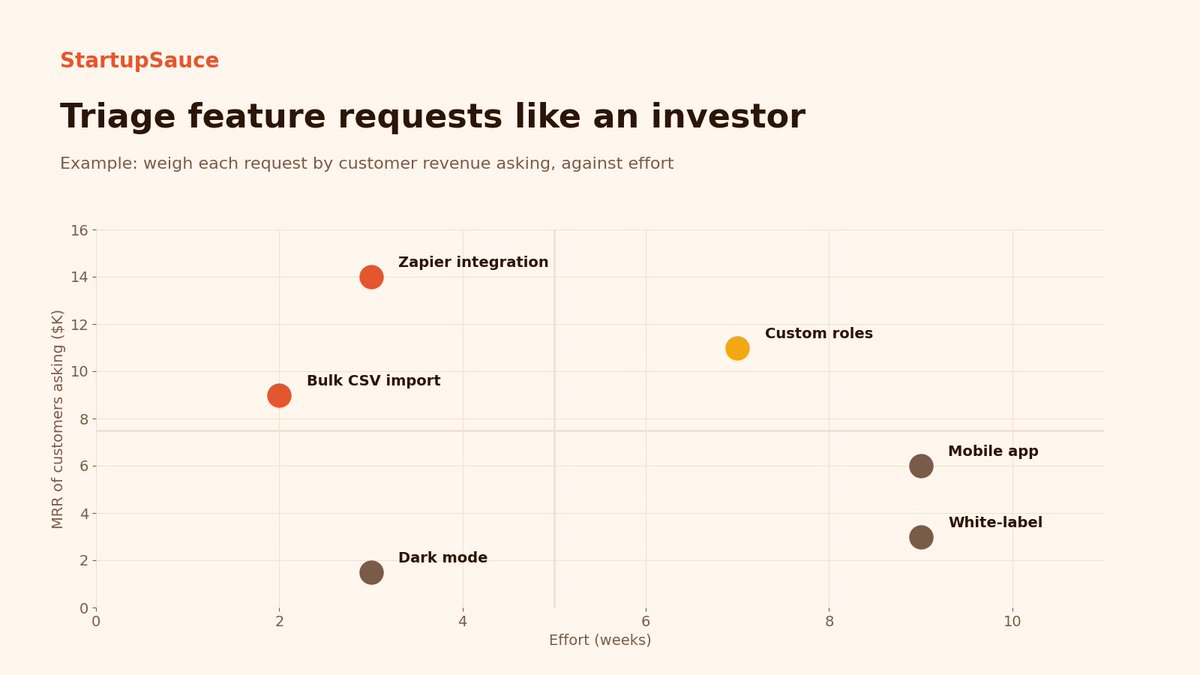
Every customer seems to want a different feature. Treat each request like an investment decision.
Plot every request on two axes: how much MRR comes from the customers asking for it, and how many weeks it will take to build. In this example, a Zapier integration and bulk CSV import are high value and low effort, so they get built now. Custom roles are valuable but take longer, so they're planned for next quarter. Dark mode, white-label and a mobile app wait.
The loudest request isn't always the most valuable one. 🧭
Every customer seems to want a different feature. Treat each request like an investment decision.
Plot every request on two axes: how much MRR comes from the customers asking for it, and how many weeks it will take to build. In this example, a Zapier integration and bulk CSV import are high value and low effort, so they get built now. Custom roles are valuable but take longer, so they're planned for next quarter. Dark mode, white-label and a mobile app wait.
The loudest request isn't always the most valuable one. 🧭
Most SaaS case studies read like press releases, and nobody finishes them. 📝
A case study that actually sells tells a story: the customer's situation before, the problem that made them look for a solution, why they chose you, what changed with specific numbers, and a direct quote in their own words.
Keep it short, lead with the result and make it easy to scan. Then use it everywhere: on your website, in sales emails, in onboarding and in ads.
Most SaaS case studies read like press releases, and nobody finishes them. 📝
A case study that actually sells tells a story: the customer's situation before, the problem that made them look for a solution, why they chose you, what changed with specific numbers, and a direct quote in their own words.
Keep it short, lead with the result and make it easy to scan. Then use it everywhere: on your website, in sales emails, in onboarding and in ads.
Your first enterprise customer will ask for legal documents you don't have yet. Better to prepare them before that email arrives. 📄
Most SaaS companies need a few basics: clear terms of service, a privacy policy that matches how you really handle data, a data processing agreement for customers in regions with privacy laws like GDPR, and a list of the subprocessors you use.
Templates are a good starting point, but have a lawyer review them for your product and markets. This isn't legal advice, just a reminder not to leave it until a deal depends on it.
Clean paperwork makes bigger deals move faster.
Most SaaS case studies read like press releases, and nobody finishes them. 📝
A case study that actually sells tells a story: the customer's situation before, the problem that made them look for a solution, why they chose you, what changed with specific numbers, and a direct quote in their own words.
Keep it short, lead with the result and make it easy to scan. Then use it everywhere: on your website, in sales emails, in onboarding and in ads.
Your first enterprise customer will ask for legal documents you don't have yet. Better to prepare them before that email arrives. 📄
Most SaaS companies need a few basics: clear terms of service, a privacy policy that matches how you really handle data, a data processing agreement for customers in regions with privacy laws like GDPR, and a list of the subprocessors you use.
Templates are a good starting point, but have a lawyer review them for your product and markets. This isn't legal advice, just a reminder not to leave it until a deal depends on it.
Clean paperwork makes bigger deals move faster.
Your first enterprise customer will ask for legal documents you don't have yet. Better to prepare them before that email arrives. 📄
Most SaaS companies need a few basics: clear terms of service, a privacy policy that matches how you really handle data, a data processing agreement for customers in regions with privacy laws like GDPR, and a list of the subprocessors you use.
Templates are a good starting point, but have a lawyer review them for your product and markets. This isn't legal advice, just a reminder not to leave it until a deal depends on it.
Clean paperwork makes bigger deals move faster.
New for StartupSauce members: Founder Coworking Hours. 💻
Every Tuesday and Thursday, members can join a live video session for two hours of focused work alongside other founders. At the start, everyone shares the one thing they'll finish. At the end, everyone reports back.
No presentations, no networking pressure. Just a quiet room full of people building, and the gentle accountability of knowing someone will ask how it went.
Founders say it's the most productive two hours of their week. Members can find the link in Slack.
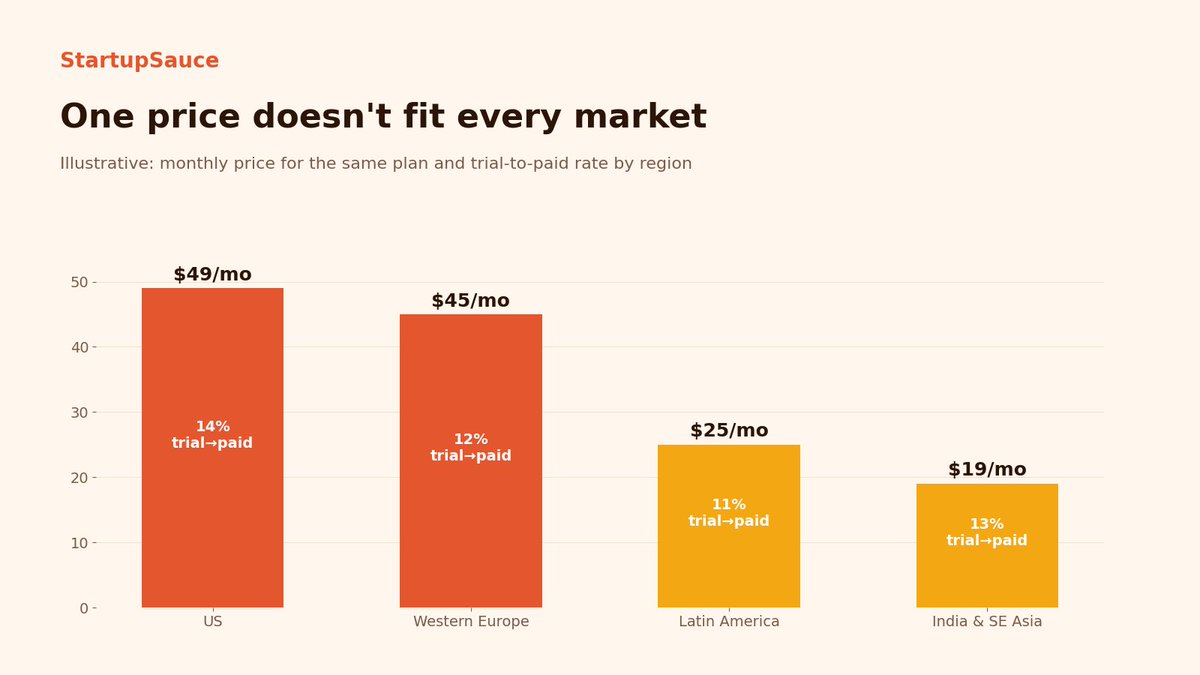
A $49 plan can feel cheap in the US and expensive in India.
In this illustrative example, a SaaS company sets regional prices for the same plan: $49 a month in the US, $45 in Western Europe, $25 in Latin America and $19 in India and Southeast Asia. Trial-to-paid conversion stays similar across regions, between 11% and 14%, instead of collapsing in markets where the original price was out of reach.
Regional pricing isn't a discount. It's matching price to what customers in each market can realistically pay.
Just add safeguards, like billing country checks, so the lower prices go to the right customers. 💰
New for StartupSauce members: Founder Coworking Hours. 💻
Every Tuesday and Thursday, members can join a live video session for two hours of focused work alongside other founders. At the start, everyone shares the one thing they'll finish. At the end, everyone reports back.
No presentations, no networking pressure. Just a quiet room full of people building, and the gentle accountability of knowing someone will ask how it went.
Founders say it's the most productive two hours of their week. Members can find the link in Slack.
New for StartupSauce members: Founder Coworking Hours. 💻
Every Tuesday and Thursday, members can join a live video session for two hours of focused work alongside other founders. At the start, everyone shares the one thing they'll finish. At the end, everyone reports back.
No presentations, no networking pressure. Just a quiet room full of people building, and the gentle accountability of knowing someone will ask how it went.
Founders say it's the most productive two hours of their week. Members can find the link in Slack.
Some SaaS companies get thousands of visitors a month from pages they built once, with a template. 🔍
Programmatic SEO means creating many pages from one structure, like "invoice template for [industry]," "[tool A] + [tool B] integration" or "[use case] software for small teams," each targeting a specific search.
It only works if every page is genuinely useful: real content for that specific case, not the same text with one word swapped. Thin, copy-paste pages get ignored by search engines, or worse.
Start with a small set, check which ones rank and convert, then expand from there.
Some SaaS companies get thousands of visitors a month from pages they built once, with a template. 🔍
Programmatic SEO means creating many pages from one structure, like "invoice template for [industry]," "[tool A] + [tool B] integration" or "[use case] software for small teams," each targeting a specific search.
It only works if every page is genuinely useful: real content for that specific case, not the same text with one word swapped. Thin, copy-paste pages get ignored by search engines, or worse.
Start with a small set, check which ones rank and convert, then expand from there.
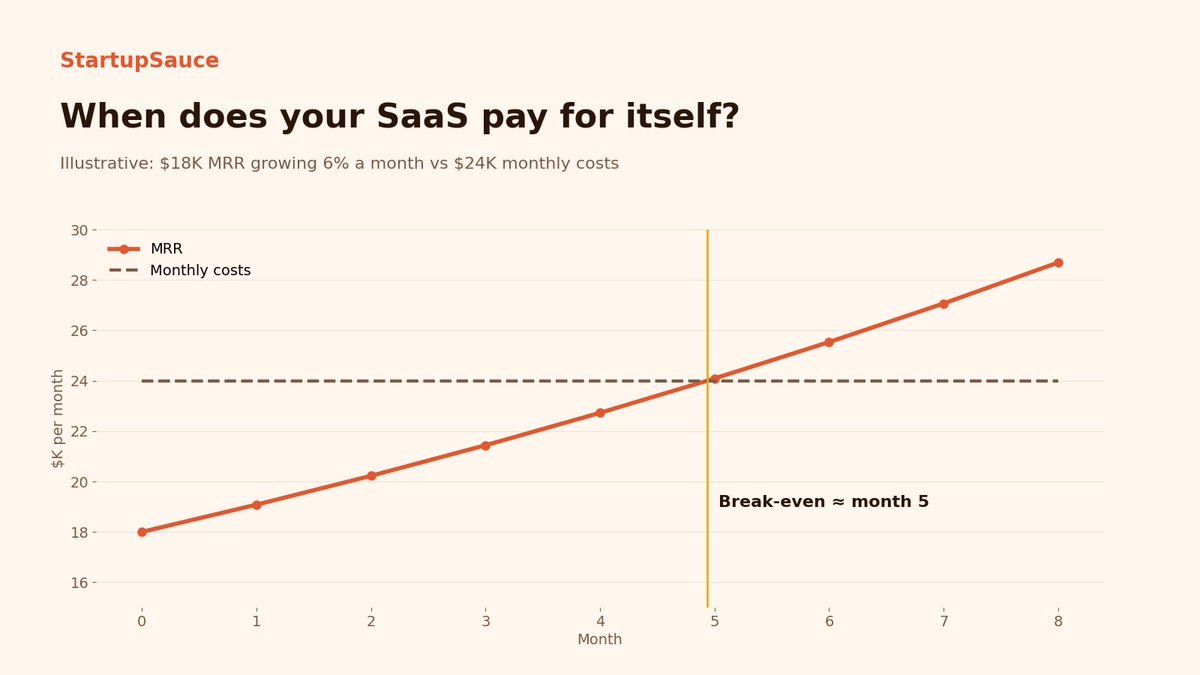
When will your SaaS pay for itself? The math is simpler than it looks.
In this illustrative example, a company has $18K in MRR, growing 6% a month, with $24K in monthly costs. If costs stay flat and growth holds, MRR crosses costs around month five. From that point, the company funds its own growth.
Run this calculation with your own numbers every month. It tells you how much runway you really need, and how a change in growth rate or costs moves the date.
Knowing when you'll be profitable changes every decision you make before then. 📈
When will your SaaS pay for itself? The math is simpler than it looks.
In this illustrative example, a company has $18K in MRR, growing 6% a month, with $24K in monthly costs. If costs stay flat and growth holds, MRR crosses costs around month five. From that point, the company funds its own growth.
Run this calculation with your own numbers every month. It tells you how much runway you really need, and how a change in growth rate or costs moves the date.
Knowing when you'll be profitable changes every decision you make before then. 📈
Nobody talks about it in launch posts, but founder burnout is one of the most common reasons SaaS companies stall. 🔋
Bootstrapped founders often do everything at once: product, sales, support, finance. Weeks turn into months without a real day off, and decisions get worse as energy drops.
What members say helps most: protecting at least one full day off every week, delegating the tasks that drain you the most first, and having people to talk to who understand what building a company is actually like.
Your company can only run as long as you can. Pace yourself like it's a marathon, because it is.
Nobody talks about it in launch posts, but founder burnout is one of the most common reasons SaaS companies stall. 🔋
Bootstrapped founders often do everything at once: product, sales, support, finance. Weeks turn into months without a real day off, and decisions get worse as energy drops.
What members say helps most: protecting at least one full day off every week, delegating the tasks that drain you the most first, and having people to talk to who understand what building a company is actually like.
Your company can only run as long as you can. Pace yourself like it's a marathon, because it is.
New for StartupSauce members: Accountability Pairs. 🤝
Every month, we'll match members in pairs based on their stage and goals. Each pair has a short weekly check-in: what you committed to, what you actually did and what's next.
It's simple, but it works. Knowing that another founder will ask you on Friday whether you shipped the pricing page or sent the investor update changes what you get done.
The first round starts next month. Members can sign up in Slack.