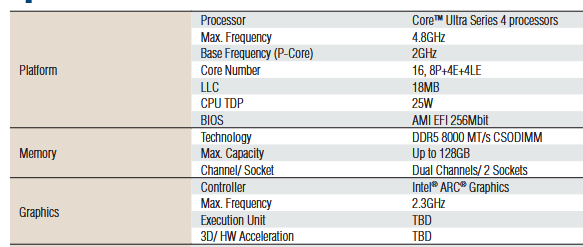
@AkileJoseph@oxyg3n1us@primusaurum HT is coming back for datacenter with Coral Rapids at the end of 2028;
At the moment, there are no plans to re-introduce HT in client processors, including Razor Lake.
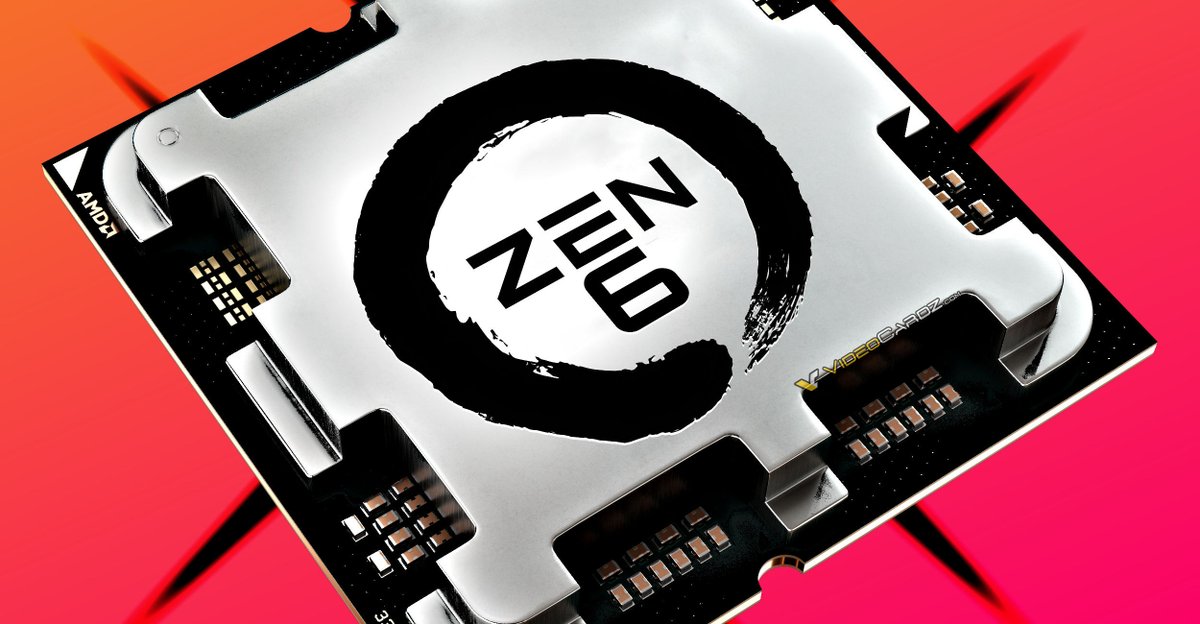
The following claims about Zen 6 on AM5 are not accurate:
- Zen 6 will use TSMC N2X (for the first processors based on this architecture).
- Zen 6 has been delayed until summer.
- Zen 6 will exceed the 6 GHz barrier.
China's Moore Threads has teased an upcoming graphics card codenamed "Lushan", aimed at tackling gaming and running local LLMs thanks to record VRAM capacity. 🔗 https://t.co/cEb8KweQ4X
A lot of people are drastically overestimating the CPU performance of the 5800X3D, thinking it would absolutely smash the PS5.
It's only 60% faster than a full 8-core Zen 2 part (see 5800X3D vs 3800X from our testing just a few months ago): https://t.co/oCuDlc5YFf
The 5800X3D is twice as fast as the Zen 1 Ryzen 7 1800X: https://t.co/fghbrxNFI7
The PS5 has cut down clocks and less L3 cache (8MB vs 32MB) relative to the 3800X. Similar to the Ryzen 7 4750G APU
Tom's Hardware found the 4750G was about 10% slower than a 3800XT in their review: https://t.co/gJXQOD2Jw7
Based on all of this data we'd expect the 5800X3D to fall short of 2x faster than the 4750G. 80% faster is a reasonable estimate.
It might sound odd that a flagship CPU from 2022 is only 80% faster than the PS5, when top tier GPUs from the same year are massively more powerful. But CPU improvements are slower year-on-year than GPUs (or at least have been)
Can we rename this enormous DX12 update coming in December to DirectX 13 already? It's too much stuff-vec/matrix linalg, MLIR, DXR 2.0 / clustered geometry; on top of other significant past AgilitySDK updates. Bump the version number, cowards.
Intel 18A yields have improved from “horrible” (when Lip-Bu Tan took over in March 2025) to 70% today.
First external customer signed for 18A-P + Microsoft becomes the first public EMIB packaging customer (Azure custom silicon) with a multi-year Xeon supply deal (including Diamond Rapids).
The turnaround is accelerating.
#Intel #Semiconductors #Foundry #18A #intc
The 3D era is being unlocked by Atomic Layer Etch semi tooling.
ALE is what I call a complementary patterning method: it augments the core lithography process (the scanner) to image chips. There are only a handful of examples, and they come along about once a decade:
1980s: Reactive Ion Etch. Better resolution by replacing wet etch.
1990s: CMP. Planarization boosted litho depth of focus, then enabled copper patterning, since Cu can't be dry etched.
2000s: Atomic Layer Deposition. Better resolution by enabling multi-patterning, both LELE (hardmask deposition) and spacer-based SADP/SAQP.
2020s: Thermal Atomic Layer Etch. Controlled lateral etch inside 3D structures (GAA, CFET, 3D NAND and DRAM).
2030s: There are at least 2 more in play that augment high-NA EUV. Can you guess what they are?
https://t.co/OvhkrsF01R
@Sebasti66855537 This reg edit prevents the file from being created in the first place:
https://t.co/xO7d3RCiwI
Changing the file to Read-only seems to work while the service is running. When it restarts it either creates a new file or removes the Read-only flag.
Why is x86 little-endian? Because a 1970 terminal did its arithmetic one bit at a time. Gustavo Pezzi's history of x86, from the 4004 to the 486, explains the quirks every assembly beginner calls arbitrary: AX, BX, CX, DX, the parity flag, segment:offset addresses.
What I like is the angle: none of it is arbitrary. Each choice was made "under pressure, usually to keep old software running on a new chip". The 8008's instruction set wasn't even designed by Intel but by Datapoint engineers Victor Poor and Harry Pyle, for the Datapoint 2200 terminal, and Datapoint then walked away from the chip. Its bit-serial processing explains the little-endian order; its serial line explains the parity flag, still bit 2 of FLAGS fifty years later.
The 8086 itself was a stopgap while Intel waited for the iAPX 432. It aimed at source compatibility with the 8080, so A became AL and HL became BX (hence BX as the only memory pointer among the four), and the odd AX, CX, DX, BX encoding order follows the 8080's BC, DE, HL pairs. Even the separate 256-port I/O space comes from the 8080.
A great reminder that backward compatibility is an architecture decision with a 50-year tail. Which legacy choice are you carrying in your own firmware today?
https://t.co/gBgxn6bvSl