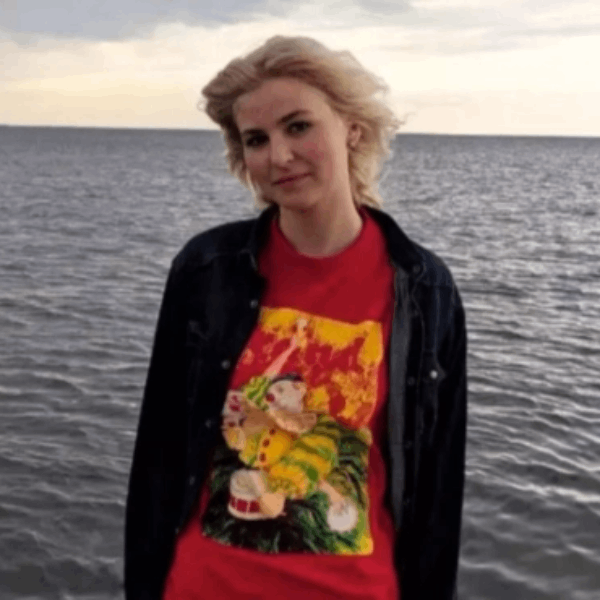
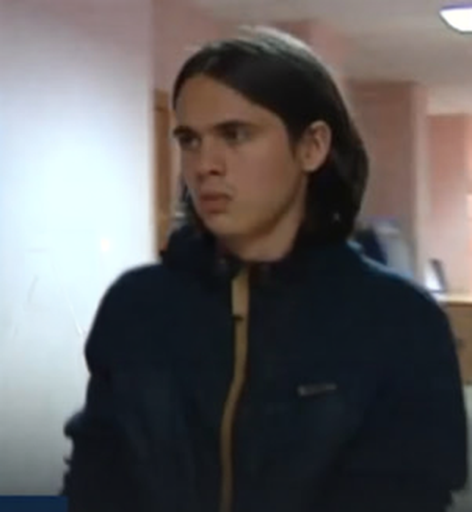
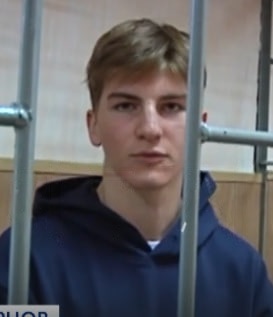
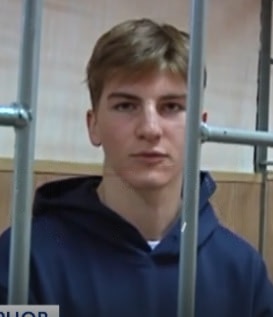
Maxim Lypkan was 18 years old when, on February 21, 2023, law enforcement officers searched his home in connection with a criminal case concerning alleged “fake news” about the Russian army.
He was born on February 10, 2005, and lived in Odintsovo before his arrest. In 2022, he graduated from high school and was preparing to apply to a college to study law. Even before the criminal case, Maxim was a prominent civic activist: he took part in rallies supporting Alexei Navalny, ran protest blogs, wrote about political prisoners, and supported them through correspondence.
On February 24, 2022, the day Russia launched its full-scale invasion of Ukraine, Maxim staged a solo picket on Manezhnaya Square holding a sign reading “No war! Нет войне!” (“No to war!”). He later said that the war in Ukraine had deeply shocked him, and that reports of civilian casualties in Kharkiv, Bucha, and other Ukrainian cities motivated him to protest openly.
Ahead of the first anniversary of the invasion, Maxim applied for a permit to hold an anti-war rally under the slogan “A Year of Hell” on Lubyanka Square on February 24, 2023. Moscow authorities refused to approve the event, citing the “epidemiological situation.” Maxim attempted to challenge the decision in court, but unsuccessfully.
On February 14, 2023, after publishing the city administration’s refusal, Maxim was detained at Leningradsky Railway Station. For announcing an unauthorized rally, police drew up two administrative offense reports against him: under Article 20.3.3 of the Russian Code of Administrative Offenses (“discrediting the use of the Armed Forces of the Russian Federation”) and Part 2 of Article 20.2 (“organizing or conducting a public event without submitting notification in the prescribed manner”). He was later fined 80,000 rubles under these charges.
However, the matter did not end with administrative prosecution.
At around six o’clock in the morning on February 21, 2023, security forces arrived at the apartment where Maxim was staying. When no one opened the door, police called in the Ministry of Emergency Situations to force entry. Maxim’s grandmother was in the apartment with him. According to human rights defenders, his lawyer was not allowed to attend the search. A search was also conducted at Maxim’s registered address, where his father was present; several books were seized during that search.
The following day, February 22, the Khamovniki District Court of Moscow ordered the 18-year-old Maxim Lypkan into pre-trial detention. One of the reasons cited for choosing detention as a preventive measure was the “complex geopolitical situation in Russia,” while defense arguments concerning the young man’s health were disregarded by the court.
Maxim was charged under Article 207.3, Part 2(d) of the Russian Criminal Code: “public dissemination, under the guise of reliable information, of knowingly false information about the use of the Armed Forces of the Russian Federation, motivated by political hatred or enmity.” This provision carries a maximum sentence of up to ten years’ imprisonment.
The criminal case was based on Maxim’s anti-war statements, including posts on his Telegram channel and an interview with Radio Liberty published on February 18, 2023. In the interview, Maxim discussed his anti-war activities, his attempt to obtain authorization for the “A Year of Hell” rally, and his belief that Russia’s war against Ukraine was criminal.
While in pre-trial detention, Maxim faced pressure and abuse. His lawyer, Alan Kachmazov, reported that cellmates threatened him, used physical force against him, and forcibly shaved a mohawk into his hair. Following public attention and appeals to the Presidential Human Rights Council, Maxim was transferred to a different cell.
In the summer of 2023, Maxim Lypkan was sent to the Serbsky Institute for a forensic psychiatric evaluation, and on October 30, 2023, a court ordered his transfer to a psychiatric hospital.
On February 19, 2024, the Odintsovo City Court of the Moscow Region relieved Maxim of criminal liability and imposed compulsory medical measures, ordering treatment in a specialized psychiatric hospital. The court found him legally insane “at the time the offense was committed.” On June 11, 2024, the Moscow Regional Court upheld this decision.
The project “Support for Political Prisoners. Memorial” considers Maxim Lypkan a political prisoner and regards his case as an example of anti-war persecution involving the use of punitive psychiatry.
In 2023, Maxim Lypkan became one of the recipients of the Boris Nemtsov Award, alongside Maria Ponomarenko, Vladimir Rumyantsev, Nikita Tushkanov, and Mikhail Simonov. They received the award for their courage in defending democratic rights and freedoms.
Максиму Лыпканю было 18 лет, когда 21 февраля 2023 года к нему пришли с обыском по делу о «фейках» про российскую армию.
Он родился 10 февраля 2005 года, перед задержанием проживал в Одинцово, в 2022 году окончил школу и готовился поступать на юридический факультет. До уголовного дела Максим уже был заметным гражданским активистом: участвовал в акциях в поддержку Алексея Навального, вёл протестные блоги, писал о политзаключённых и сам поддерживал их письмами.
24 февраля 2022 года, в день начала полномасштабного вторжения России в Украину, Максим вышел в одиночный пикет на Манежную площадь с плакатом «No war! Нет войне!». Позже он рассказывал, что война в Украине потрясла его, и после сообщений о жертвах в Харькове, Буче и других украинских городах он решил протестовать открыто.
К годовщине вторжения Максим подал уведомление о проведении 24 февраля 2023 года антивоенного митинга «Год ада» на Лубянской площади. Московские власти отказали в согласовании, сославшись на эпидемиологическую обстановку. Максим пытался оспорить отказ в суде, но безуспешно.
14 февраля 2023 года, после публикации отказа мэрии, Максима задержали на Ленинградском вокзале. За анонс несогласованного митинга на него составили два административных протокола: по ст. 20.3.3 КоАП РФ — «дискредитация использования Вооружённых сил РФ», и по ч. 2 ст. 20.2 КоАП РФ — «организация либо проведение публичного мероприятия без подачи уведомления в установленном порядке». Позже по этим протоколам ему назначили штраф 80 тысяч рублей.
Но административным преследованием дело не ограничилось.
21 февраля 2023 года около шести утра силовики пришли в квартиру, где находился Максим. Когда дверь не открыли, полиция вызвала сотрудников МЧС, чтобы её выломать. В квартире вместе с Максимом была его бабушка. По данным правозащитников, адвоката к обыску не допустили. Обыск прошёл и по адресу регистрации Максима, где находился его отец; во время обыска были изъяты некоторые книги.
На следующий день, 22 февраля, Хамовнический суд Москвы отправил 18-летнего Максима Лыпканя в СИЗО. Одним из объяснений избрания заключения под стражу в качестве меры пресечения стала «сложная геополитическая обстановка в России», а аргументы стороны защиты о состоянии здоровья молодого человека были судом проигнорированы.
Максиму вменили п. «д» ч. 2 ст. 207.3 УК РФ — «публичное распространение под видом достоверных сообщений заведомо ложной информации об использовании Вооружённых сил РФ, совершённое по мотиву политической ненависти или вражды». Эта часть статьи предусматривает наказание до 10 лет лишения свободы.
Поводом для уголовного дела стали антивоенные высказывания Максима: посты в телеграм-канале и интервью Радио Свобода, опубликованное 18 февраля 2023 года. В нём Максим говорил о своих антивоенных акциях, о попытке согласовать митинг «Год ада» и о том, что считает войну России против Украины преступной.
В СИЗО Максим столкнулся с давлением и издевательствами. Его адвокат Алан Качмазов рассказывал, что сокамерники угрожали Максиму, применяли к нему силу и насильно выбрили ему на голове ирокез. После огласки и обращений в Совет по правам человека Максима перевели в другую камеру.
Летом 2023 года Максима Лыпканя отправили в Институт имени Сербского на судебно-психиатрическую экспертизу, а 30 октября 2023 года суд постановил перевести его в психиатрический стационар.
19 февраля 2024 года Одинцовский городской суд Московской области освободил Максима от уголовной ответственности и назначил ему принудительные меры медицинского характера — лечение в психиатрической больнице специализированного типа. Суд признал его невменяемым «в момент совершения преступления». 11 июня 2024 года Московский областной суд оставил это решение без изменения.
Проект «Поддержка политзаключённых. Мемориал» считает Максима Лыпканя политическим заключённым и относит его дело к антивоенным преследованиям с использованием карательной психиатрии.
В 2023 году Максим Лыпкань стал одним из лауреатов премии Бориса Немцова — вместе с Марией Пономаренко, Владимиром Румянцевым, Никитой Тушкановым и Михаилом Симоновым. Премию им присудили за смелость в отстаивании демократических прав и свобод.
Вы можете поддержать Максима письмом по адресу:
142360, Московская область, городской округ Чехов, п. Мещерское, стр. 39, к. 21, ГБУЗ Московской области «Психиатрическая больница №2 имени В. И. Яковенко», Лыпкань Максим Кириллович, 2005 г. р.
Danil Berdyugin was 18 years old when, in October 2022, he left the Novosibirsk region heading toward Kursk — and never returned home.
He was born on December 9, 2003, lived in the village of Beryozovka in the Novosibirsk District, and was a second-year student at the Novosibirsk Medical College. After completing his first year, Danil had already earned a nursing assistant qualification. He has a twin brother; according to their mother, Danil has been having health problems from childhood, including glaucoma and hearing loss, while his brother has cerebral palsy. Their mother said that Danil would usually go to classes in the morning and return home in the evening to help care for his brother.
He did not seem like someone against whom the state would one day build a treason case. Friends remember him as an ordinary student: studying, learning languages, and playing computer games. Danil was interested in German and Japanese and played an online game called “Legend of the Vampire.” Through the game, he met a girl from Ukraine. They communicated regularly, discussing languages and, after February 24, 2022, the war.
On March 6, 2022, Danil was detained at an anti-war rally in central Novosibirsk. His mother said that he was not an active participant in the protest but was simply sitting on a bench in Lenin Square when OMON officers approached him. After checking his documents, they released him.
On October 20, 2022, Danil left home without telling his parents in advance. Normally, he would take a commuter train to Novosibirsk to attend classes, but this time he went to the railway station and boarded a train to Moscow. He took with him a white medical coat, his nursing assistant diploma, a passport for international travel, and a laptop.
While on the journey, he wrote to his parents that he wanted to go “to the front to help the wounded.” Danil’s mother believes that he was traveling to the Kursk region not to take part in the war but to see the Ukrainian girl he had met online.
On October 24, 2022, Danil was detained at the railway station in Kursk. Then followed a series of administrative arrests. Human rights advocates describe such arrests as a “carousel” system: after a person completes an administrative sentence, they are repeatedly re-arrested and charged with new administrative offenses while law enforcement prepares a criminal case. According to the human rights group “Memorial,” during this period Danil was not allowed to contact his relatives or receive assistance from an independent lawyer.
He was later charged under two articles of the Russian Criminal Code: Part 3 of Article 30 and Part 1 of Article 322 (attempted illegal crossing of the Russian state border), and Part 1 of Article 30 together with Article 275 (preparation for high treason). Investigators alleged that Danil intended to join the Freedom of Russia Legion, a Russian paramilitary unit fighting on Ukraine’s side.
Danil’s mother said that in January 2023, FSB officers conducted a search of their home. They demanded documents “connected with Ukraine,” as well as weapons and money, but found nothing. FSB officers also visited the medical college where Danil studied, looking for possible accomplices, but found none. The family wanted to hire an independent lawyer, but, as Danil’s mother recounted, the FSB investigator discouraged them from doing so, saying that “no one can help” in a case under such charges. As a result, Danil was represented during the investigation by a state-appointed lawyer.
The trial at the Kursk Regional Court began on July 26, 2023, and, as is common in such cases, was held behind closed doors. The proceedings lasted only eight days. On August 3, 2023, the Kursk Regional Court sentenced Danil Berdyugin to six years in a maximum-security penal colony, followed by one year of restricted freedom. He was 19 years old at the time of sentencing.
The project “Political Prisoners Support. Memorial” considers Danil Berdyugin to be a political prisoner.
Danil Berdyugin is currently serving his sentence in Penal Colony No. 9 in Chuvashia.
Данилу Бердюгину было 18 лет, когда в октябре 2022 года он уехал из Новосибирской области в сторону Курска — и больше не вернулся домой.
Он родился 9 декабря 2003 года, жил в селе Берёзовка Новосибирского района и учился на втором курсе Новосибирского медицинского колледжа. После первого курса Данил уже получил диплом медбрата. У него есть брат-близнец; по словам матери, у Данила с детства были проблемы со здоровьем — глаукома и тугоухость, а у его брата — ДЦП. Мать рассказывала, что Данил обычно утром ездил на учёбу, а вечером возвращался домой помогать брату.
Он не выглядел человеком, вокруг которого государство однажды построит дело о госизмене. Знакомые вспоминают его как обычного студента: учёба, языки, компьютерные игры. Данил увлекался немецким и японским, играл в онлайн-игру «Легенда о вампире». Через игру он познакомился с девушкой из Украины. Они общались, обсуждали языки, а после 24 февраля 2022 года — войну.
6 марта 2022 года Данила задержали на антивоенной акции в центре Новосибирска. Его мать говорила, что он не был активным участником протеста, а просто сидел на лавочке на площади Ленина, когда к нему подошли сотрудники ОМОНа. После проверки документов его отпустили.
20 октября 2022 года Данил ушёл из дома, ничего заранее не сказав родителям. Обычно он садился на электричку до Новосибирска, чтобы ехать на учёбу, но в этот раз поехал на вокзал и сел на поезд до Москвы. С собой он взял белый халат, диплом медбрата, загранпаспорт и ноутбук.
Уже в дороге он написал родителям, что хочет отправиться «на фронт помогать раненым». Мать Данила считает, что сын ехал в Курскую область не на войну, а к знакомой девушке из Украины.
24 октября 2022 года Данилу задержали на вокзале в Курске. После этого началась цепочка административных арестов. Правозащитники называют такие аресты «карусельными»: человека повторно и многократно задерживают после отбытия срока административного ареста и фабрикуют новое административное обвинение, пока силовики готовят уголовное дело. По данным «Мемориала», в этот период Данилу не давали связаться с родственниками и получить помощь независимого адвоката.
Позже ему предъявили уголовное обвинение по двум составам: ч. 3 ст. 30, ч. 1 ст. 322 УК РФ (покушение на незаконное пересечение государственной границы РФ) и ч. 1 ст. 30, ст. 275 УК РФ (приготовление к государственной измене). Следствие утверждало, что Данил пытался вступить в Легион «Свобода России» и перейти на сторону противника.
Мать Данила рассказывала, что в январе 2023 года к ним пришли сотрудники ФСБ с обыском: требовали документы, «связанные с Украиной», оружие и деньги. Ничего не нашли. Сотрудники ФСБ также приезжали в медицинский колледж, где учился Данил, искали возможных сообщников, но, по словам матери, никого не нашли. Семья хотела привлечь независимого адвоката, но, как рассказывала мать Данила, следователь ФСБ отговаривал их от этого: говорил, что по такой статье «никто не поможет». В итоге интересы Данила на следствии представлял адвокат по назначению.
Суд в Курском областном суде начался 26 июля 2023 года и прошёл, как и всегда в таких делах, в закрытом режиме. Рассмотрение дела заняло всего восемь дней. 3 августа 2023 года Курский областной суд приговорил Данила Бердюгина к 6 годам колонии строгого режима с ограничением свободы на 1 год. На момент вынесения приговора Данилу было 19 лет.
Проект «Поддержка политзаключённых. Мемориал» считает Данила Бердюгина политическим заключённым.
Сейчас Данил Бердюгин отбывает срок в ИК-9 в Чувашии.
Вы можете поддержать Данила письмом по адресу:
429900, Чувашская Республика, г. Цивильск, ул. Северная, д. 13, ФКУ ИК-9 УФСИН России по Чувашской Республике, Бердюгину Данилу Александровичу, 2003 г. р.
Bogdan Protazanov was 14 years old when a police SWAT team arrived at the door of his family’s apartment in Vyborg in April 2025.
Before the criminal case, he played volleyball, competed for the Leningrad Region youth team, and was preparing for tournaments. His coach later told journalists that Bogdan was making rapid progress and was a calm, open teenager and a great team player. His father, a former military border guard, said that the family had never expected to see their son become a defendant in a terrorism case: they had been planning to enroll him in an FSB cadet corps.
The story began several days before his arrest. Bogdan met a girl online. After that, he was contacted by unknown individuals who claimed to be officers of the Ministry of Internal Affairs and the FSB (Federal Security Service). A person posing as a security service representative threatened to open a criminal case against the boy’s parents and have them sentenced to life imprisonment if the teenager failed to comply. Initially, the phone scammers were interested only in valuables. Bogdan was asked to open the family safe, but he could not find the keys. He was then instructed to make bank transfers: Bogdan transferred 180,000 rubles from his mother’s bank card, as well as 7,000 rubles of his own money, which his father had given him for a trip to a sports competition.
The demands then changed: he was instructed to set fire to railway equipment.
On April 12, 2025, Bogdan went to the railway tracks near the Vyborg station. According to the investigation, he brought a canister of gasoline, poured fuel near a switch heater heating control cabinet, and started a fire nearby while simultaneously showing what was happening to an unknown interlocutor via video call.
The equipment, which was left with nothing more than soot marks, remained operational. An expert witness confirmed in court that the functioning of the railway infrastructure had not been disrupted. The damage was estimated at approximately 5,000 rubles. Several hundred additional rubles were added for graffiti near the station.
The case was classified under Article 205, Part 1 of the Criminal Code of the Russian Federation as a terrorist act. In addition, the teenager was charged with vandalism under Article 214, Part 1.
On April 15, 2025, law enforcement officers arrived at the family’s home early in the morning. After his arrest, Bogdan gave a confession and recorded a video apology, which was later used as part of the case materials.
The case was heard by the First Western District Military Court. During the proceedings, the defense argued that the teenager had acted under pressure from unknown individuals operating through the internet and that the actual consequences of the incident were disproportionate to its classification as a terrorist act.
On October 15, 2025, the court found Bogdan Protazanov guilty and sentenced him to five years and six months in a juvenile correctional facility. In January 2026, the Military Court of Appeal upheld the sentence.
Bogdan is currently being held at Pre-Trial Detention Center No. 5 in St. Petersburg.
Yulia Sokolova was born on June 11, 2006. A resident of the Kherson region, she holds dual Ukrainian and Russian citizenship.
When human rights defenders learned of her sentence in April 2025, Yulia was only 18 years old. Very little is known about her case, as is true for most prosecutions on charges of treason and espionage in today’s Russia. Increasingly, such cases are heard behind closed doors, without public scrutiny and without any opportunity for society to examine the evidence or understand what actually happened. Human rights defenders are often forced to piece together information about such prosecutions bit by bit.
In April 2025, the Kherson Regional Court found Yulia guilty under Articles 276 (espionage) and 275 (high treason) of the Criminal Code of the Russian Federation and sentenced her to nine years in a general-regime penal colony.
According to the prosecution, Yulia allegedly “filmed facilities used by the Russian Armed Forces and other Russian government agencies with her mobile phone” and sent the recordings to a “cliant via messaging apps and email.”
The project “Support for Political Prisoners. Memorial” considers Yulia Sokolova to be among the “other victims of political repression,” meaning people whose prosecution is highly likely to have a political motive and to involve serious violations of the law.
Yulia Sokolova is currently being held at Penal Colony No. 5 in the Saratov region.
Юлия Соколова родилась 11 июня 2006 года. Жительница Херсонской области, она имеет двойное гражданство Украины и России.
Когда в апреле 2025 года правозащитникам стало известно о её приговоре, Юлии было всего 18 лет. О ее деле известно очень мало, как и в большинстве случаев привлечения к уголовной ответственности по обвинениям в госизмене и шпионаже. Всё чаще такие дела рассматриваются за закрытыми дверьми, без публичности и без возможности для общества увидеть доказательства и понять, что на самом деле произошло. Правозащитники буквально по крупицам вынуждены собирать информацию о фактах подобного преследования.
Херсонский областной суд в апреле 2025 года признал Юлию виновной по ст. 276 УК РФ и ст. 275 УК РФ и назначил ей 9 лет колонии общего режима.
По версии обвинения, Юлия якобы «снимала на камеру своего мобильного телефона объекты, используемые ВС РФ и другими российскими ведомствами» и отправляла их «заказчику через мессенджеры и по электронной почте».
Проект «Поддержка политзаключённых. Мемориал» относит Юлию Соколову к «другим жертвам политических репрессий», то есть к людям, в чьём преследовании с высокой вероятностью есть политическая мотивация и серьёзные нарушения закона.
Сейчас Юлия Соколова находится в ИК-5 в Саратовской области.
Вы можете поддержать Юлию письмом по адресу:
412900, Саратовская область, г. Вольск, п. Видим, д. 12, ФКУ ИК-5 УФСИН России по Саратовской области, Соколова Юлия Олеговна, 2006 г. р.
Danila Bagrov had just turned 18 when he was detained in August 2024.
The young man lived in Saint Petersburg with his mother and younger sister. He worked as an auto mechanic and was passionate about cars and motorcycles.
On August 27, 2024, Danila was arrested on charges of preparing to commit high treason and participating in the activities of a terrorist organization.
According to the prosecution, Danila, “being an opponent of the special military operation, entered into correspondence with a representative of the organization Russian Volunteer Corps (RDK),” which is designated as a terrorist organization in Russia. Investigators alleged that the young man expressed a desire to join the RDK in order to fight against the Russian army on Ukraine’s side, provided personal information about himself, received instructions, and purchased a plane ticket to Georgia with the intention of traveling onward to Ukraine. However, he allegedly “was unable to carry out his criminal intent due to circumstances beyond his control, as he was detained at the airport by officers of the Federal Security Service (FSB).”
He was charged with preparing to commit two especially serious crimes: under Part 2 of Article 275 of the Russian Criminal Code (“high treason”) and Part 2 of Article 205.5 (“participation in the activities of an organization recognized as terrorist in Russia”).
On October 10, 2024, Danila was added to Rosfinmonitoring’s (Russia’s Federal Financial Monitoring Service) list of terrorists and extremists.
On September 16, 2025, the Southern District Military Court found Danila Bagrov guilty under Part 1 of Article 30 in conjunction with Part 2 of Article 275, and Part 1 of Article 30 in conjunction with Part 2 of Article 205.5 of the Russian Criminal Code. He was sentenced to nine years of imprisonment: the first three years in a prison facility, with the remainder to be served in a maximum-security penal colony. He was also given one year of restricted freedom following his release.
The defense appealed the verdict and requested a lighter sentence. Danila’s lawyer pointed to his age, his admission of guilt, his remorse, and the fact that he had grown up in a single-parent family. In his appeal, Danila himself noted the unusual length of the sentence: the prosecutor had requested seven and a half years, yet the court imposed nine years.
“I don’t understand why that happened,” he said.
On January 29, 2026, the Military Court of Appeal upheld the sentence without changes.
In December 2024, Danila’s sister Eva, then an eighth-grade student, was also detained. We already wrote about her case earlier. She was convicted of publicly justifying terrorism and sentenced to four years in a juvenile correctional colony.
Danila learned of his sister’s sentence during a break in his own appeal hearing.
“In cases like this, I’ve seen grown men get two years, but she, a minor, got four,” he commented.
The project “Support for Political Prisoners. Memorial” considers Danila and Eva Bagrov to be political prisoners. Human rights advocates emphasize that even if Danila had genuinely intended to join the RDK, criminal prosecution under the articles on treason and participation in a terrorist organization would still be improper. They also point to the risk of entrapment: in cases involving attempts to join the RDK and the Freedom of Russia Legion, Russian security services have frequently used fake websites, bots, and online correspondence to identify people with anti-war and pro-Ukrainian views.
Danila Bagrov is currently being held in Prison No. 2 in the city of Yelets, Lipetsk Region.
You can support Danila by writing to him a letter: https://t.co/VQxUmXtF3K
Даниле Багрову только исполнилось 18 лет, когда его задержали в августе 2024 года.
Молодой человек жил в Санкт-Петербурге с матерью и младшей сестрой. Работал автомехаником, увлекался автомобилями и мотоциклами.
27 августа 2024 года Данилу арестовали по обвинению в приготовлении к госизмене и участию в деятельности террористической организации.
По версии обвинения, Данила, «будучи противником специальной военной операции, вступил в переписку с представителем организации “Русский добровольческий корпус”», признанной в России террористической. Следствие утверждало, что молодой человек написал о желании присоединиться к РДК, чтобы воевать против российской армии на стороне Украины, передал сведения о себе, получил инструкции и купил авиабилет в Грузию, чтобы оттуда попасть в Украину, однако «не смог довести свой преступный умысел до конца по независящим от него обстоятельствам, так как был задержан в аэропорту сотрудниками Федеральной службы безопасности».
Ему вменили приготовление к двум особо тяжким составам: по ч. 2 ст. 275 УК РФ — государственная измена, и ч. 2 ст. 205.5 УК РФ — участие в деятельности организации, признанной в России террористической.
10 октября 2024 года Данилу внесли в перечень террористов и экстремистов Росфинмониторинга.
16 сентября 2025 года Южный окружной военный суд признал Данилу Багрова виновным по ч. 1 ст. 30, ч. 2 ст. 275 УК РФ и ч. 1 ст. 30, ч. 2 ст. 205.5 УК РФ и приговорил его к 9 годам лишения свободы: первые 3 года — в тюрьме, оставшийся срок — в колонии строгого режима. Ещё на год ему назначили ограничение свободы.
Защита обжаловала приговор и просила назначить более мягкое наказание. Адвокат указывал на возраст Данилы, признание вины, раскаяние и то, что он рос в неполной семье. В апелляции сам Данила обратил внимание на странность назначенного срока: прокурор просил для него 7 лет 6 месяцев, но суд дал 9 лет. «Я не понимаю, почему так произошло», — сказал он.
29 января 2026 года Апелляционный военный суд оставил приговор без изменений.
В декабре 2024 года задержали и сестру Данилы, Еву, на тот момент ученицу 8 класса, о которой мы рассказывали ранее. Ее осудили по делу о публичном оправдании терроризма и приговорили к реальному сроку — четырем годам воспитательной колонии.
Данила узнал о приговоре сестре в перерыве собственного апелляционного заседания. «По таким статьям я встречал, что взрослым мужикам давали по два года, а ей дали четыре, малолетке», — прокомментировал он.
Проект «Поддержка политзаключённых. Мемориал» считает Данилу и Еву Багровых политическими заключёнными. Правозащитники подчёркивают: даже если бы Данила действительно хотел присоединиться к РДК, уголовное преследование по статьям о госизмене и участии в террористической организации неправомерно. Они также указывают на риск провокации: в делах о попытках вступления в РДК и Легион «Свобода России» российские спецслужбы нередко используют фейковые сайты, ботов и переписки, через которые выявляют людей с антивоенными и проукраинскими взглядами.
Сейчас Данила Багров находится в тюрьме №2 в Ельце Липецкой области.
Вы можете поддержать Данилу письмом по адресу:
399783, Липецкая область, г. Елец, ул. Пролетарская, д. 1Б, ФКУ Т-2 УФСИН России по Липецкой области, Багров Данила Владиславович, 2006 г. р.
Eva Bagrova was 16 years old when she was detained at the end of December 2024. She lived in Saint Petersburg with her mother and older brother, and was an ordinary eighth-grader.
The criminal case stemmed from two photographs displayed on a school notice board. According to the investigation, Eva placed portraits of Denis Kapustin and Aleksei Lyovkin, both associated with the Russian Volunteer Corps (RVC) designated a terrorist organization by the Russian authorities, in an educational center in Saint Petersburg’s Kirovsky District, accompanied by the caption: “Honored Heroes of Russia.” The photographs remained on display for several days before students and teachers noticed them. Law enforcement officers first detained the school employee responsible for the notice board and then came for the schoolgirl herself. Investigators alleged that Eva had posted the photographs and charged her under the article concerning the public justification of terrorism (Part 1, Article 205.2 of the Russian Criminal Code).
The charges were later expanded. In addition to the accusation of “justifying terrorism,” Eva was charged with “assisting terrorist activities” (Part 1, Article 205.1 of the Russian Criminal Code). This additional charge was based on other leaflets and on testimony from a teenager who later retracted his statements and said that he had been pressured by the investigator. Eva’s defense lawyer pointed out that neither her fingerprints nor any biological traces were found on the leaflets. On March 27, 2025, she was transferred from pretrial detention to house arrest, but after the verdict she was taken back into custody.
On October 13, 2025, the First Western District Military Court sentenced Eva Bagrova to four years in a juvenile correctional colony.
On January 22, 2026, the appellate court upheld the sentence. During the hearing, Eva stated that after her detention she had been interrogated without a legal representative present and was threatened with torture. According to her testimony, the threats were directed not only at her but also at her father and brother Daniela, who at that time was also already in custody on charges of high treason and participation in terrorist activities.
The human rights project Support for Political Prisoners. Memorial considers Eva Bagrova to be a political prisoner.
Eva is currently being held at Pretrial Detention Center No. 5 (SIZO-5) in Saint Petersburg.
You can support Eva by sending her a letter:
https://t.co/PjMHzIULKI
Vladislava Zagorodneva was 17 years old when she was detained on October 11, 2024.
Vladislava is originally from Samara. Before her detention, she lived with her family, studied to become a special education teacher for preschool children at a pedagogical college, and volunteered at “Food Not Bombs” events.
The authorities accuse Vladislava of supporting the Russian Volunteer Corps under several articles of the Russian Criminal Code:
* Part 1 of Article 30 and Part 2 of Article 205 (“Preparation for a terrorist act by a group of persons acting in conspiracy”);
* Part 1.1 of Article 205.1 (“Facilitating terrorist activity”);
* Part 2 of Article 205.2 (“Public calls for terrorism using the Internet”);
* Part 2 of Article 205.5 (“Participation in a terrorist organization”);
* Article 275 (“High treason”).
After her arrest, the court ordered pretrial detention as a preventive measure. From that moment on, Vladislava was deprived of her freedom.
The criminal case is a group case, involving several other defendants in addition to her.
During a hearing on the extension of her detention, her lawyer argued that there was no evidence that she had committed any specific actions, and that the accusations were effectively based on interpretations of her possible awareness of the actions of third parties and the content of discussions.
Since October 2024, Vladislava Zagorodneva has been living in isolation. Her mother has died. Her only close relatives are her father and grandmother. According to cellmates who were held with her in pretrial detention, she receives very few letters.
Political prisoner and SotaVision journalist Antonina Favorskaya, who encountered Vladislava in detention, describes her as an open, well-read, and sociable young woman in need of friends and support. Vladislava loves cats, stories about travel and life abroad, books (classics, history, science fiction, and detective novels), the band Khimera, stickers, diamond paintings, paint-by-number kits, and beadwork.
Gagik Grigoryan was 17 years old and in his senior year of high school when he disappeared in Kursk on October 4, 2023.
Gagik had become interested in politics at an early age, was a member of the Russian Social Democratic Youth Union, and participated in the “Left Socialist Action” movement.
According to his parents, he openly opposed the war. On October 18, 2023, two weeks after his disappearance, he was added to the official register of “terrorists and extremists,” but for several more months his family members and friends did not know anything about his whereabouts. Only in the summer of 2024 did it become known that Gagik was being held in Moscow’s Detention Center No. 5.
The investigation claimed that the teenager had allegedly been communicating via the messenger Signal with people whom the security services considered connected to Ukrainian intelligence; that, acting on their instructions, he retrieved an explosive device from a hiding place, conducted surveillance of the home of a Russian serviceman, and prepared to blow up the serviceman’s car in the Kursk region. Later, the charges were expanded to include treason, participation in a terrorist organization, preparation for a terrorist attack, and possession of an explosive device. Grigoryan himself admitted only to part of the factual actions, but did not agree with their legal classification.
The boy’s family members, friends, as well as human rights advocates insist that the case was fabricated: the key piece of evidence was allegedly a staged video recording. Gagik was detained near his home, beaten, threatened, and only afterward forced to go to the location where the device was supposedly “recovered.” Moreover, according to open sources, by the time the schoolboy was allegedly supposed to blow up the car of Lieutenant Colonel Alexander Galya, that serviceman was already dead, having reportedly been killed on September 24, 2023, during a drone attack on the Khalino airfield in the Kursk region — that is, 10 days before Grigoryan’s arrest.
The trial was conducted behind closed doors: observers and even family members were barred from attending the hearings, and the press was admitted only for the announcement of the verdict. On January 29, 2025, the 2nd Western District Military Court sentenced Gagik Grigoryan to seven years in a general-regime penal colony and a fine of 40,000 rubles. On May 19, 2025, the appeal court upheld the sentence.
While in detention, he finished school and enrolled in a law program. He is currently being held in Penal Colony No. 4 in Torzhok.
The project “Support for Political Prisoners. Memorial” considers his case politically motivated and is demanding a review.
You can support Gagik by writing him a letter: https://t.co/arf8i78JOl
Yana Grigoryeva was sixteen when, in the spring of 2022, she wrote on Instagram what at the time, for many people, was not considered a “criminal offense,” but an ordinary human reaction to the war. On her page, she wrote that Russia had attacked Ukraine, that Russian soldiers were killing civilians, and she posted stories about Bucha.
Those few posts from April 4, April 9, and May 21, 2022, later became the basis of a criminal case. At the time, Yana was a minor.
Now Yana is twenty, and almost her entire adult life has already been shaped not by plans, studies, or work, but by investigations and court hearings in the same endless case.
What is especially frightening in this story is not only the article on “fake news” about the army itself, but also how persistently the state refuses to let a person go, even when, it would seem, everything should already have been over.
On April 4, 2025, the Leninsky District Court of Tyumen terminated the criminal case against Yana Grigoryeva due to the expiration of the statute of limitations and lifted her travel restrictions. The court explicitly proceeded from the fact that the posts had been published back in 2022 and that the limitation period had expired.
But the story did not end there. The case was sent back for a new hearing, and Yana was once again forced to go through the same nightmare.
On December 2, 2025, the Leninsky District Court of Tyumen closed the case for the second time — again because the statute of limitations had expired. The court once more stated that the case concerned posts from 2022, made by Yana when she was underage, and that the criminal prosecution should be terminated.
And still the authorities did not leave her alone. On February 19, 2026, the Tyumen Regional Court overturned this second dismissal and sent the case back for a new — third — hearing in the same district court, but before a different panel of judges. In other words, because of anti-war posts made four years earlier, Yana is being drawn into the same judicial vortex again and again, despite the repeated dismissal of the case by the courts, without being allowed to bring this story to an end.
The case of Yana Grigoryeva is not only a story about a repressive law, but also about how the machinery of the state can persecute a young person for years over a few words written out of horror, pain, and compassion.
Arseniy Turbin is modern Russia’s youngest political prisoner, whose persecution began when he was just 14 years old. He was not some “dangerous terrorist” from television propaganda, but a teenager from the Oryol region, a schoolboy with strong abilities in mathematics and a passion for physics and technology.
After finishing school, Arseniy planned to study political science because he wanted to understand what was happening in the country. After the war began, his views became more defined — and this, essentially, became the basis for his persecution.
From the very beginning, Arseniy’s case appeared monstrous even by the standards of Russia’s already established repressive practices. The teenager was accused of “participation in a terrorist organization” because of correspondence, leaflets, and his anti-war position. At the same time, the full audio recording of his first interrogation does not contain the key confession that later appeared in the official protocol and became the foundation of the charges against him. Despite this, in June 2024, Turbin was sentenced to five years in a juvenile correctional colony, and in March 2026, the Supreme Court of the Russian Federation upheld the verdict.
But the repression did not stop with the sentence itself. While imprisoned, Arseniy encountered what is increasingly becoming the second stage of political persecution: pressure through detention conditions.
According to his mother, while in pretrial detention he lost 17 kilograms and was repeatedly placed in solitary confinement. There were also reports of an attack by a cellmate, problems with receiving packages, and obstacles preventing his legal defense team from having normal access to him.
In other words, the politically motivated imprisonment of a school boy was merely the beginning of a new stage of persecution.
Arseniy’s story matters not only as the story of one teenager whose heartbroken mother is beside herself with worry for her son’s physical and mental health while he is being kept behind bars without having committed any crimes. It demonstrates that minors in Russia are increasingly becoming targets of political repression, punished for their beliefs, their positions, and their attempts to make sense of what is happening around them. By speaking about Arseniy, we are also speaking about a broader reality: about children confronting a repressive system at an age when they especially need protection and guidance. Instead, the repressive regime steals their childhood.
https://t.co/QDcl6ZwDKA
At the time of his arrest, Yegor Balazeykin was 16 years old.
He was a high schooler in the Leningrad region and had never previously been prosecuted or charged with any offense. Yegor’s uncle took part in the war in Ukraine and was killed. His uncle’s death, along with reports of war crimes in Bucha, Mariupol, and Irpin, had a profound impact on the boy. According to his mother, Yegor was deeply affected by these events, spoke about them constantly, and closely followed the news.
In February 2023, Yegor threw a Molotov cocktail at a military enlistment office building. The bottle did not ignite, no fire occurred, and there were no injuries or property damage. In his testimony, Yegor said that he had previously attempted to set fire to another enlistment office in Saint Petersburg, but no one paid attention to it. In court, Yegor admitted that he had twice thrown bottles at military enlistment offices, but stated that he had no terrorist intentions and did not want to harm anyone’s health. He said he wanted to set fire to the enlistment office as a symbolic act of protest against the war and the deaths of people in Ukraine.
At first, the case was opened under Article 167 of the Russian Criminal Code for property damage. Later, it was reclassified as attempted terrorism (Part 3 of Article 30 and Part 1 of Article 205 of the Criminal Code).
Yegor has been in custody since March 2023. The trial of the school student, who had turned 17 by the time proceedings began, started on October 23, 2023. On November 22, 2023, a panel of judges — Andrey Morozov, Andrey Pruzhnikov, and Konstantin Repeta — sentenced Yegor to six years in prison. The Leningrad Region Prosecutor’s Office was represented in court by Vladimir Mikhailov.
Until the age of 19, Yegor was supposed to serve his sentence in a juvenile correctional colony and then be transferred to a general-regime penal colony. However, already in November 2024, shortly after he turned 18, he was transferred to the Adult Correctional Colony No. 5 in Metallostroy near Saint Petersburg.
Yegor has been diagnosed with autoimmune hepatitis, a chronic disease in which the immune system attacks and destroys the liver, requiring constant monitoring and treatment. His lawyers and relatives have repeatedly tried to draw attention to the fact that, in prison conditions and without adequate medical care, Yegor’s health has been deteriorating and his liver fibrosis has been progressing. According to his parents, during long visits they witnessed that their son could not eat regular food and was vomiting bile.
Yegor Balazeykin was sixteen years old at the time of his arrest. This year he will turn twenty, and the Russian authorities have already stolen three years of his life from him.
You can support Yegor by sending him a letter: https://t.co/D9YCC9uzrc
Lyubov Lizunova was 16 years old when she was detained in Chita in the autumn of 2022. A schoolgirl, an anarchist and anti-fascist, she played drums, did well in school, studied music, drew, and volunteered at shelters for homeless animals. Together with Alexander Snezhkov and friends, she belonged to a small punk and anarchist community in Chita and ran the Telegram channels “Shugan-25” and 75ZLO, which had only around a hundred subscribers. Alongside sharp political texts, the channels published material about local issues, music, animal rights, and anti-war actions.
On October 31, 2022, Lizunova was detained after graffiti reading “Death to the regime” appeared on a garage wall in Chita. At first, the security services opened a vandalism case (Article 214 Part 2 of the Russian Criminal Code), but after examining phones and Telegram channels, they added charges of public calls for extremism and justification of terrorism (Article 280 Part 2 and Article 205.2 Part 2) because of posts about direct anti-war actions, including arson attacks on military enlistment offices and railway sabotage. In January 2023, after being detained again, Lyubov was placed under house arrest, where she remained for more than a year. In April 2024, the preventive measure was tightened and she was sent to pre-trial detention. She had to finish school from behind bars.
On April 25, 2024, the 1st Eastern District Military Court sentenced Lyubov to three and a half years in prison. The vandalism charge against her was dropped because she had been a minor at the time of the graffiti incident, but the court upheld the charges of calls for extremism and justification of terrorism, imposing a real prison sentence.
Two other people were prosecuted in the same case — Alexander Snezhkov and Vladislav Vishnevsky. Snezhkov was sentenced to six years in prison. Later, another case for justification of terrorism under Article 205.2 Part 1 was opened against him because, while imprisoned, he read materials from his own first criminal case aloud to cellmates. In October 2025, he received another five-year sentence, which was reduced on appeal in February 2026 to four years and six months. Vishnevsky was sentenced to one and a half years of forced labor.
While most girls her age were preparing for graduation, Lyubov was finishing her school notes in the Chita detention center. After the pre-trial jail, she was transferred through Irkutsk and Mariinsk to Tomsk — to the only juvenile correctional colony for girls in Russia, where she spent a little over two and a half months. There, she completed the grade, received her diploma, and according to her support group, graduated from high school with mostly top marks.
When Lyubov turned 18, she was transferred to an adult Penal Colony No. 7 in Ulan-Ude, where she remains today. In letters, she wrote that she works in a sewing workshop, helps maintain the prison grounds, participates in organizing community events, reads a great deal, draws, and studies French. Even within the prison system, Lyubov tries not to let it completely crush her and turn her into camp dust.
But her story does not end there. On January 20, 2026, the Zabaykalsky Regional Court declared the “Transbaikal Left Association” a terrorist organization. The defendants in the case were Alexander Snezhkov and Lyubov Lizunova, whom the court described as its “leaders.” Afterward, Lyubov wrote that no new criminal case had yet been opened against her, but that she expects another blow every day: Article 205.5 of the Russian Criminal Code, concerning the organization of a terrorist community, carries sentences of 15 to 20 years.
Today, Lyubov Lizunova remains behind bars.
You can support Lyubov with a letter: https://t.co/efwlsEKLqA
At the time the persecution began, Yegor Starshinov was a student at Lyceum No. 82 in Nizhny Novgorod. In April 2025, a Russian court sent him to a penal colony for “fake news” over a school video about the war in Ukraine.
In the autumn of 2023, Yegor and his classmate Kirill Smirnov recorded a video in which the teenagers sat in a kitchen discussing the war, the Russian army, politics, and their school teachers. In the background, the boys hung portraits of Putin and Hitler. The video was later published in a private Telegram channel with only 26 subscribers.
In November 2023, the lyceum’s principal, Nina Govorova, contacted the police, stating that the school had received an email containing a video in which students criticized the Russian army.
At the time, Starshinov and Smirnov were underage ninth-grade students. Initially, they were charged under Article 20.3.3 of the Russian Code of Administrative Offenses for “discrediting” the army and fined 30,000 rubles each.
But the matter did not end there.
Later, the Investigative Committee opened a criminal case under Part 2(b) of Article 207.3 of the Russian Criminal Code: “the public dissemination of knowingly false information about the use of the Armed Forces of the Russian Federation, committed by a group of persons acting in prior conspiracy.” The basis for the charges was the same video.
On August 13, 2024, Yegor Starshinov’s home was searched. Later, the young man was placed under restrictions prohibiting certain activities.
The key evidence for the prosecution was an expert examination that declared the teenagers’ statements about the war and the actions of the Russian army to be “false.”
During the trial, Yegor said that they had recorded the video after a history lesson at school and had not expected it to spread widely. According to him, the video had been posted in a small private channel intended only for people they knew.
After the administrative case, Starshinov began preparing for the Unified State Exam (EGE), enrolled in university, and continued his studies. The defense pointed to the defendants’ positive character references, lack of criminal records, and young age.
Yegor himself stressed that he had not intended to spread any “false information” and had never expected that a school conversation would become grounds for criminal prosecution.
Nevertheless, on April 10, 2025, the Sormovsky District Court of Nizhny Novgorod found Yegor Starshinov guilty and sentenced him to two years and six months in a general-regime penal colony. Immediately after the verdict was announced, he was taken into custody. In July 2025, the Nizhny Novgorod Regional Court upheld the sentence unchanged.
The human rights project “Support for Political Prisoners. Memorial” recognized Yegor Starshinov as a political prisoner.
Yegor Starshinov, who turned 20 on May 11, is currently being held in Penal Colony IK-16 in the Nizhny Novgorod region.
You can support Yegor by sending him a letter:
https://t.co/uXXmQnsG6D
На момент начала преследования Егор Старшинов был учеником нижегородского лицея № 82. В апреле 2025 года Российский суд отправил его в колонию по делу о «военных фейках» за школьный видеоролик о войне в Украине.
Осенью 2023 года Егор вместе со своим одноклассником Кириллом Смирновым записал видео, на котором подростки сидели на кухне, обсуждали войну, российскую армию, политику и учителей школы. На заднем плане ребята повесили портреты Путина и Гитлера. Позже ролик опубликовали в закрытом Telegram-канале, где было всего 26 подписчиков.
В ноябре 2023 года директор лицея Нина Говорова обратилась в полицию с заявлением о том, что на почту лицея пришло электронное письмо с видеороликом, на котором ученики выступают с критикой российской армии.
На тот момент Старшинов и Смирнов были несовершеннолетними учениками девятого класса. Сначала их привлекли к административной ответственности по ст. 20.3.3 КоАП РФ о «дискредитации» армии и оштрафовали на 30 тысяч рублей каждого.
Но этим дело не закончилось.
Позже Следственный комитет возбудил уже уголовное дело - по п. «б» ч. 2 ст. 207.3 УК РФ: публичное распространение заведомо ложной информации об использовании Вооружённых сил РФ, совершённое группой лиц по предварительному сговору. Основанием стало то же самое видео.
13 августа 2024 года у Егора Старшинова прошёл обыск. Позже молодому человеку избрали меру пресечения в виде запрета определённых действий.
Ключевым доказательством обвинения стала экспертиза, признавшая «ложными» высказывания подростков о войне и действиях российской армии.
Во время суда Егор рассказывал, что видео они записали после школьного урока истории и не рассчитывали на широкое распространение. По его словам, ролик публиковался в небольшом закрытом канале для знакомых.
После административного дела Старшинов начал готовиться к ЕГЭ, поступил в вуз и продолжил учёбу. Защита указывала суду на положительные характеристики, отсутствие судимостей и молодой возраст фигурантов.
Сам Егор подчёркивал, что не преследовал цели распространения какой-либо «ложной информации» и не ожидал, что школьный разговор станет основанием для уголовного преследования.
Тем не менее 10 апреля 2025 года Сормовский районный суд Нижнего Новгорода признал Егора Старшинова виновным и приговорил его к 2 годам 6 месяцам колонии общего режима. Сразу после оглашения приговора его взяли под стражу. В июле 2025 года Нижегородский областной суд оставил приговор без изменения.
Правозащитный проект «Поддержка политзаключенных. Мемориал» признал Егора Старшинова политическим заключённым.
Сейчас Егор Старшинов, которому 11 мая исполнилось 20 лет, находится в ИК-16 Нижегородской области.
Ему можно написать письмо: 606246, Нижегородская область, Лысковский район, с. Просек, ул. Заводская, д. 50, ФКУ ИК-16 ГУФСИН России по Нижегородской области, Старшинову Егору Дмитриевичу, 2006 г. р.
Написать онлайн можно через сервисы «ФСИН-письмо» и ZT.
Kirill Smirnov was 17 years old when the administration of his school effectively reported him to the security services.
He was a student at Lyceum No. 82 in Nizhny Novgorod. In the autumn of 2023, the school’s principal, Nina Govorova, contacted the police after a video featuring several high school students was sent to the school’s email address. In the video, Kirill Smirnov and Yegor Starshinov were sitting in a kitchen discussing the war in Ukraine, the Russian army, politics, and their school teachers. Portraits of Putin and Hitler could be seen hanging in the background. The students had posted the recording in a private Telegram channel with only 26 members.
At first, the teenagers were charged under the administrative article on “discrediting” the Russian army (Article 20.3.3 of the Russian Code of Administrative Offenses). According to human rights defenders, both were fined 30,000 rubles.
At the time, Kirill and Yegor were ninth-grade students. But the case did not end there.
On August 12, 2024, the Investigative Committee opened a criminal case under Article 207.3, Part 2(b) of the Russian Criminal Code: the public dissemination of knowingly false information about the use of the Russian Armed Forces, committed by a group of persons acting in conspiracy. The criminal prosecution was based on the very same video.
By that point, both defendants had already reached adulthood. The following day, searches were carried out at their homes. The young men were placed under restrictions prohibiting certain activities pending trial.
On April 10, 2025, the Sormovsky District Court of Nizhny Novgorod found Kirill Smirnov guilty and sentenced him to two years and six months in a general-regime penal colony. He was taken into custody directly in the courtroom after the verdict was announced. In July 2025, the Nizhny Novgorod Regional Court upheld the sentence on appeal.
The human rights project Memorial recognized Kirill Smirnov as a political prisoner. Human rights defenders point out that the criminal case was initiated over a discussion of the war and the dissemination of information differing from the state’s official position. They also note that the young men were first punished administratively and then effectively prosecuted again for the very same incident.
Kirill Smirnov is currently being held in Penal Colony IK-16 in the Nizhny Novgorod region.
You can support him with a letter: https://t.co/FTGgWZw0ws
Кириллу Смирнову было 17 лет, когда руководство его школы фактически донесло на него силовикам.
Он учился в нижегородском лицее № 82. Осенью 2023 года директор лицея Нина Говорова обратилась в полицию после того, как на электронную почту школы прислали видеозапись с участием старшеклассников. На видео Кирилл Смирнов и Егор Старшинов сидели на кухне, обсуждали войну в Украине, российскую армию, политику и учителей своей школы. На заднем плане висели портреты Путина и Гитлера. Эту запись старшеклассники выложили в закрытый Telegram-канал, где было всего 26 участников.
Сначала подростков привлекли к административной ответственности по ст. 20.3.3 КоАП РФ о дискредитации армии. По данным правозащитников, обоих оштрафовали на 30 тысяч рублей.
На тот момент Кирилл и Егор были учениками девятого класса. Но на этом дело не закончилось.
12 августа 2024 года Следственный комитет возбудил уже уголовное дело по п. «б» ч. 2 ст. 207.3 УК РФ: публичное распространение заведомо ложной информации об использовании Вооружённых сил РФ, совершённое группой лиц по предварительному сговору. Основанием для уголовного преследования стало то же самое видео.
К этому моменту оба фигуранта уже достигли совершеннолетия. На следующий день у них дома прошли обыски. Молодым людям избрали меру пресечения в виде запрета определённых действий.
10 апреля 2025 года Сормовский районный суд Нижнего Новгорода признал Кирилла Смирнова виновным и назначил ему 2 года 6 месяцев колонии общего режима. Сразу после оглашения приговора его взяли под стражу в зале суда. В июле 2025 года Нижегородский областной суд оставил приговор без изменения.
Правозащитный проект «Мемориал» признал Кирилла Смирнова политическим заключённым. Правозащитники указывают, что уголовное дело было возбуждено за обсуждение войны и распространение информации, отличающейся от официальной позиции государства. Кроме того, они обращают внимание на то, что молодых людей сначала уже наказали по административной статье, а затем фактически повторно привлекли к ответственности за тот же самый эпизод.
Сейчас Кирилл Смирнов находится в ИК-16 Нижегородской области.
Вы можете поддержать его письмом: 606246, Нижегородская область, Лысковский район, с. Просек, ул. Заводская, д. 50, ФКУ ИК-16 ГУФСИН России по Нижегородской области, Смирнову Кириллу Эдуардовичу, 2006 г. р.