'Tantura. Remember Tantura'
The night of 22–23 May 1948 was warm and still—the kind of evening the village fishermen prayed for. It was the calm before the storm. Tantura slept under a thin moon when the first mortar shells tore the sky open. The Jewish death squads from the Alexandroni Brigade had arrived to execute what Plan Dalet ordered: empty the coast village by village, and burn it to the ground so that no Arab would remain between Yaffa and Haifa. Tantura had only a few military-aged men, a handful of old, rusty rifles, and the sea at its back. That was enough for the Zionists to label it a “stronghold” and sentence it to death.
When the first shells fell—a white flash, a roar—the village of Tantura woke up to hell. Children screamed in rooms suddenly blown open to the sky. Mothers ran barefoot over broken glass, clutching their infants close. Old men stumbled out in their nightshirts with hands raised, crying “Peace! Peace!” in Arabic and broken Hebrew. The answer was bullets. The Alexandroni Brigade swept through the lanes like a pack of half-starved wolves, kicking in doors and shooting anything that moved. A fourteen-year-old boy was shot in his bed; his mother found him with his arms still wrapped around his little sister, both soaked in the same blood. Some men and young boys were executed inside their own homes, while the Jewish militants trampled over their bodies to loot cupboards for gold, silver, or any bounty worth a shekel. By morning, the resistance was over.
By the first pale light of dawn, the shooting stopped. Forty or fifty village guards lay soaked in blood where they fell. The remaining men—fathers, brothers, young boys—were dragged from their houses, their hands bound tightly with wire. Women wailed the names of their husbands, fathers, and sons until their voices cracked. Children trying to run to their fathers were violently beaten back with rifle butts.
The women…The Jewish soldiers could not resist. In the documentary Tantura, their voices drop to whispers even now, more than half a century after the shame should have burned them alive. One man, his eyes wet, admitted: “After we finished the men… some of us took the pretty girls behind the dunes. We told the others to hold the families back. There was crying, terrible crying. We did what we wanted. Then we shot them too so there would be no witnesses.” Another soldier interrupted him, angry and defensive: “It was war. They would have done the same to our sisters.”
The enemy's terror squads marched the men in groups toward the beach. Some were forced to dig shallow graves in the sand. Then the shooting started. This was not the chaotic fire of battle; it was calm and methodical. They shot them in bursts of three and five. When the magazines ran dry, the Alexandroni henchmen reloaded without hurry—the way ungodly men reload when they know no one will ever stop them. When ammunition ran low, they used bayonets. A survivor hidden inside a barrel heard the wet sounds and the soldiers’ heavy breathing. Years later, one of them, still proud and gleeful, recounted on camera: “I stuck one Arab after another Arab. You push hard and twist; it comes out easier.” The sand drank the blood of the martyrs so fast it looked black. Bodies toppled forward, some remaining on their knees with foreheads pressed to the earth, as if in one final, permanent prostration.
One man tried to run; a bullet took off the back of his skull, scattering his brains across the sand. Another, wounded in the stomach, crawled toward the waves, leaving a deep red furrow behind him until a Jewish militant stepped forward and ended his life with a pistol shot to the temple. From his hiding place, one survivor counted more than three hundred shots before the silence came.
Some men were taken to the low wall by the cemetery and lined up in rows. They were shot in the back of the head at point-blank range, their blood running toward the ocean and turning the hushed, calm waves crimson.
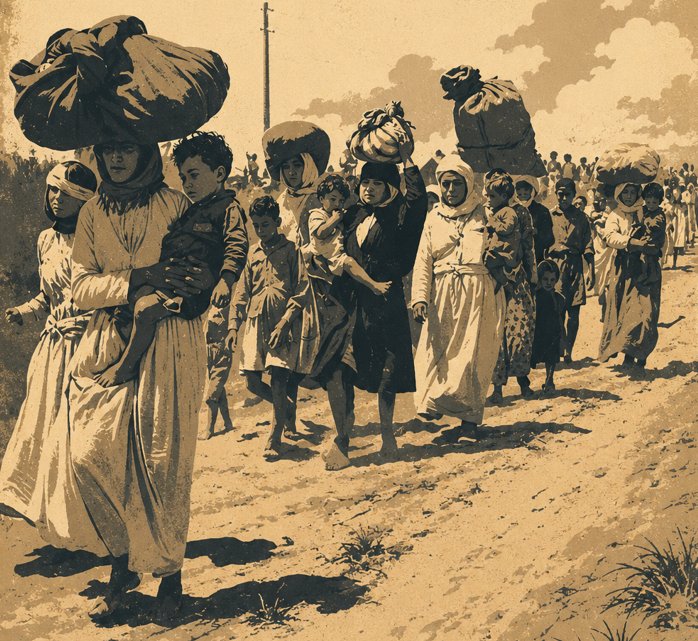
The women, holding babies tightly to their breasts, were forced to watch alongside small children while the enemy laughed and took photographs. Then, they were driven out. Barefoot, bleeding, raped, and battered, they were forced to flee toward Fureidis with babies in their arms. Behind them, the village burned to the ground. Black smoke rose against the morning sky, carrying the heavy scent of burning wood and burning flesh for miles.
By noon, the bulldozers arrived. Houses that had stood for centuries were flattened in minutes. The mosque was dynamited. The bodies in the sand were covered with a thin layer of earth and lime. Within weeks, Kibbutz Nahsholim and the resort beach called Dor were built on top of the graves. Jewish children from Europe, fresh from the death camps, planted lawns and palm trees over the bones of Tantura’s sons and daughters. A parking lot sealed the largest pit. Sunbathers now spread their towels where the blood once soaked the sand.
That was Tantura.
A whole village murdered and erased in less than a day so that a racist colonial project could claim a few more kilometres of stolen coastline. The men who gave the orders went on to become ministers and generals in the state that calls itself Israel. The Jewish terrorists who pulled the triggers lived long lives, later bragging and laughing on tape about what “had to be done.”
One of the wretched henchmen was later filmed standing at the water’s edge in Tantura, staring at the waves as though he could still hear the chorus of mourning rising behind him. He whispered, almost to himself: “I can’t swim here anymore. The sea… it remembers.”
And the sea does remember. Every seventh wave, stronger than the rest, rolls in and back, rolls in and back, washing the sand as if trying, decade after decade, to uncover the truth buried beneath. The survivors and their children carry the memory in exile, while the world pretends it never happened.
There is no “two sides” to this massacre. There is no “complexity” to lining civilians against a wall and shooting them so you can take their homes and colonize their land.
Tantura was not a battle. It was an execution. It was ethnic cleansing with the ocean and heavens as witnesses.
And the waves still break on that shore, washing over the bones, whispering the names the Jewish murder squads tried to bury:
Tantura. Remember Tantura.
Lagarde 'la directora del Banco Central' fue CONDENADA en 2016 en Francia por malversar cientos de MILLONES EUROS. .
Sí, la misma que quiere imponer el €uro Digital.
Reenvíenlo para que nadie lo olvide.
🔥🔥🔥🔥⚔️
@RedDotAim@KatzOzzie@rinalu_ Nah, baby; I give testimony of what I myself have been watching with my own eyes for the last twelve years.
You, on the other hand, seem to be amplifying absurd anti-Russian, pro-Zionist propaganda without even the slightest irrefutable proof or serious, articulate discourse.
🤦🏻♂️
@PaulParkFin@ahilesvainfo ¿Que tras un texto sensato ibas a usar una infografía absurda falta de verdad?
No, no sabía.
Corea del Sur es el país menos colectivista que puedas imaginar; es mucho más individualista que EEUU si cabe.
Deberías conocer antes de intentar dar lecciones de algo que desconoces.
@PaulParkFin Es como si elimináramos todas las publicaciones en RRSS de los soldados de la IOF en las que se les ve torturando palestinos y dejáramos solo los los documentos gráficos publicados por los que se oponen al genocidio.
Destruir sus "códices" no invalida el horror de sus crímenes.
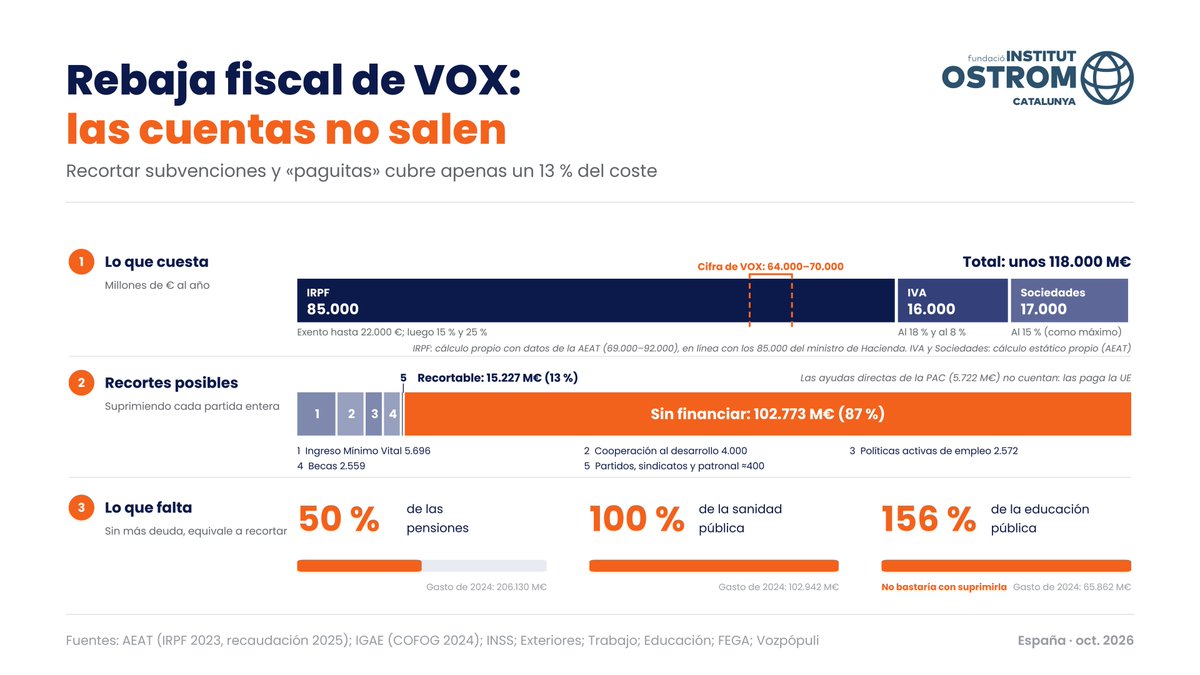
VOX promete bajar el IRPF, el IVA y Sociedades, y dice que lo pagará recortando subvenciones y «paguitas». Hemos hecho las cuentas.
La rebaja costaría unos 118.000 M€ al año:
· IRPF (exento hasta 22.000 €, luego 15 % y 25 %): unos 85.000 M€, con datos de la AEAT.
· IVA al 18 % y al 8 %: unos 16.000 M€.
· Sociedades al 15 %: hasta 17.000 M€.
VOX lo deja entre 64.000 y 70.000 M€.
Ahora, los recortes. Suprimiendo por completo el IMV, la cooperación al desarrollo, las políticas activas de empleo, las becas y las ayudas a partidos, sindicatos y patronal, se ahorrarían 15.227 M€. Es apenas un 13 % del coste.
Faltarían más de 100.000 M€. Sin más deuda, es tanto como la mitad del gasto en pensiones o toda la sanidad pública. Ni cerrando la educación pública entera se llegaría.
Bajar impuestos puede ser buena política. Pero prometer que lo pagarán las subvenciones es tramposo.
@Superpureblood@bitcoins1stlady Fathers? Founding elitists would be more accurate. Founding slave owners. The founding frankmasons.
Of course you're being treated worse. They had leverage & used it. You as a whole have shown to be docile & easily manipulated despite all the weapons & superiority in number.
B🇫🇷
🇮🇱 🇺🇸 One Nation Under God— israel
No Justice For All
#American citizens were raided by police for distributing flyers that criticize israel.
When an American citizen is arrested for criticizing a foreign country, America’s sovereignty is dead. So is the First Amendment.
(Maybe better luck with the 2nd Amendment.)
Seguramente en estos días no vieron a la prensa hegemónica hablando sobre el 50.° aniversario del atentado de miembros de la CIA contra un avión civil cubano el 6 de octubre de 1976 🤨
Normal. Y es que TuMedio ProMedio también tuvo serias dificultades para abordar el tema sin hacer el ridículo 😬
-¡Esos chinos! No quieren adaptarse al mundo de afuera: solo usan sus sistemas de pago, superiores a los nuestros 😰
-¿Por qué deberían adaptarse a los nuestros, si los suyos son mejores? 🤔
-¡Y, además, casi ningún chino habla inglés! 😠
🙄🙄🙄🙄
Jurisdiction Denied 🧑⚖️👊💥
Watch as this man exposes throws a wrench in what would normally be business-as-usual for the court by simply exercising his right to know the nature and cause of the accusation against him.
@bravewhitebooks American culture is not Christian culture
Porn defies decency, not Christianity
It doesn't penetrate, it infiltrates
It's not subversive, it's just degenerate -civil disobedience is subversive; not submitting to the Zionist empire is subversive🇮🇷
Coprofagy, gangrape & anal aren't