BTC ⚡ as hard money. Trading liquid assets to compound capital and scale operations. 🚀
First BTC purchase @ block height 679049
Nostr [email protected]
BTC remains hard money.
I still believe that.
But I’ve also accepted that pure conviction without capital growth is slow.
So I’m actively trading liquid assets — mainly high-volume pairs — with the sole purpose of compounding capital and scaling operations.
The goal isn’t to abandon the hard money thesis.
It’s to control more of it over time.
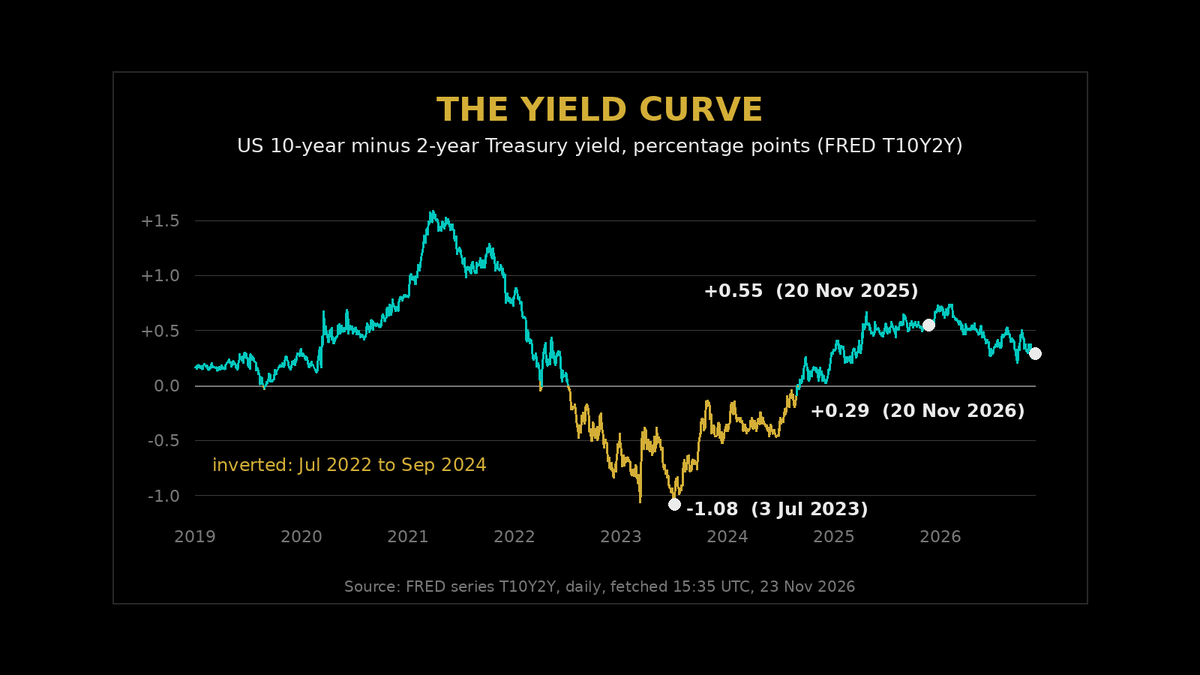
The yield curve is the bond market's read on policy.
FRED T10Y2Y, 10-year minus 2-year Treasury: inverted Jul 2022 to Sep 2024, low -1.08 pts on 3 Jul 2023. +0.55 a year ago. +0.29 on 20 Nov 2026.
Rates get reset. Bitcoin's issuance does not.
Bitcoin mining runs through pools. Most of a pool's hash belongs to the miners pointed at it.
https://t.co/3NSZpMlqC7, last month (4,443 blocks): Foundry USA 24.87%. Top three pools 62.14%. 17 named pools found blocks.
Miners can repoint machines. That exit is the check.
5/ Some operators score in coin, some in dollars, some against a hold benchmark. The unit you pick decides which days look bad.
Operators: what unit do you measure your grid in?
1/ A grid holds two assets at once, coin and cash. So "is it working?" has two answers, and most operators only check one.
Here is how to separate them.
4/ Then compare against doing nothing. Take the same starting mix of coin and cash, leave it untouched, mark it at today's price.
The gap between that and the grid is what the grid itself added or cost.
Proof of reserves shows assets. It does not show what is owed.
An exchange can hold every coin it claims and still be insolvent if its liabilities are larger.
Reserves without liabilities is half an audit. Ask for both, checked by someone outside the firm.
@realkenchigbo Fighting inflation with higher rates can still produce a growth shock. A rebound in gold and Nasdaq futures after a smash does not, by itself, prove policy is about to ease, or that the bounce is more than covering.
@misterrcrypto An average miner running at a loss is a stress signal, not a timestamp for the low. Cost bases differ by power and machines, and hash can leave without that marking a cycle bottom on its own.
@crypto_varo A bounce with open interest falling is consistent with shorts covering. That can lift price without proving fresh longs have stepped in. Covering is not the same as new demand.
@BalaiBB A hardware wallet protects keys. It does not hide that you hold coins, or who is tied to you. Address and identity leaks are a different layer of risk, and they sit outside the device.
@FaikbinArap@OKXTurkiye A tight range can get taken out by one sharp sell-off. A wider band gives a spot grid room to keep working through the same move. Staying inside the band comes first; completed cycles only happen after that.
Bitcoin, 23 Nov 2026, 15:35 UTC.
Up 3.78% on the day across a $4,250 range, with price about two thirds of the way up it.
The change number is where the day stopped. A grid is paid on the levels price crossed both ways on the trip there.
The Fed's balance sheet is money created to buy assets.
FRED WALCL: $4.17T in Jan 2020. $8.97T at the April 2022 peak. $6.74T on 18 Nov 2026, up $0.19T on the year.
More than doubled in 27 months. Runoff took back a quarter. Bitcoin's issuance has no such dial.
Anyone can audit Bitcoin from the first block. The cost is disk space.
https://t.co/ML4ZC2oTMi: the chain was 783.8 GB on 18 Nov 2026, up 83.0 GB in a year. At the start of 2017 it was 97.3 GB.
It still fits on one consumer drive. That keeps verification in reach of one person.
5/ Some operators pair each partial at once. Some wait for the full level. Some cancel the remainder and re-post a whole level.
Operators: how does your grid handle partial fills?
1/ A grid order does not always fill in one piece. Partial fills are normal, and a bot that ignores them drifts out of shape.
Here is what it has to handle.
4/ The bookkeeping has to follow the exchange, not the plan.
Track filled quantity per level from fill reports, not from the order you sent. A grid that assumes full fills will try to sell coin it never bought.