Several of these men began dying in October. By November, I was reaching out to media companies, warning them that we might be facing a serious outbreak. They replied, saying it was cancer they were unaware of. Now, we will see how they respond to this situation.
🚨 UPDATE: President Trump has abruptly CANCELED his trip to Trump National in Bedminster, NJ, and will be heading STRAIGHT BACK to the White House following a speech in New York
It's unclear why, but in a post about not attending Don Jr.'s wedding, 47 said "I feel it is important for me to remain in Washington, DC, at the White House during this important period of time"
JD Vance: Fraudsters will 'FACE JUSTICE' https://t.co/sy1U2UbQfD
Thank you, @VP, for framing this issue correctly. Your frame doesn't cause division. It unites all people for justice! It's fantastic to learn how these new strategies are being implemented for swift justice! #fraud
Post 1 — The Overlooked Middle Layer
Federal oversight is often described as a straight line: Washington sets the rules, agencies implement them, and the public receives services.
But that picture is incomplete. In many programs, the state layer is the first point of contact, the first reviewer of evidence, and the first filter of complaints. When that layer breaks, the entire system above it becomes blind.
State offices control: initial reporting channels wage and identity verification benefit coordination complaint triage the first interpretation of evidence
When these functions fail, federal agencies receive an incomplete or distorted picture. The public rarely sees this layer, but it is often where the earliest—and most consequential—failures occur.
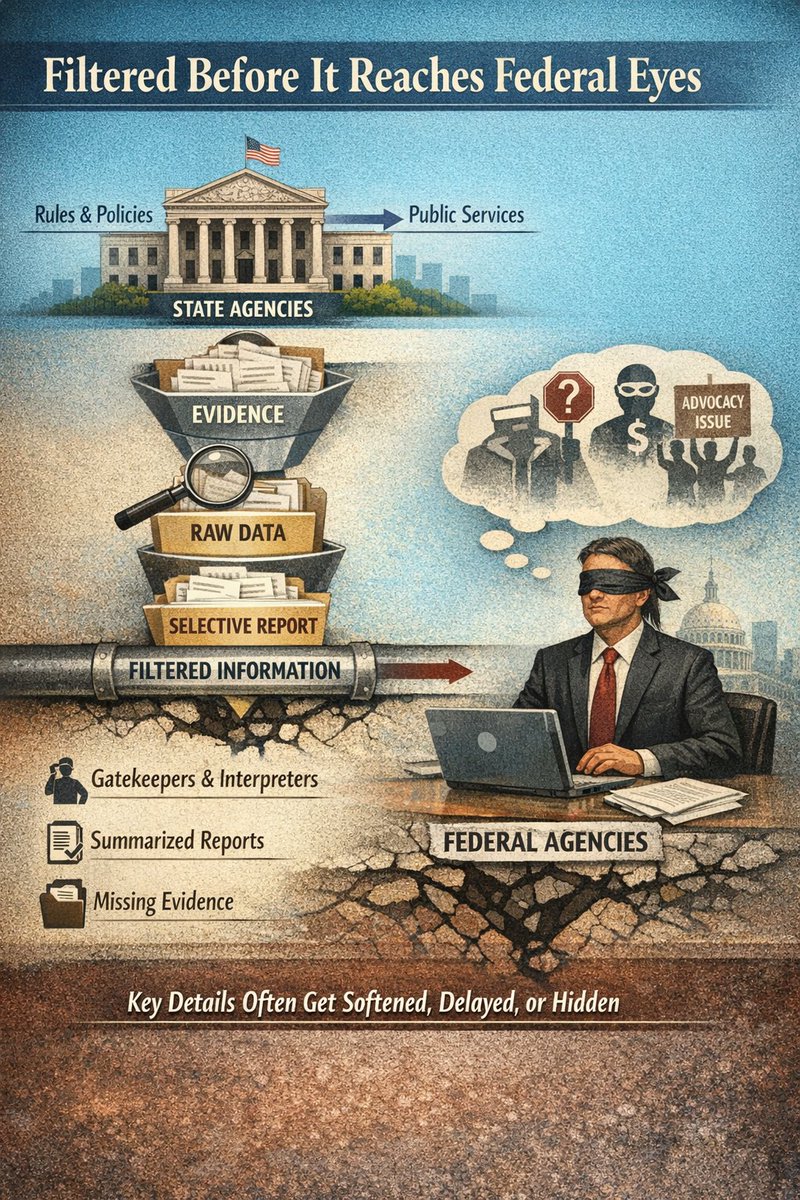
Post 2 — How Information Gets Filtered Before It Reaches Federal Eyes
Most people assume that when a problem is reported, federal agencies receive the full details. In practice, they often receive only what the state layer chooses to forward.
In one representative case, identity misuse and benefit disruptions occurred simultaneously with ongoing advocacy activity. The state-level offices responsible for wage reporting and identity verification did not escalate the issue, even when the consequences affected federal benefits. The federal agency later confirmed it had never received the underlying evidence.
This is not an anomaly. It is a structural flaw:
State offices act as both gatekeepers and interpreters.
Federal agencies rely on state summaries, not raw data.
Evidence can be softened, delayed, or omitted entirely.
This filtering effect creates blind spots that allow both fraud and retaliation to occur without detection.
Post 3 — When Digital Intrusion and Identity Misuse Collide With Advocacy
During periods of heightened administrative conflict, individuals raising concerns sometimes experience unrelated but alarming disruptions—compromised accounts, unauthorized use of identifying information, or sudden benefit irregularities. These events may be coincidental, but the system has no mechanism to distinguish coincidence from vulnerability.
In one case I observed, digital intrusion and identity misuse occurred in close proximity to protected advocacy activity. The affected individual had to navigate multiple agencies to correct the fallout, and each agency treated the issue as isolated rather than part of a broader pattern.
The lesson is not that retaliation always takes this form, but that the system lacks the tools to recognize when multiple disruptions may share a common root: a failure of oversight at the state layer.
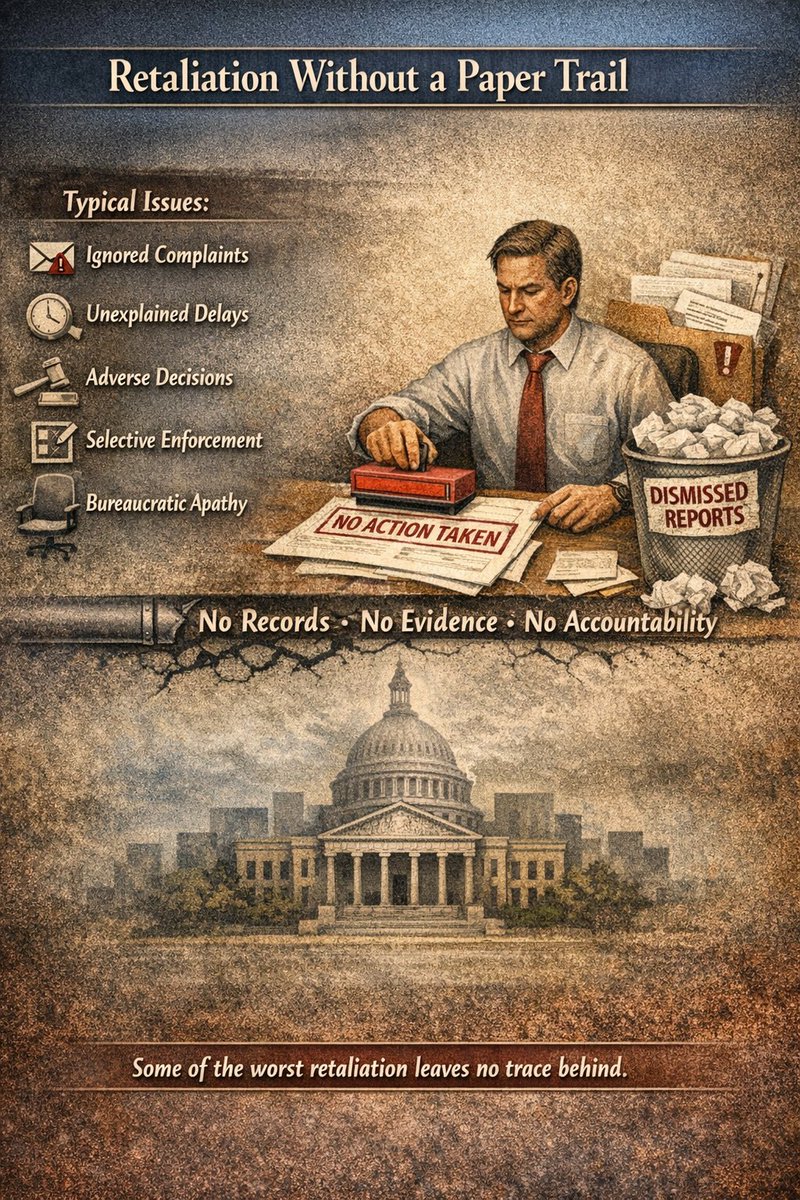
Post 4 — Retaliation Without a Paper Trail
Retaliation inside administrative systems rarely looks like a dramatic act.
It often appears as: ignored complaints unexplained delays sudden adverse decisions selective enforcement of rules administrative indifference Because state-level offices control the first reporting channels, retaliation can occur without generating a formal record. When complaints are dismissed or minimized at the state layer, federal agencies never see the warning signs.
In one case I handled, formal complaints were repeatedly ignored at the state level, even when they involved identity misuse and benefit disruption. By the time the issue reached federal review, the record had been sanitized to the point that the underlying concerns were invisible.
This is how retaliation becomes systemic: not through overt acts, but through silence.
Post 5 — Why Federal Protections Fail When the State Layer Collapses Federal whistleblower protections are strong on paper, but they depend on one assumption: that the state layer will accurately document and escalate concerns. When that assumption fails, the protections fail with it.
Three structural weaknesses make this inevitable:
State offices are both employer and investigator, creating a conflict of interest. Federal agencies rely on state summaries, not original evidence.
There is no cross-level accountability loop, so retaliation can occur without triggering federal review.
In the case I observed, protected advocacy activity was followed by administrative indifference, identity misuse, and benefit disruption. None of these events were escalated by the state layer, and federal agencies later confirmed they had no record of the underlying issues.
This is not a personal story—it is a systems story. And it is happening in more cases than the public realizes.
📷
Post 6 — What Reform Requires: You cannot fix federal oversight without fixing the state layer that feeds it. And you cannot fix the state layer without protecting the people who speak up.
Offer a systems-based solution:
independent reporting channels
federal visibility into state-level retaliation
standardized evidence-handling
cross-level accountability loops
These steps represent leadership harnessing Fire Horse energy — proactive, centralized, and reform-oriented — to expose and dismantle the very “Four Elements of Fraud” (emotional pressures, political winds, unchecked power centers, and crumbling institutions) that the London, KY case study illuminates. Yet, the ongoing series emphasizes, the Fire Horse’s full transformative power demands more than top-down initiatives: it requires sustained structural safeguards that prevent fraud from simply changing form (e.g., from improper approvals to improper denials), plus whistleblower-safe pathways that bypass local power centers.
🚨 CIA JUST CASUALLY ADMITTED BITCOIN IS THEIR SURVEILLANCE TOOL!
CIA General Counsel Michael Ellis admitted: “Bitcoin isn’t truly anonymous… it’s a TOOL we use for intel gathering.”
Russia called it a CIA control weapon. Bitcoin patents reveal it was designed by NSA. China banned it.
They LET it explode on purpose. Why do you think Tether printed endless USDT with no audit for a decade and continues without any scrutiny? Total transparency for the deep state.
That’s why they crucified Ripple with endless lawsuits and attacks.
XRPL is the real power shift: private transactions, zk-privacy for YOU, auditability when needed, compliance WITHOUT mass spying. Built for a post-surveillance world.
@DNAOnChain is building a zero-knowledge privacy system for decentralized identity on the XRPL(https://t.co/9wJytHr7dC).
Private Money. Private Identity.
Bitcoin = CIA’s perfect asset.
XRPL = freedom.
Now Africa, Europe, Asia, BRICS are adopting XRPL corridors into their economy for a true neutral bridge asset…
Your “decentralized” crypto was never yours.
It was always marketed for control and surveillance.
Series 4: The Missing Layer — State Oversight and the Silence Around Retaliation
This series examines the oversight layer that rarely receives public attention: the state‑level offices that sit between federal rules and agency operations. When this layer fails, federal protections collapse, evidence is filtered before it reaches Washington, and retaliation against advocates or whistleblowers can occur quietly, without triggering alarms.
Across multiple cases, including one I handled directly, I observed a pattern: identity misuse, digital intrusion, and administrative indifference occurring in close proximity to protected advocacy activity. These events were not isolated incidents; they revealed how fragile the oversight chain becomes when the state layer is the chokepoint.
This series explains how those failures happen, why they persist, and what it means for anyone who relies on federal benefits, state partners, or agency-level decision‑makers.
POST 6 — NATIONAL REFORM
Series: Systems Oversight – From Case Study to National Reform
What happened in London, KY is not an isolated failure — it is a blueprint of what happens when oversight is reactive instead of preventative. The same vulnerabilities exist nationwide: misaligned incentives, fragmented authority, and no unified audit pathway.
National reform requires: Automatic audit triggers when patterns deviate from norms. Unified routing protocols so complaints cannot be buried. Cross‑agency visibility to prevent siloed misconduct.
Citizen‑centered metrics that measure accuracy, not speed. Whistleblower‑safe reporting lanes that bypass local power centers.
This is how we rebuild trust — not with slogans, but with systems.
#NationalReform #SystemsThinking #FraudResistance #ModernizeGovernment
POST 2 — OVERSIGHT HIERARCHY
Series: Systems Oversight – Oversight Hierarchy
Pressures acknowledged. SSA recently announced it is bringing Medical Continuing Disability Reviews in‑house — a strategic shift toward federal accountability and relief for states.
“By centralizing medical continuing disability reviews under Social Security, we are taking another important step towards operational excellence, reducing improper payments, and providing best‑in‑class service to Americans in critical need of support.” — Commissioner Frank J. Bisignano, March 12, 2026
Centralization is progress — but only if state‑level behaviors, incentives, and past misconduct are addressed. Our Kentucky case shows what happens when they aren’t.
Hashtags: #FederalReform #OversightMatters #GAO #DOJ #Accountability