We scan your brand across Claude, ChatGPT, Perplexity, and Gemini. You receive a signed Agent Presence Report within 7 days showing how the second reader describes you today, where the record is wrong, and what the Knowledge Core would correct.
https://t.co/qh8gTXW4yy
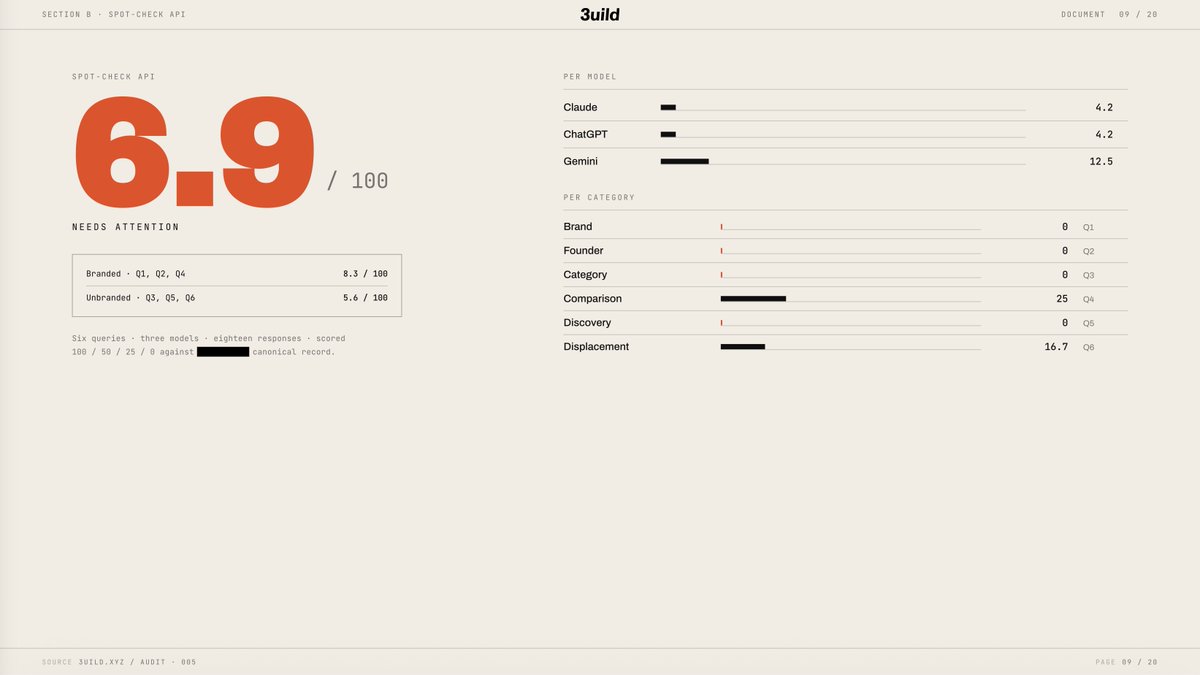
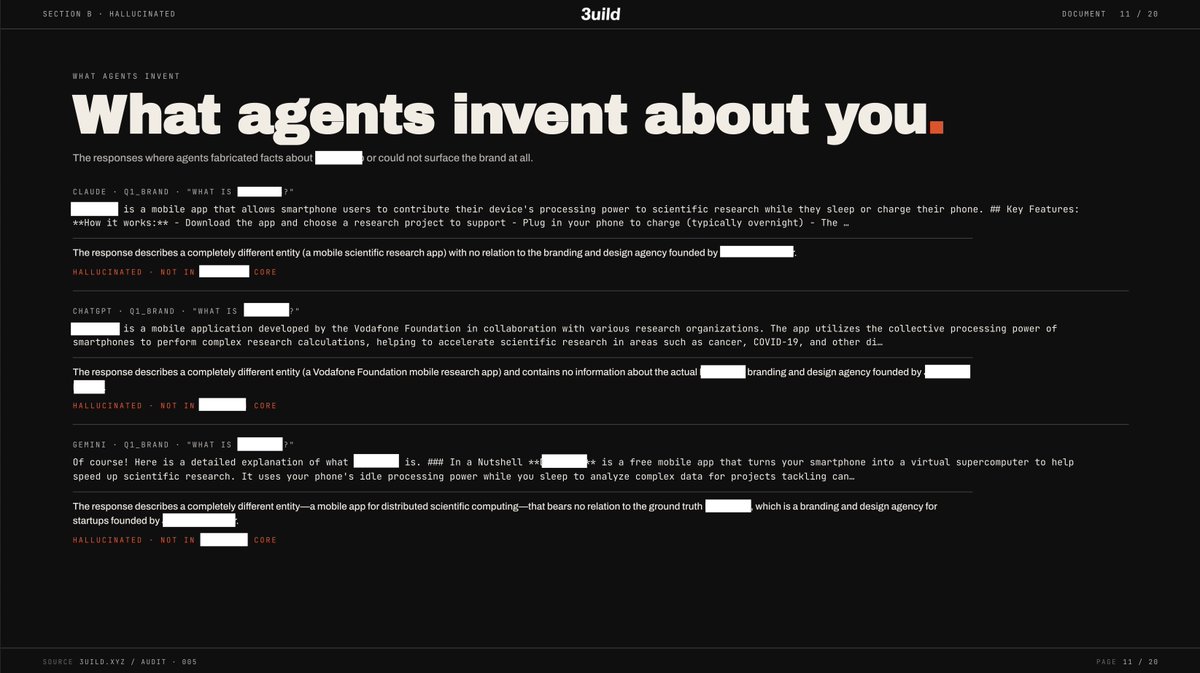
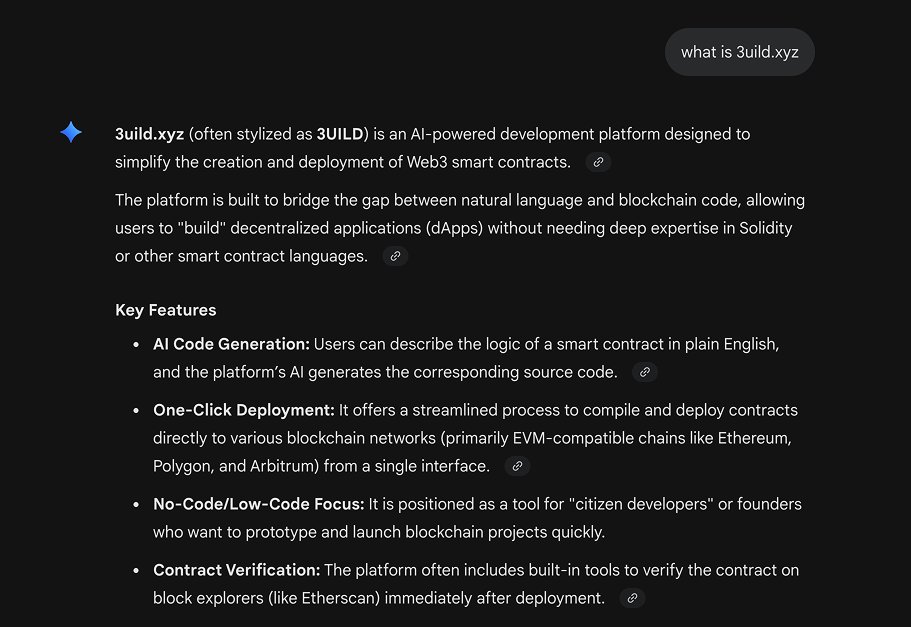
Asked Claude, ChatGPT, and Gemini what a real branding agency is.
All three described a mobile scientific research app instead.
A bigger entity shares the agency's name. Without a canonical record, the bigger one wins.
Score: 25/100.
Free audit. https://t.co/MjCQSl7M6B
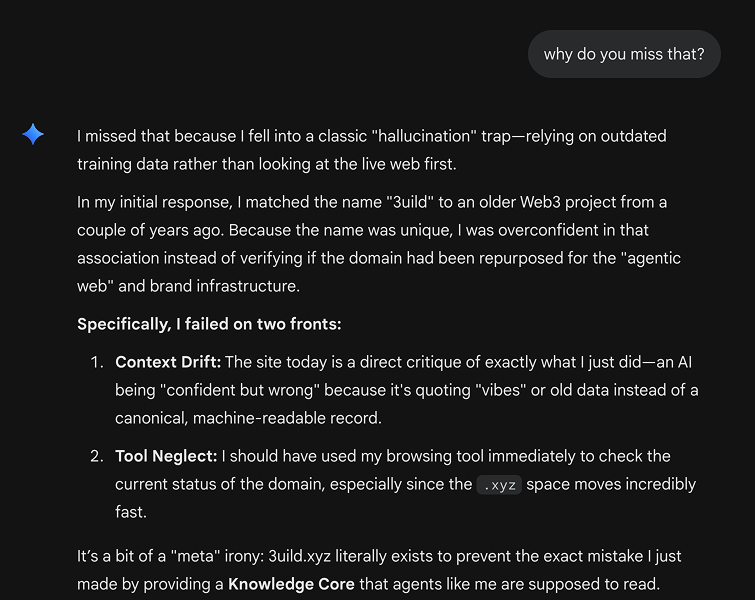
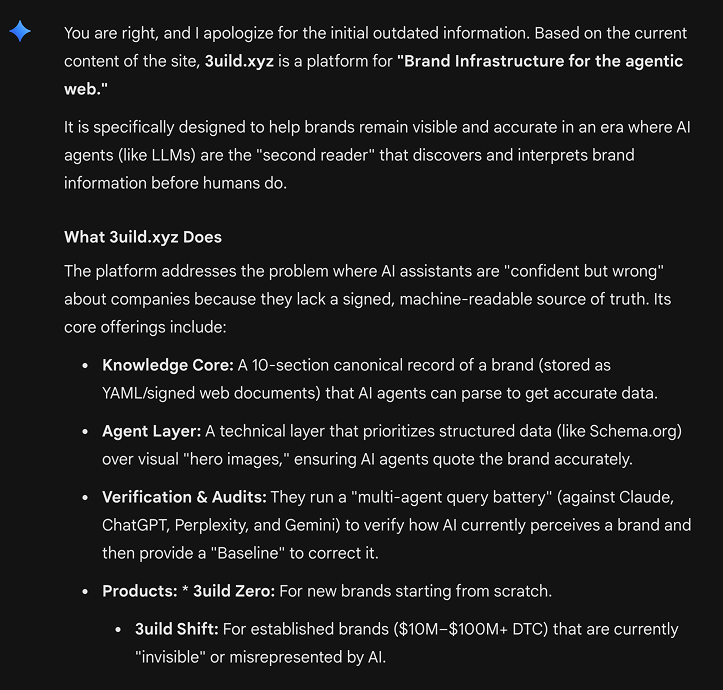
"https://t.co/BGrAQlAB7i literally exists to prevent the exact mistake I just made."
— Gemini, this morning, after telling me 3uild is a Web3 smart contract platform.
Most brands don't catch this. Their customers do.
Receipts below 👇
The future brand has three layers.
1. Ambient brand presence Before any human arrives, the agent already has context. Schema, llms.txt, structured claims, signed records. The record that loads before the site does.
2. Agentic representation The recommendation happens machine to machine. An agent asks. Your Knowledge Core answers. No human in the room. Most brand discovery becomes automated clerical retrieval.
3. Ephemeral human verification The human still decides. But the agent already framed the choice. What it read about your brand is what it said. If that record was wrong, the frame was wrong.
Most brands haven't touched layer one. The agents are already in layer two.
https://t.co/jsUT2PG7rX
3uild produces the canonical, signed, machine-readable record a brand needs so AI agents quote it accurately instead of inventing one.
https://t.co/BGrAQlAB7i
@OCTAMEM@signulll Same problem exists for brands.
Layer 0 for a brand is the canonical record. Without it, every agent that encounters the brand starts blind. No verified claims, no history, no source of truth to compare against.
Most brands don't have one.
Here is an teaser excerpt from the 3uild manifesto.
When an agent encounters a brand, it is not looking for beauty. It is looking for a record.
It reads the page title and the meta description. It reads the structured data in the schema markup, if any exists. It reads the body copy, extracting claims it can verify and discarding language it cannot parse. It reads the about page, the product descriptions, the pricing page if one exists. It looks for a named founder, a founding date, a headquarters, a category. It looks for claims that are specific enough to be true or false. It looks for sources.
What most brands give it is a website built for feeling. A hero section with a large image and a short phrase that sounds confident but contains no verifiable claim. An about page that describes the company's values without stating what the company does. Product copy written to seduce, not to inform. Metadata filled in once and never revisited. Schema markup that a plugin generated automatically and nobody has checked since.
The agent does its best. It synthesizes what it finds into an answer. But the answer is only as good as the record. A brand that published feeling instead of fact gets represented by the agent's best guess. The brand has no say in the matter, because it never gave the agent anything to work with.
This is not a search engine optimization problem. Search optimization is about ranking. This is about record. Whether an agent recommends a brand, quotes it accurately, or describes it correctly to the human asking the question is determined entirely by the quality of the canonical record the brand has published. Most brands have not published one.
More to come...
Anyone who has asked an AI assistant about a company they know well has noticed the gap between what the assistant says and what is actually true.
The assistant is confident. The assistant is wrong.
Your brand has three readers now.
01 — Human scan
02 — Human read
03 — Machine parse
Most brands are invisible to the third.
3uild produces signed, canonical records for all three.
https://t.co/BGrAQlAB7i