All welcome to join us for a virtual seminar from the quite wonderful @JoyYWu next week on the intersections of 🦴and🩸@ANZBMSoc@ANZBMS_ECIC I’m really looking forward to hearing her latest work!
Thread: Thanks to @ECTS_science for inviting me to speak today on What is New in Basic Bone Biology Techniques at #ECTS2021. It is an overview of many interesting papers over the past 18 months, so to make it simple for listeners, here’s a thread of the papers I’ll discuss. 1/21
@ORSsociety @cpane94 #orsambassador scavenger hunt event… team Partridge Family staging Abbey Road picture at HSS with @PCZ_2016 @425_ad and Nicola Partridge. Super fun event and great to see NYC ORS members!
Diabetic patients can always try to manage the condition on their own through lifestyle and home remedies. Committing to managing your diabetes, scheduling a physical exam and regular eye exams, etc. Mayo Clinic has all these tips and much more https://t.co/1QoVBPtcVw
The outcome was that not only A1C levels had decreased but also patients had lost weight with both kinds of drugs. The results are promising, however SGLT-2s have not been approved by the FDA yet. There are concerns relating to diabetic ketoacidosis https://t.co/yyKMyx4P8u
Insulin isophane is an intermediate acting insulin used to treat blood sugar level in adults and children. Depending on what other medicines that you may be taking, this insulin may not work. Its side effects may be weight gain, swelling, itching, etc. https://t.co/IqRKnaDFpH
In two studies involving adults with type 1 diabetes, the addition of two different oral type 2 meds from the SGLT-2 inhibitor class lowered A1C without causing hypoglycemia. Other researchers added injections of a type 2 drug from the GLP-1 receptor. https://t.co/yyKMyx4P8u
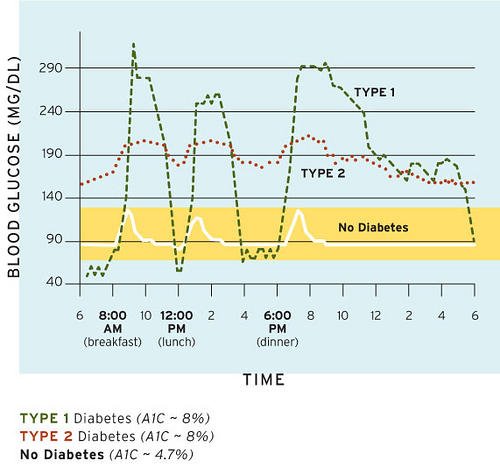
Blood Glucose readings may vary considerably, the target A1C is most likely lower. A person without diabetes stays within a narrow band, ranging from about 70 to 130 mg/dl. The person with type 1 diabetes,oscillates widely between low and high depending on insulin/food intake.
Insulin detemir, also known as Levemir, is a long-acting sterile solution. It is recommended for once- or twice-daily subcutaneous administration. Some common side effects with other insulins are hypoglycemia, hypersensitive and allergic reactions.
https://t.co/w3ir6KSxQm
It is important to keep blood glucose levels targeted for preventing diabetes-related complications and may also help prevent dementia later in life. Studies compared patients with diabetes or not that later on developed dementia or did not. https://t.co/YUC6twBjfr
Another insulin to treat type 2 diabetes is Lantus. It is a sterile solution consisting of insulin glargine dissolved in a clear aqueous fluid, where each milliliter of lantus contains 100 Units insulin glargine. https://t.co/CvmhEYPZKj
A1C test is a clinical tool that experts now recommend using it to diagnose diabetes and prediabetes. An A1C of below 5.7% is considered normal, while A1C levels of 6.5% and above call for a diagnosis of diabetes. Anything in between links to prediabetes. https://t.co/7NxI8W20Xk
Insulin aspart injuction is also known as Novolog, a fast-acting insulin. It is produced by recombinant DNA technology utilizing Saccharomyces cerevisiae. Its side effects can be hypoglycemia, allergic reactions, and hypokalemia. https://t.co/DSKKMB9P0r
A1C molecule is hemoglobin A— it has the same sequence of amino acids—but with one critical difference: a glucose molecule stuck to one end. This could be the reason why hemoglobin A1C tracked with blood glucose levels is higher in people with diabetes. https://t.co/7NxI8W20Xk
Another type of insulin to treat type 2 diabetes is Humalog. It is also known as insupin lispro. Different from human insulin, humalog has lysine and proline. Some side effects are: lipodystrophy, weight gain, peripheral edema, ect.
https://t.co/isuWPSIYbt
For some patients gene therapy for neuropathy relief seems to have successful outcomes. The gene was injected in each leg twice two weeks apart. Some patients had pain relief and the therapy seemed to work very well for them.
Diabetic patients sometimes suffer diabetic neuropathy as well, a tingling sensation, pain or numbness in their feet. Scientists discovered that intensive blood glucose management does prevent amputations but unfortunately, not foot ulcers. https://t.co/1fkYJD7Cdl