Aquí el anuncio entero de Nike para el Mundial. Es una absoluta locura. Seguramente el mejor comercial de futbol de todos los tiempos. Vale cada segundo.
Sci-Hub is an evil website that pirated 85M+ research papers and made them freely available
And now they've added AI to their database to make Sci-Bot.
It answers your questions using latest, full-text articles.
But DO NOT use it. We should all try to make billion-dollar academic publishers richer.
I'm putting the link below so you know how to avoid it.
🇪🇸 España se incorpora a Open Research Europe, la plataforma pública de publicación científica en acceso abierto impulsada por @EU_Commission@CienciaGob representará a nuestro país en la plataforma a través de #FECYT
👉 https://t.co/FFuyAcsF1M
I suspect (and I’m certainly not alone) that science without humans will be limited. I’m not sure AI scientists would pursue the same questions humans do, especially those driven by curiosity rather than immediate practicality. Plus, there's something really sad about science-without-scientists, it's like art-without-artists. Whether it's wishful thinking or not, the AI I want is AI that helps scientists, not AI that replaces them.
I currently have three papers in review at "high impact" journals.
One of them has been sitting there for two years. In that time my daughter was born and learned how to walk, but apparently publishing a PDF was still not possible for me. For another one, after four months in review the editor told me they cannot find a second reviewer and asked me to suggest more reviewers. A third one sent me a message in 2026 saying the PDF I uploaded was larger than 10 MB and that I should please reupload everything to make the file smaller.
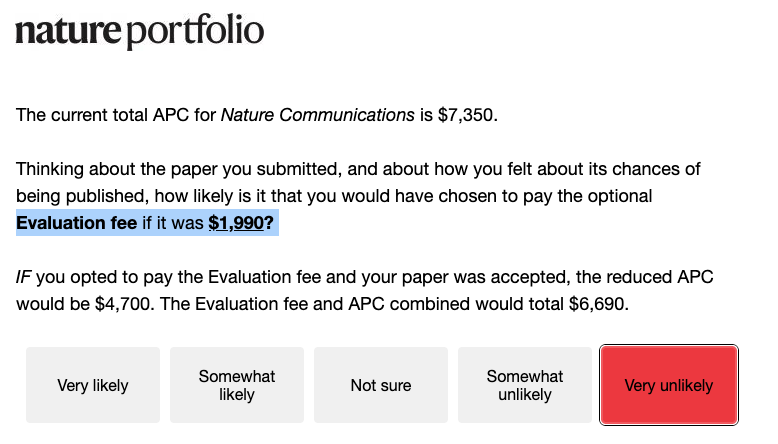
All of this just to eventually pay between 7,000 and 12,000 USD per paper so someone can officially approve that the science we do is "legitimate". Reminder: not a single reviewer will be compensated here.
I still don't understand how we as scientists can collectively be so smart when doing science and still tolerate a system like this when it comes to sharing our findings. We should move to preprints plus open review, whether human or AI, asap. So frustrated about it.
I'd suggest sharing your work on bioRxiv or medRxiv, reading and reviewing preprints when you can, and highlighting good research, especially if it is still a preprint. Try platforms like ResearchHub (that pay for peer review) and experiment with AI based reviewers for faster feedback.
Instead I read this as a proposed "revolutionary" measure:
🔴 ¡NUEVO LTX 2.3 OPEN SOURCE!
El mejor modelo opensource de vídeo se actualiza con la nueva versión 2.3 que trae mejora de gráficos, de control, mejor generación multimodal de audio, soporte para vídeo vertical...
FUAH!
Happy 30th birthday, Pokémon! Since 1996, the Japanese media sensation has inspired generations of researchers in fields as diverse as evolution, biodiversity and research integrity. https://t.co/xDkf4D7VyT
🔬 Investigadores de la #UGR transforman la investigación del microbioma con un nuevo indicador físico-matemático para el diagnóstico clínico
🧬 Se trata del índice #ENBI: una herramienta robusta para la detección temprana de enfermedades
➡️ Info: https://t.co/OPOMNcKFo6
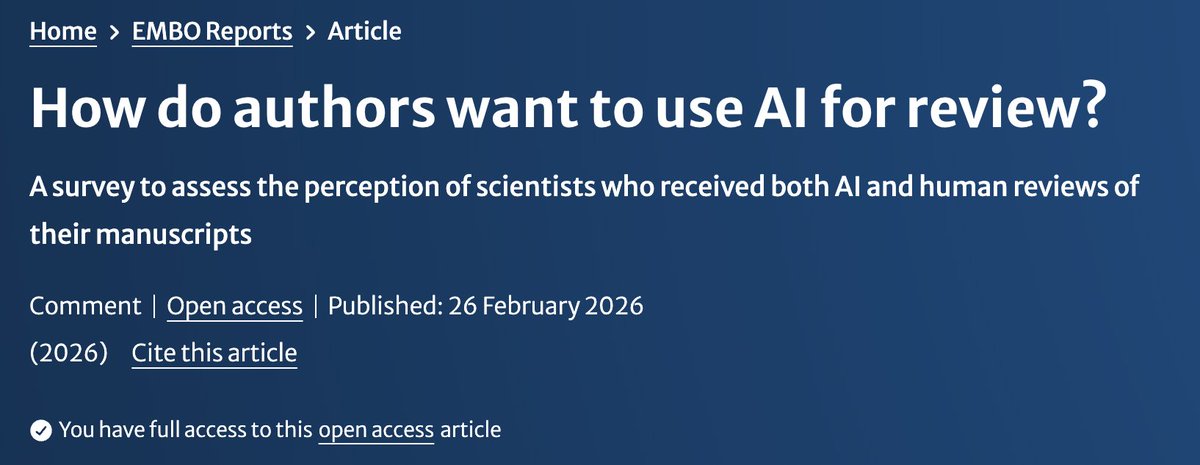
It’s finally out! Together with @EMBO and @ReviewCommons, we conducted a structured side-by-side comparison of human peer review and our AI scientific review.
Here’s what we did: Authors whose manuscripts had already received journal-agnostic review at Review Commons were provided with an independent AI review generated by @qedScience. The AI analysis was compared to the combined feedback of multiple human reviewers, not to a single report, and had no access to those reviews.
We then asked authors how they evaluate the strengths and limitations of both approaches, and how they would actually want to use AI.
The conclusion was clear: Scientists want AI feedback to strengthen their work IN ADVANCE, under their control. Not as a gatekeeper, but as a tool for constructive input.
That is exactly what we are building at q.e.d! We are on the authors' side.
q.e.d. is not working in isolation; we are collaborating with leading pro-scientists organizations, including EMBO (and other journals), Review Commons, and OpenRxiv (@biorxivpreprint), and are working closely with researchers across fields. At the same time, we are building an alternative model that puts agency directly in scientists’ hands.
Researchers should be the ones deciding when their work is ready to be shared. We are building the infrastructure to support that.
A pleasure doing this with the great Thomas Lemberger @tlemberger and Niv Samuel Mastboim @nivmast