What if the most relevant paper for your research is one you'd never think to search for?
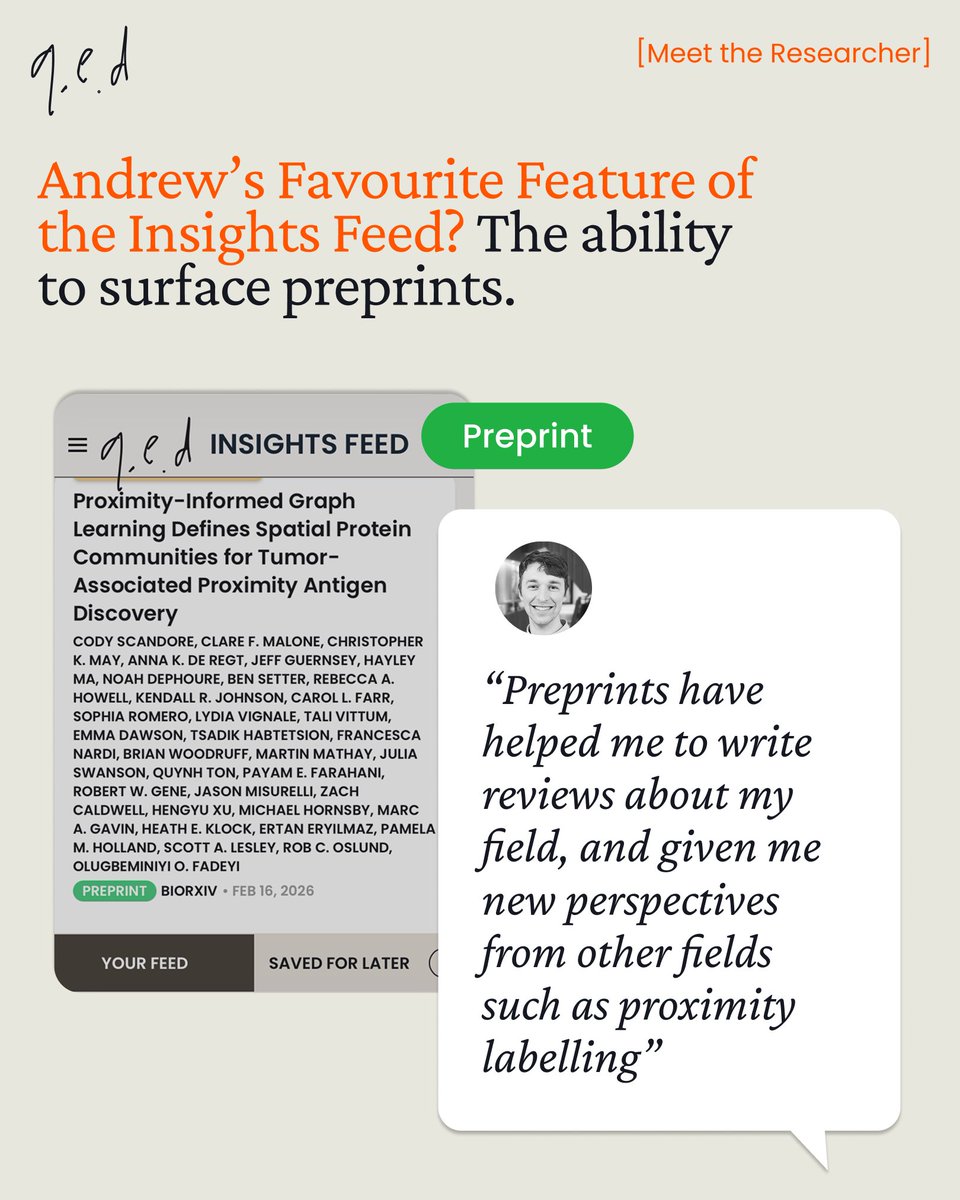
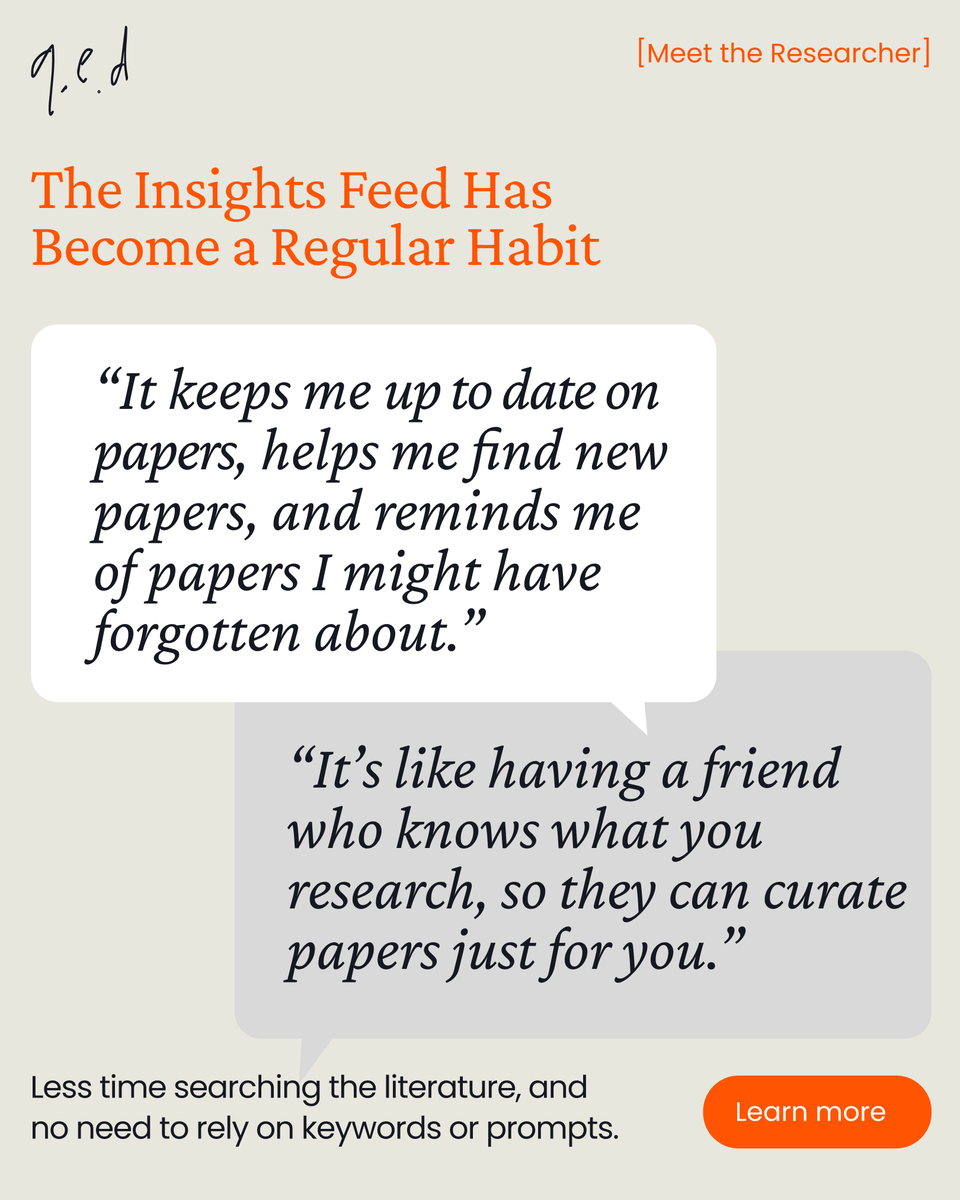
Dr Andrew Baker (University of Cambridge) uses QED’s Insights Feed to discover papers and preprints he might otherwise miss.
See how it fits into his research routine 👇
Hola Eduardo, gracias por plantear esta preocupación. Entendemos perfectamente la importancia de proteger trabajos de investigación aún no publicados.
Queremos aclarar que los manuscritos y otros contenidos que subes a QED Science NO se utilizan para entrenar ni ajustar modelos de IA. Se utilizan únicamente para generar la revisión que solicitas.
Mejoramos la precisión de nuestras revisiones a partir del feedback que los usuarios deciden compartir, no de sus investigaciones.
Puedes consultar nuestra política de seguridad aquí: https://t.co/RUuyedPp3n, en la sección “How Your Work Is Used”.
After countless readings, it can be hard to see your own manuscript clearly.
We’re working with Wiley to help at that moment: authors at selected Wiley journals are now invited to use QED Science to strengthen their manuscripts before submission.
As submissions grow and reviewer capacity struggles to keep pace, we’re exploring how scientific AI can help authors strengthen work before peer review.
Thank you to @KlugYoel , @latwec and the Wiley team.
As submissions grow and reviewer capacity struggles to keep pace, we’re exploring how scientific AI can help authors improve work before peer review.
Thank you to @KlugYoel, @latwec and the Wiley team.
More about the pilot:
https://t.co/csvnxBXa5F
QED examines claims, evidence and reasoning, flagging gaps and inconsistencies. Authors decide what to change.The pilot is optional and independent of Wiley’s editorial review. Manuscripts and reports stay private to the author.
Researchers don't need to search harder. They need the right paper to find them.
How biomechanist Dr. Sauvik Das Gupta went from prompting an LLM to having a continuously updated Insights Feed that learns what matters to his work.
@etornosinza@AntonioMasAB@AntonioMasAB Thank you for recommending QED Science! We're glad to hear you're finding it helpful for reviewing manuscripts and research projects. We really appreciate your support! 🙌 Grazie per aver consigliato QED Science!😀
@jpjviro@OdedRechavi@jpjviro - Yes, absolutely! 😊 Your Insights feed can cover all three topics: virology, reproductive science, and cancer research. You can stay up to date across all your areas of interest.
@sauvikdasgupta It’s been so great getting to know you and your research, Sauvik! We loved working with you and hearing your thoughts on Insights Feed. Really appreciate all your feedback and support! 🙏🙏
It's official: Insights Feed is here! 🎉
The most useful finding for your research might be hiding in a paper you'd never think to search for.
Meet QED Science's Insights Feed: personalized research recommendations, each explaining "Why you should care."
Discover what matters to your research: https://t.co/CfvmKvwYyD
“We’re supposed to be standing on the shoulders of giants, but the scientific corpus is unreliable.”
At the STS Forum in Kyoto, our co-founder @OdedRechavi raised a critical question for AI-driven science:
If AI learns from an incomplete, unreliable scientific record, what is it really building on?
What happens to my unpublished work when I upload it to AI?
Fair question.
Researchers trust us with manuscripts, grants, and ideas that may represent years of work. They should know where that work goes and how it’s protected.
At QED Science:
• Your work stays private unless you choose to share it
• We do not train or fine-tune models on your research
• We use enterprise-grade security, including encryption at rest and in transit, least-privilege access, monitoring, vulnerability scanning, and independent penetration testing
• We have completed a SOC 2 Type II audit and are ISO 27001 certified.
Different AI tools handle sensitive data in different ways. The important thing is knowing what happens to your work.
That should be easy to find out. https://t.co/MEcV8UsAKH
#ResearchSecurity #AIinScience