@sairahul1 I really hate it when they call it engineering. It's not. It's computer programming. It's software design. Why are the programmers so hesitant to call it what it is? If software is engineering, then so is interior design and thousands of other endeavors. It never ends.
TMI revival is back on track!
Backstory:
In March, Constellation Energy, the owner and operator of the Crane Clean Energy Center– formerly known as Three Mile Island (TMI) Unit 1 – was informed by PJM (the regional grid operator) that the restarted plant could not be connected to the grid until 2031, four years after its scheduled 2027 refurbishment completion date.
For those who watch these things closely, that sounded both stupid and depressing. Why would the operator of a grid that is paying enormous sums in capacity payments make a plant that can steadily produce over 800 MW of clean electricity twiddle its thumbs for 4 years waiting for a grid connection?
For Constellation, the plant owner, a four-year delay would represent about $3 billion in lost sales. (Assuming 835 MWe, 90% CF, $120/MWh)
For Microsoft, the customer whose PPA stimulated the plant restart, it would represent a significant interruption in its corporate decarbonization and data center BYOP plans.
Recent update:
On June 2, the Federal Energy Regulator Commission (FERC) granted a waiver that would allow Constellation Energy to connect Crane Clean Energy Center promptly after the project is ready by transferring grid connection rights from a power plant that it has scheduled to retire.
Phew. We can all breathe a little easier with just a little more confidence that the system can work and make useful decisions.
I think it is these economists that should lose their jobs. They are applying the old labor and productivity rules to a completely new reality. It just doesn't add up.
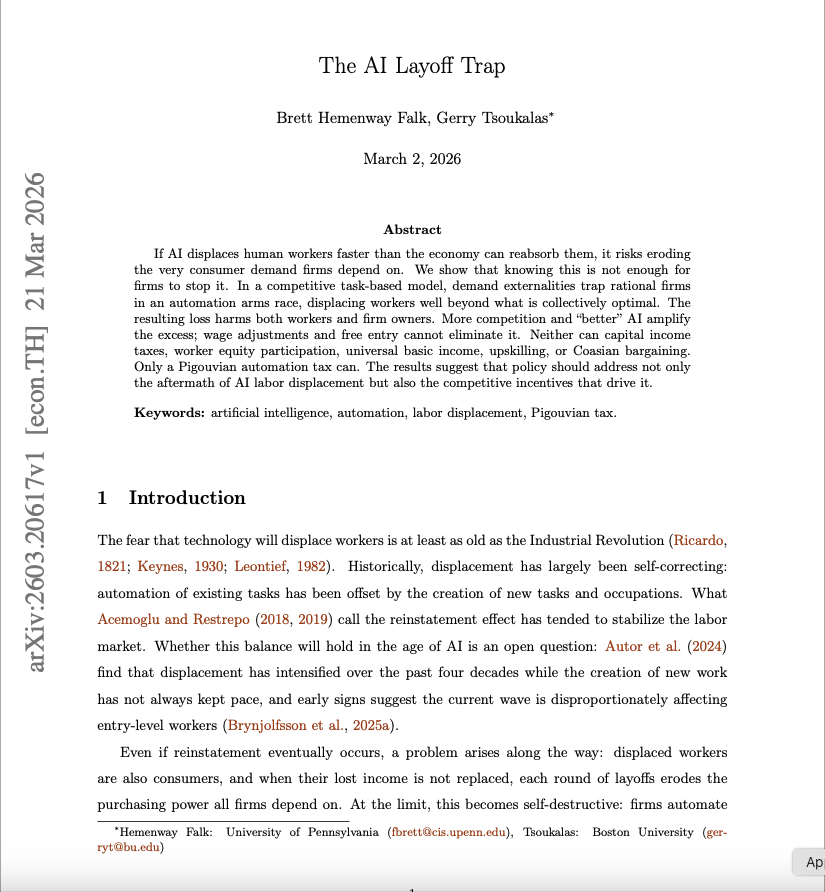
Two economists just published a mathematical proof that AI will destroy the economy.
Not might. Not could. Will — if nothing changes.
The paper is called "The AI Layoff Trap." Published March 2, 2026. Wharton School, University of Pennsylvania. Boston University. Peer reviewed. Mathematically modeled.
The conclusion is one sentence.
"At the limit, firms automate their way to boundless productivity and zero demand."
An economy that produces everything. And sells it to nobody.
Here is how you get there.
A company fires 500 workers and replaces them with AI. A competitor fires 700 to keep up. Another fires 1,000. Every company is behaving rationally. Every company is following the incentives correctly. And every company is building a trap for itself.
Because the workers who were fired were also customers.
When they lose their jobs faster than the economy can absorb them, they stop spending. Consumer demand falls. Companies respond by cutting costs — which means automating more workers — which means less spending — which means more falling demand — which means more automation.
The loop has no natural exit.
The researchers tested every proposed solution. Universal basic income. Capital income taxes. Worker equity participation. Upskilling programs. Corporate coordination agreements.
Every single one failed in the model.
The only intervention that worked: a Pigouvian automation tax — a per-task levy charged every time a company replaces a human with AI, forcing them to price in the demand they are destroying before they pull the trigger.
No government has implemented this. No major economy is seriously discussing it.
Meanwhile the numbers are already tracking the curve. 100,000 tech workers laid off in 2025. 92,000 more in the first months of 2026. Jack Dorsey fired half of Block's workforce and said publicly: "Within the next year, the majority of companies will reach the same conclusion."
Nobody is doing anything wrong. Companies are following their incentives perfectly. That is exactly the problem.
Rational behavior. At scale. Simultaneously. With no mechanism to stop it.
Two economists built the math. The math leads to one place.
Source: Falk & Tsoukalas · Wharton School + Boston University ·
"Consume the water" seems impossible. Water enters the facility, cools the equipment, and then returns to the environment. Either back to the river or into the air. It is not consumed.
Local utility companies have an opportunity to play this to their advantage by leveraging funds from data facilities. If there is one thing AI companies have plenty of its dollars. And good deals are being created even now.
We should not be drawing conclusions without looking at each case.
AI needs water.
Lots of it.
Researchers estimate that by 2030, U.S. AI data centers could consume as much water as 10 million Americans use in their homes every year.
The question nobody's asking: Why are so many of these facilities being built in communities already facing water shortages?
Watch this. Full interview on Rumble. Link in bio.
If you zoom out you can see it as normal volatility. In order to manipulate price you must sell off a huge bag and lose a fortune in so doing. So manipulation never makes any sense to me. I just don't believe in it.
XRP, as well as the entire crypto cap, is a high risk asset. You win bigly when you are prepared to lose it all. Personally, I will be back in accumulation mode if the token dips below $1.00. I have been buying the dips since 2018. That's when I first realized it was going to be a long long process.
Jensen Huang just announced the death of the empty room.
He listed it alongside dishwashers and lawn mowers.
Like it was furniture.
It’s not furniture.
It’s the end of silence.
We spent the last century buying machines to replace muscle.
The lawnmower. The dishwasher. The engine.
They were appliances. They saved us calories.
Now we’re installing the machine that replaces agency.
Huang: “It’s running all of your agents, it’s running all of your assistants, and they’re doing all kinds of things for you all the time.”
Not when you ask.
All the time.
A PC waits for input. A smartphone waits for a tap.
This doesn’t wait at all.
It anticipates. It negotiates. It acts.
It runs your life in the background while you sleep.
Huang: “It becomes a lot more like R2-D2 to you. It becomes more like C-3PO to you, than it feels like a PC.”
It doesn’t feel like a machine because it doesn’t act like one.
It acts like a presence.
Huang: “This reinvention of the computer is as big of a deal as the reinvention of the phone into what we now know as the smartphone.”
He’s understating the math.
The smartphone put a window to the world in your pocket.
This puts a second mind in your living room.
We didn’t just domesticate fire.
Fire domesticated us.
It changed what we ate. How we slept. Where we lived.
Every technology we’ve ever brought inside the walls has quietly rewritten what it means to be human.
Intelligence won’t be different.
For ten thousand years, when you locked your door, you were the only intelligence inside.
One day, the most unsettling thing about the past won’t be the lack of technology.
It will be the realization that you could sit alone in a room, and nothing else in that room was thinking.
And you never once appreciated the silence.
A human form robot trying to be human is a complete waste of time. We already have assembly machines that can do this in 2 seconds.
Robots should do robot things to give humans free time to do human things - like me sorting my own undies.
🤖WATCH: A new AI-powered factory robot is showing off advanced motor skills by packing orders with human-like precision.
Physical AI is moving from demos to real warehouse work.
XRP is a deeply liquid market. High daily volume. Its valuation follows normal commodity rules as large holders such as exchanges and institutions adjust inventories. I don't believe any one holder can manipulate the price. It would be a self defeating prospect. A single wheat farmer cannot control the price of grain by buying and selling. If that were possible, we would have seen it happen.
The company Ripple has turned the token into a commodity rather than just a meme. Therefore the valuation will regulate just like a commodity. And based partially on that, I consider XRP to be a safe long term investment.
But the price of XRP will stay within its current range until there is an event that changes the demand. And I think major events are still possible. All we have to do is maintain our exposure and wait.
Lately, I’ve been thinking deeply about ripple:native, and honestly… the more I research, the more questions I have.
If XRP is truly designed to become a bridge between global fiat currencies…
If Ripple’s technology is already being explored or integrated in places like Dubai, Japan, and other financial corridors…
If regulation in the US is slowly becoming clearer…
Then why does XRP’s price still feel so disconnected from the vision people have talked about for years?
Why hasn’t the market truly repriced it yet?
What is the real obstacle?
Is it the massive circulating supply?
Is it because too much XRP is concentrated in the hands of early creators and institutions?
Or does the market simply not believe global adoption will happen at the scale many expect?
I used to believe the emotional narratives — “$100,” “$500,” even “$1000 XRP.”
But today, I’m trying to separate hope from reality.
Because if XRP really has utility, partnerships, speed, liquidity, and one of the strongest communities in crypto…
Then what exactly is the market still waiting for?
Liquidity?
Regulatory certainty?
Mass institutional usage?
Or are we all overestimating how much utility alone can impact price?
I’m not asking this from a place of hate.
I still hold XRP.
In fact, I’ve even added more recently.
But I genuinely want to understand the truth behind the valuation — using logic, economics, adoption data, and market structure… not just hype and emotions.
Would love to hear objective opinions from people who truly understand this space. 🙏
#XRP #Ripple #Crypto
@glennbeck@kevinolearytv Glenn -
Dude! You said "public power" without thinking. A facility as big as a data center has a power purchase agreement in place long before any decision to proceed. Long before a shovel hits the dirt. And here you are thinking they don't know how to make decisions.
@investmattallen We are at the phase where the label "AI" can be used for advertising and business development. I am certain that electronic collars can function perfectly without the use of AI. Such collars have been in use for years. But now that we have AI, suddenly it's innovative.
@ValaAfshar This would be an electrical nightmare. Instead of arranging these panels efficiently in a tight configuration, they are spread miles apart. They will go broke buying copper wire to connect them.
@WallStreetApes We don't invest trillions in infrastructure without a good business case. The facilities are being created with the expectation of increasing use of AI. Everyone knows this.
@Ai_Tech_tool I am a registered professional engineer in mechanical engineering. Also worked a career in nuclear. These "engineers" you speak of, they sound like computer programmers to me. They are not engineers.
Tyler is a youngster without a clue. Oreos and coffee have never been cheap. I raised a family in the 1970s. It was the hardest thing I've ever done. Politicians should not be leading young people to believe it's supposed to be easy.
Too expensive to have kids in SC?
SC-1 Candidate Tyler Dykes is fighting the skyrocketing cost of living, crushing SC families.
Tyler will make South Carolina affordable again!
Learn how he'll fight for your family ->
@karlmehta Why is it scary? We've had agents for years:
- Automatic door locks
- ILS airliner landing systems
- Credit card auto billing systems
- Price scanners and inventory tracking
- Automatic traffic lights
- Automatic billing for speed traps
It's endless