Science · Intelligence · Capital
Connecting the People, Ideas and Capital Shaping the Future
499 Capital Circle|Symbiosis Science|Her Symbiosis|OpenSchool
For a business paying overseas in stablecoins, the job is finished when the recipient has money they can actually use.
The FSB’s Nov 17 update discussed a possible 2027 stocktake of how regulatory frameworks interact across borders: https://t.co/EeTbUJSHCi
That is a discussion of future work. A payment route still needs its own checks:
• Which entity owes redemption, and to whom?
• Which jurisdiction governs that claim?
• What fees, conversion steps and waiting time remain before the recipient can use the funds?
These are our evaluation questions, not a claim that a particular provider has permission to operate. Blockchain confirmation is one point on the timeline. For a treasury team, compare the whole route—from funding the transfer to usable money at the destination.
One implementation constraint alongside falling technology costs is grid readiness. The same WEO estimates that the next ten years need at least 25 million km of new power lines, plus upgrades or replacement for 15 million km of existing lines. Copper, transformers and cables are already in tight supply.
For project teams, compare the supply-contract start date, funded grid-work completion date and first energisation date. That makes delivery dependencies visible; the global estimate does not establish a delay at any individual site.
Source:
https://t.co/oWg1QaRq9L
Before budgeting a factory or data-centre project, check when its power can actually be switched on.
The IEA’s World Energy Outlook 2026 estimates that the next ten years require at least 25 million km of new power lines and upgrades or replacement for 15 million km of existing lines. Copper, transformers and cables are already in tight supply.
For a project review, ask for three separate pieces of evidence:
• Supply: what price, volume and delivery period does the energy agreement cover?
• Connection: which grid works are funded, and what completion dates are documented?
• Execution: when will key equipment arrive, and what remains before energisation?
Those are our screening questions. The global estimate does not establish a delay at any individual site.
Put the supply-contract date, connection-ready date and first usable power date on the same project timeline. That makes the remaining dependencies visible.
Source: IEA, Nov 19:
https://t.co/oWg1QaRq9L
Customer cash flow, matched to the debt/lease payment calendar. Paid utilization only helps liquidity when cash arrives before obligations fall due.
NVIDIA’s $48.3B quarterly operating cash flow is supplier-side cash generation; it does not establish customers’ returns. For the customer-side test, I’d compare cash collected from paid usage with operating costs and scheduled debt/lease payments, then identify any funding gap before refinancing is needed.
Source:
https://t.co/r9habMVlLe
NVIDIA’s $65.3B quarterly profit came with $48.3B in operating cash flow. For readers assessing AI’s funding needs, cash tied up in receivables and inventory matters alongside revenue.
In Q3 FY27, ended Oct 25, changes in receivables used $18.1B of cash and inventories used $8.1B, net of acquisitions. These are two items in the cash-flow bridge, not the whole explanation for the profit-to-cash gap.
Operating cash flow still more than doubled from $23.8B a year earlier.
A useful test for the buildout: compare sales growth, operating cash generation and working-capital demands. Growing receivables alone do not establish customer credit losses.
Source: NVIDIA Q3 FY27 earnings release, Nov 17:
https://t.co/r9habMVlLe
U.S. import prices for capital goods rose 1.5% in October. For businesses budgeting equipment purchases, this is a price increase before customs duties.
BLS’s Nov 17 release records the category’s biggest monthly rise since monthly publication began in December 1988. Capital goods include computers, semiconductors and industrial machinery.
The all-import headline rose 1.1%. Both changes are month on month, not seasonally adjusted.
BLS import-price indexes exclude duties. Use the relevant equipment category to benchmark supplier prices, then account separately for actual duty, freight and financing costs when building a purchase budget.
Sources:
https://t.co/HGPhzGGswD
https://t.co/7uirRM387M
@Cointelegraph The central banks’ note adds a useful performance detail: ZK proof generation took most of the test’s settlement time. Both FX legs were coordinated without a shared ledger or direct bilateral link. A concrete bottleneck for the next tests.
Source, p. 5:
https://t.co/eeX3W1rT2p
Cross-border payment progress needs two scorecards: settlement safety and what the customer actually receives.
Two official releases on Nov 16 show why.
MAS and the Bundesbank tested EUR/SGD payment-versus-payment using wholesale CBDCs in separate test environments. The proof of concept coordinated both currency legs to one settlement outcome.
The FSB’s annual progress report, meanwhile, says improvements in the end-user experience remain gradual and uneven across regions and payment segments.
For treasury teams evaluating a new route, ask for corridor-specific evidence:
• End-to-end time until the recipient can use the funds.
• All-in fees and FX spread.
• How much liquidity must be committed, and for how long.
• Legal finality and handling when settlement fails.
That is our evaluation checklist. Simbolon’s wider application still requires assessment of liquidity benefits, legal requirements and operating arrangements.
Technical milestones matter. The business case needs evidence at the level of the payment a customer actually makes.
Sources:
https://t.co/aXZR8ndZFQ
https://t.co/OqsUWj3mqd
AI financing exposure extends beyond the debt line.
The Fed’s Nov 13 Financial Stability Report describes how long-term data-centre leases can help developers borrow for construction, while GPU residual-value guarantees can support buyers’ financing.
For anyone assessing the buildout, trace who has promised cash, capacity or collateral support—and the conditions attached.
One accounting limit matters: guarantees, leases and contract commitments are generally reported undiscounted. The Fed warns that they are not directly comparable with discounted balance-sheet debt.
These links can shift losses between firms. A debt total alone cannot show the full exposure.
Source: Box 2.2, pp. 23–25.
https://t.co/N9vHVnefSj
Europe’s AI sovereignty agenda needs customers as well as computing capacity.
At their Nov 13 Dublin meeting, EU leaders discussed investment, infrastructure and affordable clean energy—alongside faster AI adoption by companies and public administrations.
For AI builders, watch whether those strands connect: usable capacity, viable operating costs and customers willing to adopt the technology.
The meeting summary describes a strategic discussion. It points to the next long-term EU budget; it does not establish that a new funding package was agreed in Dublin.
Track adoption and procurement decisions alongside capital announcements.
Source:
https://t.co/0CNMClzMDu
Energy prices eased. Moving goods got more expensive.
The U.S. PPI release published by BLS on Nov 13 shows October prices for:
• Final-demand energy goods: −0.1% month on month.
• Final-demand transportation and warehousing services: +2.0%.
Both are seasonally adjusted.
For businesses planning deliveries, these are different parts of the cost base. A lower energy index does not establish that freight and warehousing bills are easing.
Read the logistics component alongside the fuel headline before assuming margin relief.
Source:
https://t.co/gBzHRABO2i
The issuer gets a veto in this U.S. route to onchain stock trading.
OKXICE said on Nov 11 that it plans 24/7 trading from Nov 23, initially for eligible U.S. customers.
Under the SEC’s temporary exemption, an issuer can block a venue from trading shares tokenized by an unaffiliated third party if it objects within 30 days of receiving notice. The venue must also verify equivalent shareholder rights, including dividends and votes.
That makes the issuer list a useful reality check on the 24/7 story. Watch participation—and how those rights reach token holders.
Sources:
https://t.co/16P6EQvmcH
https://t.co/XtJFJ5QTGU
@DefiantNews May 5 is an earliest date, not a migration deadline. The Foundation ties removal to an audited replacement reaching mainnet. Will custodians get a common readiness checklist before that six-month window starts?
An AI that helps you shop and an AI that helps a seller sell are different products.
OpenAI’s Nov 10 beta puts both inside ChatGPT: eligible U.S. ecommerce and online service businesses can build Business Agents. OpenAI says their chats are clearly labeled and separate from ChatGPT’s independent answers; sponsored placements are separately labeled too.
The design question is the handoff. Can a user tell when advice has become a conversation with the seller?
For AI commerce, that boundary matters as much as how helpful the answer sounds.
https://t.co/o6jFMXlyGk
October’s U.S. CPI release has a missing comparison—not zero inflation.
BLS reported +0.4% month on month for headline prices and +0.3% for core, seasonally adjusted.
But it could not publish either 12-month rate: October 2025 survey data were not collected during a funding lapse. Some individual components still have annual readings.
Before sharing an inflation chart, check the comparison: monthly change, annualised pace and an actual year-on-year change answer different questions.
Source: BLS, Nov 10.
https://t.co/cFQfkuHleA
Anthropic says Fable 5.2 and Mythos 5.2 share an underlying model, but differ in safeguards and access (Nov 9).
For dual-use AI, which should weigh most in access decisions?
https://t.co/vB6CLxuv7E
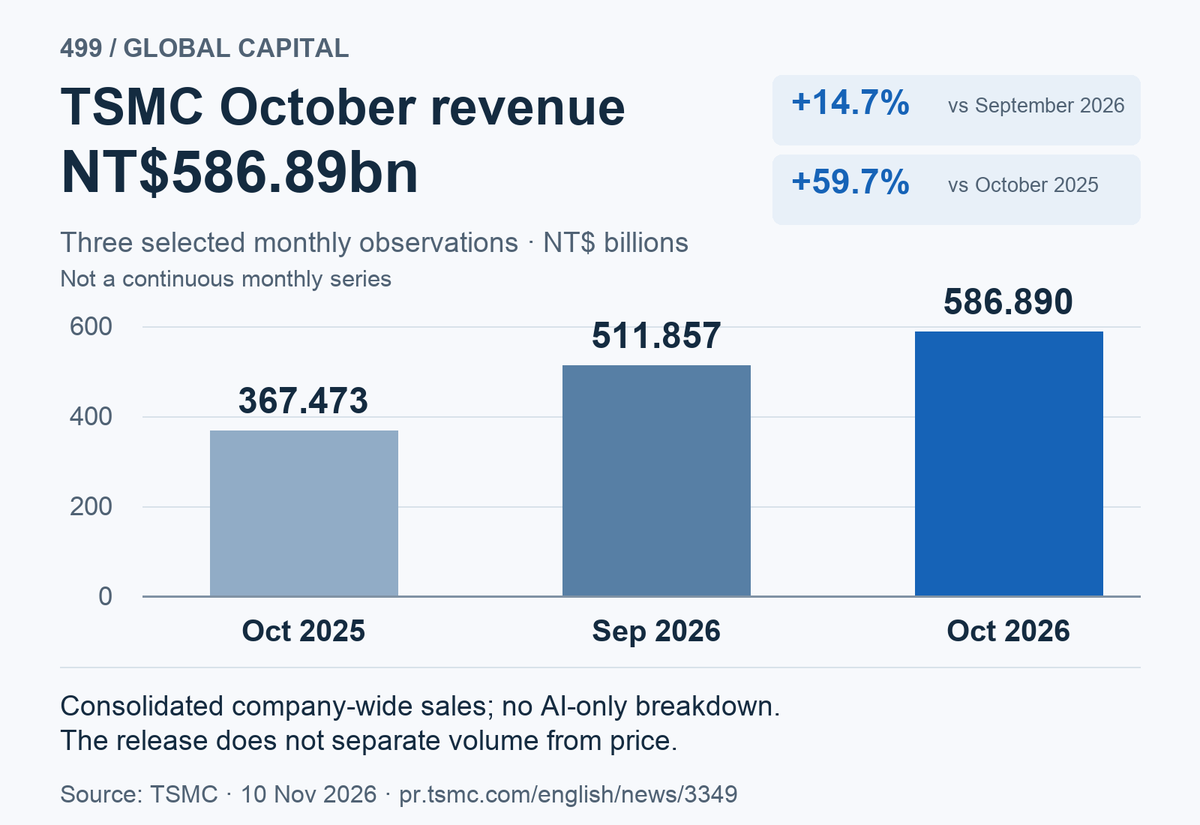
TSMC’s October revenue jumped 59.7% year on year to NT$586.89bn, and 14.7% from September.
A supplier’s sales and an AI customer’s returns are different scoreboards.
Today’s release covers consolidated, company-wide revenue. It provides no AI-only breakdown and no split between volumes and prices.
For the AI buildout, the next cross-check is utilisation and cash generation at the businesses using the infrastructure. Rising chip sales alone cannot establish their returns.
Source: TSMC, Nov 10.
https://t.co/AwpRPEn0KL
Berkshire’s Q3 net earnings fell 28.2%. Its operating earnings fell 5.8%.
The Nov 7 results show net earnings attributable to shareholders of $22.1 billion, versus $30.8 billion a year earlier. Company-defined non-GAAP operating earnings were $12.7 billion, versus $13.5 billion.
Most of the net earnings decline came from lower investment gains: $9.4 billion versus $17.3 billion, including realised and unrealised items. All figures are after tax.
499 view: separate portfolio gains from operating results before interpreting the headline. Then examine the businesses themselves. Operating earnings also declined, and performance varied: insurance underwriting earnings fell while BNSF rail earnings rose.
The useful distinction is where the profit changed, rather than treating every dollar of the decline as the same signal.
Source: Berkshire, released Nov 7.
https://t.co/OQfFICxPaC