@logue_phil I had the pelletised product in the trial at the recommended (& expensive) rate of 360 kg/ha and yes I have talked to Jan de Jager about this in 2026 and 20 yrs ago. The issue with the liquid is keeping it in suspension - our chemist @fertscientist has this solved.
#CalciumAdvance trial in Kirwin barley (acid tolerant) in pH 4.9 (CaCl2) - looks like we are getting very useful yield responses from just 2L/ha . Grain yields not far away. It is nano CaCO3 with some Mg, Zn, B & low N. I’m surprised by the benefits we are seeing.
@agriprof Yes Wayne, no visible deficiencies observed though - quite a curious trial which is no orphan either. This is right up your alley #LearningPlantLanguage
Could lentils find your pH problem?
🎧 Full episode with Mark Seymour: EP13 of The 4Farmers Podcast, on YouTube, Spotify and Apple Podcasts.
#4Farmers#4FarmersPodcast#SoilHealth
No-tiller Matt Griggs is going to dive deep into all his trials at the 2027 National No-Tillage Conference, Jan. 13-15 in Indianapolis.
🌱Learn more about his work and this do-not-miss event of 2027:
https://t.co/EnvZYy9ORe
Don’t miss Martin Rollet at the 2027 National No-Tillage Conference this Jan. 13–15 in Indianapolis, IN.
1-day, 2-day and 3-day passes are available. For registration info, hotel details and more, click here: https://t.co/ZP69dq2mGd
#serradella went gangbusters after sowing mid-late July in crappy low nutrient soil. I can do a #wildoat trial next year if you have any new ideas team X.
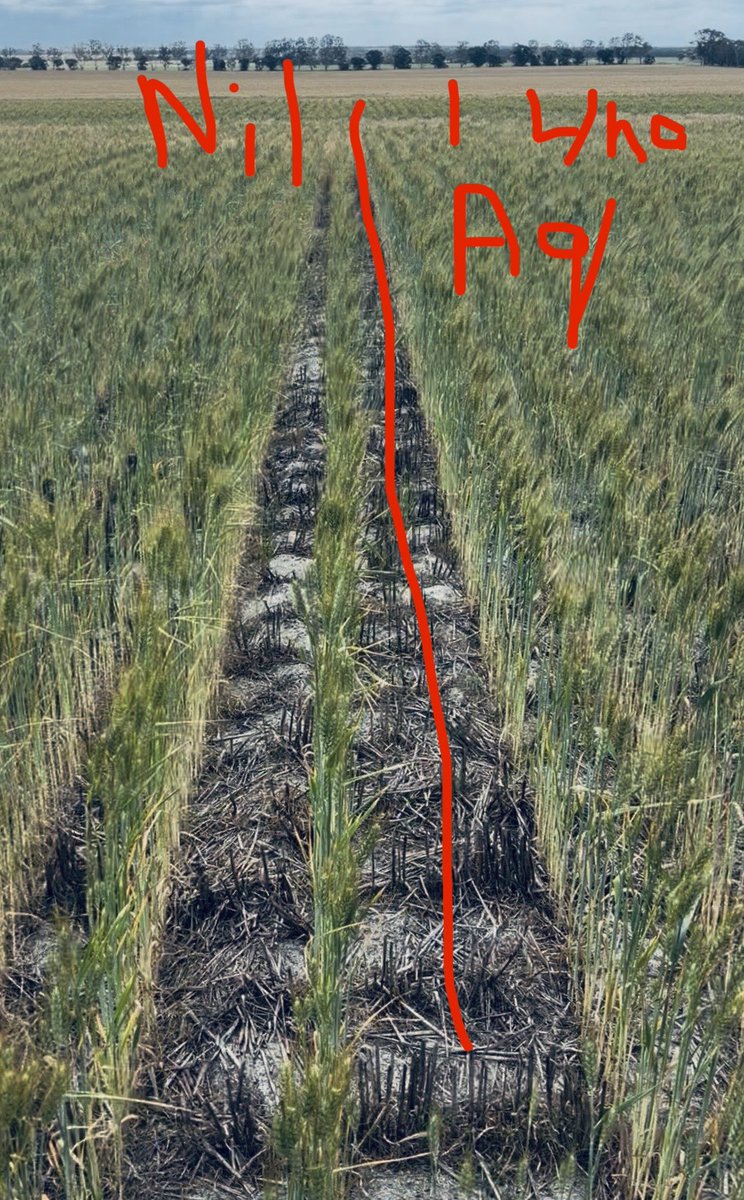
Highest return on investment is with just 1 L/ha of #Aquifer in #wheat. But most profit comes from 2 L/ha. Much more profitable than with #SE14 at 2 L/ha. Also notice the yield trend drops over the 2 L/ha rate for both products.
@M44971457Thomas Yes, it’s a great product - have put it side by side against #Aquifer for 5 years & get independent agros get the same result - even at even half that rate & it’s much cheaper. Here’s a farmers example.
@M44971457Thomas Yes, it’s a great product - have put it side by side against #Aquifer for 5 years & get independent agros get the same result - even at even half that rate & it’s much cheaper. Here’s a farmers example.
Highest return on investment is with just 1 L/ha of #Aquifer in #wheat. But most profit comes from 2 L/ha. Much more profitable than with #SE14 at 2 L/ha. Also notice the yield trend drops over the 2 L/ha rate for both products.
Now it's the sixth growing seson after once-off re-engineering intervention in 2021 at Meenar, Meckering, WA. Stark diffrences between Re-engineering Vs soil surface treatments. All seasonal crop management is carried out by the grower @TyFulwood@GRDCWest@DPIRDbroadacre@azam_gaus
“In the year 2000, John Deere’s flagship combine was $165,000.”
“Today, it’s $1.3 million.”
“$12,000-a-year increase has now turned into… $125,000-a-year increase.”
“If we’re looking five years out at combines that are $2.5 million, there’s not going to be very many people who can afford those… and still make a profit.”
Willie Cade has spent years fighting John Deere over farmers’ right to fix their own equipment.
Now, he’s warning that the corporate giant is pricing family farmers out of business faster than ever.
“Back in 2019, it all of a sudden just took off.”
“It’s not something that the industry could sustain.”
“Getting the food from the field all the way to your table, there’s a whole lot of people [and] different organizations that need to make a profit in order to stay in business.”
The scale of the crisis facing farmers is far worse than Washington will ever admit.
And this story exposes the central problem driving the crisis:
Corporate consolidation.
Not only is John Deere’s combine priced higher than many family farmers can afford, but Cade and other advocates have spent years fighting just to secure farmers’ right to repair their own equipment after they buy it.
@WillieCade7@TeddyDowney@Capitol_Forum