Most likely, yes. But ETE is exactly the kind of domain I wouldn't want to sell. It belongs to the 30-40% of my portfolio that I'd actually prefer to keep.
The whole idea is to get rid of the weaker, less liquid names that drag down the overall performance. By my estimates, doing so would bring the portfolio's annualized ROI closer to 8-10%, which I think is a perfectly respectable conservative return in today's environment.
Especially considering that, unlike bonds, you're holding an asset that has the potential to appreciate over time rather than simply return its face value at maturity. At least that's been the trend so far.
So I'm not really looking to exit the domain market. I'd just prefer to own fewer, better names and let the rest of the capital work somewhere more efficiently. The only problem, as we've discussed, is finding buyers willing to pay anything remotely close to those wonderful auction prices :)
ETE at $35K certainly looks like a great deal by today's standards. But I'm not so sure about the idea that I could liquidate my portfolio at current wholesale prices and achieve a decent return.
The problem is that "current wholesale prices" seem to exist mainly at expired-domain auctions. I've been watching those auctions for the past three years, and prices for comparable 3L/4L names are often 2-3 times what I originally paid. But the moment you try selling the exact same type of domain at a user auction, the laws of economics mysteriously change. Suddenly, buyers become extremely price-sensitive, liquidity disappears, and even recovering your original purchase price becomes a challenge.
To be clear, I'm talking about the less liquid names with weaker letters, not the premium stuff.
I'd actually be perfectly happy to liquidate 60-70% of my portfolio tomorrow at my original acquisition cost plus, say, 15% for having my capital tied up for three years. No regrets whatsoever. Unfortunately, I haven't seen much evidence that the market is willing to offer even that.
And this brings me to a broader point. I treat domaining purely as a hobby, since I make my money in completely different industries. But if I were approaching it as a serious investment business, I'd have a hard time justifying holding a large portfolio of illiquid 3L/4L domains at current US Treasury yields.
You can buy short-term Treasuries if you're concerned about inflation and interest-rate risk, or lock in higher yields with longer maturities, sit back, and collect your coupons without doing anything. In my case, even without paying tax on that income.
No renewals, no illiquidity headaches, no waiting years for someone to appreciate your particular combination of consonants.
So yes, on paper, my portfolio may be worth considerably more than I paid for it. The only minor technical problem is finding someone willing to pay those wonderful "market prices." Apparently, domains are worth a fortune when they're expiring, but become much less exciting once they're owned by another domainer :)
That's the beauty of this market: everyone loves wholesale prices until it's their turn to buy at them.
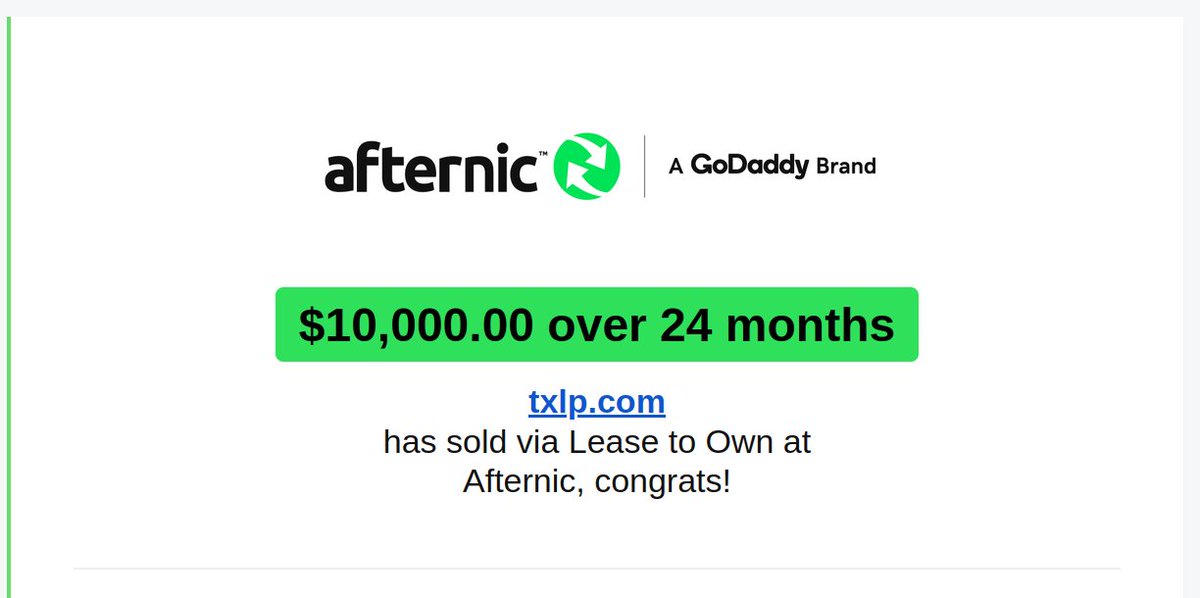
I count all the profit from an LTO sale in the month the domain is sold.
For example, if I sell a domain for 10k with payments spread over 24 months, I count the full profit in the month of the sale. Otherwise, I would have to record and include all 24 payments separately in my calculations, which would take much more time.
Sure, why not? Including my latest sale, the average yearly return on my portfolio of three-letter .com domains is 5.63% (XIRR). The calculation uses the actual purchase and sale dates, and unsold domains are valued at their original purchase cost.
I currently have 105 domains in my portfolio:
Good letters (only premium letters) - 22 domains.
Average letters (contain 1 or more of F/G/H/K and no bad letters) - 63 domains.
Bad letters (contain exactly one of J/Q/U/V/W/X/Y/Z) - 20 domains.
I currently have 105 3L .com domains. Since end-user sales are very rare - usually 1, or 2 domains per year - I do not write about them often.
These sales are usually completed through more complicated arrangements, often using escrow, and buyers usually do not want the details to be made public.
In this case, the sale was completed through Afternic, so there was nothing preventing me from sharing it with my followers for information.
4L. com portfolio update: December 2024–September 2026
For 21 consecutive months, from December 2024 through August 2026, my analyzed four-letter .com portfolio was profitable using a standardized renewal cost of $10.18 per domain per year.
September ended that streak. It was also the first full month of my experiment with a fixed $10,000 asking price for every domain included, with a 24-month Lease to Own (LTO) option.
Under those conditions, September produced zero sales. Revenue stopped, while the ongoing cost of holding the portfolio remained. That resulted in a $17,399.15 loss under the same renewal-cost calculation used throughout this report.
This is the context behind the September decline: it occurred during a deliberate change in pricing.
The updated report now covers 22 months, from December 2024 through September 2026. All amounts are in USD:
• Gross domain sales: $771,092
• Domains sold: 353
• Average sale price: $2,184.40
• Profit using standardized renewal costs: $220,231
• Profitable months: 21 out of 22
• Domains held at the end of September: 20,874
December 2024 is the starting point because that was when I fully moved my sales to Afternic, switched to Afternic nameservers, and adopted more realistic pricing. The results reflect that combination of changes.
Despite September’s setback, the longer-term figures show progress.
Comparing the same nine-month periods:
January–September 2025:
• 188 domains sold
• $315,140 in gross sales
• $1,676.28 average sale price
• $91,921 in profit
January–September 2026:
• 114 domains sold
• $342,000 in gross sales
• $3,000 average sale price
• $106,333 in profit
Even after including September’s loss, gross revenue increased by 8.5% and profit by 15.7% compared with the same period in 2025.
Sales volume fell by 39.4%, while the average price achieved increased by 79.0%. Fewer sales generated more revenue and more profit.
For me, that is an important distinction. Higher realized sale prices had been compatible with a profitable portfolio. However, September’s much higher blanket asking price produced no transactions.
The portfolio also grew. Holdings increased from 15,973 at the end of December 2024 to 20,874 at the end of September 2026 — approximately 30.7%.
That growth matters when interpreting the results. A larger portfolio carries a larger renewal obligation, and sales counts need to be considered alongside portfolio size and sell-through rate.
Profit is calculated consistently throughout the report: sales revenue minus fees, the original acquisition cost of the domains sold, and portfolio renewal expenses.
Renewals are standardized at $10.18 per domain per year, prorated for the reporting period. These figures do not represent the exact renewal invoices paid in each month.
Purchases of domains still held are not deducted from this profit figure. The reported profit therefore should not be interpreted as cash flow or a return on all the capital invested in the portfolio.
Across these 22 months, standardized renewal expenses totaled approximately $348,185, accounting for 45.2% of gross sales revenue. The resulting profit margin was 28.6%.
The separate group of 2,768 less liquid domains being sold off at lower prices remains excluded from this analysis.
September’s updated figures were:
• Domains sold: 0
• Gross sales revenue: $0
• Standardized renewal expense: $17,399.15
• Profit / loss: −$17,399.15
With no sales, cumulative revenue and the historical average sale price stayed unchanged. Renewal expense reduced accumulated profit from approximately $237,630 at the end of August to $220,231 at the end of September.
My interpretation remains that a blanket $10,000 asking price is too high to produce sustainable results for the ordinary, random four-letter .com domains in my portfolio. Individual names may sell at that price, but enough sales need to occur to cover the cost of holding the entire inventory.
The 24-month LTO option did not produce a sale during September.
As announced previously, I am continuing the experiment through October under exactly the same conditions: a fixed $10,000 asking price and a 24-month LTO option.
The next update will show whether a second full month produces a rebound. I will evaluate the results against this historical benchmark, using sales volume, sell-through rate, revenue, and profit after expenses.
All updated charts are in the comments below.
@DavidSustiel@domainretail That is exactly the question I am interested in. I hope the representatives of the @Dynadot registrar will clarify this issue soon.
I do not know where the information that QDA .com sold for $5,655 came from. The auction ended with a final bid of more than $26,000. I participated in the Dynadot auction for this domain.
I did not wait until the end of the auction because the bids became extremely high and did not make sense to me. However, I took a screenshot about 30 minutes before the auction ended, showing how the auction was going.
As in 99% of similar cases when bids become unusually high, the leading bidders were users with 0 previous purchases on the platform.
@Dynadot, could you please clarify what happened in the end: who won the auction, what was the final price, and on which platform the sale was completed?
No, that does not make sense.
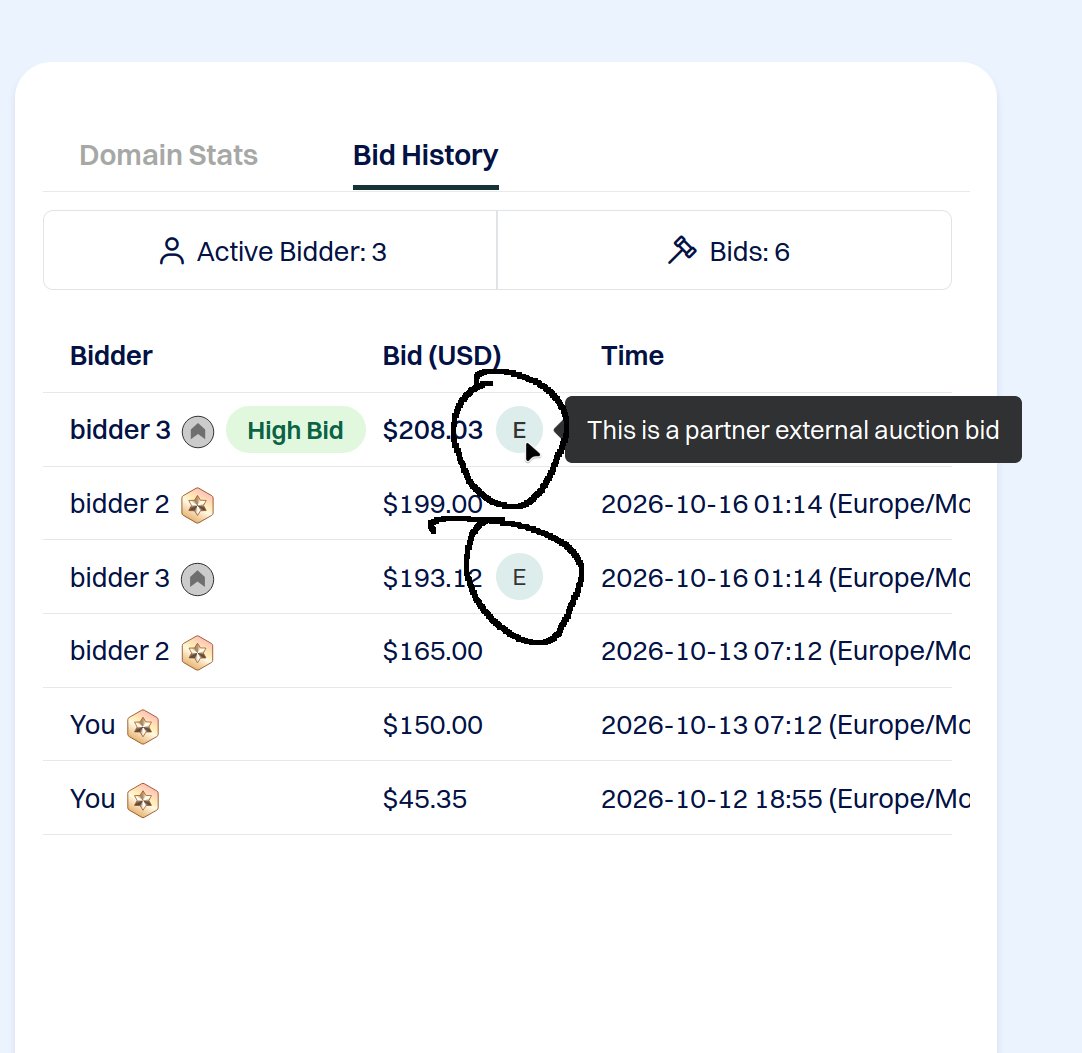
When Dynadot shows bids from external partners, those accounts have the letter "E" in the description. If you move the cursor over it, you can see the word "External".
In this case, these were bids made directly on the Dynadot platform by Dynadot users.
4L. com portfolio update: December 2024–September 2026
For 21 consecutive months, from December 2024 through August 2026, my analyzed four-letter .com portfolio was profitable using a standardized renewal cost of $10.18 per domain per year.
September ended that streak. It was also the first full month of my experiment with a fixed $10,000 asking price for every domain included, with a 24-month Lease to Own (LTO) option.
Under those conditions, September produced zero sales. Revenue stopped, while the ongoing cost of holding the portfolio remained. That resulted in a $17,399.15 loss under the same renewal-cost calculation used throughout this report.
This is the context behind the September decline: it occurred during a deliberate change in pricing.
The updated report now covers 22 months, from December 2024 through September 2026. All amounts are in USD:
• Gross domain sales: $771,092
• Domains sold: 353
• Average sale price: $2,184.40
• Profit using standardized renewal costs: $220,231
• Profitable months: 21 out of 22
• Domains held at the end of September: 20,874
December 2024 is the starting point because that was when I fully moved my sales to Afternic, switched to Afternic nameservers, and adopted more realistic pricing. The results reflect that combination of changes.
Despite September’s setback, the longer-term figures show progress.
Comparing the same nine-month periods:
January–September 2025:
• 188 domains sold
• $315,140 in gross sales
• $1,676.28 average sale price
• $91,921 in profit
January–September 2026:
• 114 domains sold
• $342,000 in gross sales
• $3,000 average sale price
• $106,333 in profit
Even after including September’s loss, gross revenue increased by 8.5% and profit by 15.7% compared with the same period in 2025.
Sales volume fell by 39.4%, while the average price achieved increased by 79.0%. Fewer sales generated more revenue and more profit.
For me, that is an important distinction. Higher realized sale prices had been compatible with a profitable portfolio. However, September’s much higher blanket asking price produced no transactions.
The portfolio also grew. Holdings increased from 15,973 at the end of December 2024 to 20,874 at the end of September 2026 — approximately 30.7%.
That growth matters when interpreting the results. A larger portfolio carries a larger renewal obligation, and sales counts need to be considered alongside portfolio size and sell-through rate.
Profit is calculated consistently throughout the report: sales revenue minus fees, the original acquisition cost of the domains sold, and portfolio renewal expenses.
Renewals are standardized at $10.18 per domain per year, prorated for the reporting period. These figures do not represent the exact renewal invoices paid in each month.
Purchases of domains still held are not deducted from this profit figure. The reported profit therefore should not be interpreted as cash flow or a return on all the capital invested in the portfolio.
Across these 22 months, standardized renewal expenses totaled approximately $348,185, accounting for 45.2% of gross sales revenue. The resulting profit margin was 28.6%.
The separate group of 2,768 less liquid domains being sold off at lower prices remains excluded from this analysis.
September’s updated figures were:
• Domains sold: 0
• Gross sales revenue: $0
• Standardized renewal expense: $17,399.15
• Profit / loss: −$17,399.15
With no sales, cumulative revenue and the historical average sale price stayed unchanged. Renewal expense reduced accumulated profit from approximately $237,630 at the end of August to $220,231 at the end of September.
My interpretation remains that a blanket $10,000 asking price is too high to produce sustainable results for the ordinary, random four-letter .com domains in my portfolio. Individual names may sell at that price, but enough sales need to occur to cover the cost of holding the entire inventory.
The 24-month LTO option did not produce a sale during September.
As announced previously, I am continuing the experiment through October under exactly the same conditions: a fixed $10,000 asking price and a 24-month LTO option.
The next update will show whether a second full month produces a rebound. I will evaluate the results against this historical benchmark, using sales volume, sell-through rate, revenue, and profit after expenses.
All updated charts are in the comments below.
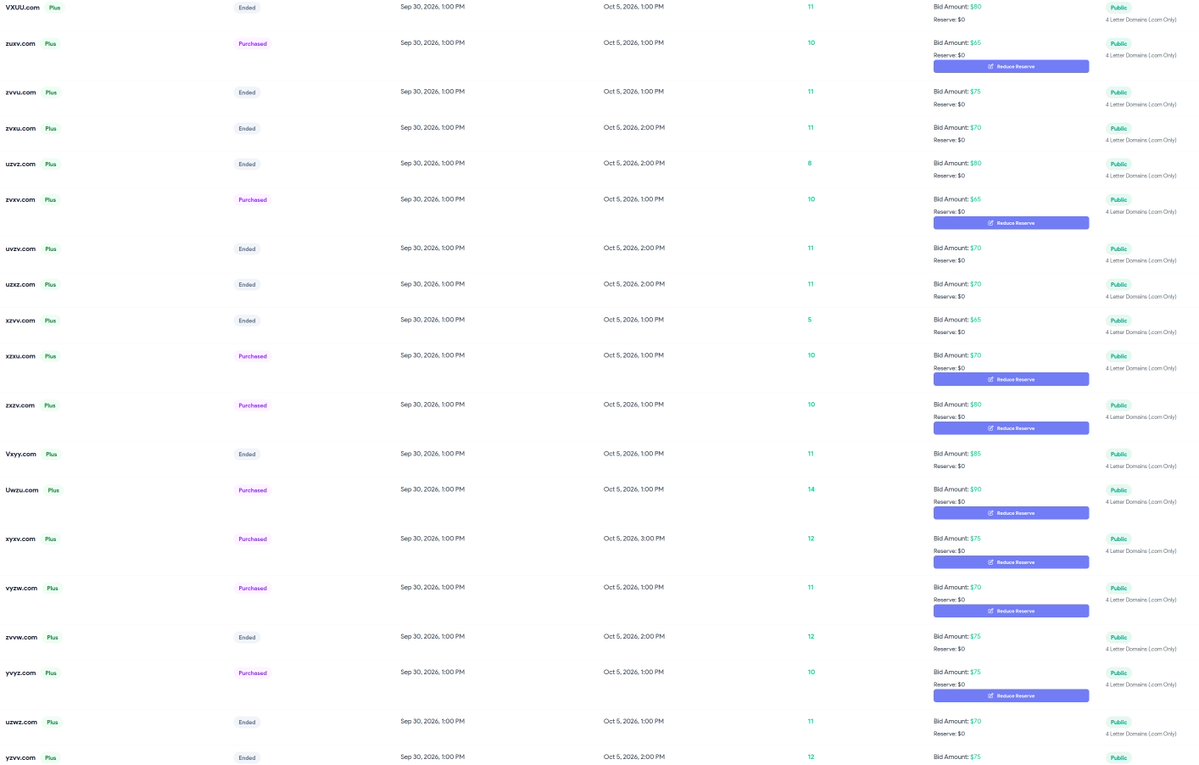
Update: Atom's 4L domain auctions are over. The last-minute bids did arrive. The impressive results apparently had other plans.
I gave Atom a second chance. Here are the final bids:
vxuu .com - $80
zuxv .com - $65
zvvu .com - $75
zvxu .com - $70
uzvz .com - $80
zvxv .com - $65
uvzv .com - $70
uzxz .com - $70
xzvv .com - $65
xzxu .com - $70
zxzv .com - $80
vxyy .com - $85
uwzu .com - $90
xyxv .com - $75
vyzw .com - $70
zvvw .com - $75
yvyz .com - $75
uzwz .com - $70
yzvv .com - $75
19 domains. $1,405 in total final bids. An average of $73.95 per domain before fees. Highest bid: $90.
Similar domains have easily sold for $100 each in my @NamePros auctions, with no commission to pay.
Based on this experience, I strongly advise against using Atom for domain auctions (No reserve). The marketplace felt dead, and these results haven't changed my impression.
Atom got its second chance. A third would be an act of charity.