This is why this kind of Christian Nationalism has no place in the Southern Baptist Convention. It's not just about contradicting Article VII of the BF&M; it's about contradicting the core purpose of the Convention.
God is raising up healthy churches in Colombia—and they are planting more churches and sending missionaries to the nations. Will Becknal and Pastor Nicolás Osorio share what the Lord is doing through the Pillar Network. Listen to this week's episode: https://t.co/ldnbUzYvXP
Strengthened churches become launching pads for global gospel advance.
“But our hope is that as your faith increases, our area of influence among you may be greatly enlarged, so that we may preach the gospel in lands beyond you . . .” 2 Cor 10:15–16a.
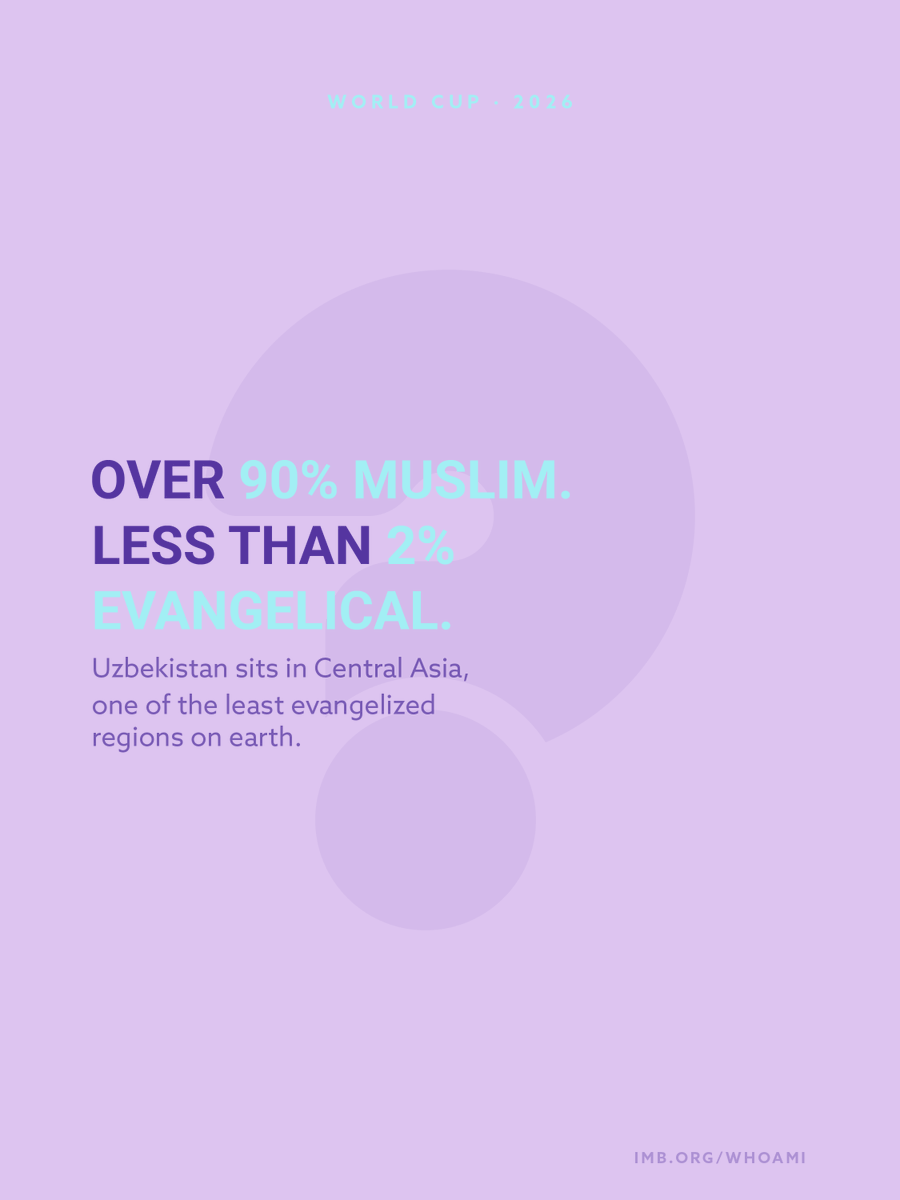
Tonight Uzbekistan plays in the World Cup for the very first time.
90% Muslim. Less than 2% Evangelical. 588 dying daily without Christ.
Tonight the world is watching. The question is whether the church is praying.
🔗 Pray for the nations playing today and learn more about the Who Am I initiative at: https://t.co/3zId6bUPvm.
I’m so grateful for my wife and the wisdom she shares in this episode. Her love for the church, her family, and the people among whom we live are unsurpassed.
In this episode, Olivia and Sam share their experience raising third-culture kids on the mission field, discussing education, identity, the challenges of cross-cultural life, and the vital role of the local church in helping them thrive. Listen here: https://t.co/q5aWE7lp2I
On spontaneous baptisms, one of our foremost Southern Baptist ecclesiologists helps us see the “biblical model” is not so certain. https://t.co/1JEa9Wgy25
These two things—spontaneous baptism and rigorous baptismal examination—do not have to be opposed. Summit Church regularly does spontaneous baptisms; we also require baptismal candidates to go through a comprehensive interview with a trained counselor on the spot before they can get in the tub. We end up turning a number of people way—or at least slowing them down to make sure they properly understand what they’re doing. I’m so glad we do it that way—many people come to genuine faith in Christ during those on the spot interviews. It’s arguably our church’s most effective evangelistic strategy.
My bigger concern here is that this approach, while well-intended, offers a pragmatic solution to a perceived problem rather than relying on the biblical model, which is ironic given that it comes from our friends at 9 Marks.
The simple fact, as others have pointed out, is that EVERY single baptism we see in the New Testament is spontaneous. Every. Single. One. Without exception. Of course, the concern to not give false assurance is legitimate and pastorally wise. The question is whether we will pursue a biblical solution to this challenge or a pragmatic one… If we want to follow the biblical model, we will use spontaneous baptism calls AND instill a process that seeks to validate whether a profession of faith is real.
Will we make mistakes? Of course. I’m pretty sure it’s unavoidable. In Acts 2 Peter gave an invitation for a spontaneous baptism and 3000 responded. The total membership of the church at that point was 120, so with 3000 respondees that means each believer had to counsel no less than 25 people that day. That’s >6 candidates per person every hour for 4 hours straight. You can’t tell me a few people didn’t slip into the baptismal that day that “weren’t ready to be baptized” — people like Simon the sorcerer (Acts 8), who had to be rebuked post-baptism and called again to repentance.
We work especially hard to vet confessions of faith, but there’s simply no way to avoid all mistakes. And any conscientious pastor will tell you that happens, no matter how long you take in the baptism catechumen process.
I appreciate the concern raised here, but let’s embrace the sufficiency of Scripture and practice baptism the biblical way!
How Does the Church's Witness Relate to God's Mission in the World? Theologian and missionary Justin Schell joins the podcast to talk about his book, The Mission of God and the Witness of the Church. Listen here: https://t.co/Ai8Vio7U4h
Augustine on tongues.
"Therefore, since also now he [the Holy Spirit] is received, someone might ask, Why does no one speak in the languages of all nations?
Because now the Church herself speaks in the languages of all nations. Before the Church was in one nation, when it was speaking in the languages of all.
By speaking in the languages of all it signified the future, that, by growing through the nations, it might speak in the languages of all."
- Augustine, Tractate on John 32.2.
What Kind of Missionaries does the Global Church Want? Evgeny Bakhmutsky, a pastor in Moscow, joins the podcast to share about what God is doing in Russia and about the kind of missionaries he hopes will come to join in the work. Click the link to listen: https://t.co/RQlRTwGGLQ
Should Missionaries Serve as Elders? In this episode, missionaries and pastors Ricky Wilhelm and Ross Frierson join the podcast to discuss church planting in Russia and Wales and the role of missionaries in local churches. Click here to access the episode: https://t.co/yDLzsmF4ML
“Resolved, That the Convention appoint a Board of Managers for Foreign Missions…”
“Resolved, That the Board for Foreign Missions be located at Richmond, Va.”
May 10, 1845
Happy 181st @IMB_SBC!
Excited to be part of this new project with friends. We’re getting better at it as we go. Find out more at https://t.co/ujk5L9lOkT. We’d love it if you’d subscribe and leave us a good review!
Being forced to leave a place of service is an experience of suffering common to many missionaries. In our very first ever episode, Erik White tells his family’s story of leaving Central Asia. Click the link to access the episode: https://t.co/zqasirRn1f
Pray for missionaries facing rejection in spiritually resistant places. Ask God to protect them and remind them of the life found in Christ. 🙏
🔗 Find our downloadable prayer guide at: https://t.co/bpcBGAKtol.
Paul’s itinerancy often prioritized relationship and strengthening churches, and he was flexible to accommodate both. His urgency was not a breathless scurrying to the next place.
1 Corinthians 16:3–9 https://t.co/8zTWXxjqDR
“I have become all things to all people” (1 Cor 9:22) isn’t referencing a strategy to bend the gospel to accommodate culture. It’s referencing a willingness to bend oneself—my rights, my freedoms—in loving service to others.
Near the end of Ramadan, Muslims observe the Night of Power.
Millions will spend the night praying, hoping their prayers are heard.
🙏 Join us in praying that those searching for mercy and forgiveness encounter the hope found in Jesus.
My morning conversation with a 5 year old:
“I’m going to Bangladesh.”
“When?”
“Today. After school. I’m going to Bangladesh after school today.”
I love third culture kids.