@a__philosopher @PhilosophieW@Disagreeable_I Quantum collapses the Aristotelian architecture, but we still use it. This would give much more to talk about for a long time.
@a__philosopher @PhilosophieW@Disagreeable_I And the principle of identity is weakened by the indiscernibility between particles as stated by Manin: "The 'sets' of photons in a glass box or of electrons in a piece of nickel are much less Cantorian than a 'set' of grains of sand".
@a__philosopher @PhilosophieW@Disagreeable_I That is precisely why John von Neumann tried to work out a quantum logic that would fit with quantum reality.
@a__philosopher @PhilosophieW@Disagreeable_I Probability in quantum physics has nothing to do with the concept of probability when a die is rolled.
States in superposition are not possible alternative outcomes but interacting realities in themselves and clearly question classical logic.
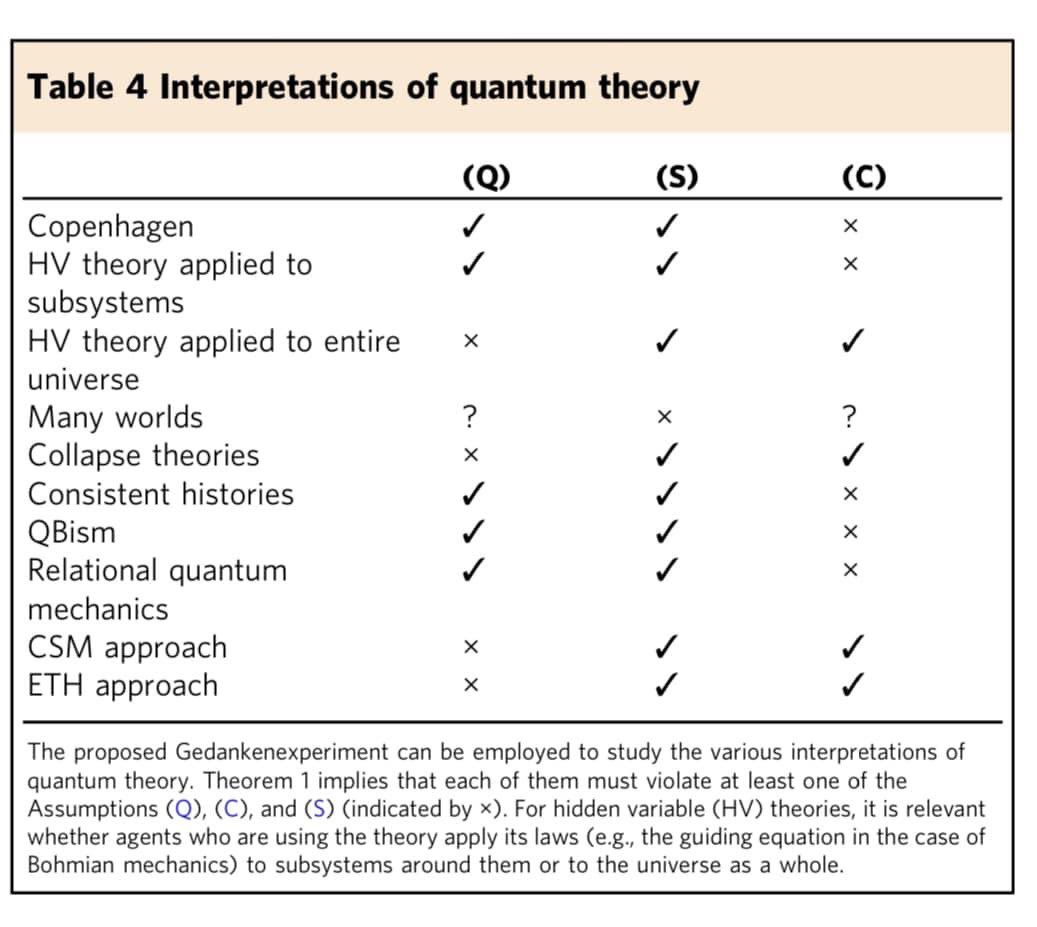
@a__philosopher @PhilosophieW@Disagreeable_I Q: validity: an agent can be sure that a proposition is fulfilled if Born rule assigns probability 1
C: consistency: predictions of different agents are not contradictory
S: measurement has only 1 outcome from point of view of an agent who is carrying out a particular measurement
@a__philosopher @PhilosophieW@Disagreeable_I No interpretation of quantum mechanics is able to explain this physical reality 100%. That is why there are so many interpretations of it.
@a__philosopher @PhilosophieW@Disagreeable_I … or denying the principle of non-contradiction, such as paraconsistent logics.
To assume that the underlying reality of the universe follows a classical logic is too much to assume.
@a__philosopher @PhilosophieW@Disagreeable_I Well, in a consistent classical logic certainly nothingness can be defined as the negation of something. But there are other logics that can be constructed denying even the principle of identity, such as non-reflexive logics, …