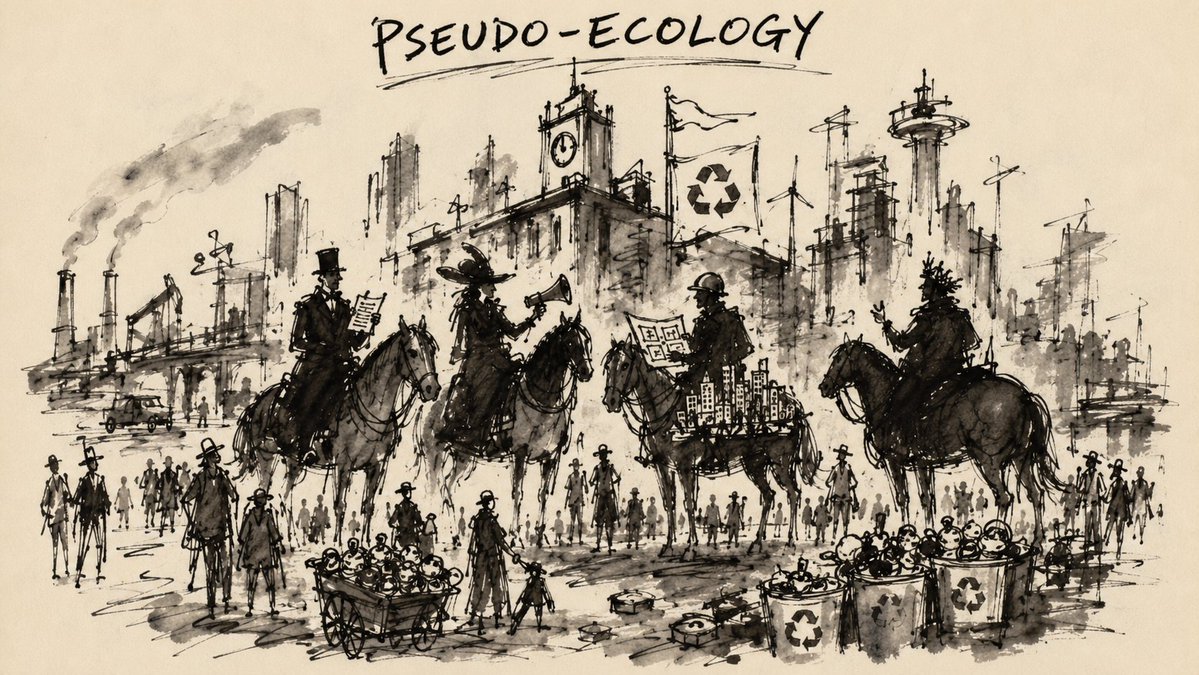
The Horsemen: managers, marketers, urbanists and idiocrats turning life into KPIs, fake desire, controlled space, and mass stupidity as modern governance.
The Four Horsemen of the System:
Managers. Marketers. Urbanists. Idiocrats.
KPIs. Manufactured desire. Controlled space. Mass stupidity.
This is the modern apocalypse.
If you see what they’re doing to the world, welcome.
#FourHorsemenOfTheSystem#Dystopia#SystemCritique
Real influence is not feeling guilty at the bin.
Real influence is buying less, using things longer, repairing them, choosing less packaging, demanding refill and reuse from retailers, and not letting brands sell old plastic in a new green language.
What to do about pseudo-ecology.
Do not trust green words without numbers.
In the EU, 53% of green claims are vague, misleading or unfounded. 40% have no supporting evidence. If there is no data on actual reductions (plastic, water, CO₂, energy, etc.), it is advertising.
Choose natural materials when they truly reduce harm. Synthetic materials and plastics create waste and microplastics, with hundreds of thousands of tonnes from textiles entering oceans each year. But only if they’re durable, repairable, and minimally packaged.
The idiocrat reduces ecology to visible rituals: straws, caps and sorting, while oil, aviation, wars and overproduction stay out of frame. Since July 3, 2024, single-use plastic bottles in the EU must have attached caps a small change the Commission says could have a huge impact.
The manager translates ecology into managed compliance: standards, tariffs, reporting and penalties for deviation. CSRD and ESRS make sustainability a system of reports, standards and formal alignment.
Do you really think ecology is about sorting waste?
Long before the UN’s 17 SDGs, it was becoming a governance tool: rules, fees, labels and moral pressure pushed onto ordinary people.
The urbanist builds pseudo-ecology into the form of city life: dependence on networks, services and control is presented as progress. The EU Mission aims for 100 climate-neutral and smart cities by 2030, turning them into experimentation and innovation hubs.
Pseudo-ecology is a regime of symbolic protection of nature: environmental language is used to regulate less powerful groups without touching the structural sources of harm.
Do you really think ecology is about sorting waste?
Long before the UN’s 17 SDGs, it was becoming a governance tool: rules, fees, labels and moral pressure pushed onto ordinary people.
@WEschenbach 1701 did not give Israel a blank cheque to invade Lebanon. It demanded a ceasefire, Israeli withdrawal, Lebanese/UNIFIL control in the south, and no armed groups south of Litani. Hezbollah’s violations don’t erase Lebanon’s sovereignty or turn occupation into law.
There is no crisis.
There is a redistribution machine.
They call it inflation.
They call it austerity.
They call it responsibility.
But the direction of money never changes.
@UNOCHA Maximum sympathy.
Minimum blame.
Maximum universal morality.
Minimum political specificity.
This is humanitarian neutrality: it helps preserve access to victims, but also turns war into an abstract tragedy without naming those who ordered it or carried it out.
The manager builds paid sorting inside the crowd.
The marketer sells proof you are not like everyone else.
The urbanist turns living places into status infrastructure.
Idiocracy turns elite escape into the same crowd with a pricier view.
The Premium Version of the Crowd.
The system standardized the crowd.
The market sold status as an escape from it.
But most “escape” is just a more expensive version of the same system.
@antonioguterres Methane cuts are necessary.
But climate policy is not serious while governments plan fossil fuel production far above the 1.5°C pathway, private aviation emissions rise 46%, and fossil subsidies still run into trillions.
It is discipline for citizens and protection for extractors