Today's image is commonly called the Alexamenos Graffito. It is a late 2nd-century or early 3rd-century graffiti from Rome, discovered on the Palatine Hill in 1857.
The drawing mocks Jesus by portraying him crucified with the head of a donkey, while a figure stands nearby in a gesture of worship. The Greek inscription reads, “Alexamenos worships [his] god.”
The image reflects common ridicule of early Christians, who were sometimes accused of absurd or impious worship—even of atheism since they rejected the gods of Rome. A crucified deity was scandalous enough; pairing that figure with a donkey’s head heaped mockery upon mockery.
It is hard for us as moderns to wrap our minds around how shameful the cross was in the Roman Empire. In the first century, the cross was a reprehensible, horrific Roman instrument used to control the masses, instill fear, and eliminate political threats.
Crucifixions were public warnings: mess with Rome, and this is what you get. Respectable society avoided even mentioning words like "cross" or "crucifixion." The cross was not a topic for polite conversation, much less something to proclaim from the rooftops as good news.
Yet Paul insists that Christ crucified is precisely what Christians preach. Why? Because God reveals his wisdom in ways that overturn human expectations. The weak shame the strong; the despised nullify what appears powerful (1 Cor. 1:27–28). God reveals himself beneath his seeming opposite: life in death, glory in shame, hope in despair.
“Alexamenos worships his god.” Indeed, he does. And we do with him. Call me Alexamenos. Call me a fool. The mocked and crucified one bore our sins, our blasphemies, the world’s corruption, and made them his own so that they are no longer ours.
Look nowhere else for God but in the crucified and resurrected Jesus. In him alone we find wisdom, righteousness, sanctification, and redemption (1 Cor. 1:30). Now that is a God worthy of worship.
______
-We read 1 Corinthians 1 today in Bible in One Year: https://t.co/XxNvEtNH7e
-The image is public domain. See the Wikipedia article "Alexamenos graffito" for more.
Between the Holy of Holies and the Holy Place hung a veil, both in the tabernacle and temple.
The NT presents two ways of understanding the veil's symbolism.
First, when “Jesus cried out again with a loud voice and yielded up his spirit… the curtain of the temple was torn in two, from top to bottom” (Matt. 27:50-51; cf. Mark 15:38; Luke 23:45).
This event signals the fulfillment and closure of the Day of Atonement (Leviticus 16). No longer would the high priest enter behind the veil with animal blood. Christ “entered once for all into the holy places… by means of his own blood, thus securing an eternal redemption” (Heb. 9:12).
The torn veil thus shows that access to God has been opened. We may now enter the Holy of Holies with confidence through the blood of Jesus (Heb. 10:19).
At the same time, it signals that God’s holiness is no longer confined to a single sacred space. Zechariah foresaw a day when ordinary objects would bear the inscription “Holy to the LORD,” indicating a spreading sanctification beyond the temple itself (Zech. 14:20-21). The tearing of the curtain marks the expansion of holiness outward.
The temple, though still standing for a time, had become an ex-sanctuary, its role fulfilled. In AD 70 it fell, and for Christians there remained only one true temple: Jesus the Messiah, whose resurrected body is our living sanctuary (John 2:19-21).
The second major way of understanding the veil comes from Hebrews. Believers have confidence to enter the holy places by the blood of Jesus, through the new and living way opened through the curtain, that is, his flesh (Heb. 10:19-22).
The OT veil marked the meeting place between God and humanity. In the incarnation, Jesus unites both sides of the curtain in his own person. His flesh becomes the place where God and humanity meet and the means by which we approach the Father.
The way is new because it belongs to the new covenant, and it is living because Jesus lives and gives life to those who come through him.
What was once a barrier has become a permanent entrance into God’s presence.
___
Adapted from my book, The Christ Key: Unlocking the Centrality of Christ in the OT. https://t.co/eAV1LclgKs
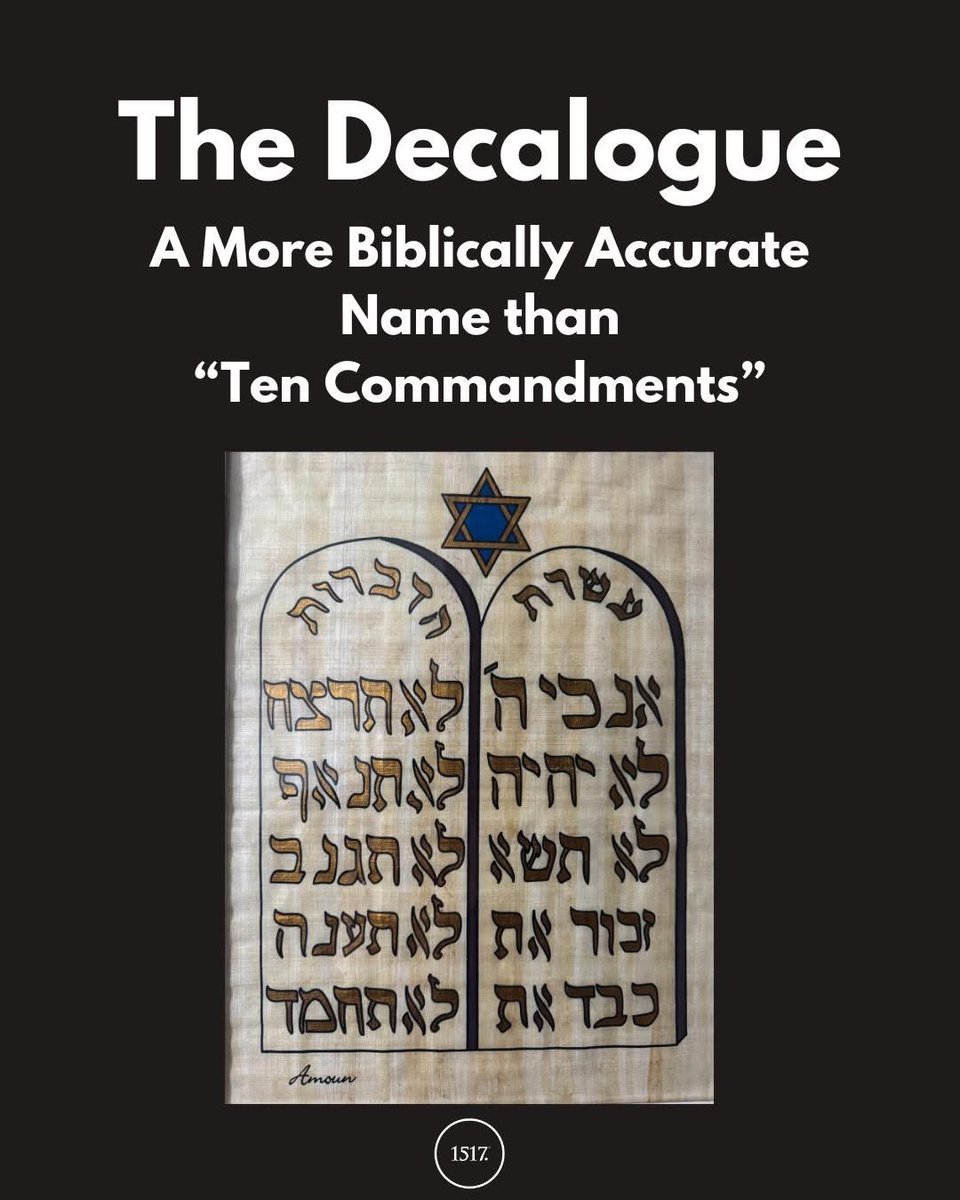
There are several ways Christians number the Ten Commandments, but I actually prefer the Jewish numbering system. Here’s why.
In Scripture, they are never called “the Ten Commandments.” That is a label we have attached to them. Instead, the Bible calls them the “Ten Words,” עֲשֶׂרֶת הַדְּבָרִים in Exod. 34:28; Deut. 4:13; 10:4. Hebrew certainly has a word for commandments (mitzvot), yet when referring to these specifically, it uses the more general term “ten words.” Thus, “Decalogue” (literally “ten words”) is actually the more biblically accurate name.
In the Jewish numbering, nine of these “words” are, indeed, commands and prohibitions. But the first “word”—the one upon which all the other are based—is this: “I am the LORD your God, who brought you out of the land of Egypt, out of the house of slavery” (Exod. 20:2).
This opening word becomes the foundation for everything that follows. Before God says, “You shall do this” or “You shall not do that,” he first says: this is who I am, this is who you are, and this is what I have done for you.
There are three key elements here.
First, God reveals his identity. He is not a nameless power in the skies; he is Yahweh, the God who gives his name and makes himself known (Exod. 3:14–15).
Second, he declares the relationship: “your God.” He has claimed Israel as his own; they belong to him as his chosen people (Exod. 6:7).
Third, he reminds them of his saving action. He is the God who has shown his compassionate and merciful heart by liberating them from Egypt, rescuing them from slavery through his mighty acts (Exod. 12–14).
This same covenantal heart of God is displayed fully in Jesus Christ. In him, God again says, “I am your God.” He has claimed us as his own, liberated us from slavery to sin and death, and brought us into life as his people (Rom. 6:6–11; Col. 1:13–14).
When God sent the ten plagues in Exodus, he was not merely showcasing his power against Pharaoh. He was uncreating Egypt, rewinding this rebellious land to Genesis 1:2, where “formlessness and void” (tohu vavohu) characterized creation.
A major feature of the creation account is God making distinctions, dividing light from darkness, water from dry land. He is ordering and organizing the world. In the plagues, all this is reversed. Water becomes blood. Water animals (frogs) swarm the land. Dust becomes gnats. Light becomes darkness. Finally, life (the firstborn) becomes death.
Pharaoh’s enslavement and mistreatment of the Israelites was a rebellion against life and creation as it was ordered by God. So, God harnesses creation to use against Pharaoh. Not just people but all creation—water, land, heavens, animals—are involved.
The events in Egypt are thus a prophetic microcosm of worldwide proportions. That is why, in Revelation, John uses the plagues as a model for his vision of divine, worldwide events.
What happens at the conclusion of the plagues? Redemption for God’s people.
What happens at the conclusion of time? Redemption for God’s people.
Exodus thus becomes a preview of world history—and the ultimate redemption we have in the resurrection of the Son of God, and our resurrection in him.
_____
We are reading through Exodus in Bible in One Year. Join us at https://t.co/XxNvEtNH7e
One of the most bizarre stories in the Bible appears early in the book of Exodus. On the way to Egypt, “the Lord met Moses and sought to put him to death” (Exod 4:24–26).
This scene is as surprising as it is strange. Moses has barely begun his God-given mission when the Lord is about to kill him! Why?
The reason becomes clear. Moses had failed to circumcise his son, neglecting the covenant obligation required of every Israelite father (Gen 17:10–14).
There are several ambiguities in this brief story. The Hebrew pronouns “he,” “him,” and “his” leave us wondering who the referent might be—Moses or his son.
Still, the basic storyline is clear. Zipporah, the wife of Moses, jumps into action. She circumcises their son and touches the bloody foreskin to Moses’ feet, declaring, “Surely you are a bridegroom of blood to me.”
Moses is spared. He is saved by blood. Though already married, he becomes a hatan damim (חֲתַן־דָּמִים), a “bridegroom of blood.”
One other detail is deeply significant and ties this narrative to the Passover. The Hebrew verb used for Zipporah “touching” Moses with the blood is naga (נגע). The same verb appears later in the Passover instructions, where Israel is told to “touch” the lintel and doorposts with the blood of the lamb (Exod 12:22).
In both scenes, blood marks the boundary between death and life.
This nighttime rescue foreshadows Israel’s deliverance from the angel of death in Egypt through the blood of the Passover lamb (Exod 12:13). And it reaches its fulfillment in Christ. He is circumcised under the law (Luke 2:21), becomes the true Passover Lamb (John 1:29; 1 Cor 5:7), and is the Bridegroom who saves his bride by his own blood (Eph 5:25–27; Rev 19:7).
Behind the shield of his blood, we are safe.
______
We read Exodus 4 today in Bible in One Year. Join us at https://t.co/XxNvEtNH7e










![birdchadlouis's tweet photo. Today's image is commonly called the Alexamenos Graffito. It is a late 2nd-century or early 3rd-century graffiti from Rome, discovered on the Palatine Hill in 1857.
The drawing mocks Jesus by portraying him crucified with the head of a donkey, while a figure stands nearby in a gesture of worship. The Greek inscription reads, “Alexamenos worships [his] god.”
The image reflects common ridicule of early Christians, who were sometimes accused of absurd or impious worship—even of atheism since they rejected the gods of Rome. A crucified deity was scandalous enough; pairing that figure with a donkey’s head heaped mockery upon mockery.
It is hard for us as moderns to wrap our minds around how shameful the cross was in the Roman Empire. In the first century, the cross was a reprehensible, horrific Roman instrument used to control the masses, instill fear, and eliminate political threats.
Crucifixions were public warnings: mess with Rome, and this is what you get. Respectable society avoided even mentioning words like "cross" or "crucifixion." The cross was not a topic for polite conversation, much less something to proclaim from the rooftops as good news.
Yet Paul insists that Christ crucified is precisely what Christians preach. Why? Because God reveals his wisdom in ways that overturn human expectations. The weak shame the strong; the despised nullify what appears powerful (1 Cor. 1:27–28). God reveals himself beneath his seeming opposite: life in death, glory in shame, hope in despair.
“Alexamenos worships his god.” Indeed, he does. And we do with him. Call me Alexamenos. Call me a fool. The mocked and crucified one bore our sins, our blasphemies, the world’s corruption, and made them his own so that they are no longer ours.
Look nowhere else for God but in the crucified and resurrected Jesus. In him alone we find wisdom, righteousness, sanctification, and redemption (1 Cor. 1:30). Now that is a God worthy of worship.
______
-We read 1 Corinthians 1 today in Bible in One Year: https://t.co/XxNvEtNH7e
-The image is public domain. See the Wikipedia article "Alexamenos graffito" for more.](https://pbs.twimg.com/media/HCuEfOWWkAAHC2t.jpg)