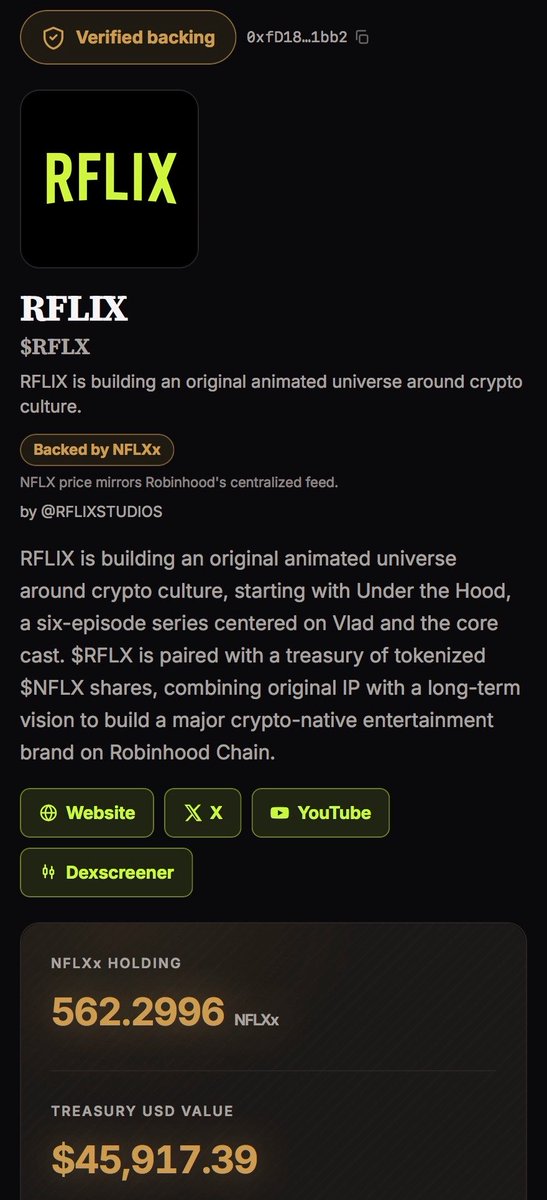
$RFLX is a strong beta play to $AI
In the last few days, $RFLX vault grew from holding 510 $NFLXx tokenised stock on Robinhood chain worth $41,133 USD Value
To holding 562 $NFLXx worth $45,917 USD Value.
Through the volume of the last few days the vault which serves as redeemable backing for the token 28% of supply burned to redeem already grew the floor bu ~10%
This is one of the strongest betas to $AI as $AI has similar vault accumulating $NVDA shares to its pool vault and community vault instead of distributing to holders
$AI: 0x2E8c31162b855A2ffa90F6F8634643Ad6F111e18
$RFLX: 0xfD181632e1F2335DaB74535E6dD29082d3191bb2
I’ve written quite a bit about why I think $RFLX is interesting, but ultimately my point is pretty simple:
I think it’s undervalued.
The harder question is how you actually value something like this.
With a DEX or another protocol, at least you have numbers you can work with — volume, fees, revenue, TVL, users, whatever. You can argue about the multiple, but there’s still something relatively concrete to anchor the valuation to.
Something like $RFLX is harder.
Because part of what you’re trying to price is art, media, characters, IP and attention.
And those things are inherently difficult to model.
You can’t really price creative upside the same way you price cash flow.
That doesn’t automatically make it valuable, obviously. Bad art is still bad art, and content nobody cares about is worth very little.
But when something actually works, the upside can be much harder to imagine in advance.
That’s what makes this interesting to me.
The $CHILL / Netflix situation is a good example.
Netflix followed the $CHILL dev, interacted with him, then later unfollowed and deleted the comment. It ended up becoming a bit of a shitshow.
But I don’t think the interesting part was the shitshow.
The interesting part was what happened during that brief moment when a major brand acknowledged something connected to the memestonk ecosystem.
The market reacted.
To me, that was a glimpse of what could eventually happen on a much larger scale.
RWA is already one of the bigger narratives in crypto, and I think it will become significantly larger.
More importantly, the market itself is already being built.
That distinction matters.
If tokenized equities continue to grow, I think it becomes increasingly difficult for companies to completely ignore them while staying attached only to the traditional market structure.
One market operates around exchange hours.
The other can trade 24/7, 365 days a year.
And the investor base itself is changing.
It’s not really about young people replacing old people. It’s more that each generation becomes increasingly native to new technology, while people who don’t adapt naturally become a smaller part of the market over time.
Where this is heading seems pretty obvious to me.
Think about Bitcoin.
When Bitcoin first appeared, did society collectively agree that it had real economic value?
Definitely not where I live.
Then more people believed it.
Then influential people believed it.
Then institutions believed it.
Eventually, enough people agreed that Bitcoin represented something valuable that this belief became embedded into markets, institutions and society.
That doesn’t mean value is imaginary.
It means markets are partly built through collective acceptance.
And I think RWA has already crossed an important threshold in that process.
People believe there is value here.
Capital is entering.
Infrastructure is being built.
A market is forming in real time.
That’s the important part.
Elon is probably the most extreme example of what attention can do.
A single post from him has created enormous economic effects around things like DOGE, and more recently we saw another version of that with Martians.
Obviously Elon is one of the most influential people on earth, so he’s an extreme case.
But the broader point is that this dynamic may not remain limited to Elon.
The tokenized stock market is not a market I expect to shrink.
If it grows, more brands will eventually pay attention to what is happening around their own tokenized equity.
Maybe next time it isn’t just a Netflix social account briefly interacting with someone.
Maybe brands experiment directly.
Maybe founders, CEOs, creators or other frontman figures start interacting with communities built around their companies.
Maybe entirely new formats emerge that we haven’t thought of yet.
And if that happens, what gets their attention?
Probably not project #47 doing exactly the same thing as everyone else.
Uniqueness matters.
Interaction starts with getting someone’s attention for a few seconds.
Keeping that attention is the harder part.
That brings me back to $RFLX.
Robinhood Chain already has some genuinely interesting experiments.
NetNet ($NET), for example, is basically an OHM-style reserve token with a $1 USDG floor, premium-based rebases, games and bonds feeding a treasury that also holds tokenized stocks.
You can call it a reflexive ponzi if you want, but it’s a well-designed one — and that novelty is part of why people are paying attention to it, imo.
$RFLX has a different economic loop.
Trading generates fees.
Those fees accumulate tokenized NFLX in the treasury.
In bearish conditions, that redeemable treasury can act as an economic floor.
If the market trades below redeemable treasury value, there is an incentive to buy $RFLX, burn it and redeem the underlying NFLX.
In bullish conditions, volume grows the treasury, the redeemable value per remaining token can increase, and holders and the team can potentially grow around the same underlying loop.
I already think that treasury structure is good enough to be a product on its own.
There are other projects where it basically is the product, and I see nothing wrong with that.
But $RFLX layers something else on top of it:
an actual Silicon Valley animation/media studio.
Under the Hood.
Characters.
Stories.
IP.
Content made specifically for the culture living in the trenches.
And I can actually watch the content for the content.
Most AI-generated animation I see loses me before I even get to the story because the quality itself keeps reminding me that I’m watching AI.
RFLX gets me past that point.
And maybe that matters more than it seems.
Because if Robinhood Chain does become one of the major homes of the RWA narrative, and if brands and important figures eventually start paying more attention to the ecosystems forming around their tokenized stocks, then being the project that can actually create something worth watching becomes a very different kind of advantage.
A treasury can give you an economic floor.
But art, IP and attention don’t really have a clean ceiling.
That’s why I find the upside so difficult to price.
Maybe I’m looking too far ahead.
Maybe none of this happens the way I imagine it.
And there will almost certainly be better trades somewhere along the way.
But I think this is worth zooming out and thinking about — even beyond $RFLX itself.
For now, at least, $RFLX is still the most interesting project on Robinhood Chain to me.
Treasury structure + RWA + media + IP + a genuinely unique position in the ecosystem.
@RFLIXSTUDIOS is one of one.
What if $RFLX becomes the new standard for memecoins?
memes backed by a redeemable floor of tokenised stock treasury??
0xfD181632e1F2335DaB74535E6dD29082d3191bb2
@solangelestv ($SOLANGELES) is at 1.3m, ATH 8.3m.
@RFLIXSTUDIOS ($RFLX) is at 200k, ATH 600k.
Similar projects, minus the treasury system.
Different styles, but I think the content quality is pretty close.
@solangelestv has a relationship with Ansem (@blknoiz06).
$RFLX doesn’t have that yet, but it has a treasury pool that acts as a floor.
The market cap gap is about 6.5x.
Exposure looks like the main difference.
If that gets filled in, I think the rest can catch up, imo.
Higher for both.
I think successful products get interesting when originality and product-market fit meet.
Being original by itself isn’t enough if nobody wants what you’re making.
And PMF without much differentiation just leaves you competing with a lot of similar products.
The interesting part is when those two overlap.
I think $RFLX already has the originality.
PMF is the part the market still has to decide.
And for $RFLX, PMF looks different from something like a DEX.
This isn’t a product people need in order to trade.
The product is cultural content.
So to me, PMF is more about the impression that content leaves.
Do people enjoy it?
Can they watch it without being distracted by the fact that it was made with AI?
Do the characters, jokes, and little details stay in their heads?
If someone watches Under the Hood and notices CashCat sitting inside a cabinet, a Pepe reference, or some other small trench detail they immediately recognize, that adds to the experience.
Those little things matter.
If the first experience feels awkward or low quality, that creates resistance the next time they see another $RFLX video.
If it’s good, that memory carries forward.
The next time they see the characters or the $RFLX name, there’s already some positive familiarity there.
And if that keeps happening, those small experiences start to accumulate.
I think that’s closer to what PMF looks like for this kind of product.
This kind of content is also time-sensitive.
One thing the team at @RFLIXSTUDIOS talked about in the Space was catching major events in the trenches and turning them into short-form content while the momentum is still alive.
That makes sense.
Doing it the same day is very different from doing it a week later, when everyone has already moved on.
The team has said that’s what they want to do, and they’ve already been doing some of it.
So now it’s about execution.
How quickly can they react?
How consistently can they do it?
And can they keep making it entertaining enough that people actually want to watch?
If they can, $RFLX could become more than a project making AI animation.
It could become a media brand that reflects trench culture in its own way.
That’s where I think PMF starts to matter much more.
If you ask me whether $RFLX has product-market fit right now, I think it has some of it.
The content works for me.
The characters and small details stick.
I can watch it without the quality getting in the way.
So at least for me, the product is already doing what it’s supposed to do.
But that’s still just my view.
The market hasn’t fully made that judgment yet.
PMF isn’t something the team can declare.
It isn’t something holders can declare either.
The market decides it through repeated behavior.
People watch, react, remember, come back, and share.
Eventually that shows up in attention, engagement, and valuation.
That’s why the valuation side is interesting.
With a DEX, you have numbers you can compare: volume, fees, revenue, TVL, users.
Media, art, IP, and attention are much harder.
Especially this early, when the market hasn’t fully decided how much it values it yet.
The treasury is something you can model.
The floor is something you can model.
But how much people might eventually care about a character, a series, an IP, or a media brand is much harder to put into a spreadsheet.
That’s the line I keep coming back to:
A treasury can give you an economic floor.
But art, IP, and attention don’t really have a clean ceiling.
That combination is what makes $RFLX interesting to me.
One side is relatively measurable.
The other side is still open-ended.
So the question is simple:
Can $RFLX turn its originality into actual product-market fit?
The market hasn’t answered that yet, but I think it can.
What I find interesting here is the treasury design itself on $RFLX
A lot of RWA projects distribute tiny amounts of tokenized stock directly to holders. There’s nothing wrong with that — it’s still value going back to holders — but in most cases, it ends there.
$RFLX takes a different approach.
Trading fees are used to continuously accumulate tokenized Netflix stock in the treasury, and holders can burn $RFLX to redeem their share of that treasury.
To me, that creates a much better alignment between holders and the team.
Right now, $RFLX is around a $250K market cap with roughly $44K of tokenized NFLX in the treasury, and around 30% of the total token supply has already been burned.
As long as the market cap trades meaningfully above the redeemable treasury value, there isn’t much economic incentive to burn your tokens for NFLX.
Meanwhile, as long as trading volume continues, the treasury keeps accumulating more NFLX.
That means the redeemable value per remaining token can continue to rise over time.
And if the market cap ever falls below the value that can actually be redeemed from the treasury, rational arbitrageurs have an incentive to buy $RFLX, burn it, and redeem the underlying NFLX.
That’s the part I find really well designed.
Instead of distributing dust-sized RWA rewards that disappear into individual wallets, the value is pooled and compounded into a treasury that can act as a growing economic floor beneath the token.
Most memecoins have nothing underneath them once attention disappears.
Here, as long as there are redeemable assets in the treasury, there is something tangible sitting underneath a Silicon Valley animation studio and its token.
And theoretically, the more volume the project generates, the stronger that backing can become.
Obviously, none of this means the market price can’t fall, and the floor itself moves with the value of the NFLX held in the treasury.
But structurally, I think this is one of the more interesting attempts I’ve seen at creating a system where long-term holders, the community, and the team can all benefit from the same growth loop.
That’s the part of $RFLX I think deserves more attention, imo.
This morning we spotted as massive market inefficiency where a Netflix and $CHILL condom was trading at $5M MC on Robinhood chain while a legitimate silicon valley animation studio $RFLX was trsding at $80K MC while having a reedemable $NFLX floor backing and being the largest holders of $NFLX on robinhood chain.
Few hours after the market inefficiency is starting to correct it self and reprice this assets correctly.
$CHILL the condom is down 90% from $5M it was trading at to $500K
$RFLX the animation studio releasing weekly episodes and daily content about the Robinhood trenches is up 155% to 240K MCAP.
THIS Violent repricing that is just starting goes to show the superior tech, and a new primitive to stock meme tokens.
Instead of projects distributing penny stocks which is often in dust amounts to holders, maybe some could try the angle of accumulating these these stock in a treasury to serve as a redeemable floor backing for the holders, such that, underneath the speculative element of a memecoin, we can give memecoins a fundamental floor backing that scales with volume and traction the project gets along the way, and build stronger floors accross memecoins as a whole
memes x stock meta is just beginning and the most innovative memestock tokens will go to BILLIONS as the meta develops more.
0xfD181632e1F2335DaB74535E6dD29082d3191bb2
The degens are finally catching on to the $RFLX flywheel.
What stands out most is the treasury design: fees accumulate tokenized NFLX, while $RFLX holders can burn to redeem their share. With 30% already burned and the treasury continuously growing, the backing per remaining token can keep increasing.
At $400K MC with ~$44K in NFLX treasury, it’s an interesting RWA flywheel with a growing economic floor. Study 👀